Master Mental Multiplication: 3rd Grade Math Tricks Without Paper
Discover how 3rd graders can master mental multiplication of 3-digit numbers using place-value chunking. Step-by-step guide for parents with practical tips.
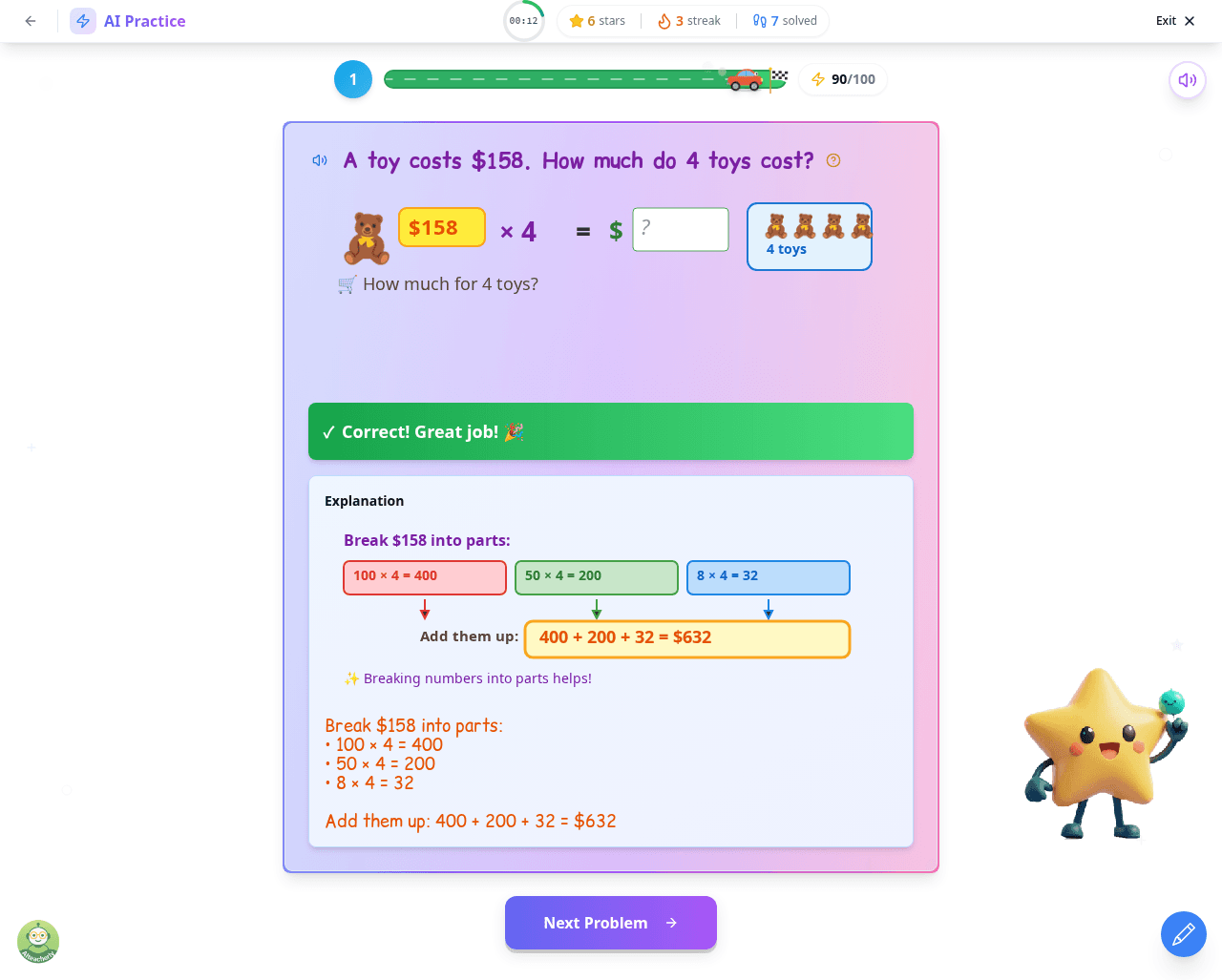
Introduction: Unlocking Mental Multiplication for 3rd Graders
Transitioning from basic single-digit multiplication facts to solving 3-digit equations can feel overwhelming for a young learner. When children first encounter problems like 432 multiplied by 3, they often grab scratch paper, draw endless tallies, or panic about making arithmetic mistakes. Yet, building strong math fluency in 3rd grade does not require endless paper drill worksheets. By introducing mental multiplication strategies, children learn to manipulate numbers flexibly in their heads, boosting both working memory and numerical confidence. On AI Teacherly, interactive lessons are designed to turn this challenging milestone into an engaging, visual game where big numbers become completely manageable.
What Is Mental Multiplication and Why Does Place-Value Chunking Matter?
Mental multiplication 3rd grade math refers to the cognitive skill of calculating multi-digit multiplication problems without relying on pencil and paper. Instead of forcing children to memorize rigid step-by-step algorithms right away, mental math encourages the 'place-value chunking' method. By breaking numbers apart into their component parts (hundreds, tens, and ones), kids tap into their existing math knowledge. Research shows that children who master place-value decomposition develop significantly stronger number sense and calculation speed. When kids understand that 321 is simply 300 plus 20 plus 1, multiplication transforms from a mysterious memorization task into a logical puzzle.
Step 2: Multiplying Chunks and Managing Partial Products (With Problem Demo)
The secret weapon of 3rd grade mental math is place-value decomposition. Before multiplying any large number, children must learn to see it as a collection of friendly chunks. For example, if the equation is 213 multiplied by 4, the first step is separating 213 into 200, 10, and 3. Each of these chunks is much easier to multiply by 4 independently than tackling the entire 3-digit number at once. Breaking problems down this way prevents cognitive overload and allows 3rd graders to succeed without second-guessing their arithmetic. Parents can practice this at home by writing numbers on cards and asking children to name the hundreds, tens, and ones instantly.
Step 3: Bringing It All Together with Real-World Money Scenarios (With Lesson Overview)
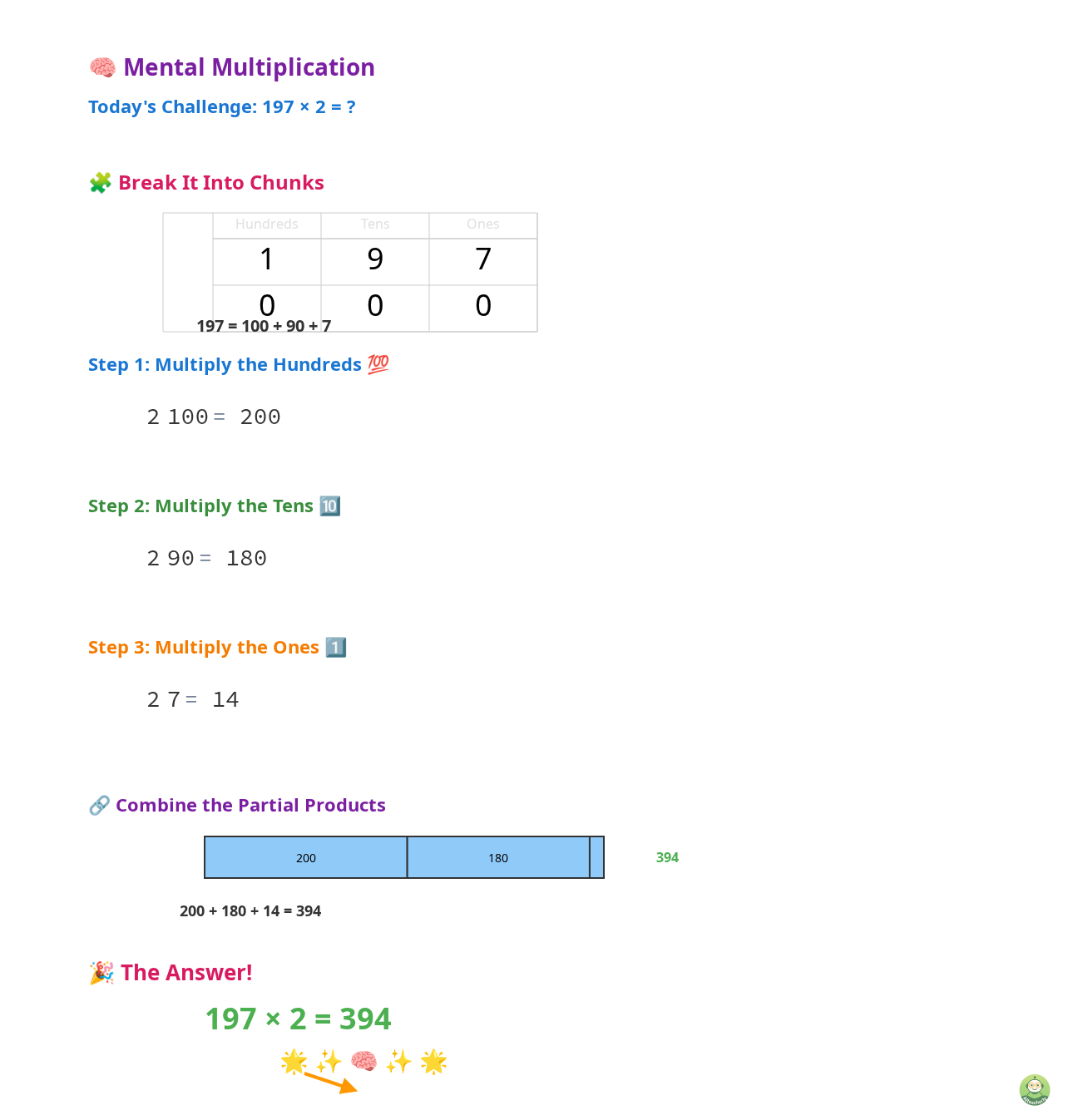
Math becomes truly engaging when children see its connection to everyday life. Imagine your 3rd grader wants to buy 3 comic books that cost 112 dollars each. Instead of feeling intimidated by the total cost, they can instantly apply mental multiplication: 100 times 3 is 300, 10 times 3 is 30, and 2 times 3 is 6, giving a total of 336 dollars. This real-world application builds practical financial intuition while reinforcing school curriculum standards. Here's what the full interactive lesson looks like on AI Teacherly, where children navigate step-by-step math challenges with immediate feedback and visual encouragement:
Common Mental Math Stumbling Blocks and How Parents Can Help
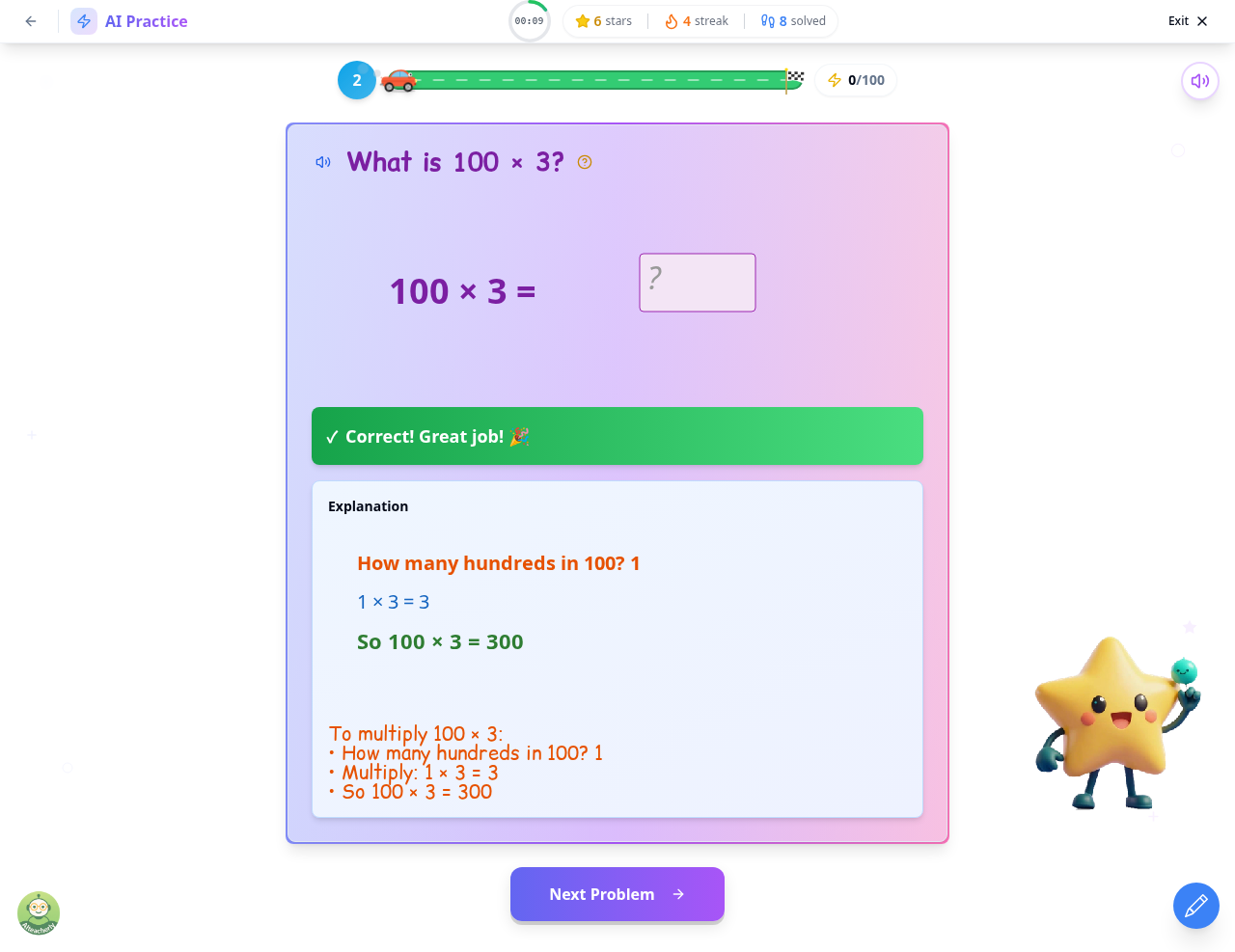
It is completely normal for 3rd graders to experience temporary mental fatigue when holding multiple partial products in their heads. When children struggle, parents often make the mistake of rushing them to use traditional algorithms prematurely. If your child forgets a partial product, encourage them to write down just that single number before continuing. Another common hurdle is mixing up place-value zeros, such as confusing 200 times 3 with 20 times 3. Using interactive visual platforms helps bridge this gap by highlighting place values with distinct colors and shapes, making mathematical errors easy to spot and correct independently.
Key Takeaways
- Decompose 3-digit numbers into hundreds, tens, and ones before multiplying.
- Calculate each place-value chunk independently using basic multiplication facts plus place value zeros.
- Add partial products together sequentially to arrive at the final answer.
- Use everyday money and shopping scenarios to build real-world math intuition.
- Practice with interactive visual platforms like AI Teacherly to reduce working memory strain.
Frequently Asked Questions
What is mental multiplication for 3rd graders?
Mental multiplication 3rd grade math is the ability to calculate equations like 321 times 3 entirely in your head without paper. It relies on breaking numbers into place-value chunks.
How do I teach my child to break apart numbers for multiplication?
Guide your child to split a 3-digit number into hundreds, tens, and ones. For 432 times 2, break 432 into 400, 30, and 2, then multiply each piece separately.
Should kids learn mental math before traditional multiplication algorithms?
Yes. Place-value chunking builds deep number sense and mental flexibility before students memorize rigid traditional algorithms.
Why does my child forget partial products while calculating?
Working memory overload is common in 3rd grade. Writing down partial products temporarily or practicing small chunks on interactive platforms helps kids track numbers without forgetting.
How can I practice mental math with my child using everyday money examples?
Use everyday money or shopping scenarios. If an item costs 123 dollars and your child wants to buy 3 of them, calculate 100 times 3, 20 times 3, and 3 times 3.
How long should my 3rd grader practice math daily?
Practice for 15 to 20 minutes a day using interactive visual platforms like AI Teacherly, which break complex problems into manageable, engaging steps.
Ready to watch your 3rd grader master mental multiplication with confidence? Explore interactive math lessons free on AI Teacherly today!