5th Grade Word Problems with Mixed Operations: A Parent's Complete PEMDAS Guide
Conquer 5th grade word problems with mixed operations using the keyword detective strategy and PEMDAS. This parent's guide breaks down multi-step math into simple, teachable steps.
Why Multi-Step Word Problems Trip Up 5th Graders (And Their Parents)
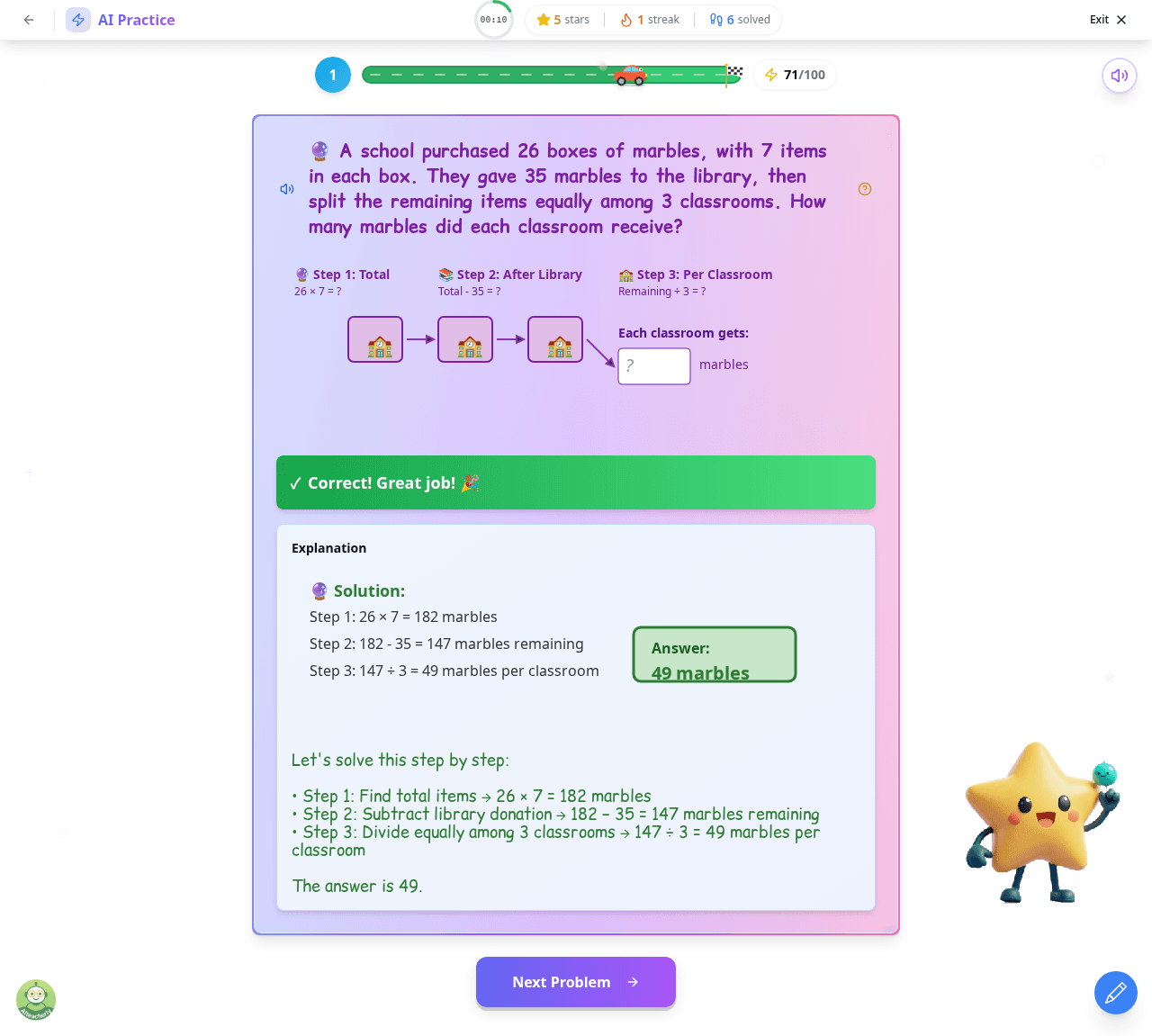
That sinking feeling when your 5th grader slides their homework across the table and you see a word problem with numbers, keywords, and what looks like three different math operations happening at once? You're not alone. 5th grade word problems with mixed operations represent one of the biggest leaps in mathematical complexity that students face in elementary school.
Here's the truth: these problems aren't just harder because they have more steps. They require a completely different way of thinking. Students must read carefully, identify multiple operations, decide the correct order to perform them, and then execute each calculation accurately. That's a lot of cognitive heavy lifting for a 10 or 11-year-old.
The good news? There's a systematic approach that makes these problems manageable. In this guide, you'll discover the keyword detective strategy that helps identify which operations to use, a simple way to explain PEMDAS (order of operations) in just two minutes, and a foolproof checking method that catches errors before they become bad grades. By the end, you'll feel confident sitting down with your child and tackling even the trickiest multi-step problems together.
What Are Mixed Operations and Why Do They Matter in 5th Grade?
Mixed operations simply means a math problem that requires more than one type of calculation: addition, subtraction, multiplication, or division. In 5th grade, students graduate from simple one-step problems ("Sarah has 5 apples and gets 3 more") to complex multi-step challenges that mirror real-world math.
Consider this typical 5th grade problem: "A bookstore has 8 boxes of books with 12 books in each box. They sell 29 books on Monday. How many books are left?" This single problem requires multiplication (8 × 12) and subtraction (96 - 29). And here's where it gets tricky: the order matters.
Why 5th Grade Is the Critical Year
This isn't just another math skill; it's a gateway concept. Multi-step word problems with mixed operations form the foundation for:
- Middle school algebra (solving equations with multiple terms)
- Real-world problem solving (budgeting, shopping, cooking measurements)
- Standardized test success (these problems appear heavily on state assessments)
When students master mixed operations in 5th grade, they build the mathematical reasoning skills that carry them through the rest of their education. When they struggle without support, those gaps compound quickly in middle school.
The Keyword Detective Strategy: Cracking the Code in Word Problems
Here's a game-changing secret that transforms how your child approaches word problems: certain words in the problem are clues that reveal exactly which operation to use. Teaching your child to become a "keyword detective" gives them a concrete, repeatable strategy instead of guessing.
The Keyword Cheat Sheet
Addition Clues: total, altogether, combined, sum, in all, both, increase, more than
Subtraction Clues: left, remaining, difference, fewer, less than, take away, decrease, how many more
Multiplication Clues: each, every, per, times, groups of, rows of, twice, triple
Division Clues: share equally, split, divided, per person, each group, how many groups
Putting It Into Practice
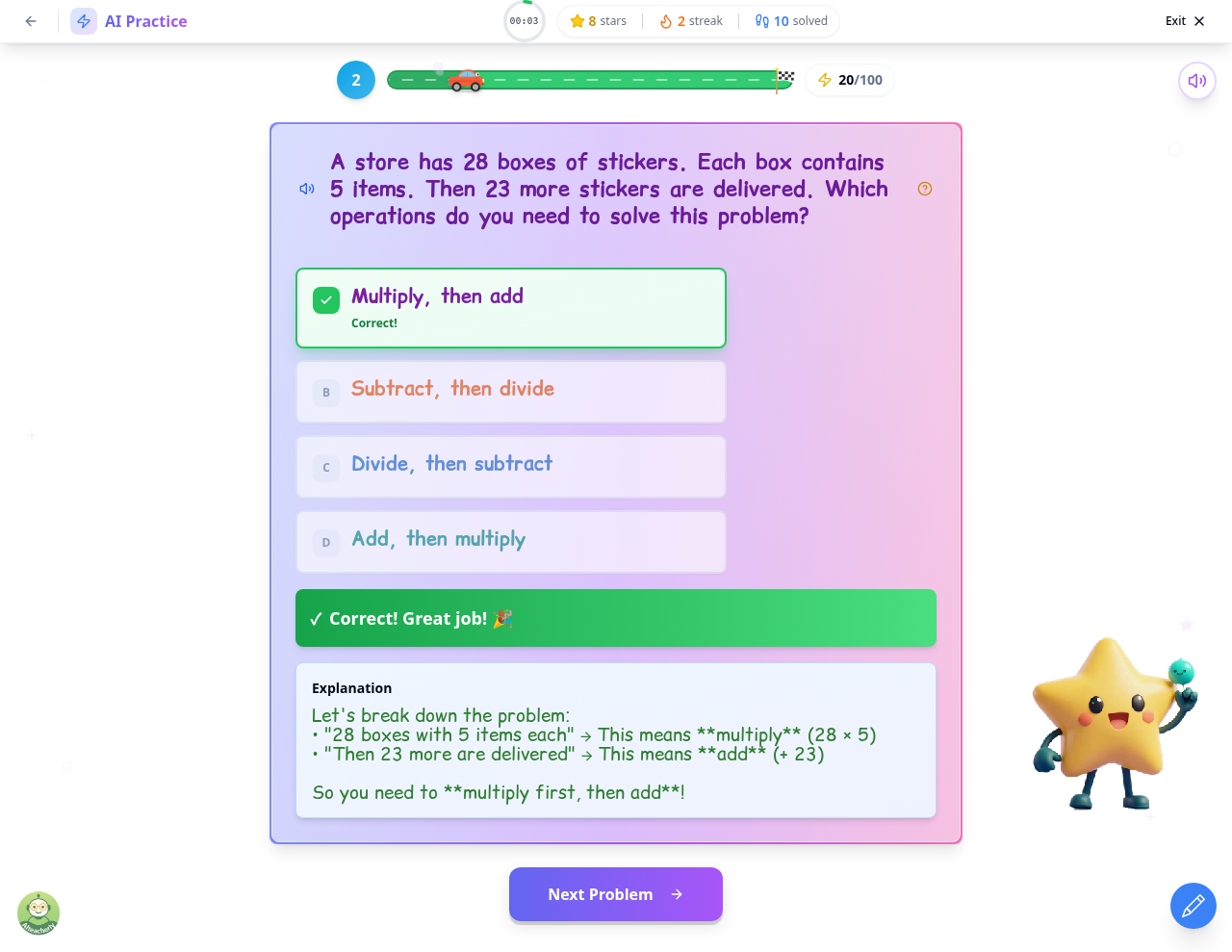
When your child reads a problem, have them circle or underline keyword clues before doing any math. For example: "Marco has 4 bags with 15 marbles each. He gives 8 marbles to his friend. How many marbles does Marco have left?"
The word "each" signals multiplication (4 × 15 = 60). The word "left" signals subtraction (60 - 8 = 52). By identifying these keywords first, students create a roadmap for solving the problem.
The interactive problem below shows exactly how this keyword identification works in practice:
How to Explain PEMDAS to Your Child in 2 Minutes
Once your child identifies the operations needed, they face another challenge: what order do they perform them in? This is where PEMDAS comes in, and contrary to what many parents remember from school, it's actually quite simple to explain.
The PEMDAS Breakdown
P - Parentheses (do what's inside the parentheses first) E - Exponents (powers like 2² or 3³) M/D - Multiplication and Division (left to right, whichever comes first) A/S - Addition and Subtraction (left to right, whichever comes first)
The Two-Minute Explanation Script
Try saying this to your child: "When a problem has more than one operation, we need a rule so everyone gets the same answer. That rule is called PEMDAS. Think of it like a ranking system: multiplication and division are 'stronger' than addition and subtraction, so they go first. When two operations have the same strength (like multiplication and division), just go left to right like reading a book."
A Common Mistake to Avoid
Many students (and adults!) think multiplication always comes before division because M comes before D in PEMDAS. Not true! Multiplication and division have equal priority. The same goes for addition and subtraction. Work left to right when you have operations at the same level.
For example: 24 ÷ 6 × 2 = 8 (not 2)
- Work left to right: 24 ÷ 6 = 4, then 4 × 2 = 8
See Multi-Step Problem Solving in Action
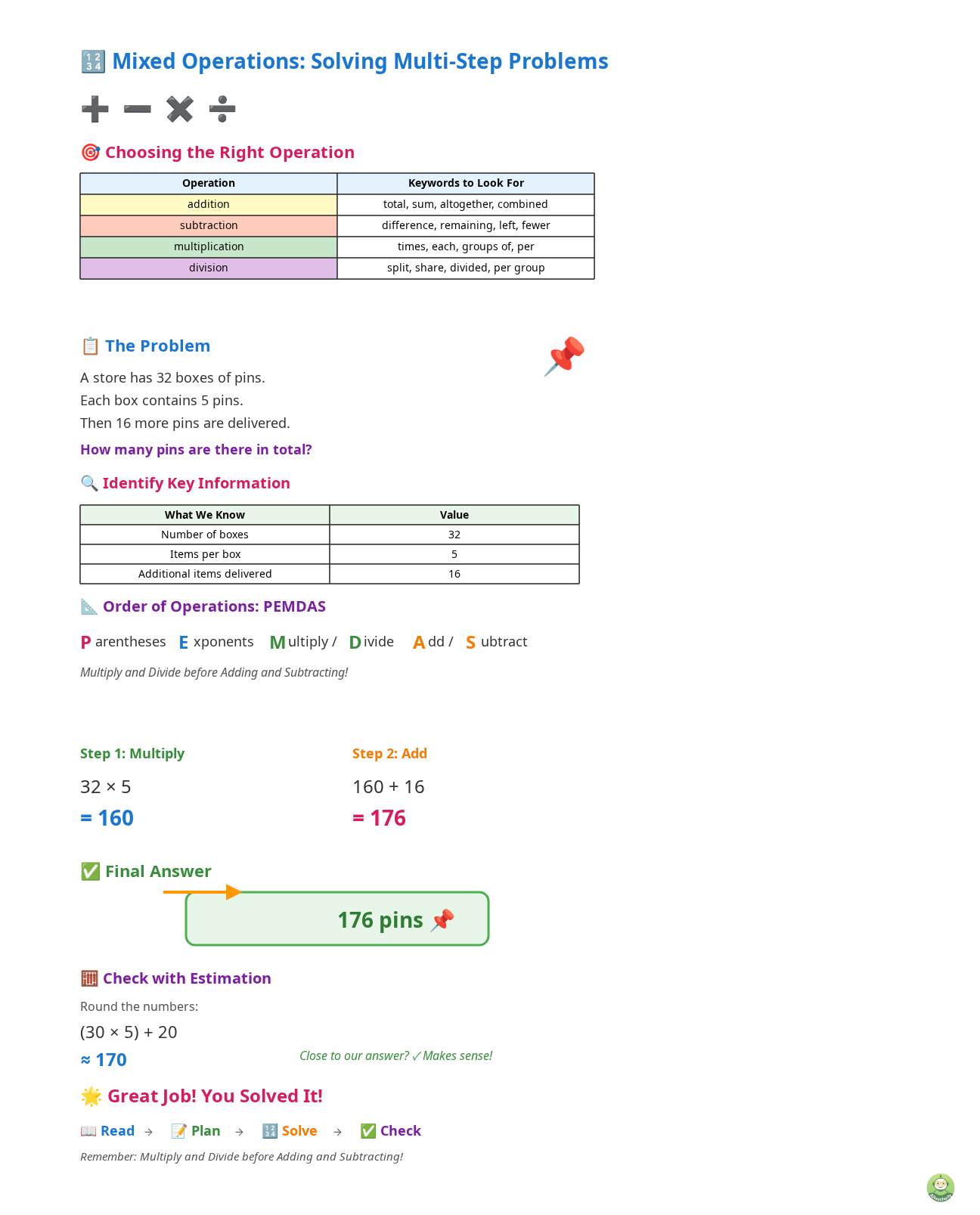
Understanding concepts is one thing; seeing them applied is another. Let's walk through how the Read-Plan-Solve-Check framework brings everything together.
The Read-Plan-Solve-Check Framework
Read: Have your child read the problem twice. First for the story, second for the specific numbers and question being asked.
Plan: Use the keyword detective strategy to identify which operations are needed. Write them down in order based on PEMDAS.
Solve: Execute each step carefully, showing all work. This isn't about speed; it's about accuracy.
Check: Use estimation or inverse operations to verify the answer makes sense.
Example Walkthrough
Problem: "A school ordered 6 packs of notebooks with 24 notebooks per pack. Teachers took 38 notebooks for their classes. How many notebooks are left for students?"
- Read: Story about school notebooks. Question asks how many are left.
- Plan: "Per pack" = multiplication. "Left" = subtraction. Do multiplication first (PEMDAS).
- Solve: 6 × 24 = 144 notebooks total. 144 - 38 = 106 notebooks left.
- Check: Estimate: 6 × 25 = 150, 150 - 40 = 110. Our answer of 106 is close. ✓
Here's what the full interactive lesson looks like on AI Teacherly:
The Estimation Trick: How to Check If an Answer Makes Sense
One of the most valuable skills your child can develop is number sense, the ability to recognize whether an answer is reasonable before moving on. Estimation is the tool that builds this skill.
The Quick Estimation Method
After solving a problem, have your child round each number to something easier to calculate mentally:
- Round to the nearest 10 for two-digit numbers
- Round to the nearest 100 for three-digit numbers
- Calculate the estimated answer
- Compare to the exact answer
If the exact answer is close to the estimate, it's probably correct. If there's a huge difference, something went wrong.
Why This Matters
Many 5th graders make calculation errors (who doesn't?) but don't catch them because they don't pause to ask, "Does this make sense?" A student who calculates that 8 boxes of 12 books equals 86 books won't catch their error unless they estimate: 8 × 10 = 80, so the answer should be close to 80, not 86. Wait... 8 × 12 = 96!
Building the Habit
Encourage your child to ask these questions after every problem:
- Is my answer reasonable for this situation?
- Is it close to my estimate?
- Does the answer make sense in real life?
This self-checking habit prevents careless errors and builds mathematical confidence that extends far beyond 5th grade.
Common Mistakes Kids Make with Mixed Operations (And How to Fix Them)
Understanding where students typically stumble helps you provide targeted support. Here are the most frequent errors in multi-step word problems grade 5 and how to address each one.
Mistake #1: Operating in Reading Order
The Problem: Students perform operations in the order they appear in the problem, ignoring PEMDAS.
The Fix: Before calculating, have your child number the operations in the order they should be performed. This creates a visual checklist that reinforces proper sequencing.
Mistake #2: Missing a Step
The Problem: Students solve only part of the problem, usually the first operation they identify.
The Fix: After reading the problem, ask: "What is the question actually asking?" Often the question is about the final result ("How many are LEFT?"), not the intermediate calculation. Have them circle the question and verify their answer addresses it.
Mistake #3: Keyword Confusion
The Problem: Students misinterpret keywords, like thinking "How many more" means addition when it often requires subtraction (finding a difference).
The Fix: Practice with intentionally tricky problems. Context matters more than individual words. "How many more does Sarah have than Tom?" requires subtraction, even though "more" is usually an addition word.
Mistake #4: Calculation Errors in Multi-Step Problems
The Problem: Even when the approach is correct, arithmetic mistakes in one step cascade through the entire solution.
The Fix: Emphasize showing all work, one step per line. This makes errors easier to spot and fix. The estimation check at the end catches most cascade errors.
Key Takeaways
- Teach the keyword detective strategy: words like 'each,' 'total,' 'left,' and 'share equally' reveal which operations to use in word problems
- PEMDAS sets the order: Parentheses, Exponents, Multiplication/Division (left to right), Addition/Subtraction (left to right)
- Use the Read-Plan-Solve-Check framework for every multi-step problem to build consistent problem-solving habits
- Estimation is your error-catching superpower: round numbers to verify answers make sense before moving on
- 5th grade mastery of mixed operations directly impacts middle school algebra success
- Common mistakes include operating in reading order and missing steps; address these with numbered operation lists and question circling
- Practice with interactive lessons builds confidence faster than worksheets alone
Frequently Asked Questions
What are mixed operations in 5th grade math?
Mixed operations means math problems requiring more than one calculation type: addition, subtraction, multiplication, or division. Fifth graders solve multi-step problems using two or more operations in the correct order.
How do I explain PEMDAS to my child in simple terms?
PEMDAS is a ranking system for operations. Parentheses and exponents come first, then multiplication and division (left to right), then addition and subtraction (left to right). Think of it as 'stronger' operations going before 'weaker' ones.
What keywords help identify which operation to use in word problems?
Addition: total, altogether, combined. Subtraction: left, remaining, difference. Multiplication: each, every, per, groups of. Division: share equally, split, divided. These 'clue words' reveal which math operation the problem needs.
Why does my 5th grader struggle with multi-step word problems?
Multi-step problems require reading comprehension, operation identification, correct sequencing, and accurate calculation all at once. This cognitive load is challenging. Teaching systematic strategies like keyword detection and PEMDAS reduces overwhelm.
Should my child use a calculator for mixed operations practice?
Initially, no. Mental math and written calculation build number sense that calculators bypass. Once strategies are solid, calculators can help with checking work, but the thinking process should come first.
How can estimation help check word problem answers?
After solving, round the original numbers and calculate a quick estimate. If the exact answer is close to the estimate, it's likely correct. Large differences signal an error to investigate.
How much time should my 5th grader spend on math homework daily?
For 5th graders, 20-30 minutes of focused practice is ideal. Short, consistent sessions are more effective than hour-long cramming. Interactive lessons help make this time engaging rather than frustrating.
Is online math practice effective for 5th graders?
Yes, studies show interactive online practice improves outcomes by 15-25% compared to worksheets alone. The key is choosing platforms with visual, engaging content that provides immediate feedback on errors.
Ready to make multi-step word problems less stressful? Try the interactive Mixed Operations with Whole Numbers lesson free on AI Teacherly and watch your child's confidence grow!