Adding Three Numbers in 1st Grade: 2 Simple Tricks That Turn Confusion into Confidence
Watching your 1st grader struggle with 3 + 5 + 7? Two simple tricks, Make-Ten and Doubles, can transform confusion into confidence. Learn how to teach these strategies at home.
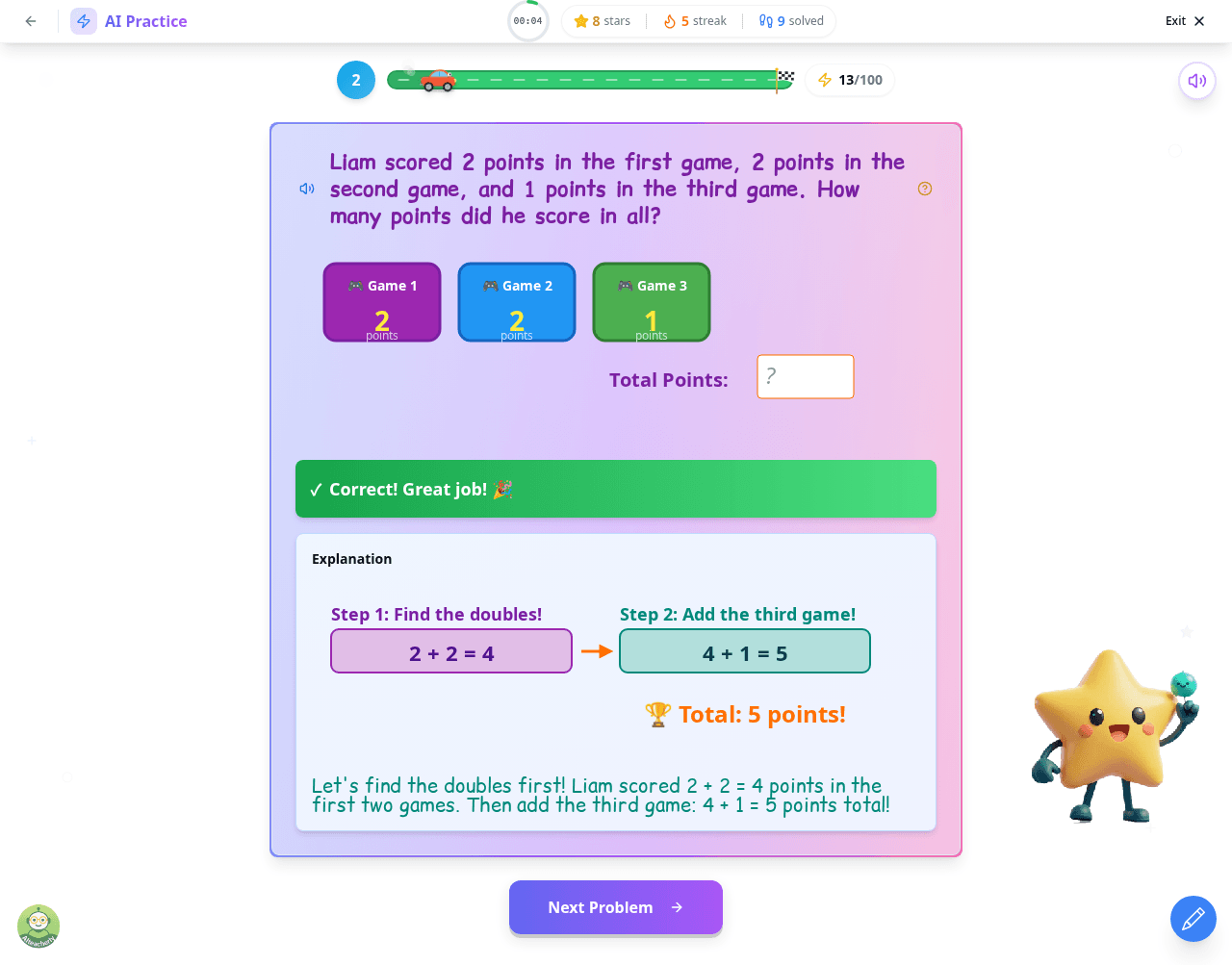
Why Adding Three Numbers Trips Up 1st Graders
Watching your 1st grader freeze when they see a problem like 3 + 5 + 7 can feel frustrating. You might wonder: Why is this so hard? They can add two numbers just fine!
Here's the thing: adding three numbers isn't just "more addition." It requires a completely different mental approach. When kids add two numbers, they have one clear task. But with three numbers, they suddenly face a choice: Which numbers do I add first? Without a strategy, children often try to hold all three numbers in their head at once, leading to overwhelm and errors.
The good news? Two simple tricks can transform this struggle into success. The Make-Ten Strategy and Doubles Strategy give your child a roadmap for tackling any three-number addition problem. These aren't complicated teaching methods; they're mental shortcuts that even math-anxious parents can teach in minutes.
By the end of this guide, you'll know exactly how these strategies work and how to practice them at home using everyday objects and interactive lessons.
What Is Three-Number Addition and Why Does Order Matter?
Three-number addition is exactly what it sounds like: adding three numbers together to find their sum. Problems like 4 + 6 + 2, 8 + 1 + 5, or 7 + 3 + 2 are common in 1st grade math.
But here's the secret that makes everything easier: order doesn't matter when adding. This mathematical principle (called the commutative property) means that 4 + 6 + 2 gives the same answer whether you add 4 + 6 first, 6 + 2 first, or even 4 + 2 first.
Why does this matter? Because it gives your child freedom to choose the easiest path. Instead of adding numbers in the order they appear, your child can scan all three numbers and pick the smartest combination to start with.
Think of it like this: if you had to carry three grocery bags of different weights, wouldn't you want to grab the two lightest ones together first? The same logic applies to addition. Some number combinations are simply easier to add than others.
This is where our two power strategies come in. The Make-Ten Strategy looks for number pairs that equal 10. The Doubles Strategy looks for matching numbers. Both make the final addition step much simpler.
How Does the Make-Ten Strategy Work?
The Make-Ten Strategy is the most powerful trick for adding three numbers in 1st grade. It's based on a simple insight: adding to 10 is easy. Once you have 10, adding the third number becomes straightforward.
Here's how it works:
- Look at all three numbers
- Find two numbers that add up to 10
- Add those two first
- Then add the remaining number to 10
Example: 7 + 5 + 3
Your child scans the numbers and spots that 7 + 3 = 10. Now the problem becomes 10 + 5 = 15. Much easier than trying to add 7 + 5 first!
Common "Make-Ten" pairs to memorize:
- 1 + 9 = 10
- 2 + 8 = 10
- 3 + 7 = 10
- 4 + 6 = 10
- 5 + 5 = 10
When children spot these pairs instantly, three-number addition becomes almost automatic. Practice by calling out two numbers and having your child shout the "partner" that makes ten.
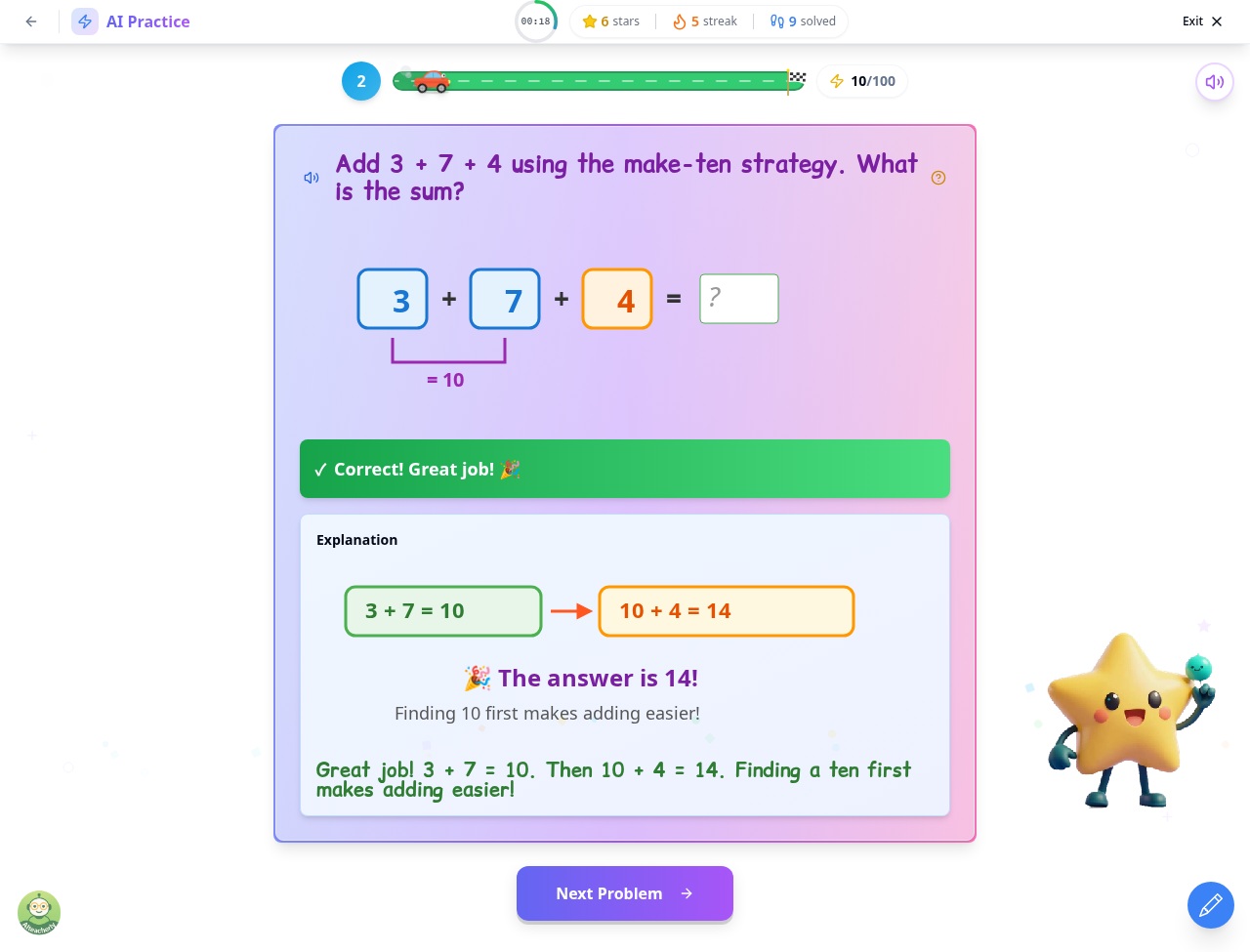
The interactive problem below shows exactly how the Make-Ten strategy works in practice, with visual brackets highlighting the number pair that equals ten.
What Is the Doubles Strategy for Addition?
Sometimes a three-number problem doesn't have a pair that makes ten. That's when the Doubles Strategy saves the day!
Doubles are matching number pairs: 2 + 2, 3 + 3, 4 + 4, 5 + 5, and so on. Most 1st graders already know their doubles from earlier lessons, making them a reliable shortcut.
Here's how it works:
- Look at all three numbers
- Find two numbers that match (doubles)
- Add the doubles first
- Then add the third number
Example: 4 + 7 + 4
Your child spots the matching 4s. Since 4 + 4 = 8 (a known doubles fact), the problem becomes 8 + 7 = 15.
Example 2: 5 + 5 + 3
The doubles (5 + 5 = 10) jump right out! Now it's just 10 + 3 = 13.
Doubles facts to practice:
- 1 + 1 = 2
- 2 + 2 = 4
- 3 + 3 = 6
- 4 + 4 = 8
- 5 + 5 = 10
Notice that 5 + 5 works for BOTH strategies since it equals 10. When your child spots matching 5s, they've hit the jackpot!
The key is helping your child recognize doubles quickly. Practice with flashcards or by pointing out doubles in everyday life: "Look, you have 3 red cars and 3 blue cars. What's the double?"
How to Choose the Right Strategy
Now your child knows two strategies. But how do they decide which one to use? Here's a simple decision tree to practice together:
Step 1: Scan for a Ten First
Always look for a Make-Ten pair first. Why? Because adding to 10 is the easiest mental math operation for most children. If your child spots 3 + 7, 4 + 6, 2 + 8, or any other ten-maker, that's the path to take.
Step 2: Look for Doubles
No ten available? Check for matching numbers. If there are two 4s, two 6s, or any doubles, use those as the starting point.
Step 3: Just Pick Two and Add
Some problems don't have tens OR doubles. That's okay! Your child can simply add any two numbers first, then add the third. The strategies are shortcuts, not requirements.
Practice Scenario:
Give your child the problem 6 + 3 + 4. Ask: "Do you see a ten? Do you see doubles?" Let them talk through their thinking.
- They might spot 6 + 4 = 10 (Make-Ten!)
- Then 10 + 3 = 13
This verbal processing helps cement the decision-making habit. Over time, it becomes automatic.
See These Strategies in Action on AI Teacherly
Understanding strategies is one thing. Practicing them with immediate feedback is where real learning happens.
On AI Teacherly, the Adding Three Numbers lesson for Grade 1 brings these strategies to life through interactive problems. Students don't just memorize; they discover. The lesson shows how adding numbers in different orders produces the same answer, building genuine understanding of why these tricks work.
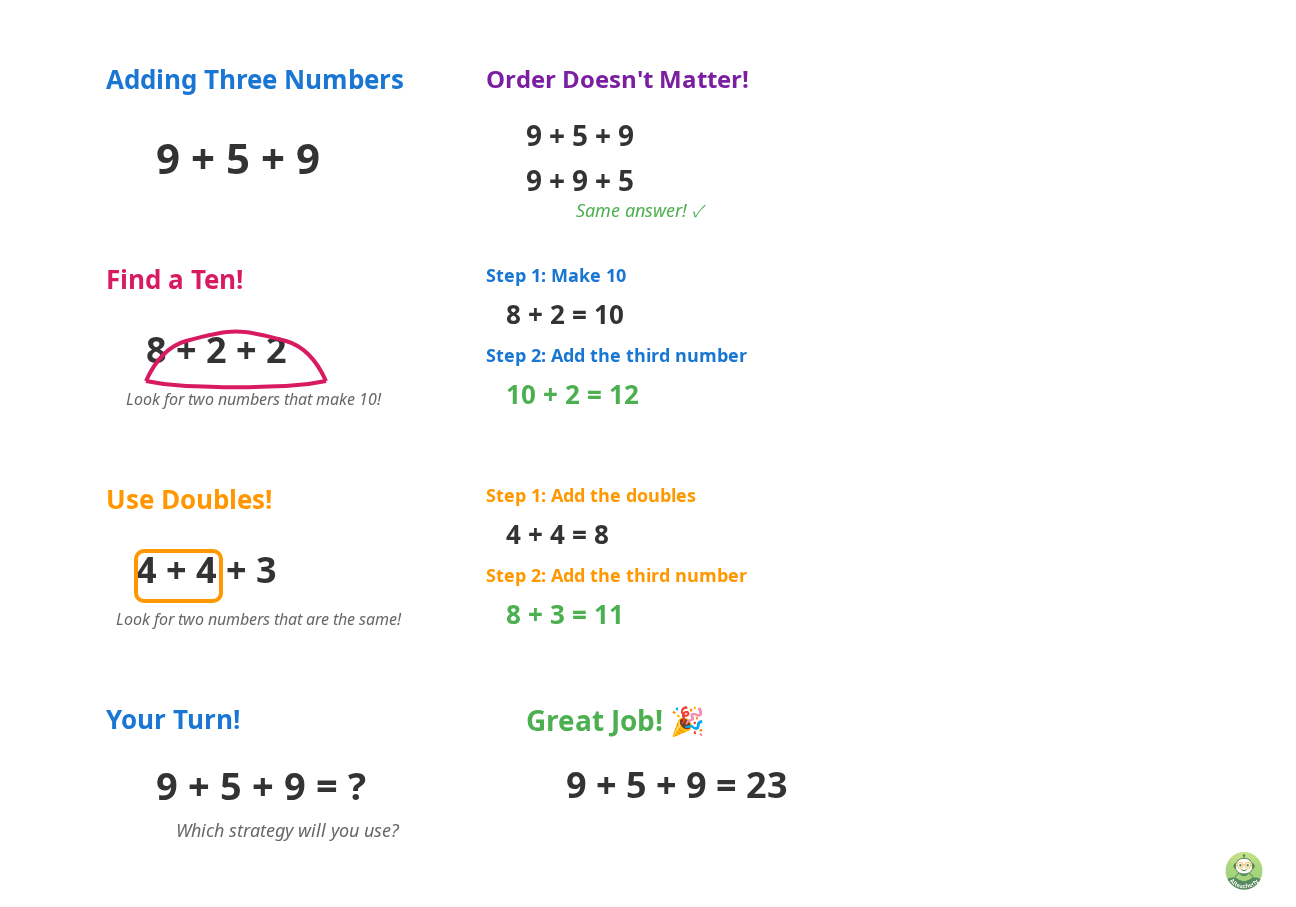
Here's what the full interactive lesson looks like on AI Teacherly:
The lesson uses visual elements like brackets and color coding to highlight Make-Ten pairs and doubles. When students solve a problem like 2 + 8 + 5, they see the bracket appear around 2 and 8, reinforcing the "find the ten" habit.
What makes it effective:
- Guided discovery: Students figure out patterns themselves, leading to deeper retention
- Visual scaffolding: Color-coded brackets show which numbers to combine
- Varied problem types: Word problems, number sentences, and strategy-choice questions
- Instant feedback: Children know immediately if their answer is correct
The lesson includes real-world scenarios like counting apples, stickers, and game points, helping children connect math strategies to everyday situations they actually care about.
For parents, this means less time explaining and more time celebrating success. Your child can practice independently while you prepare dinner, and you can review their progress afterward.
Fun Ways to Practice Adding Three Numbers at Home
The best math practice doesn't feel like practice. Here are engaging ways to reinforce these strategies without worksheets:
Snack Math
Put out three small piles of snacks (goldfish crackers, grapes, or cheerios). "You have 4 crackers, 6 crackers, and 3 crackers. How many altogether? Can you find a ten?"
Dice Game
Roll three dice and race to find the sum. Bonus points if your child can explain which strategy they used. This builds both speed and strategic thinking.
Toy Inventory
While cleaning up, count three groups of toys. "You have 5 cars, 5 blocks, and 2 dolls. What's the total? Oh look, there are doubles!"
Sticker Store
Create a pretend store where items cost 1 to 9 stickers. "You want to buy three things that cost 7, 3, and 4 stickers. How many do you need?" Let your child hunt for tens.
Number Hunt
While driving or walking, spot three numbers (house numbers, signs, prices) and add them together. Real-world numbers make math feel relevant.
Daily Questions
Build addition into routines: "We read 3 books yesterday, 4 today, and we'll read 6 tomorrow. How many is that altogether?"
The goal is frequency, not duration. Five minutes of playful practice daily beats a frustrating 30-minute worksheet session weekly.
Key Takeaways
- The Make-Ten Strategy helps kids find number pairs that equal 10 (like 3+7 or 4+6), making the final addition step easy
- The Doubles Strategy uses matching numbers (4+4, 5+5) as mental shortcuts when there's no ten available
- Order doesn't matter in addition, so teach your child to scan all three numbers before deciding which two to add first
- Practice "Make-Ten partners" (1+9, 2+8, 3+7, 4+6, 5+5) until your child recognizes them instantly
- Use everyday moments like snack time, dice games, and toy cleanup to practice three-number addition naturally
- Interactive lessons with visual feedback help children discover strategies themselves, leading to deeper understanding
Frequently Asked Questions
What is the make-ten strategy for adding three numbers?
The make-ten strategy means finding two numbers that add up to 10 first (like 3+7 or 4+6), then adding the third number to 10. This simplifies the problem because adding to 10 is easy mental math for most children.
How do I explain doubles to my 1st grader?
Doubles are matching numbers added together: 2+2, 3+3, 4+4, etc. Tell your child: "When two numbers are twins, add them first!" Most kids memorize doubles early, making them reliable shortcuts for three-number addition.
Why does the order not matter when adding three numbers?
This is called the commutative property. It means 4+6+2 equals the same whether you add 4+6 first or 6+2 first. This gives kids freedom to choose the easiest combination to start with.
Is it normal for 1st graders to struggle with adding three numbers?
Yes, completely normal. Three-number addition requires holding multiple numbers in working memory and making strategic choices. Most children need explicit strategy instruction and lots of practice before it feels automatic.
What if my child can't find a ten or doubles in the problem?
That's okay! The strategies are shortcuts, not requirements. If there's no ten or doubles, your child can simply add any two numbers first, then add the third. The key is having a plan rather than feeling overwhelmed.
Should my child memorize addition facts or use strategies?
Both! Strategies build number sense and problem-solving skills, while memorized facts increase speed. Start with strategies for understanding, then practice frequently until the facts become automatic.
How long does it take for kids to learn three-number addition?
With consistent practice, most 1st graders become comfortable within 2 to 4 weeks. The key is short, frequent practice sessions (5 to 10 minutes daily) rather than occasional long drilling sessions.
What are fun ways to practice adding three numbers at home?
Try snack math with small food piles, rolling three dice and racing to find sums, counting toy groups during cleanup, or creating a pretend sticker store. Playful practice beats worksheets for building lasting skills.
Ready to make three-number addition fun? Try the interactive Adding Three Numbers lesson on AI Teacherly, where visual strategies and instant feedback turn math practice into an engaging game your child will actually want to play.