Adding Three Numbers in 1st Grade: 2 Simple Tricks That Make Math Click
When your child sees 4 + 6 + 3, do they freeze up? Discover two simple strategies that transform three-number addition from overwhelming to easy.
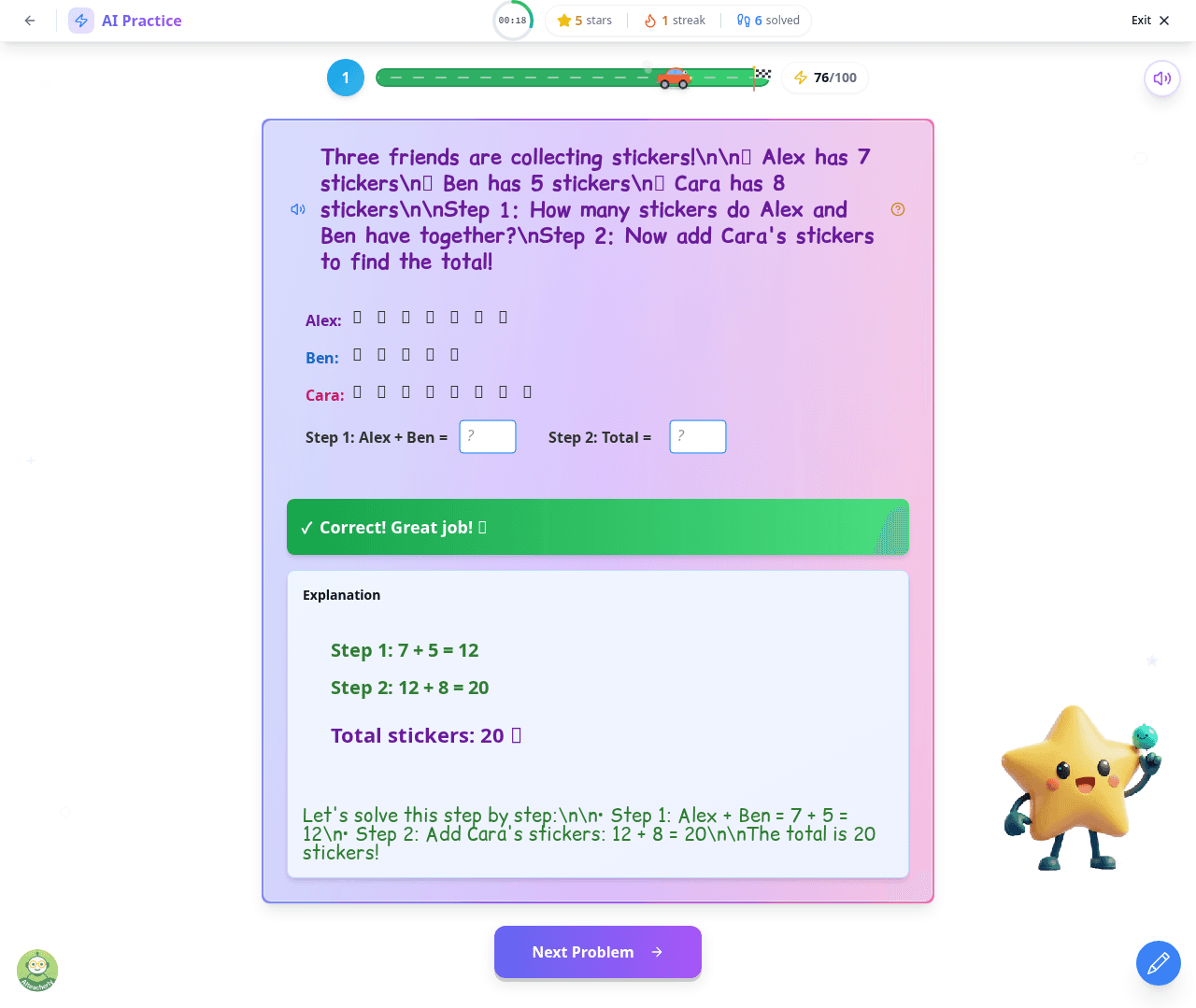
Why Three-Number Addition Trips Up 1st Graders
When your child sees a problem like 4 + 6 + 3, do they freeze up? You're not alone. Adding three numbers in 1st grade is one of those sneaky math milestones that catches many families off guard.
Here's why it's tricky: up until now, your child has been adding just two numbers at a time. Adding a third number means they need to hold one answer in their head while calculating again. That's a lot of mental juggling for a 6 or 7-year-old!
The good news? There are two simple strategies that transform this challenge into an "I got this!" moment. These aren't complicated math concepts; they're clever tricks that make adding three numbers almost as easy as adding two. And you can teach them at home in just 10 minutes.
In this guide, you'll learn exactly what these strategies are, why they work, and how to practice them with your child using everyday moments and interactive lessons.
What Is Three-Number Addition and Why Is It Harder?
Three-number addition is exactly what it sounds like: adding three separate numbers together to find the total. Problems might look like:
- 2 + 5 + 3 = ?
- 7 + 1 + 4 = ?
- 6 + 4 + 5 = ?
In 1st grade, children typically work with numbers up to 20, so these problems won't involve huge numbers. But the challenge isn't about the size of the numbers; it's about the process.
When adding two numbers, your child can count on their fingers, use objects, or visualize the addition in one step. But with three numbers, they need to:
- Add the first two numbers
- Remember that answer
- Add the third number to that sum
This requires working memory, which is still developing in young children. If your child loses track of the first sum while trying to add the third number, they get frustrated and confused. It's not a lack of math ability; it's simply how young brains work.
That's where strategies come in. Instead of relying purely on memory, we can teach children smarter ways to group numbers that make the mental math much easier.
The Secret Rule: Order Doesn't Matter in Addition
Before diving into the two main strategies, your child needs to understand one powerful rule: when we add, we can add in any order, and the answer stays the same.
Mathematicians call this the "commutative property," but your child just needs to know the simple version: rearranging numbers doesn't change the sum.
Let's see it in action:
- 4 + 6 + 3 = 13
- 6 + 4 + 3 = 13
- 3 + 6 + 4 = 13
Same numbers, different order, same answer every time!
Why does this matter? Because it gives your child freedom to choose which two numbers to add first. Instead of being stuck adding from left to right, they can look for number combinations that are easier to work with.
This is the foundation for both strategies below. Once your child realizes they can rearrange numbers, they'll start spotting easier combinations naturally. As the AI Teacherly lesson explains: "When we add, we can add in any order... Same numbers, different order... And look! Same answer! That's the trick, order doesn't matter!"
Strategy 1: The Make-Ten Trick for Easy Mental Math
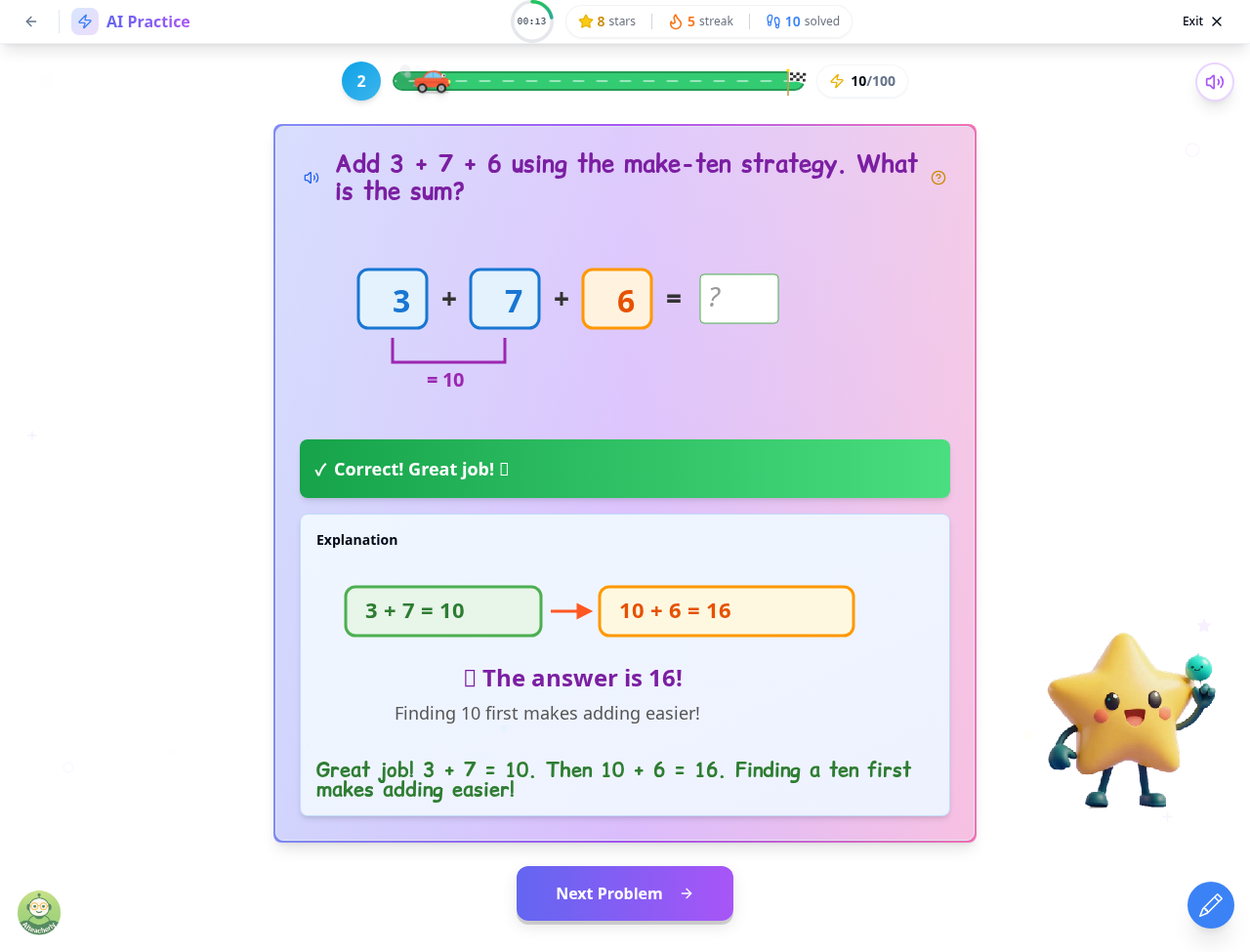
The Make-Ten strategy is the most powerful trick for adding three numbers in 1st grade. Here's how it works: your child looks for any two numbers that add up to 10, then adds the third number.
Why 10? Because adding to 10 is easy! 10 + 3 = 13. 10 + 7 = 17. There's no regrouping, no complicated carrying; it's smooth mental math.
Common "Make-Ten" pairs your child should recognize:
- 7 + 3 = 10
- 6 + 4 = 10
- 8 + 2 = 10
- 9 + 1 = 10
- 5 + 5 = 10
Example in action: Let's solve 7 + 5 + 3.
- Look for a pair that makes 10: 7 + 3 = 10 ✓
- Rearrange: (7 + 3) + 5
- Solve: 10 + 5 = 15
Instead of adding 7 + 5 = 12, then 12 + 3 = 15 (which requires remembering 12), your child gets to work with the friendly number 10.
The interactive problem below shows exactly how the Make-Ten strategy works in practice.
Practice tip: Play "Find the Ten" at home. Say three numbers aloud and have your child spot the pair that makes 10. Make it a game, and they'll start seeing tens everywhere!
Strategy 2: Using Doubles When There's No Ten
Sometimes, the three numbers don't contain a pair that makes 10. No problem! That's when we use the Doubles strategy.
Doubles are addition facts where both numbers are the same:
- 2 + 2 = 4
- 3 + 3 = 6
- 4 + 4 = 8
- 5 + 5 = 10
- 6 + 6 = 12
Most children memorize doubles quickly because they have a satisfying pattern. When your child spots two matching numbers in a three-number problem, they can use their doubles knowledge as a shortcut.
Example in action: Let's solve 4 + 3 + 4.
- Check for tens: 4 + 3 = 7, 4 + 4 = 8, 3 + 4 = 7. No tens.
- Look for doubles: 4 + 4 = 8 ✓
- Rearrange: (4 + 4) + 3
- Solve: 8 + 3 = 11
As the AI Teacherly lesson teaches: "Sometimes there's no ten. But we have another trick! Use Doubles. When two numbers match, that's a double!"
The decision process: Once your child knows both strategies, they can quickly scan a problem:
- First, look for a pair that makes 10
- If none exists, look for doubles
- Use whichever trick fits!
This simple two-step check becomes automatic with practice, making three-number addition feel effortless.
How to Practice Three-Number Addition at Home
The best way to reinforce these strategies is through everyday practice that doesn't feel like homework. Here are some easy ways to work three-number addition into your daily routine:
At snack time: "You have 3 crackers, 7 grapes, and 2 cheese cubes. How many snacks is that? Can you find a pair that makes 10?"
During cleanup: "You need to pick up 4 books, 4 toys, and 5 crayons. How many things total? I see doubles!"
On a walk or drive: "I see 6 red cars, 4 blue cars, and 3 white cars. What's the total? Which two numbers would you add first?"
With toys or blocks: Create three small groups and have your child count each group, then find the total using Make-Ten or Doubles.
Key tips for practicing:
- Always ask "which two would you add first?" This prompts strategic thinking.
- Celebrate the strategy, not just the answer. "Great job finding that ten!" matters more than "Correct!"
- Keep sessions short. 5-10 minutes is plenty for a 1st grader.
- Let them use fingers if needed. It's okay! The strategies will eventually reduce finger reliance.
When your child needs more structured practice, interactive lessons provide immediate feedback and visual support that builds confidence.
See These Strategies in Action on AI Teacherly
Reading about the Make-Ten and Doubles strategies is helpful, but seeing them in action makes all the difference. The Adding Three Numbers lesson on AI Teacherly brings these concepts to life through:
- Interactive discovery: Children experiment with rearranging numbers and see for themselves that the order doesn't change the answer.
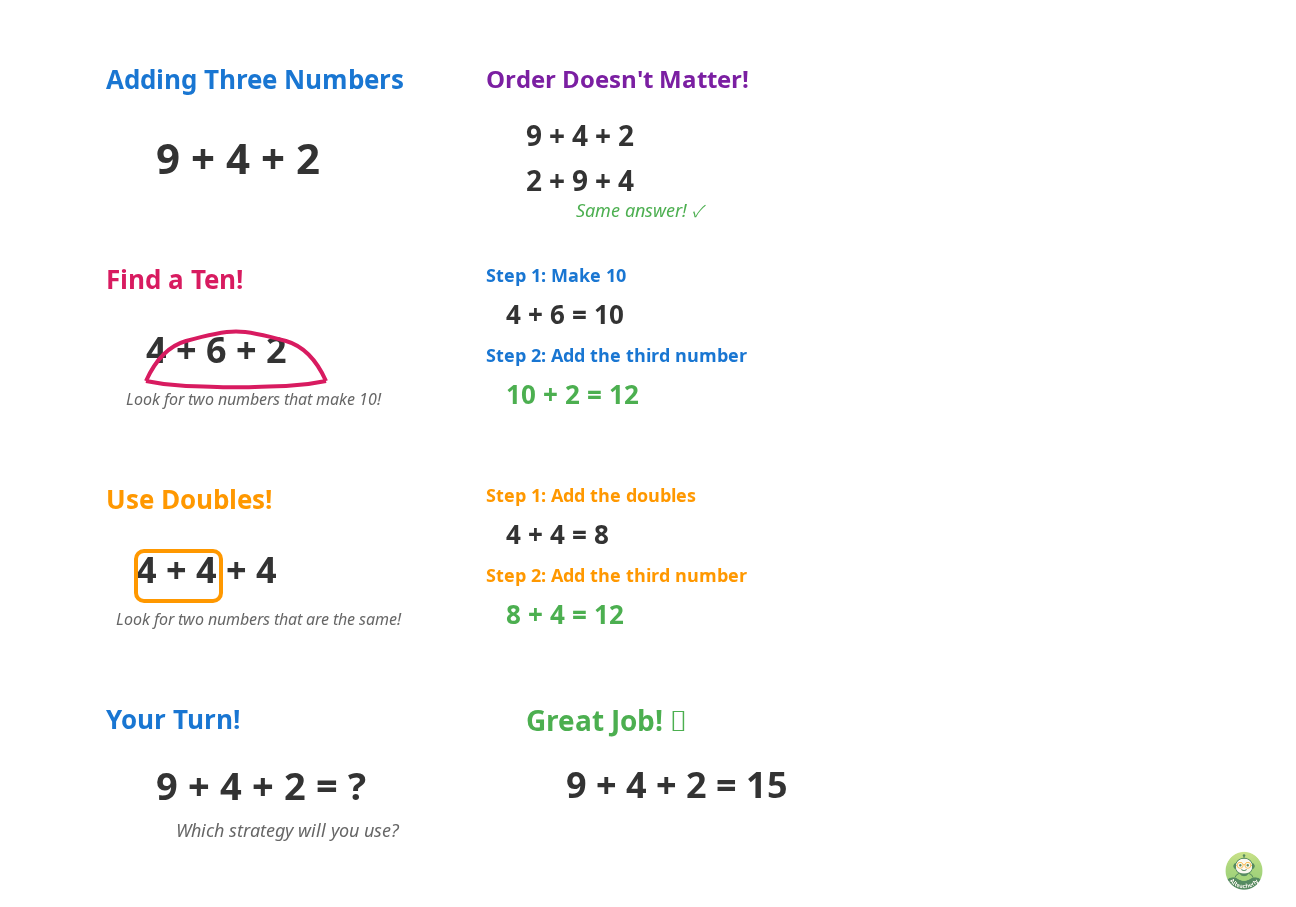
- Visual highlighting: The lesson uses color-coded brackets to show which numbers make a ten, making the pattern unmistakable.
- Guided practice: Problems start simple and gradually increase in difficulty, building confidence step by step.
- Real-world word problems: From picking apples to counting stickers, problems connect math to situations kids understand.
Here's what the full interactive lesson looks like on AI Teacherly:
The lesson asks your child at key moments: "Which strategy will you use?" This simple question builds the habit of strategic thinking rather than random guessing.
What makes interactive practice different from worksheets? Your child gets instant feedback. If they make a mistake, they can try again immediately; no waiting for you to check their work. And the colorful, engaging format keeps them motivated far longer than black-and-white practice sheets.
For parents who feel unsure about teaching math strategies themselves, these lessons do the heavy lifting while you provide encouragement from the sidelines.
Key Takeaways
- Three-number addition is harder because it requires working memory to hold intermediate sums while calculating.
- The commutative property (order doesn't matter) gives children freedom to rearrange numbers strategically.
- The Make-Ten strategy: find two numbers that add to 10, then add the third number for easy mental math.
- The Doubles strategy: when there's no ten, look for matching numbers like 4 + 4 or 5 + 5.
- Teach children to scan problems in order: first look for tens, then look for doubles.
- Practice naturally through snack time, cleanup, and everyday counting moments.
- Interactive lessons with instant feedback build confidence faster than worksheets alone.
Frequently Asked Questions
What is the make-ten strategy for adding three numbers?
The make-ten strategy involves finding two numbers that add up to 10, then adding the third number. For example, in 7 + 5 + 3, you'd first combine 7 + 3 = 10, then add 5 to get 15. This works because adding to 10 is easy mental math.
How do I explain doubles to my 1st grader?
Doubles are addition facts where both numbers match: 2+2, 3+3, 4+4, etc. Kids memorize these quickly. When they see matching numbers in a problem like 4 + 3 + 4, they can add the doubles first (4+4=8) then add 3.
Does the order matter when adding three numbers?
No! This is called the commutative property. 4 + 6 + 3 equals 13 no matter which order you add. This freedom lets children rearrange numbers to find easier combinations, which is the foundation of both strategies.
When do kids learn to add three numbers in school?
Most curricula introduce three-number addition in 1st grade, typically mid-year after children have mastered basic addition facts within 10. By the end of 1st grade, children should handle sums up to 20.
Why does my child struggle with adding more than two numbers?
Three-number addition requires working memory, which is still developing in young children. They must hold the first sum in their head while adding the third number. Strategies like Make-Ten reduce this mental load.
Should my child use fingers to add three numbers?
Yes, using fingers is perfectly fine and developmentally appropriate for 1st graders. As children internalize strategies like Make-Ten and Doubles, they'll naturally rely less on fingers. Don't rush this transition.
How long does it take for a 1st grader to master three-number addition?
With regular practice, most children become comfortable with three-number addition strategies within 4-6 weeks. Focus on building strategic thinking rather than speed; fluency develops naturally over time.
What are fun ways to practice three-number addition at home?
Use everyday moments: counting snacks, toys during cleanup, or items on walks. Play 'Find the Ten' by calling out three numbers and having your child spot the pair that makes 10. Keep it playful and short.
Ready to see your child's confidence grow? Try the free Adding Three Numbers lesson on AI Teacherly and watch these strategies click!