Coordinate Plane for 5th Graders: A Parent's Complete Guide to Graphing Success
Your 5th grader already uses coordinates in video games and maps. Learn how to make the connection click with fun tricks, real-world examples, and interactive practice.
Why Coordinates Are Everywhere (Even in Your Kid's Video Games)
Here's something that might surprise you: your 5th grader already uses coordinates every single day. When they navigate through Minecraft, find a location on Google Maps, or play a game of Battleship, they're using the exact same skills they need for the coordinate plane in math class.
The difference? In school, they learn the official mathematical language for what they're already doing intuitively. The x-axis, y-axis, ordered pairs, and origin are just formal names for concepts they've been using all along.
This is actually great news for parents. It means you don't need to teach something completely foreign. Instead, you're helping your child connect the dots between the math on their homework and the navigation skills they use naturally. Once that connection clicks, the coordinate plane transforms from confusing math homework into something that finally makes sense.
In this guide, you'll discover exactly how to explain coordinates in simple terms, learn memory tricks that stick, and find fun ways to practice that don't feel like homework. Let's turn those abstract x and y values into something your child genuinely understands.
What Is the Coordinate Plane and Why Does It Matter in 5th Grade?
The coordinate plane is a flat grid made of two number lines that cross each other. Think of it like a treasure map where you can pinpoint any location using just two numbers.
Here's how it works:
- The x-axis is the horizontal line (the one that goes left and right, like the horizon)
- The y-axis is the vertical line (the one that goes up and down)
- The origin is the point where both lines meet, marked as (0, 0). It's the starting point for everything
Every point on this grid has an address called an ordered pair, written as (x, y). The first number tells you how far to move horizontally from the origin, and the second number tells you how far to move vertically.
Why is this a big deal in 5th grade?
The coordinate plane is a foundational skill that unlocks almost everything your child will learn in middle school math. Graphing equations, understanding functions, and even geometry all build on these concepts. According to Common Core standards (5.G.A.1-2), 5th graders need to master graphing points and understanding coordinate relationships.
When your child truly understands coordinates now, they'll have a much easier time with algebra and geometry later. It's one of those skills that keeps paying dividends year after year.
How to Explain Ordered Pairs to Your Child (The Alphabet Trick)
One of the most common struggles kids face with coordinates is remembering which number comes first. Is it the horizontal or vertical one? Here's a simple trick that works almost every time.
The Alphabet Trick: X Comes Before Y
Just like in the alphabet, X comes before Y. So in an ordered pair (x, y), you always read and plot the x-coordinate first (horizontal movement), then the y-coordinate (vertical movement).
When explaining this to your child, try saying: "X before Y, just like the alphabet! First we walk sideways, then we walk up."
A Step-by-Step Example
Let's say you need to plot the point (3, 5):
- Start at the origin (0, 0), where the two lines cross
- Move 3 spaces to the right along the x-axis (because x is 3)
- Move 5 spaces up from there (because y is 5)
- Mark the spot! That's where (3, 5) lives on the grid
Why Order Matters
Here's something important to emphasize: (3, 5) and (5, 3) are NOT the same point! If you plot them both, you'll see they end up in completely different places. This is a common mistake, and using the alphabet trick consistently helps prevent it.
You can practice this at home by calling out random ordered pairs and having your child point to where they'd be on an imaginary grid. Make it a game, and watch their confidence grow.
3 Fun Ways to Practice Graphing Points at Home
Worksheets have their place, but they're not the only way to practice coordinates. Here are three engaging activities that make learning feel like play.
1. Treasure Hunt Coordinates
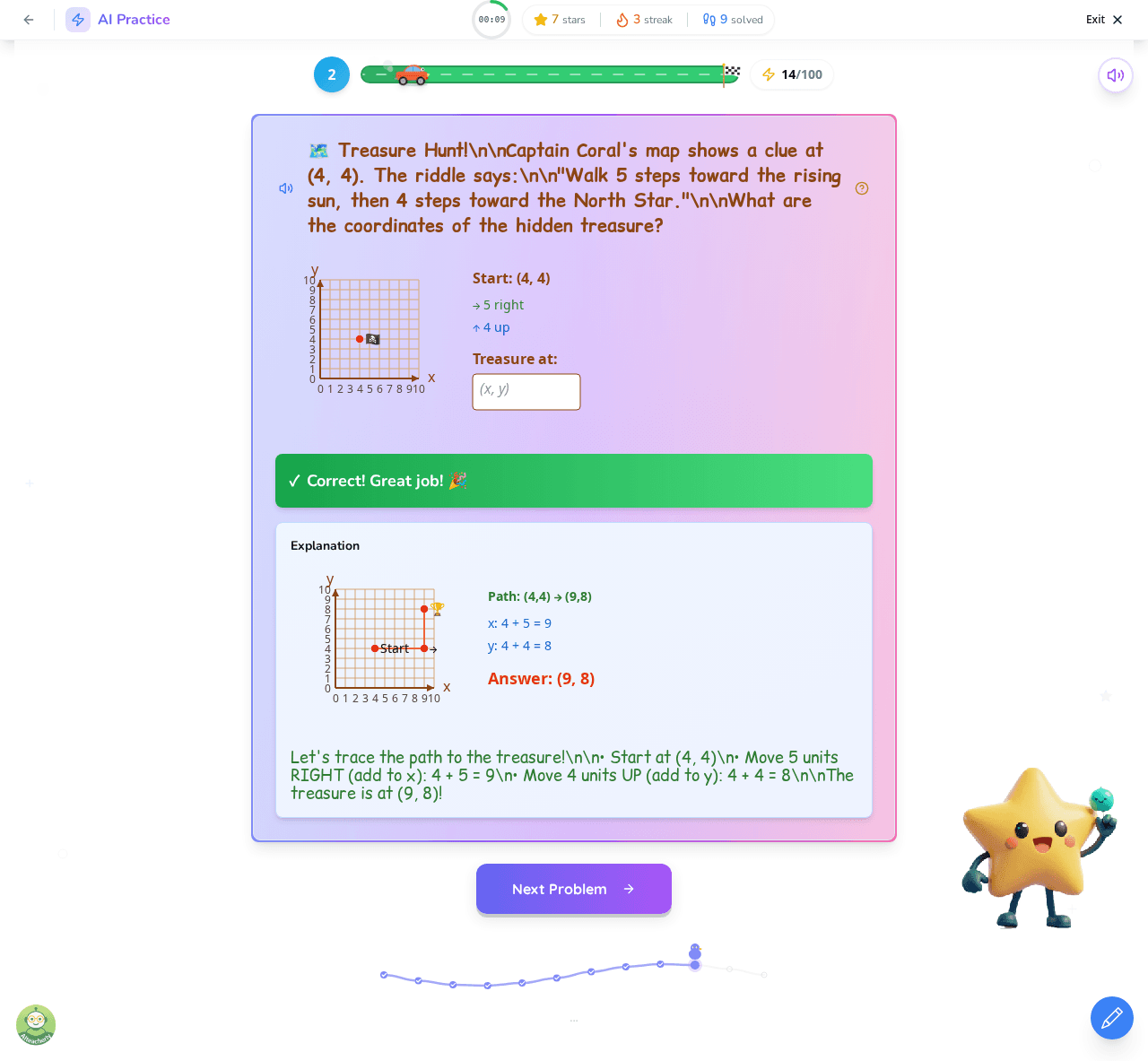
Create a simple grid on paper or use masking tape on the floor. Hide a small "treasure" (a treat or toy) and give your child coordinate clues to find it. "The treasure is at (4, 2). Can you find it?" This is exactly how interactive math lessons approach coordinate learning, transforming abstract concepts into adventures.
2. Battleship (The Classic)
The game Battleship is essentially coordinate plane practice in disguise. Every time your child calls out "B4" or "G7," they're using ordered pairs. Play a few rounds and point out how they're already a coordinate expert!
3. Map Reading Challenges
Pull up Google Maps or use a paper map with a grid. Challenge your child to find locations using coordinates. "What's at the corner of 5th Street and 3rd Avenue?" Real-world applications like this show kids why coordinates actually matter.
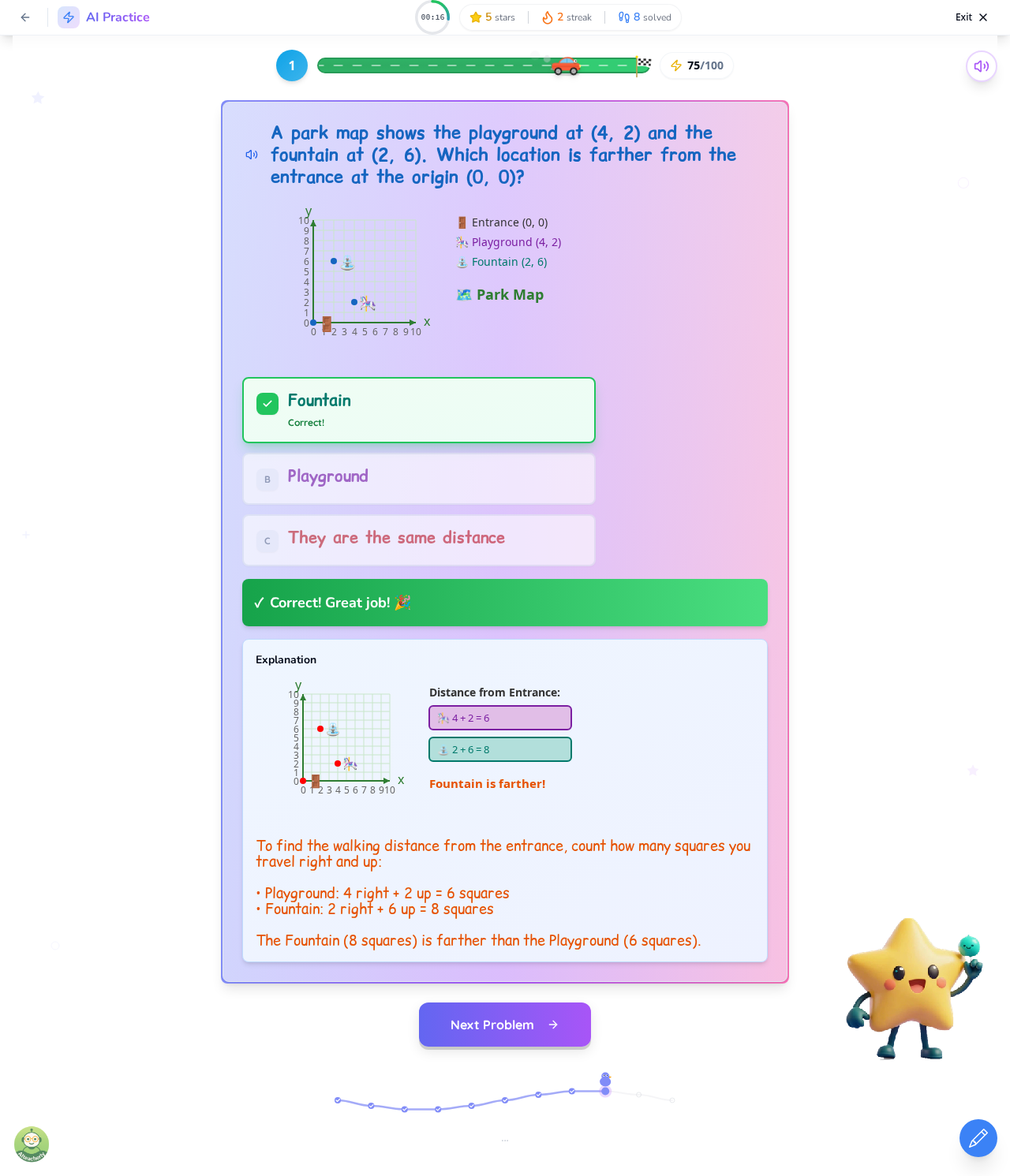
The interactive problem below shows how AI Teacherly uses real-world scenarios, like finding locations on a park map, to make coordinate practice engaging and relatable.
See How Interactive Coordinate Lessons Work
While home practice is valuable, having structured, visual lessons can make a huge difference in how quickly your child grasps coordinates. Interactive learning platforms offer something worksheets simply can't: immediate feedback and engaging visuals.
Here's what makes interactive coordinate lessons effective:
Visual Grids with Instant Feedback
Instead of plotting points on paper and waiting for a teacher to check them, students see immediately whether they've placed a point correctly. This instant feedback loop helps cement the connection between the ordered pair and its location.
Story-Based Problems
The best lessons turn math problems into mini-adventures. Treasure hunts, map explorations, and rescue missions all use coordinates as the underlying skill. When kids are motivated by a story, they practice more without realizing they're doing math.
Progressive Difficulty
Interactive lessons start simple (identifying coordinates on a grid) and gradually increase complexity (plotting multiple points, finding patterns). This scaffolded approach builds confidence at each step.
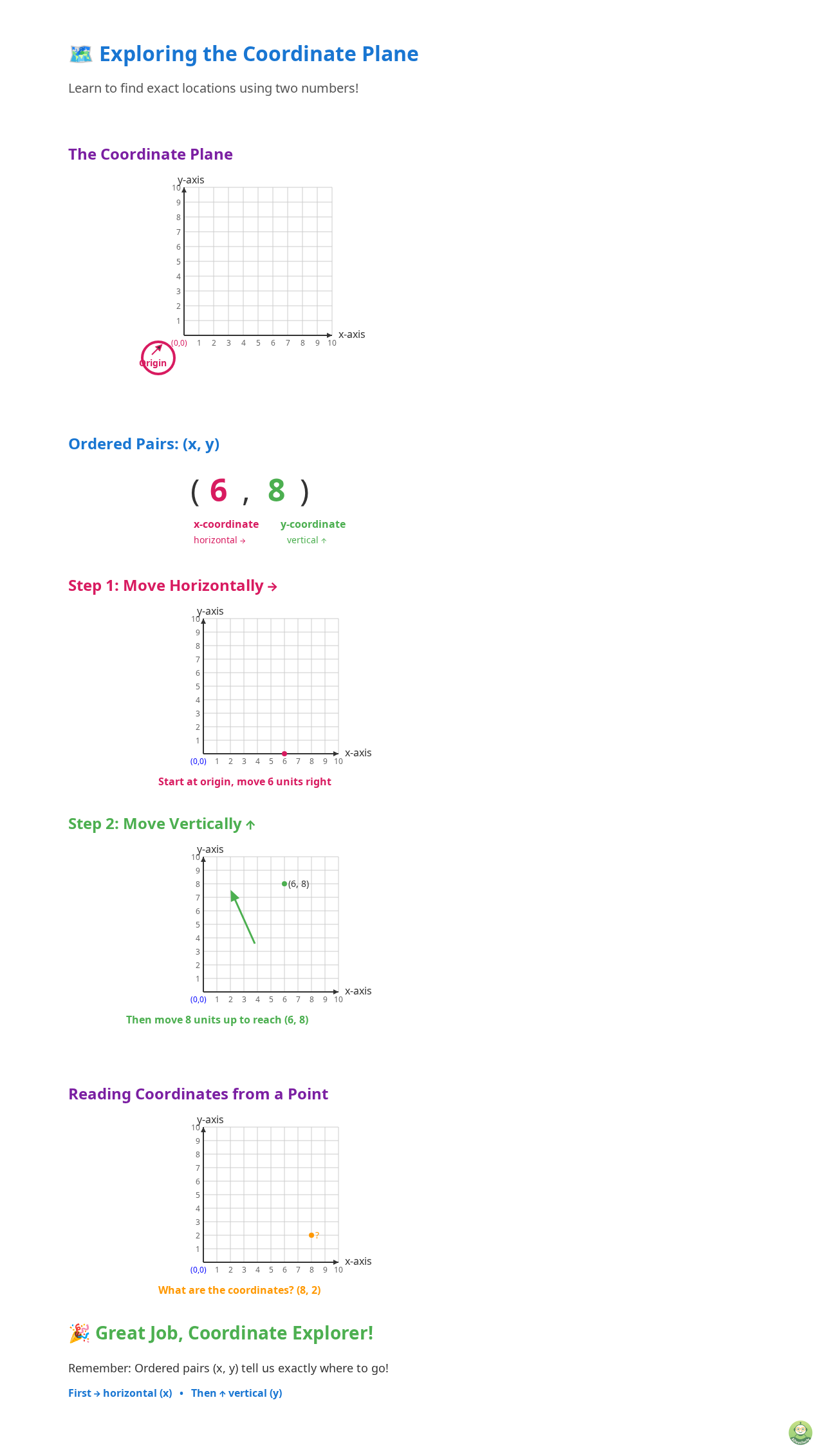
Here's what the full interactive lesson looks like on AI Teacherly:
The Introduction to the Coordinate Plane lesson on AI Teacherly uses animated explanations to show kids exactly how to move along the x-axis before moving up the y-axis. The treasure hunt theme keeps kids engaged while they master essential graphing skills.
Common Mistakes Kids Make With Coordinates (And How to Fix Them)
Even smart kids stumble on coordinates. Here are the most common errors and practical ways to address them.
Mistake #1: Mixing Up X and Y
This is the most frequent error. Kids plot (3, 5) as if it were (5, 3), moving vertically first instead of horizontally.
The Fix: Reinforce the alphabet trick every single time. "X before Y" should become automatic. You can also add a physical component: have them walk sideways first (x), then forward or backward (y) when practicing on a floor grid.
Mistake #2: Starting From the Wrong Place
Some kids start counting from wherever their pencil happens to be, rather than from the origin.
The Fix: Always remind them: "Every journey starts at the origin." Make it a rule that their finger or pencil must touch (0, 0) before they start counting.
Mistake #3: Confusing Axes Labels
Kids sometimes forget which line is which. Is x the flat one or the tall one?
The Fix: Use the memory device: "X is across, like crossing your arms." The x-axis lies flat, like you're lying down to cross your arms across your chest. The y-axis stands tall, reaching for the sky.
Mistake #4: Forgetting That Order Matters
Kids might think (2, 4) and (4, 2) are the same because they have the same numbers.
The Fix: Plot both points together on a grid and show how different they are. Make it visual, and the lesson sticks.
Key Takeaways
- The coordinate plane is like a treasure map: x tells you how far to walk sideways, y tells you how far to walk up, and the origin (0,0) is your starting point
- Use the Alphabet Trick: X before Y helps kids remember that horizontal (x) always comes before vertical (y) in ordered pairs
- Order matters! (3, 5) and (5, 3) are completely different points; this is a common mistake to watch for
- Games like Battleship and treasure hunts are coordinate practice in disguise; use them to make learning feel like play
- Interactive visual lessons with instant feedback help kids grasp coordinates faster than worksheets alone
- The coordinate plane is foundational for middle school algebra and geometry, so mastering it now pays off for years
Frequently Asked Questions
What is a coordinate plane and why do 5th graders need to learn it?
A coordinate plane is a grid formed by two number lines (x-axis and y-axis) that cross at the origin. 5th graders learn it because it's foundational for graphing equations, geometry, and algebra in middle school.
How do I explain ordered pairs to my child in simple terms?
An ordered pair is like an address for a point on the grid. The first number (x) tells you how far to walk sideways, and the second number (y) tells you how far to walk up. Always start at the origin (0, 0).
What's the easiest way to remember which coordinate comes first?
Use the Alphabet Trick: X comes before Y in the alphabet, so the x-coordinate (horizontal) always comes before the y-coordinate (vertical) in an ordered pair.
Why does my child confuse (3, 5) and (5, 3)?
Kids often think same numbers mean same point. Show them visually by plotting both points. They'll see (3, 5) and (5, 3) land in completely different spots, making the lesson memorable.
What real-world examples can I use to teach coordinates?
Use maps, seating charts at theaters, Battleship game, video games like Minecraft, or even a chess board. Any grid-based system uses the same coordinate logic your child is learning.
How can I practice coordinate plane skills at home without worksheets?
Try treasure hunts with coordinate clues, play Battleship, create a floor grid with tape, or use map reading challenges. These activities build coordinate skills while feeling like games.
Is it normal for kids to struggle with graphing points?
Yes! Mixing up x and y or forgetting to start at the origin are extremely common. With consistent practice using the Alphabet Trick and visual grids, most kids overcome these struggles quickly.
What math skills come after coordinate plane in middle school?
Coordinate plane skills lead directly to graphing linear equations, understanding slope, plotting functions, and coordinate geometry. Mastering coordinates now makes 6th-8th grade math significantly easier.
Ready to make coordinates click for your 5th grader? Try the interactive Introduction to the Coordinate Plane lesson on AI Teacherly, where treasure hunts and visual grids turn graphing into an adventure!