Demystifying 4th Grade Rounding: A Parent’s Guide to Nearest Hundreds
Struggling with 4th grade math homework? Discover how to teach rounding to the nearest hundreds using simple place value strategies and interactive tools without nightly tears.
Introduction: Why Rounding 4-Digit Numbers Triggers Math Homework Battles
If your dining table looks like a battlefield every evening when math homework comes out, you are not alone. For many families, 4th grade mathematics introduces abstract concepts that can trigger unexpected frustration. Between multi-digit multiplication, long division, and place value rules, children often hit a roadblock. Among these topics, rounding numbers frequently causes the most confusion during evening study sessions.
When children look at a large 4-digit number like 4,382 and are asked to round it to the nearest hundred, panic can set in. Which digit do I look at? Do I change the thousands place? Why do we even need to round numbers when calculators exist? As a parent, trying to explain these mathematical rules without professional teaching tools can feel overwhelming. Fortunately, mastering rounding does not require endless worksheet drills or nightly arguments. By breaking the process down into visual, bite-sized steps, you can turn math homework into a calm and rewarding experience. In this guide, we will explore simple strategies for how to round to nearest hundred 4th grade students can easily understand and apply with confidence.
What Is Rounding to the Nearest Hundreds in 4th Grade?
Before diving into practice, it helps to understand what rounding actually means in 4th grade mathematics. Rounding is the process of approximating a number to a specific place value to make calculations easier and numbers easier to understand. In 4th grade, students expand their skills from rounding to the nearest ten and hundred up to working with thousands and rounding 4-digit numbers to the nearest hundred.
When we round to the nearest hundreds, we are asking a simple question: Which multiple of one hundred is this number closest to? For instance, if a school has 4,328 books in its library, rounding to the nearest hundred means figuring out whether 4,328 is closer to 4,300 or 4,400. Because 28 is less than 50, the number rounds down to 4,300. Understanding this fundamental concept gives children an intuitive grasp of number magnitude and estimation, which is essential for checking the reasonableness of answers in more complex math problems.
The 2-Step Rule: How to Teach Place Value Rounding Without Tears
One of the best ways to eliminate homework frustration is teaching your child a reliable, two-step procedure. Instead of looking at a 4-digit number as one giant puzzle, teach your child to isolate the relevant digits using a simple underline method.
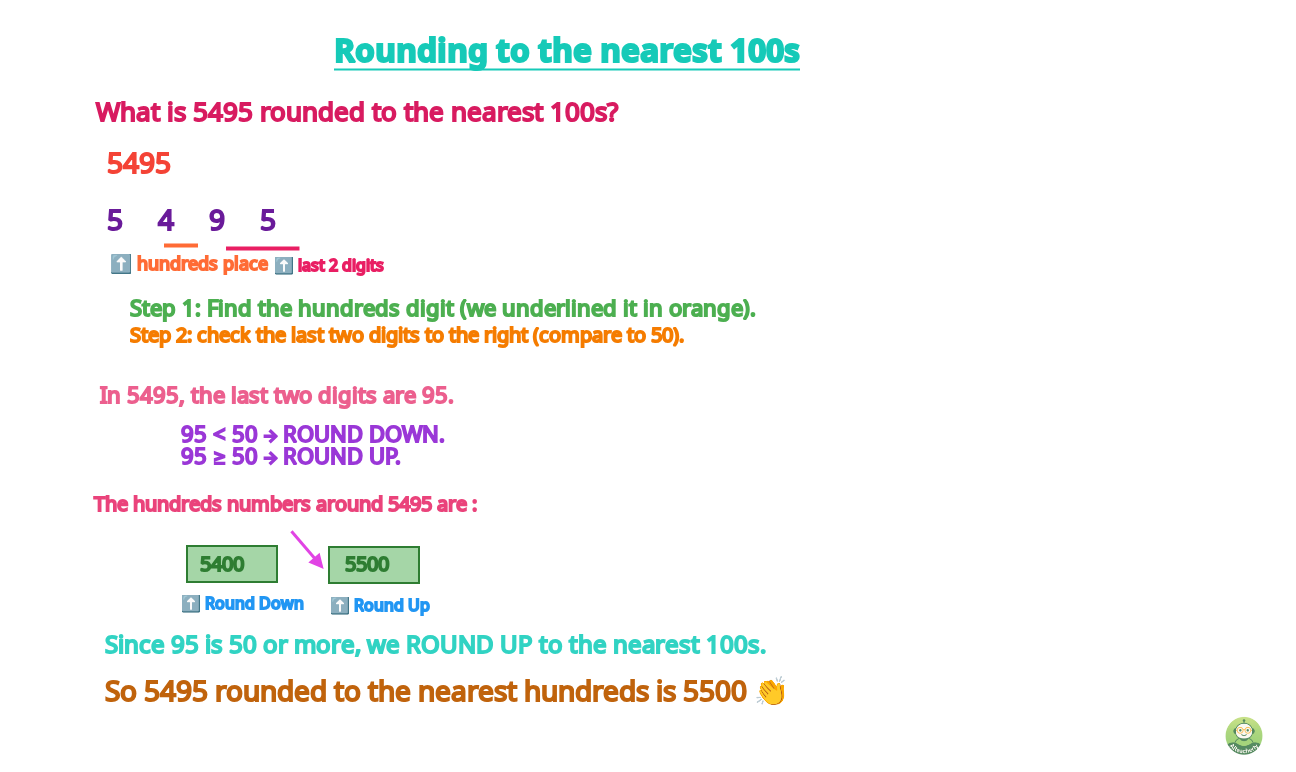
Step one is to identify and underline the digit in the place value you are rounding to. If the question asks to round to the nearest hundred in the number 5,742, your child should underline the 7 in the hundreds place. Step two is to look immediately to its right at the tens digit. In 5,742, the tens digit is 4. This brings us to the famous 50-rule: if the last two digits are 50 or more, round up. If the last two digits are less than 50, round down. Because 42 is less than 50, the hundreds digit stays a 7, and the trailing digits turn into zeros, resulting in 5,700. This systematic approach takes the guesswork out of rounding and builds lasting math confidence.
3 Simple At-Home Activities to Master Rounding Numbers
Worksheets alone can feel dry and discouraging for a 9-year-old. Introducing hands-on activities makes place value concepts tangible and fun. Here are three simple ways to practice rounding at home without opening a textbook:
First, use a physical number line drawn on a whiteboard or paper. Write 4,300 on the left, 4,400 on the right, and 4,350 right in the middle. Have your child place a toy figurine on various numbers between 4,300 and 4,400 to visually see whether the figurine is closer to the lower or upper hundred. Second, turn grocery shopping into an estimation game. Ask your child to look at the total price of produce items and round them to the nearest hundred cents. Third, play card games where drawing four cards creates a 4-digit number that both of you race to round correctly.
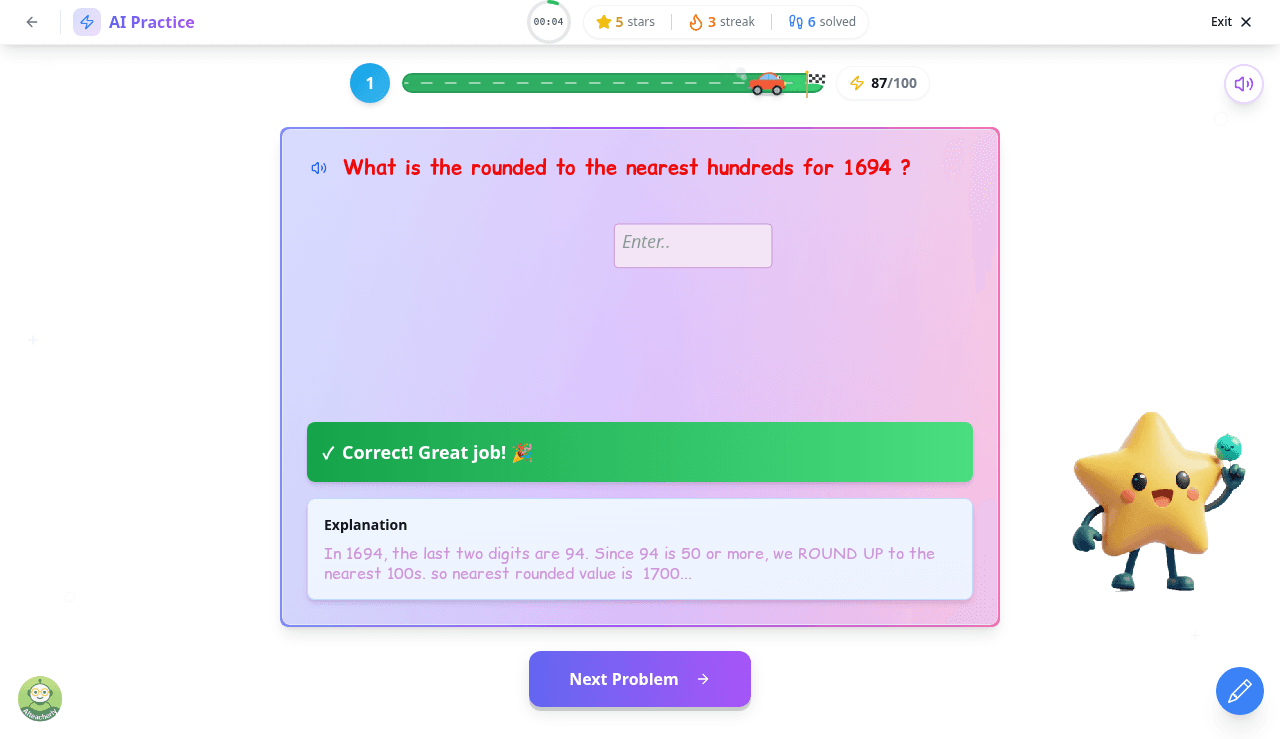
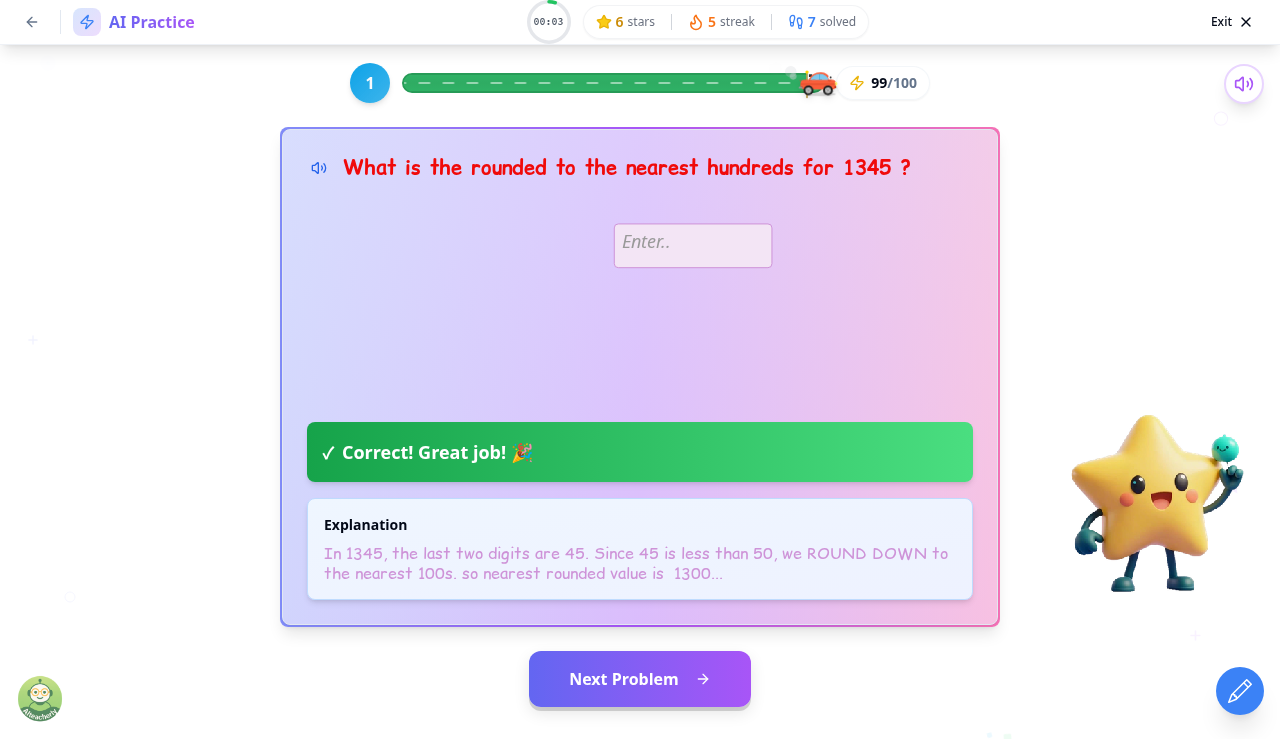
The interactive practice problem below shows exactly how place value elements work in practice on AI Teacherly:
5ed99e6b-e93a-465c-86a8-9f336c77df63
These engaging activities reinforce rounding rules through active participation rather than passive memorization.
Common Rounding Mistakes (And How to Fix Them)
Even with great instruction, children often fall into a few common traps when learning to round 4-digit numbers. Spotting these pitfalls early can save you hours of review time.
The most frequent mistake children make is changing the thousands place when rounding to the nearest hundred. For example, when rounding 4,872 to the nearest hundred, a student might accidentally change the 4,000 to 5,000 because they get confused by the rounding up process. Remind your child that when rounding to the nearest hundred, the thousands digit always stays the same unless the number rounds up from 999 to 1,000. Another common error is looking at the ones digit instead of the tens digit. Emphasize that only the two digits immediately to the right of the target place value matter when making the round-up or round-down decision. Pointing out these patterns helps students self-correct before turning in their assignments.
How AI Teacherly Makes Math Practice Stress-Free
Supporting your 4th grader does not mean you have to spend hours searching for worksheets or stressing over lesson plans. Modern interactive learning platforms bridge the gap between classroom instruction and at-home practice, providing gentle guidance tailored to each child's pace.
AI Teacherly offers interactive lessons designed specifically for 4th-grade mathematics, turning challenging concepts like rounding to the nearest hundreds into engaging, game-like experiences. With step-by-step visual prompts, immediate feedback, and positive reinforcement, children build foundational math skills without the frustration of traditional flashcards.
Here's what the full interactive lesson looks like on AI Teacherly:
18bbc63c-9d40-4a6f-b775-a700311f14c8
By combining clear explanations with adaptive practice, AI Teacherly empowers students to master place value concepts independently, giving parents peace of mind and reclaiming peaceful evenings at home.
Frequently Asked Questions About 4th Grade Rounding
Here are answers to common questions parents ask about teaching rounding and place value to 4th graders.
Key Takeaways
- Focus on the hundreds place and the last two digits rather than getting overwhelmed by 4-digit numbers all at once.
- Use the reliable 50-threshold rule: last two digits under 50 round down, 50 or more round up.
- Incorporate visual number lines to show physical distance between lower and upper hundred bounds.
- Turn everyday scenarios like grocery shopping into fun estimation and rounding games.
- Leverage interactive platforms like AI Teacherly to provide stress-free, guided math practice at home.
Frequently Asked Questions
What is rounding to the nearest hundreds in 4th grade math?
Rounding to the nearest hundreds in 4th grade means finding the closest hundred to a given 4-digit number. For example, rounding 4,328 to the nearest hundred results in 4,300 because 28 is closer to 0 than 100.
How do you round to the nearest hundred in 4th grade?
To teach rounding at home, use the two-step rule: first, underline the digit in the hundreds place, and second, look at the last two digits (tens and ones). If the last two digits are 50 or more, round up; if less than 50, round down.
When should my child round up versus round down?
The magic threshold is 50. If the tens and ones digits combined are 50, 60, 75, or any number up to 99, you round the hundreds digit up by one. If the number is between 01 and 49, you keep the hundreds digit the same and turn the trailing digits into zeros.
Why do 4th graders struggle with rounding numbers?
Fourth graders often struggle because they confuse place values, looking at the thousands place or ones place instead of focusing on the hundreds and tens digits. Using visual number lines and interactive tools helps clarify these steps.
Are visual number lines better than standard rounding rules?
Yes! Visual number lines show children the physical distance between numbers, helping them see why 4,350 sits exactly halfway between 4,300 and 4,400, making the rounding rule much more intuitive than memorizing abstract steps.
How can I help my child practice rounding at home?
You can practice rounding during everyday moments like grocery shopping, car trips, or cooking by asking your child to round prices, distances, or ingredient quantities to the nearest hundred.
Ready to make math homework frustration-free? Explore interactive rounding lessons and place value activities for your 4th grader free on AI Teacherly today!