Demystifying 6th Grade Percent Relationships: A Parent’s Guide
Mastering 6th grade percent relationships doesn't have to cause kitchen table stress. Discover simple formulas and interactive strategies to help your child conquer percents.
Introduction: Why Percentages Click (or Don't) in 6th Grade
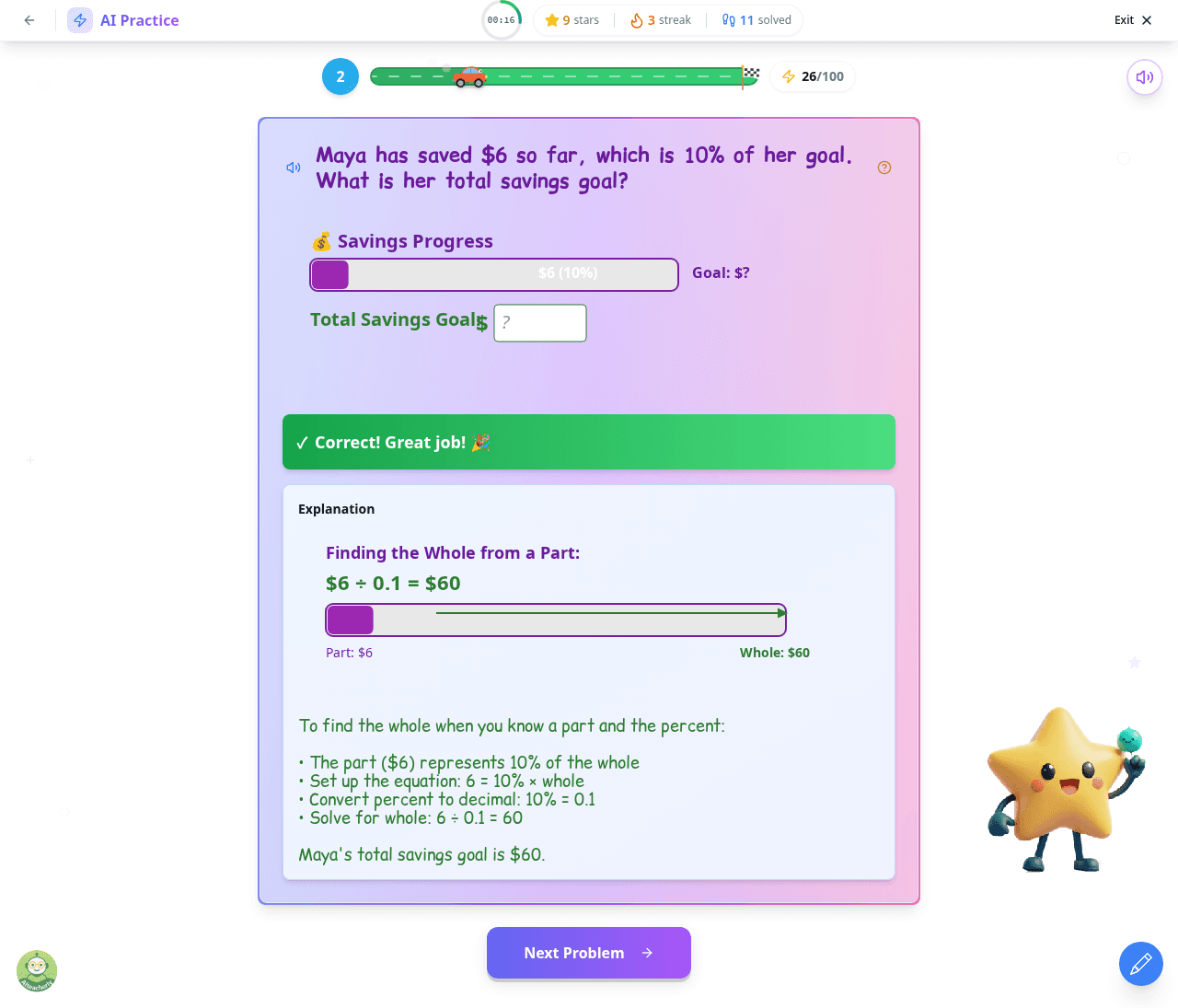
Math anxiety often hits a peak in 6th grade when percentages show up everywhere, from shopping discounts to test scores and financial literacy lessons. You do not need a math degree to help your child master percent relationships; you just need a simple, visual way to break them down. When percentages click, students stop memorizing random formulas and start seeing how math governs everyday life. In this guide, we will unpack how to navigate 6th grade percent relationships without the tearful kitchen-table meltdowns, turning math practice into an empowering experience for both you and your middle schooler.
What Are Percent Relationships and Why Are They Tricky?
At its core, understanding percent relationships means recognizing that every percentage problem involves three key components: the part, the percent, and the whole. In 6th grade math, students move beyond simple computation to explore proportional reasoning. They learn that percent literally means per hundred. When children struggle, it is usually because they are trying to memorize formulas rather than visualizing what is missing. Before solving any problem, encourage your child to pause and ask a vital question: Are we looking for the part, the percent, or the whole? This simple habit transforms a confusing word problem into a manageable puzzle with clear boundaries.
How to Find What Percent One Number Is of Another
One of the most common 6th grade math tasks is figuring out what percent one number is of another. For instance, if a student gets 18 correct answers out of 20 on a science quiz, what is their percentage score? To solve this, students divide the part by the total whole and multiply by 100. Walking through this at home is easier than you think. You can show your child that 18 divided by 20 equals 0.90, which converts to 90 percent. By framing this around familiar experiences like test grades or gaming achievements, students quickly grasp that finding a percentage is simply comparing a smaller amount to a total baseline.
How to Find the Whole When You Only Know the Part
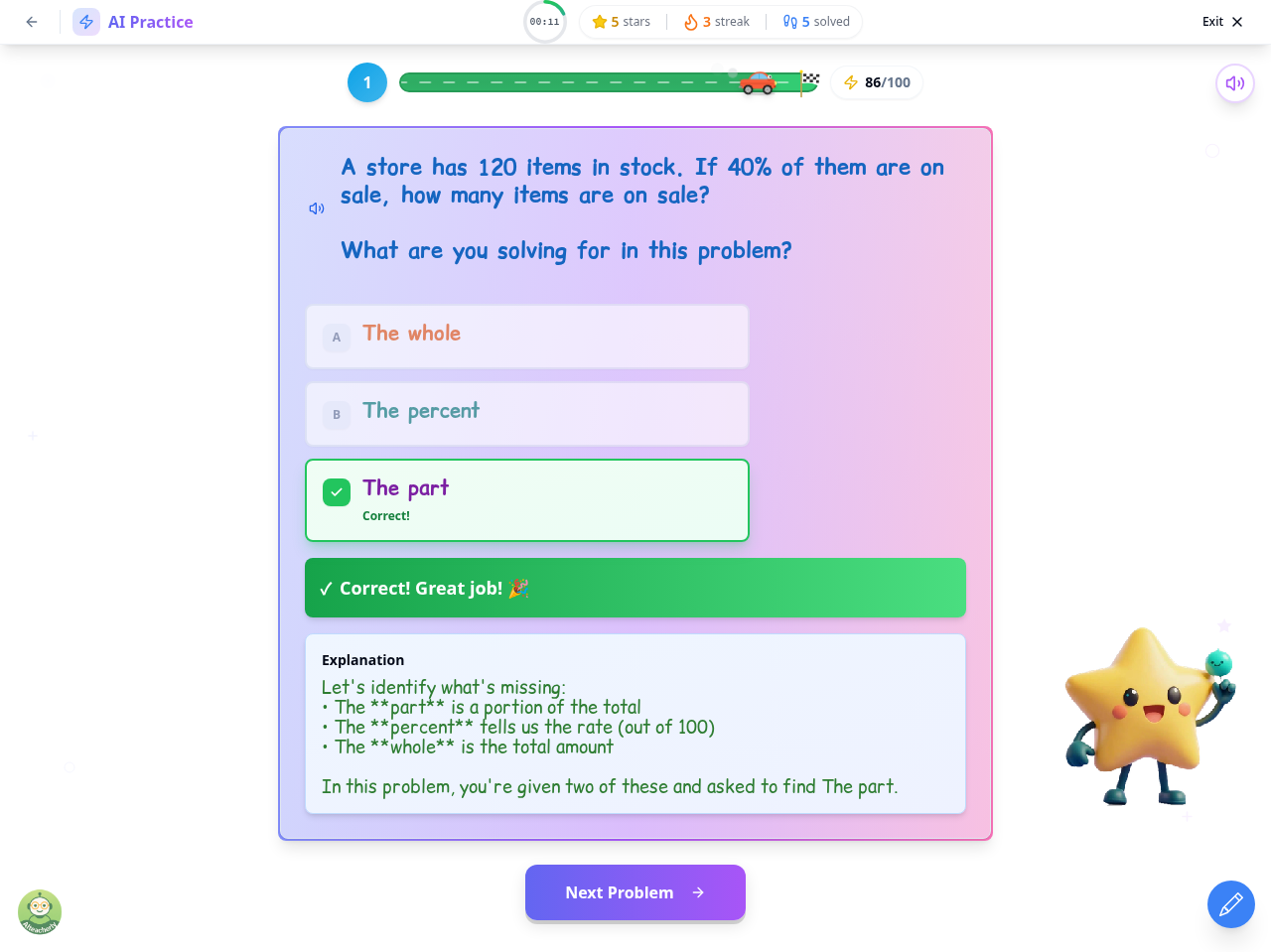
Another hurdle in middle school mathematics is calculating the total whole when you only know a part and its percentage. For example, if a jacket is on sale for 45 dollars, which represents 75 percent of its original price, what was the original cost? Many students instinctively try to multiply, leading to numbers that do not make sense. The golden rule to share with your child is simple: the whole is always larger than the part in these scenarios. To solve it, convert the percentage into a decimal by moving the decimal point two places to the left, then divide the part by that decimal. The interactive problem below shows exactly how students work through this exact calculation step by step.
3 Simple Ways to Practice Percents at Home Without Worksheets
You do not need endless drill worksheets to reinforce these concepts. Practical, everyday moments offer the best learning opportunities. When you visit the grocery store or shop online together, invite your child to calculate 20 percent off a clothing item or estimate sales tax at checkout. Another great strategy is exploring savings goals. If your child wants to buy a new bicycle worth 200 dollars and has saved 50 dollars, ask them what percentage of their goal they have reached. These low-pressure conversations build profound mathematical intuition without feeling like homework.
See How AI Teacherly Makes Percent Practice Stress-Free
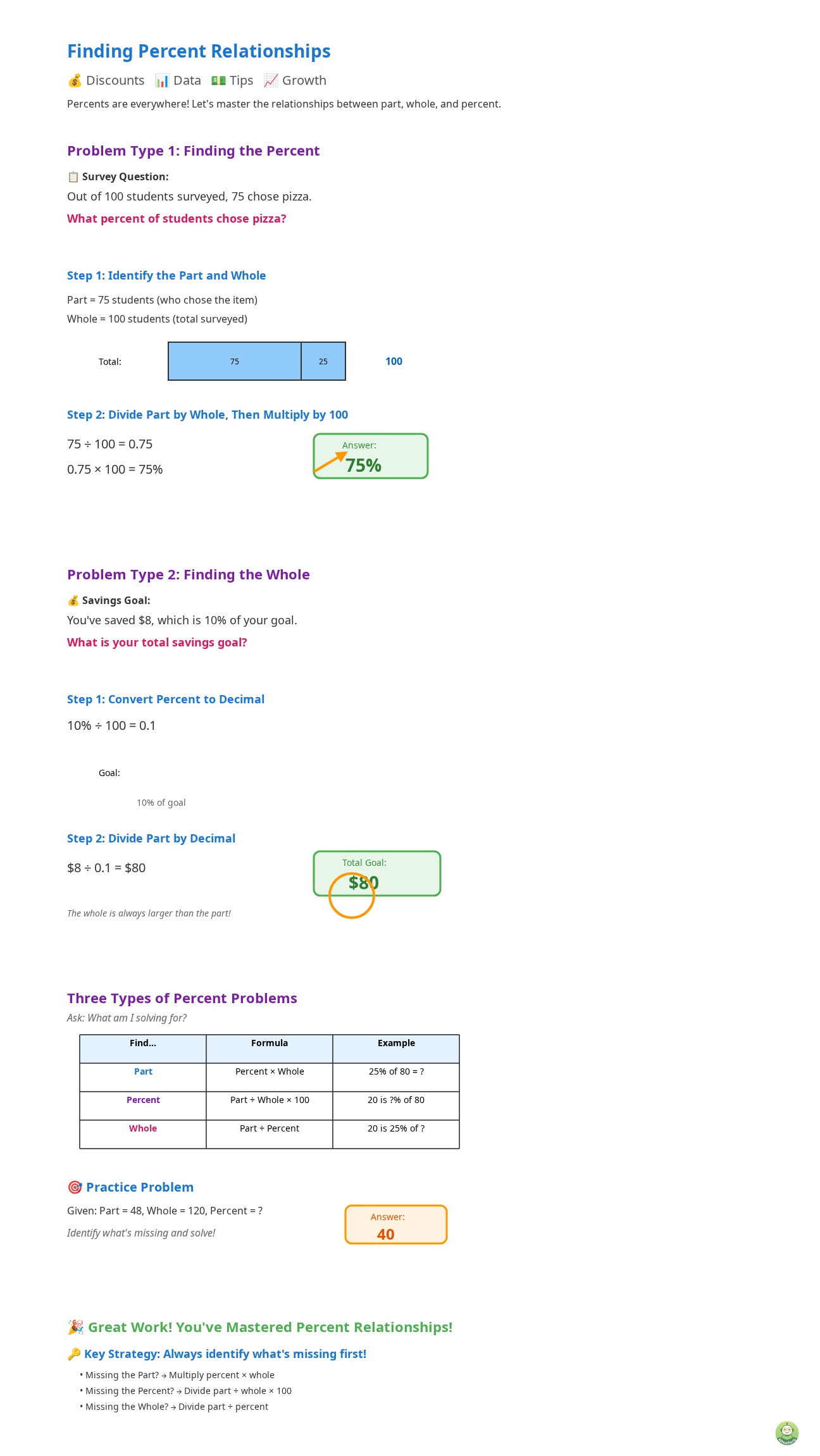
Traditional worksheets can sometimes make math practice feel like a chore, but interactive digital tools change the dynamic entirely. Platforms like AI Teacherly turn abstract concepts into visual, gamified challenges that keep students motivated and curious. Here is what the full interactive lesson looks like on AI Teacherly:
Key Takeaways
- Every percent problem boils down to three core elements: the part, the percent, and the total whole.
- Always convert percentages into decimals by moving the decimal point two places to the left before calculating.
- When finding a total from a part and a percent, remember that the whole is always larger than the part.
- Use real-world scenarios like shopping discounts and restaurant tips to make abstract math tangible.
- Interactive digital platforms like AI Teacherly replace frustrating drills with engaging, self-paced practice.
Frequently Asked Questions
What are percent relationships in 6th grade math?
Percent relationships in 6th grade math involve understanding how parts, wholes, and percentages connect in proportional situations. Students learn to find a percent of a number, find what percent one number is of another, and find the total when given a part and a percentage.
How do I help my child find the whole when given a part and percent?
To find the whole, convert the percentage into a decimal by dividing by 100, then divide the given part by that decimal. For example, if 15 dollars is 25 percent of a total, divide 15 by 0.25 to get a total of 60 dollars.
Why is my 6th grader struggling with percent word problems?
Sixth graders often confuse whether they are looking for the part or the whole, or they struggle with moving decimals correctly when converting percentages. Visual models and real-world contexts like shopping discounts clarify these concepts quickly.
How do you calculate what percent one number is of another?
Divide the part by the total whole, then multiply the result by 100. For instance, if your child scores 18 out of 20 on a quiz, divide 18 by 20 to get 0.90, which equals 90 percent.
Are there easy tricks to solve percent problems at home?
Yes! Turn grocery shopping into a math game by asking your child to calculate 20 percent off a sale item or figure out a 15 percent restaurant tip using mental math and estimation strategies.
Which is better for kids: percent proportions or decimal equations?
Proportions and decimal multiplication are both effective. Many 6th graders prefer converting the percent to a decimal because it reduces equation steps, but understanding proportional reasoning builds stronger conceptual foundations.
Is it normal for middle schoolers to struggle with percentages?
Yes, it is completely normal. Sixth grade marks a major shift from basic arithmetic to abstract proportional reasoning, requiring children to apply numbers in entirely new multi-step contexts.
Ready to make math practice engaging and stress-free? Explore Finding Percent Relationships and hundreds of interactive 6th-grade math lessons free on AI Teacherly today!