Divisibility Rules for 4th Graders: 6 Easy Math Shortcuts Every Parent Should Know
Master 6 simple divisibility rules that make math faster for your 4th grader. Easy tricks for checking 2, 3, 5, 6, 9, and 10 that you can practice together tonight.
Why Divisibility Rules Are Your Child's New Math Superpower
Your 4th grader doesn't need to struggle through long division just to check if a number divides evenly. There's a better way, and it takes seconds instead of minutes.
Divisibility rules are mental shortcuts that let kids instantly know whether a number can be divided by 2, 3, 5, 6, 9, or 10 without any calculation. Think of them as "math detective tricks" that reveal secrets about numbers at a glance.
Why does this matter right now? Fourth grade is the critical year when these concepts are introduced before fraction work intensifies in 5th grade. When your child can quickly identify factors, simplifying fractions becomes dramatically easier. A child who knows that 36 is divisible by both 4 and 9 can simplify 36/72 in seconds, while classmates are still doing long division.
The best part? You can teach these rules at home tonight. They require no special math background, no worksheets, and no tears. Just a few simple patterns that, once learned, stick forever.
In this guide, you'll learn all six divisibility rules in order from easiest to most complex, with real examples you can practice together. By the end, your child will feel like a number detective who can crack any divisibility case.
What Are Divisibility Rules and Why Do 4th Graders Need Them?
Divisibility rules are simple tests that tell you if one number divides evenly into another, without doing the actual division. Instead of calculating 846 ÷ 3 the long way, your child can add 8 + 4 + 6 = 18, see that 18 divides by 3, and know instantly that 846 is divisible by 3. No pencil needed.
These rules work because of mathematical patterns in our base-10 number system. While your child doesn't need to understand the deep "why" behind each rule, knowing that these shortcuts are mathematically proven (not just tricks) can boost their confidence.
When Do Kids Learn Divisibility Rules in School?
Most students encounter divisibility rules in 4th grade as part of the "Factors and Multiples" unit. This timing is intentional: students need these skills before tackling fraction operations in 5th grade, where finding common denominators and simplifying fractions becomes essential.
Real Benefits of Mastering Divisibility Rules:
- Faster homework completion: Mental checks replace tedious calculations
- Better fraction skills: Simplifying fractions requires knowing factors
- Stronger number sense: Understanding how numbers relate builds mathematical intuition
- Test confidence: Standardized tests often include divisibility questions
- Foundation for algebra: Factoring expressions uses the same logical thinking
Think of divisibility rules as the "sight words" of multiplication and division. Just as recognizing common words speeds up reading, recognizing divisibility patterns speeds up all number work.
The Easy Three: Rules for 2, 5, and 10 (Last-Digit Tricks)
Let's start with the three easiest divisibility rules. These all share something in common: you only need to look at the last digit. No adding, no calculating, just a quick glance.
Rule for 2: Is It Even?
A number is divisible by 2 if its last digit is even (0, 2, 4, 6, or 8).
- 4,738 → Last digit is 8 (even) → Divisible by 2 ✓
- 2,915 → Last digit is 5 (odd) → Not divisible by 2 ✗
Parent tip: Ask your child, "Can we share this evenly between two people?" Even numbers always split into two equal groups.
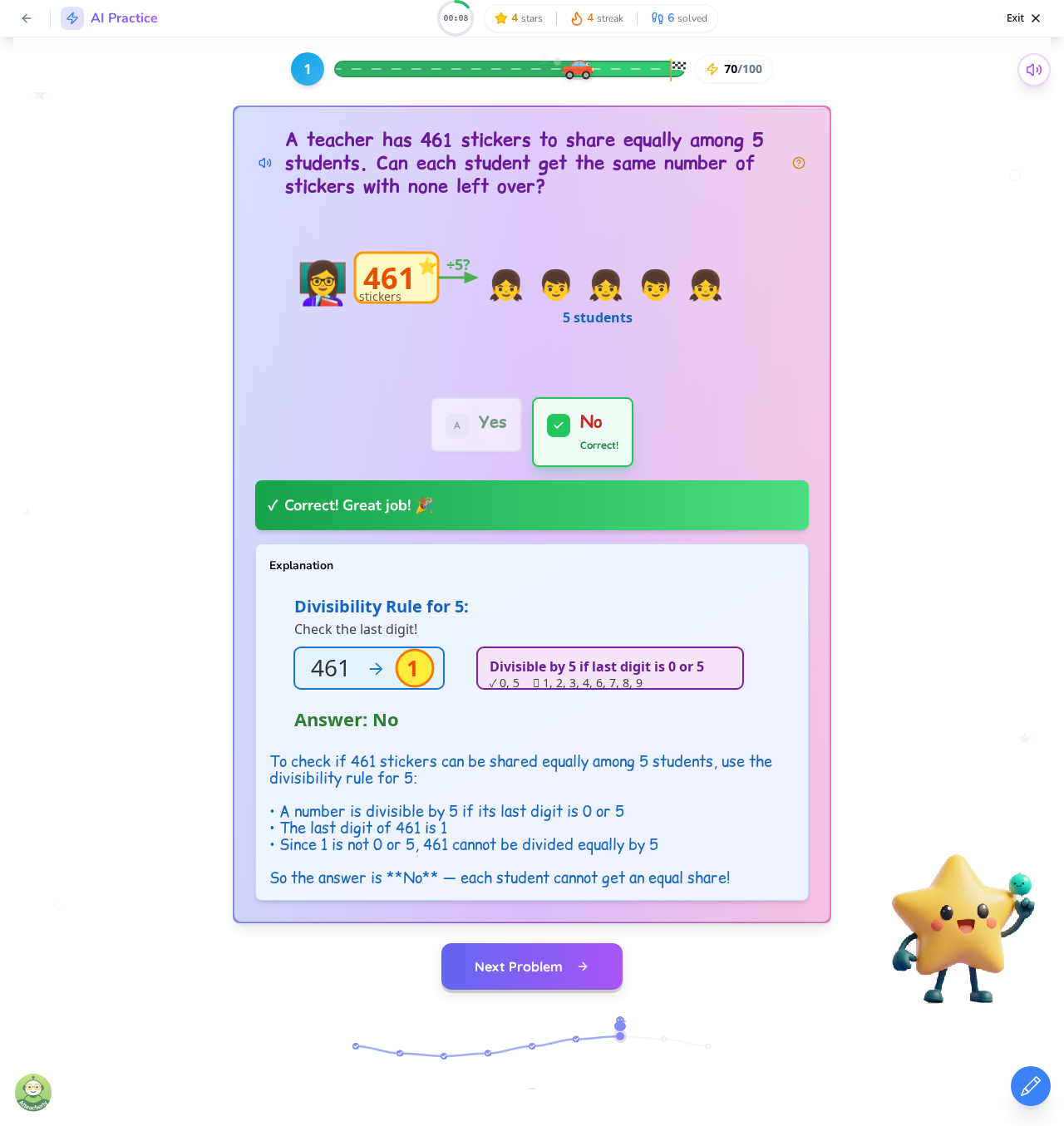
Rule for 5: Does It End in 0 or 5?
A number is divisible by 5 if its last digit is 0 or 5.
- 1,245 → Last digit is 5 → Divisible by 5 ✓
- 3,680 → Last digit is 0 → Divisible by 5 ✓
- 4,823 → Last digit is 3 → Not divisible by 5 ✗
Parent tip: Connect this to counting by 5s. Every number your child says when skip-counting by 5 ends in 0 or 5.
Rule for 10: The Easiest One!
A number is divisible by 10 if its last digit is 0.
- 5,730 → Last digit is 0 → Divisible by 10 ✓
- 8,945 → Last digit is 5 → Not divisible by 10 ✗
Practice together: Look at prices in a store flyer. Which items could be split evenly among 10 people without dealing with cents?
The Digit Sum Rules: How to Check for 3 and 9
Now for the rules that feel like magic: add up all the digits, then check if that sum is divisible by the target number. This technique works because of fascinating properties of our number system.
Rule for 3: Add the Digits
A number is divisible by 3 if the sum of its digits is divisible by 3.
Let's try 4,521:
- Add the digits: 4 + 5 + 2 + 1 = 12
- Is 12 divisible by 3? Yes! (12 ÷ 3 = 4)
- So 4,521 is divisible by 3 ✓
Let's try 7,834:
- Add the digits: 7 + 8 + 3 + 4 = 22
- Is 22 divisible by 3? No (22 ÷ 3 = 7 remainder 1)
- So 7,834 is NOT divisible by 3 ✗
Rule for 9: Same Trick, Stricter Test
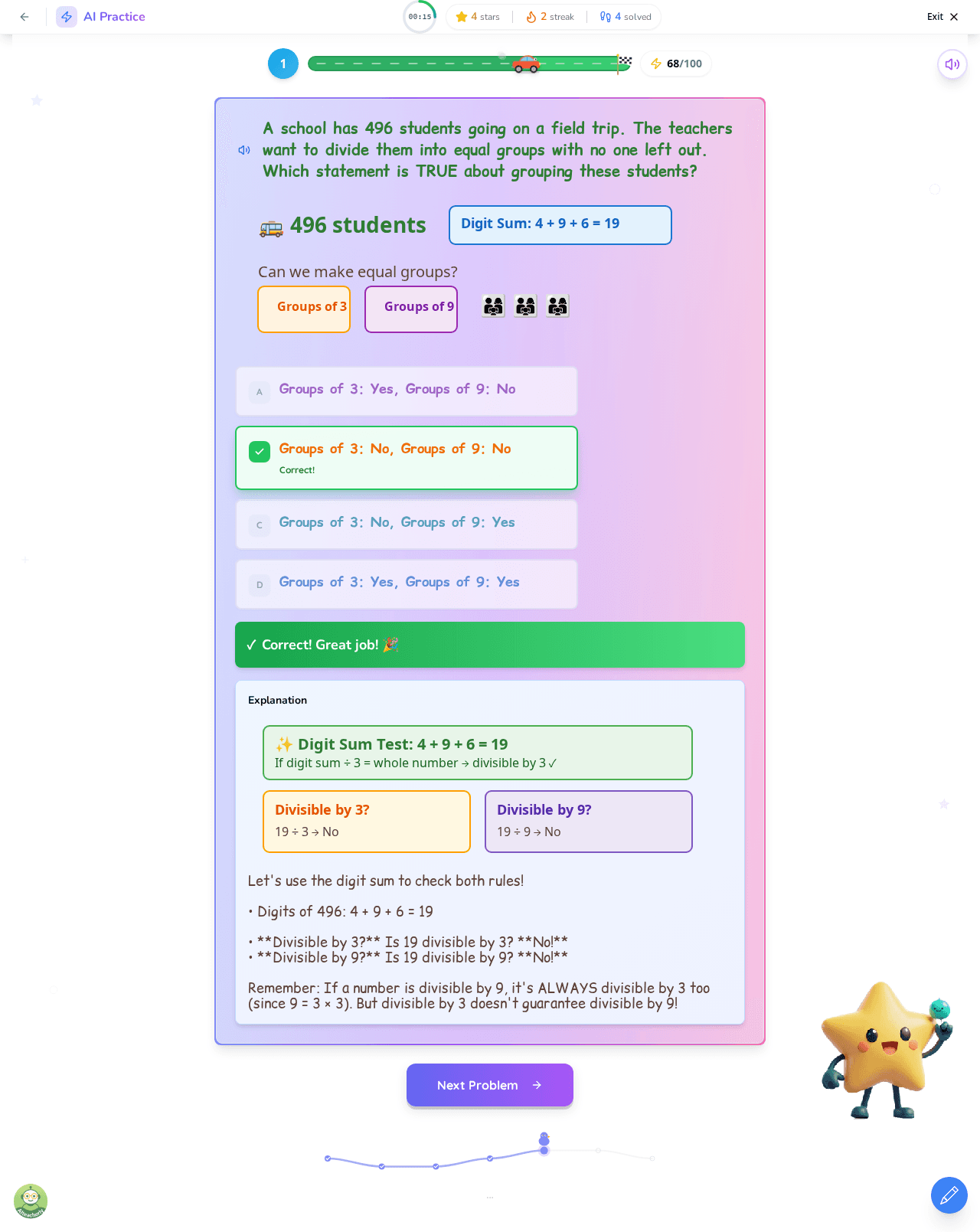
A number is divisible by 9 if the sum of its digits is divisible by 9.
Let's try 6,318:
- Add the digits: 6 + 3 + 1 + 8 = 18
- Is 18 divisible by 9? Yes! (18 ÷ 9 = 2)
- So 6,318 is divisible by 9 ✓
What's the Difference Between Rules for 3 and 9?
Both use digit sums, but 9 is stricter. Every number divisible by 9 is also divisible by 3, but not vice versa. For example, 12 is divisible by 3 but not by 9.
Parent tip: Make it a game! Have your child add up the digits of your house number, phone number, or the current year. Can they determine if it's divisible by 3 or 9?
The Combination Rule: Why 6 Requires Two Tests
Here's where your child gets to think like a true math detective. The rule for 6 requires passing two tests, because 6 is the product of 2 and 3.
Rule for 6: Two Tests in One
A number is divisible by 6 if it's both divisible by 2 AND divisible by 3.
Let's try 438:
- Test 1 (Rule for 2): Is 438 even? Last digit is 8, so yes! ✓
- Test 2 (Rule for 3): Is the digit sum divisible by 3? 4 + 3 + 8 = 15, and 15 ÷ 3 = 5. Yes! ✓
- Result: 438 passes both tests, so 438 is divisible by 6 ✓
Let's try 532:
- Test 1 (Rule for 2): Is 532 even? Last digit is 2, so yes! ✓
- Test 2 (Rule for 3): Is the digit sum divisible by 3? 5 + 3 + 2 = 10, and 10 ÷ 3 = 3 remainder 1. No! ✗
- Result: 532 fails one test, so 532 is NOT divisible by 6 ✗
Why This Rule Matters Beyond Math Class
The combination rule teaches logical thinking that applies everywhere. Your child is learning to break complex problems into smaller, manageable checks. This same reasoning appears in coding, science experiments, and everyday decision-making.
Parent tip: Ask real-world questions like, "We have 42 cookies. Can we arrange them in groups of 6 with none left over?" Walk through both tests together.
Practice Makes Perfect: Try These at Home Tonight
Ready to put these rules into action? Here are some engaging ways to practice divisibility rules with your 4th grader that feel more like games than homework.
Quick-Fire Practice
Call out numbers and have your child identify which rules they pass:
- 36: Divisible by 2 (even), 3 (3+6=9), 6 (passes both), 9 (digit sum is 9)
- 125: Divisible by 5 (ends in 5) only
- 480: Divisible by 2, 3, 5, 6, 10 (the grand slam!)
Real-World Scenarios
Divisibility rules aren't just for math class. Try these conversations:
- "We have 48 students going on a field trip. Can we split them into equal groups of 6?" (Yes! 48 is even and 4+8=12 is divisible by 3)
- "There are 36 stickers. Can 4 friends share them equally?" (Yes! 36 ÷ 4 = 9)
- "A bakery made 85 cookies. Can they pack them into boxes of 10 with none left over?" (No, 85 doesn't end in 0)
The interactive problem below shows exactly how these real-world scenarios work in practice.
Why Interactive Practice Accelerates Learning
While dinner-table practice is great for introduction, consistent interactive practice with immediate feedback helps these rules become automatic. When children see colorful visuals and get instant confirmation, the patterns stick faster than with worksheets alone.
How AI Teacherly Makes Divisibility Practice Fun
Teaching divisibility rules at home is a great start, but consistent, engaging practice is what transforms knowledge into automatic recall. That's where interactive learning platforms make a real difference.
Here's what the full interactive lesson looks like on AI Teacherly:
The Divisibility Rules lesson on AI Teacherly turns these concepts into an adventure. Instead of boring drills, your child becomes a "divisibility detective" solving real-world mysteries like sharing stickers fairly or packing cookies into boxes.
What Makes This Approach Different:
- Visual learning: Colorful animations show why rules work, not just what they are
- Immediate feedback: Kids know instantly if they're right, preventing bad habits from forming
- Progressive difficulty: Problems start simple and gradually increase in complexity
- Real-world contexts: Word problems feature relatable scenarios like field trips, baking, and sharing
- Celebration of progress: Encouraging messages like "Great job! You're a divisibility detective!" keep motivation high
The Lesson Structure:
The lesson guides students through each rule systematically:
- Introduction to what divisibility means
- Last-digit rules (2, 5, 10) with practice
- Digit sum rules (3, 9) with examples
- The combination rule for 6
- Mixed practice with word problems
- Celebration and confidence building
This structured approach ensures no rule is left behind, and the interactive format keeps kids engaged far longer than traditional worksheets.
Key Takeaways
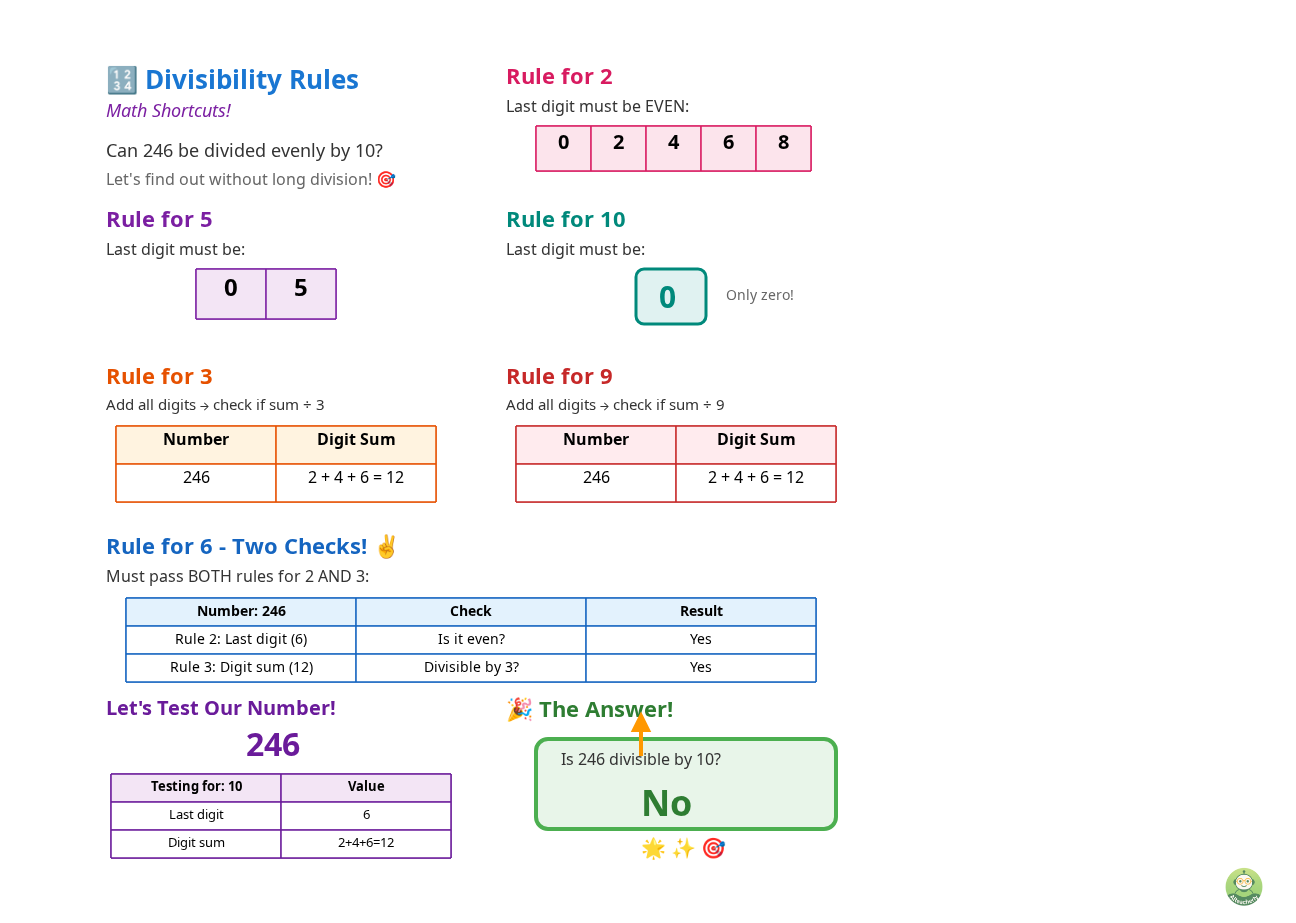
- Divisibility rules are mental shortcuts that eliminate long division for checking if numbers divide evenly
- Rules for 2, 5, and 10 only require looking at the last digit, making them perfect starting points
- Rules for 3 and 9 use digit sums: add all digits, then check if that sum divides by 3 or 9
- The rule for 6 combines two tests: the number must be even AND have a digit sum divisible by 3
- These skills directly prepare your child for simplifying fractions and finding factors in 5th grade
- Real-world practice with sharing, grouping, and packing scenarios makes the rules memorable
- Interactive practice with immediate feedback helps rules become automatic faster than worksheets
Frequently Asked Questions
What are the divisibility rules for 2, 3, 5, 6, 9, and 10?
For 2: last digit is even. For 5: last digit is 0 or 5. For 10: last digit is 0. For 3: digit sum divides by 3. For 9: digit sum divides by 9. For 6: number must be even AND digit sum divides by 3.
How can I help my child remember divisibility rules?
Start with the easiest rules (2, 5, 10) that only check the last digit. Use real-world examples like sharing items equally. Practice with house numbers, prices, and phone numbers. Make it a quick game rather than a drill.
Why is learning divisibility rules important for 4th graders?
Divisibility rules prepare kids for 5th grade fractions. Students who can quickly identify factors can simplify fractions faster and find common denominators more easily. These skills also build number sense and mental math confidence.
What's the difference between the divisibility rules for 3 and 9?
Both use digit sums, but 9 is stricter. Add all digits together. If the sum divides by 9, the number is divisible by 9. If the sum divides by 3 (but not 9), it's only divisible by 3. Every number divisible by 9 is also divisible by 3.
Is my child supposed to memorize all divisibility rules?
Yes, but through understanding rather than rote memorization. When kids understand the patterns (last digit checks vs. digit sums), the rules become intuitive. Most 4th graders can master all six rules within a few weeks of practice.
How do divisibility rules help with fractions later?
To simplify fractions, kids need to find common factors. A child who instantly knows 36 is divisible by 4, 6, and 9 can simplify 36/72 quickly. Without divisibility rules, this requires trial-and-error long division.
What are some real-life examples of using divisibility rules?
Sharing items equally among friends, splitting costs, determining if items fit evenly into containers, checking if a group can be divided into teams, and verifying if prices divide evenly. These scenarios make abstract rules concrete and memorable.
When do kids learn divisibility rules in school?
Most schools introduce divisibility rules in 4th grade as part of the Factors and Multiples unit. This timing prepares students for fraction operations in 5th grade, where finding common denominators and simplifying become essential skills.
Ready to turn your 4th grader into a divisibility detective? Try the interactive Divisibility Rules lesson free on AI Teacherly and watch those math shortcuts become second nature!