Divisibility Rules for 4th Graders: The Math Shortcuts That Build Number Confidence
Divisibility rules are the math shortcuts every 4th grader needs. Learn the simple tricks for 2, 3, 5, 6, 9, and 10 that make division feel like a superpower, with fun home activities included.
What Are Divisibility Rules and Why Should Your 4th Grader Learn Them?
Divisibility rules are simple mental math shortcuts that tell you whether a number divides evenly by another number, without doing any long division. Think of them as cheat codes for math that make your child feel like a number detective.
For example, instead of dividing 246 by 3 the long way, your child can simply add the digits (2 + 4 + 6 = 12) and check if that sum divides by 3. Since 12 divides evenly by 3, so does 246. No pencil needed!
Why do these rules matter for 4th graders specifically?
Fourth grade is the pivotal year when division concepts solidify before fraction operations begin in 5th grade. Mastering divisibility rules now gives your child:
- Faster mental math skills that build confidence
- Stronger number sense for understanding how numbers relate
- Essential preparation for fractions (simplifying fractions requires knowing what divides evenly)
- A foundation for factors and multiples tested throughout middle school
The best part? You don't need to be a math expert to teach these. The rules are simple enough that you can practice them anywhere: during car rides, at the grocery store, or while sharing snacks.
The Easy 'Last Digit' Rules: Checking for 2, 5, and 10
Let's start with the easiest divisibility rules, the ones your child can master in minutes. These 'last digit' rules only require looking at the final digit of any number.
Divisibility by 2: Is It Even?
A number is divisible by 2 if it ends in 0, 2, 4, 6, or 8. That's it! If the last digit is even, the whole number divides evenly by 2.
- 348 ends in 8 → Divisible by 2 ✓
- 527 ends in 7 → Not divisible by 2 ✗
Practice tip: Call out house numbers or license plates during car rides and have your child give a thumbs up or down for divisibility by 2.
Divisibility by 5: Look for 0 or 5
A number is divisible by 5 if it ends in 0 or 5. Your child probably already knows this from skip counting!
- 735 ends in 5 → Divisible by 5 ✓
- 482 ends in 2 → Not divisible by 5 ✗
Divisibility by 10: The Easiest Rule
The rule for 10 is the simplest of all. If a number ends in 0, it's divisible by 10. Period.
- 1,230 ends in 0 → Divisible by 10 ✓
- 1,235 ends in 5 → Not divisible by 10 ✗
These three rules are your quick wins. Most kids can remember them after just a few practice rounds because they only require checking one digit.
The 'Digit Sum' Rules: Mastering 3, 9, and 6
Once your child conquers the last digit rules, it's time to level up with the digit sum rules. These are slightly trickier but incredibly powerful.
Divisibility by 3: Add All the Digits
To check if a number is divisible by 3, add all its digits together. If that sum is divisible by 3, so is the original number.
Let's try 126:
- Add the digits: 1 + 2 + 6 = 9
- Is 9 divisible by 3? Yes!
- So 126 is divisible by 3 ✓
Now try 847:
- Add the digits: 8 + 4 + 7 = 19
- Is 19 divisible by 3? No (3 × 6 = 18, with 1 left over)
- So 847 is NOT divisible by 3 ✗
Divisibility by 9: Same Process, Different Check
The rule for 9 works exactly like the rule for 3, but you check if the digit sum is divisible by 9 instead.
- 738: 7 + 3 + 8 = 18, and 18 ÷ 9 = 2 → Divisible by 9 ✓
- 126: 1 + 2 + 6 = 9, and 9 ÷ 9 = 1 → Divisible by 9 ✓
Divisibility by 6: The Two-Test Rule
Here's where it gets interesting. A number is divisible by 6 only if it passes TWO tests:
- It must be even (divisible by 2)
- Its digit sum must be divisible by 3
Both conditions must be true. Let's check 132:
- Ends in 2 (even) → Passes test 1 ✓
- 1 + 3 + 2 = 6, and 6 ÷ 3 = 2 → Passes test 2 ✓
- 132 is divisible by 6!
This rule teaches kids logical "AND" thinking, a skill they'll use throughout math and science.
5 Fun Ways to Practice Divisibility Rules at Home
The secret to making divisibility rules stick is practice that doesn't feel like homework. Here are five engaging activities you can do anywhere.
1. License Plate Detective
During car rides, call out license plate numbers and challenge your child to quickly determine what they're divisible by. Start with checking for 2, 5, and 10, then add more rules as confidence grows.
2. Grocery Store Math
While shopping, point to prices and ask: "If we had $4.26, could we split it evenly between 3 people?" (Check if 426 is divisible by 3: 4 + 2 + 6 = 12, yes!)
3. Snack Sharing Challenge
Before sharing snacks, count them together: "We have 24 crackers and 4 people. Will everyone get the same amount?" This connects abstract rules to real fairness questions kids care about.
4. The "Beat the Calculator" Game
Give your child a number and race them using your phone calculator. They use divisibility rules; you divide the old-fashioned way. Kids love winning!
5. Interactive Online Practice
Digital lessons turn divisibility into an engaging game. The interactive problem below shows exactly how real-world scenarios make these rules click.
This bakery cookie problem demonstrates divisibility by 10 in a context kids find relatable and fun.

See How Interactive Lessons Make Divisibility Click
When kids can visualize math concepts and get immediate feedback, learning accelerates. That's why interactive lessons work so well for teaching divisibility rules.
On AI Teacherly, the Divisibility Rules lesson for 4th graders takes students on a step-by-step journey:
- Start with the 'why': Kids learn that these are shortcuts to avoid tedious long division
- Build from easy to complex: Last digit rules first, then digit sum rules
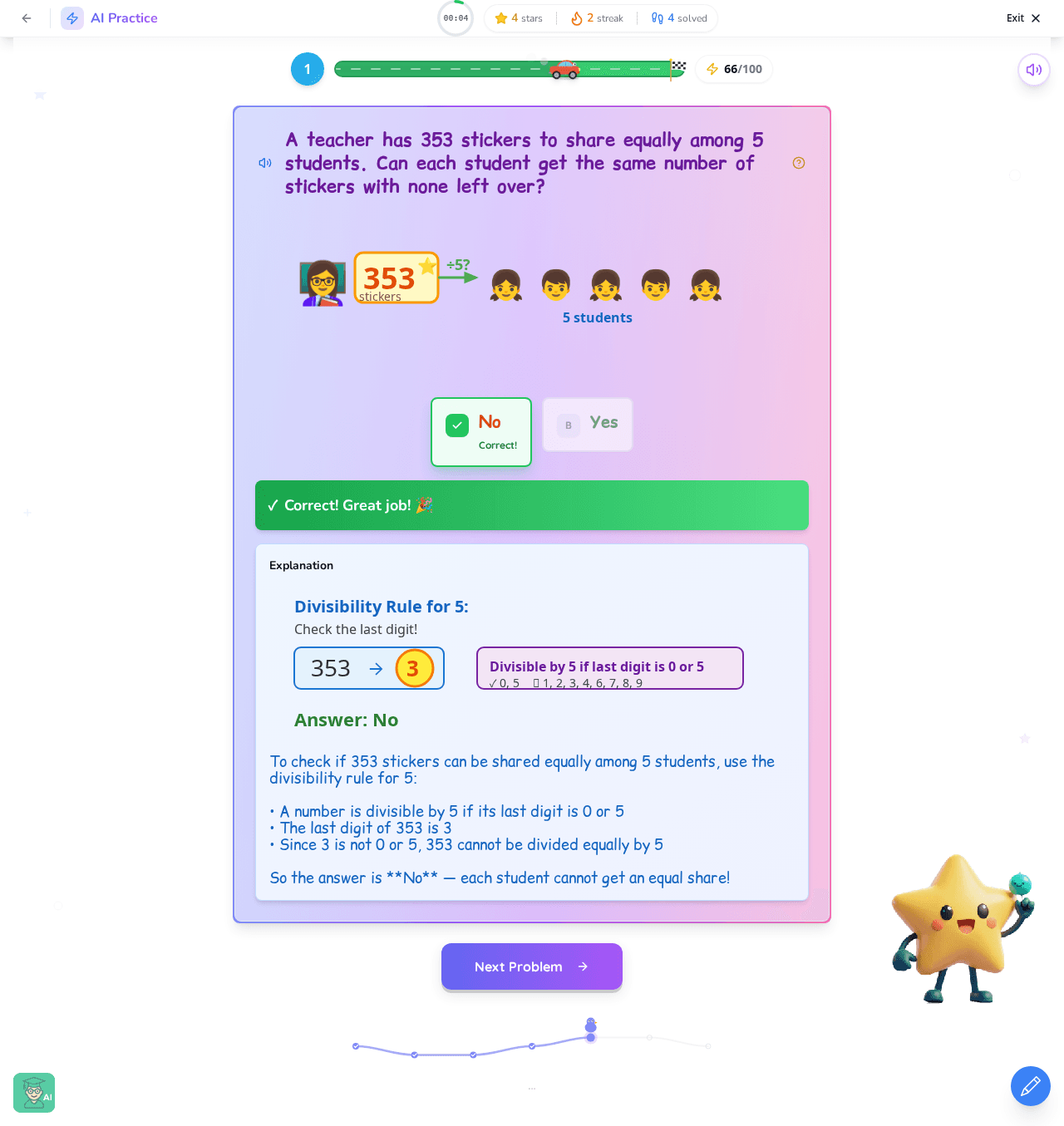
- Practice with word problems: Real scenarios like sharing stickers or packing cookies
- Instant feedback: Kids know immediately if they're on track
- Celebration moments: "Great job! You're a divisibility detective!"
Here's what the full interactive lesson looks like on AI Teacherly:
The lesson includes engaging word problems where students apply divisibility rules to real situations, like a teacher figuring out if 36 stickers can be shared equally among students. This context makes the math meaningful rather than abstract.
What makes interactive practice different from worksheets?
- Engagement: Colorful visuals and immediate rewards keep kids motivated
- Self-paced learning: Kids can pause, rewatch explanations, and try again
- Progress tracking: Parents can see exactly what's mastered and what needs work
- No prep required: Just click and learn, no printing or grading needed
Whether you use it as homework help, weekend enrichment, or summer skill-building, interactive lessons give your child the practice they need without the battle.
Common Mistakes Kids Make (And How to Fix Them)
Even with clear rules, certain stumbling blocks trip up most 4th graders. Here's what to watch for and how to help.
Mixing Up the Rules for 3 and 9
The mistake: Kids add the digits correctly but then check for the wrong divisor. They might say 126 is divisible by 9 (1 + 2 + 6 = 9) when they meant to check for 3.
The fix: Use a memory trick. "3 is smaller, so MORE numbers pass its test. 9 is bigger, so FEWER numbers pass." Any number divisible by 9 is also divisible by 3, but not vice versa.
Forgetting Both Tests for 6
The mistake: Kids check if a number is even OR if the digit sum divides by 3, but not both. They might say 15 is divisible by 6 because 1 + 5 = 6.
The fix: Teach them to hold up two fingers for the rule of 6 (one for "even," one for "digit sum"). Both fingers must go down before the number passes.
Adding Digits Incorrectly with Large Numbers
The mistake: When checking bigger numbers like 4,827, kids sometimes skip digits or add incorrectly.
The fix: Have them point to each digit as they say it aloud: "4... plus 8... is 12... plus 2... is 14... plus 7... is 21." Writing the addition helps too.
Thinking These Rules Work for All Numbers
The mistake: Kids try to use these rules for divisors like 4, 7, or 8 where they don't apply.
The fix: Be clear that 4th grade focuses on 2, 3, 5, 6, 9, and 10. There ARE rules for other numbers, but they're more complex and come later.
Key Takeaways
- Divisibility rules are mental math shortcuts that eliminate tedious long division for 4th graders
- Start with the 'last digit' rules (2, 5, 10) since they only require checking one digit
- The 'digit sum' rules (3, 9) involve adding all digits together to check divisibility
- For divisibility by 6, numbers must pass TWO tests: be even AND have a digit sum divisible by 3
- Practice anywhere using license plates, grocery prices, or snack-sharing scenarios
- Interactive lessons with real-world word problems help these rules stick
- Mastering divisibility now prepares kids for fractions and factors in 5th grade
Frequently Asked Questions
What are the divisibility rules for 2, 3, 5, 6, 9, and 10?
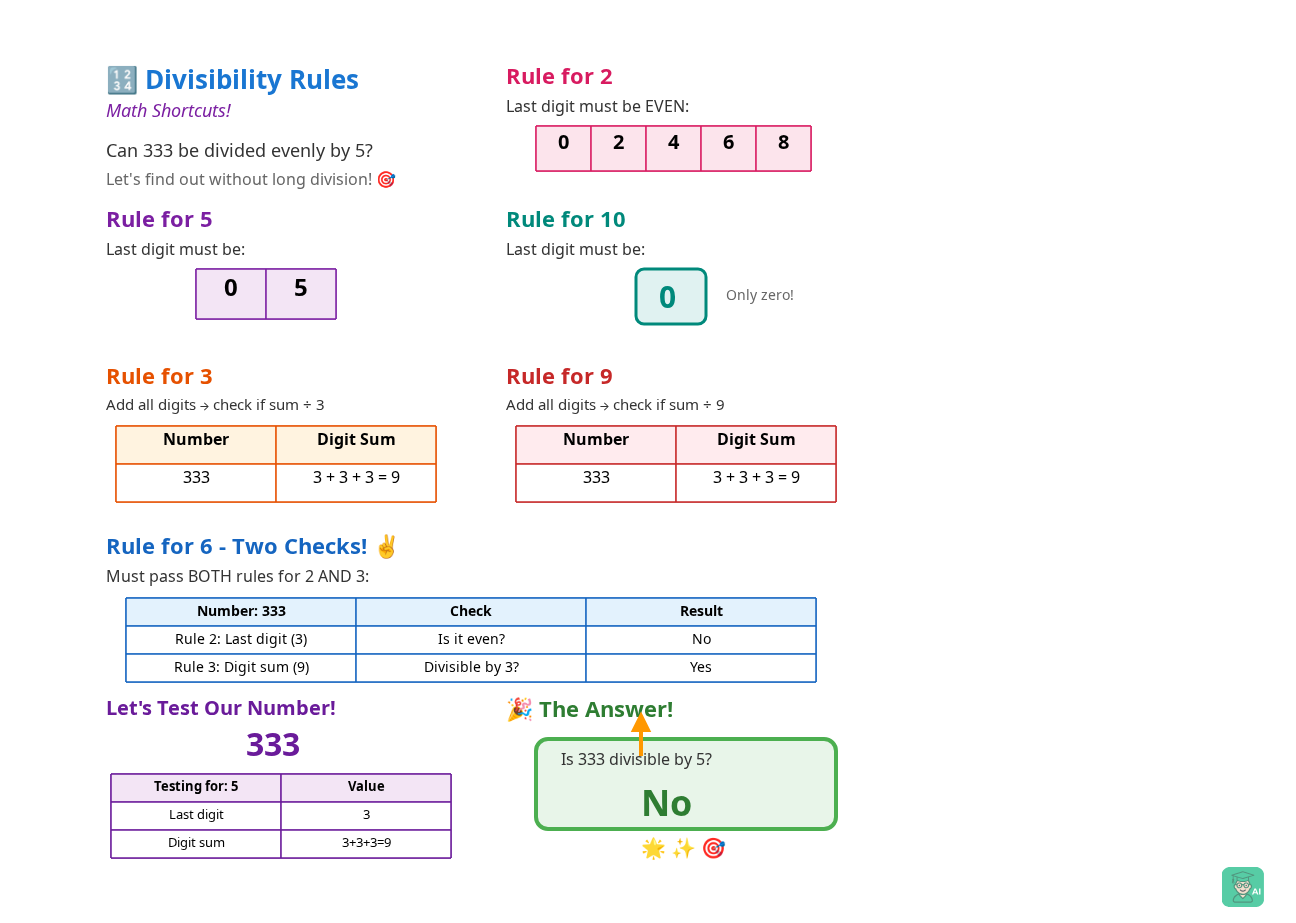
For 2, 5, and 10, check the last digit (even for 2; 0 or 5 for 5; 0 for 10). For 3 and 9, add all digits and check if that sum divides evenly. For 6, the number must be even AND have a digit sum divisible by 3.
How can I help my 4th grader remember divisibility rules?
Use memory tricks and real-world practice. Group them as 'last digit rules' (2, 5, 10) and 'digit sum rules' (3, 9, 6). Practice with license plates, prices, or sharing snacks to make the rules stick naturally.
Why are divisibility rules important for 4th graders?
These rules build number sense and mental math confidence. They're essential preparation for 5th grade fractions, where kids need to simplify fractions by finding what divides evenly into both numerator and denominator.
What is the easiest way to check if a number is divisible?
Start with the last digit rules. Check if the number ends in 0, 2, 4, 6, or 8 (divisible by 2), ends in 0 or 5 (divisible by 5), or ends in 0 (divisible by 10). These require no calculation at all.
How do divisibility rules help with fractions?
When simplifying fractions, kids need to find common factors. Divisibility rules let them quickly identify what numbers divide evenly into both parts of a fraction without trial and error.
Is it normal for kids to confuse the rules for 3 and 9?
Yes, this is very common since both use digit sums. Remind your child that 3 is 'easier to please' (more numbers pass), while 9 is 'pickier.' Any number divisible by 9 is also divisible by 3, but not the reverse.
What are fun ways to practice divisibility rules at home?
Try 'License Plate Detective' in the car, grocery store math with prices, snack-sharing challenges before treats, or 'Beat the Calculator' races. Interactive online lessons also make practice feel like a game.
When will my child use divisibility rules in school?
4th graders use them for factors and multiples. In 5th grade, they're essential for simplifying fractions. By middle school, these rules help with prime factorization, GCF, LCM, and algebraic expressions.
Ready to make divisibility rules click for your child? Try the interactive Divisibility Rules lesson free on AI Teacherly and watch them become a number detective!