Equal Groups for 2nd Graders: The Secret First Step to Multiplication Success
Your 2nd grader isn't just counting anymore. They're building the foundation for multiplication through equal groups, skip counting, and repeated addition. Discover practical ways to support this crucial skill at home.
What Are Equal Groups in 2nd Grade Math?
Equal groups are collections of objects that have the same number of items in each group. This deceptively simple concept is the foundation of multiplication, and it's one of the most important skills your 2nd grader will learn this year.
Think about it this way: when your child sees 3 baskets with 4 apples in each, they're looking at equal groups. The key insight is that each basket contains the same amount. This consistency is what makes multiplication possible.
In the classroom, teachers introduce this concept using a two-number framework that children will use throughout their math journey:
- How many groups? (In our example: 3 baskets)
- How many in each group? (4 apples per basket)
Once children identify these two numbers, they can find the total using several strategies. But here's what many parents don't realize: recognizing unequal groups is equally important. When groups have different amounts (say, 4, 3, and 5 apples), multiplication doesn't work. Your child needs to understand when multiplication applies, not just how to do it.
This distinction between equal and unequal groups builds mathematical reasoning that goes far beyond memorizing times tables. It teaches children to analyze situations and choose the right approach, a skill that serves them well in advanced math and everyday problem-solving.
Why Equal Groups Matter for Multiplication Success
If you've ever wondered why your 2nd grader isn't jumping straight into times tables, here's the answer: multiplication without conceptual understanding leads to fragile math skills. Equal groups provide the "why" behind the "what."
Research consistently shows that students who understand multiplication conceptually (through equal groups) outperform those who simply memorize facts. Why? Because conceptual understanding creates flexible thinking. When your child truly grasps that 4 × 3 means "4 groups of 3," they can:
- Solve unfamiliar problems by reasoning through them
- Check their own work by thinking about what makes sense
- Apply multiplication to real-world situations naturally
- Understand division as the reverse process (splitting into equal groups)
Without this foundation, multiplication becomes a house of cards. Students might memorize that 4 × 3 = 12, but when faced with word problems or larger numbers, they struggle to apply what they "know."
The 2nd grade focus on equal groups is intentional. Curriculum designers understand that spending time here prevents struggles later. Your child isn't behind if they're working with groups rather than times tables. They're building the scaffold that will support multiplication fluency for years to come.
Think of equal groups as the training wheels of multiplication. They provide stability while your child develops balance. And just like training wheels, the goal is eventual independence, but rushing that transition leads to crashes.
How to Teach Skip Counting with Equal Groups
Skip counting is the "fast way" to count equal groups, and it's a strategy your 2nd grader can use immediately. Instead of counting each item one by one, children learn to "hop" by the number in each group.
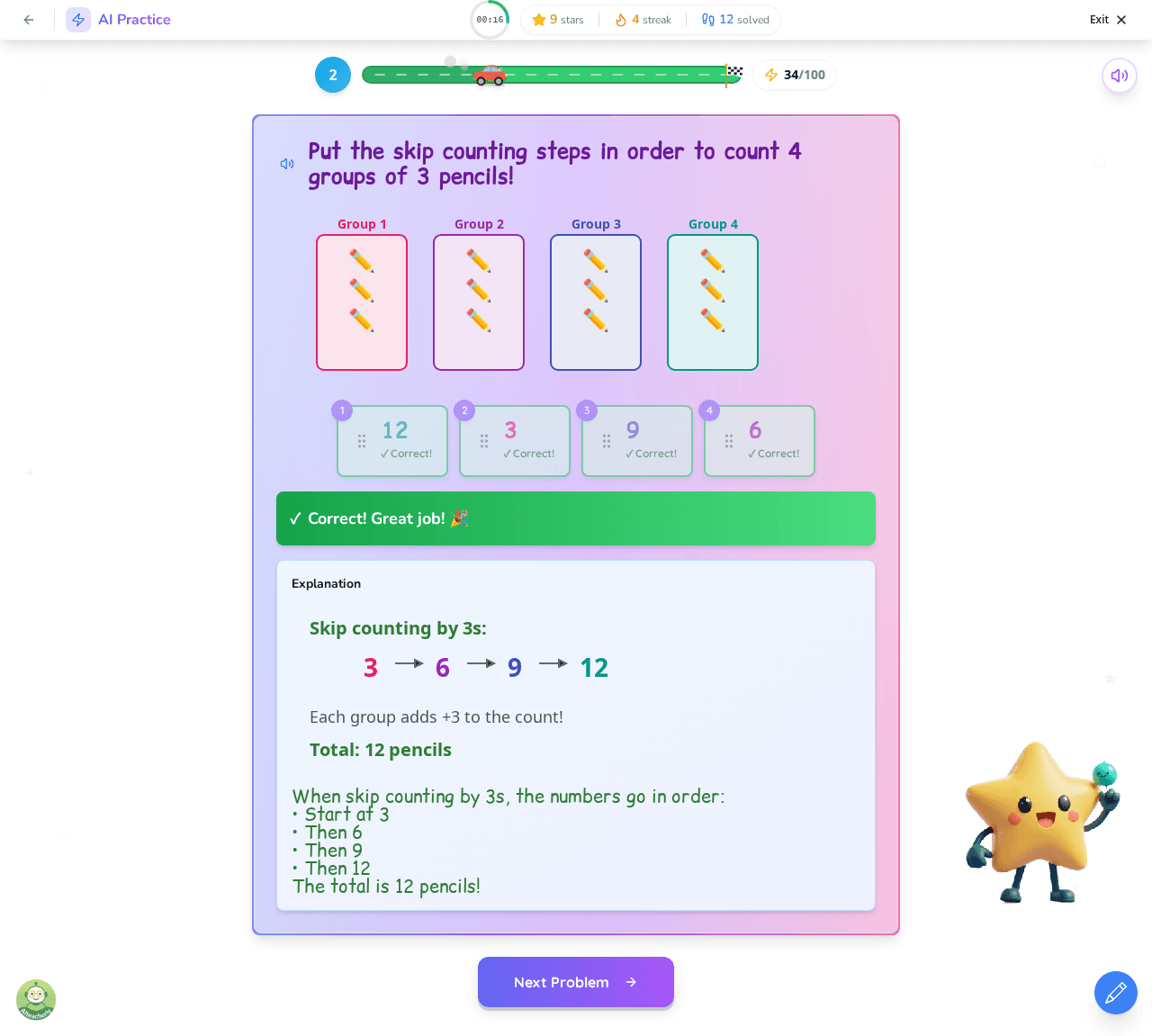
Here's how the lesson approaches it: "Instead of counting one by one, we hop by 3s. Each hop adds 3 more."
Let's say your child has 4 groups of 3 stars. Instead of counting 1, 2, 3, 4, 5, 6... all the way to 12, they skip count: 3, 6, 9, 12. Four hops, and they're done!
This isn't just faster; it builds number sense. Children start recognizing patterns:
- Counting by 2s: 2, 4, 6, 8, 10...
- Counting by 5s: 5, 10, 15, 20, 25...
- Counting by 10s: 10, 20, 30, 40, 50...
These patterns become the multiplication facts they'll eventually memorize. But because they discovered them through skip counting, the facts make sense rather than seeming arbitrary.
Practice tip for parents: Use a number line! Draw a simple line with numbers, and have your child make "jumps" of equal size. If they're counting 3 groups of 4, they jump from 0 to 4, then to 8, then to 12. The visual of landing on the answer reinforces the concept powerfully.
Skip counting also connects to time (counting by 5s on a clock), money (counting nickels and dimes), and measurement. When your child practices skip counting, they're building skills that transfer across mathematics.
Repeated Addition: The Bridge to Times Tables
Repeated addition is multiplication written out the long way, and it's the bridge between counting and formal multiplication notation. When your child writes 3 + 3 + 3 + 3 = 12, they're actually doing 4 × 3.
The lesson explains it beautifully: "Repeated addition — we write 3, 3 times, and add them together. Same answer!"
This connection is crucial because it demystifies the multiplication symbol. The "×" isn't magic; it's a shorthand for adding the same number repeatedly. When children understand this, multiplication feels logical rather than like a new set of rules to memorize.
Here's how the three strategies connect:
| Strategy | Example (4 groups of 3) | Answer |
|---|---|---|
| Count all | 1, 2, 3, 4, 5, 6, 7, 8, 9, 10, 11, 12 | 12 |
| Skip count | 3, 6, 9, 12 | 12 |
| Repeated addition | 3 + 3 + 3 + 3 = | 12 |
All three strategies lead to the same answer, and that's the point! Your child learns that mathematics offers multiple paths to the same destination. This flexibility builds confidence and problem-solving skills.
Why this matters for times tables: When your child later memorizes that 4 × 3 = 12, they'll understand why it equals 12. If they forget the fact during a test, they can reconstruct it through repeated addition or skip counting. That safety net reduces math anxiety and builds resilience.
Fun Ways to Practice Equal Groups at Home
The best news about equal groups? Practice opportunities are everywhere in your home. You don't need worksheets or special materials. Everyday moments become learning moments with just a little intention.
Here are parent-tested ideas that work:
Snack Time Math
- "I have 15 crackers. Can you make 3 equal groups? How many in each group?"
- "Put 4 grapes on each of these 3 plates. How many grapes total?"
- Use any small snacks: raisins, berries, carrot sticks, or cereal pieces
Toy Organization
- "Let's put your cars into equal groups of 5. How many groups can we make?"
- "If we have 4 boxes and want the same number of blocks in each, how do we divide these 20 blocks?"
Setting the Table
- "We need forks for 4 people. How many forks is that?" (4 groups of 1)
- "Everyone gets 2 cookies. There are 5 of us. How many cookies do we need?"
Nature Walks
- Count petals on flowers (most have equal groups!)
- Look for patterns: legs on insects, wheels on bikes, windows on buildings
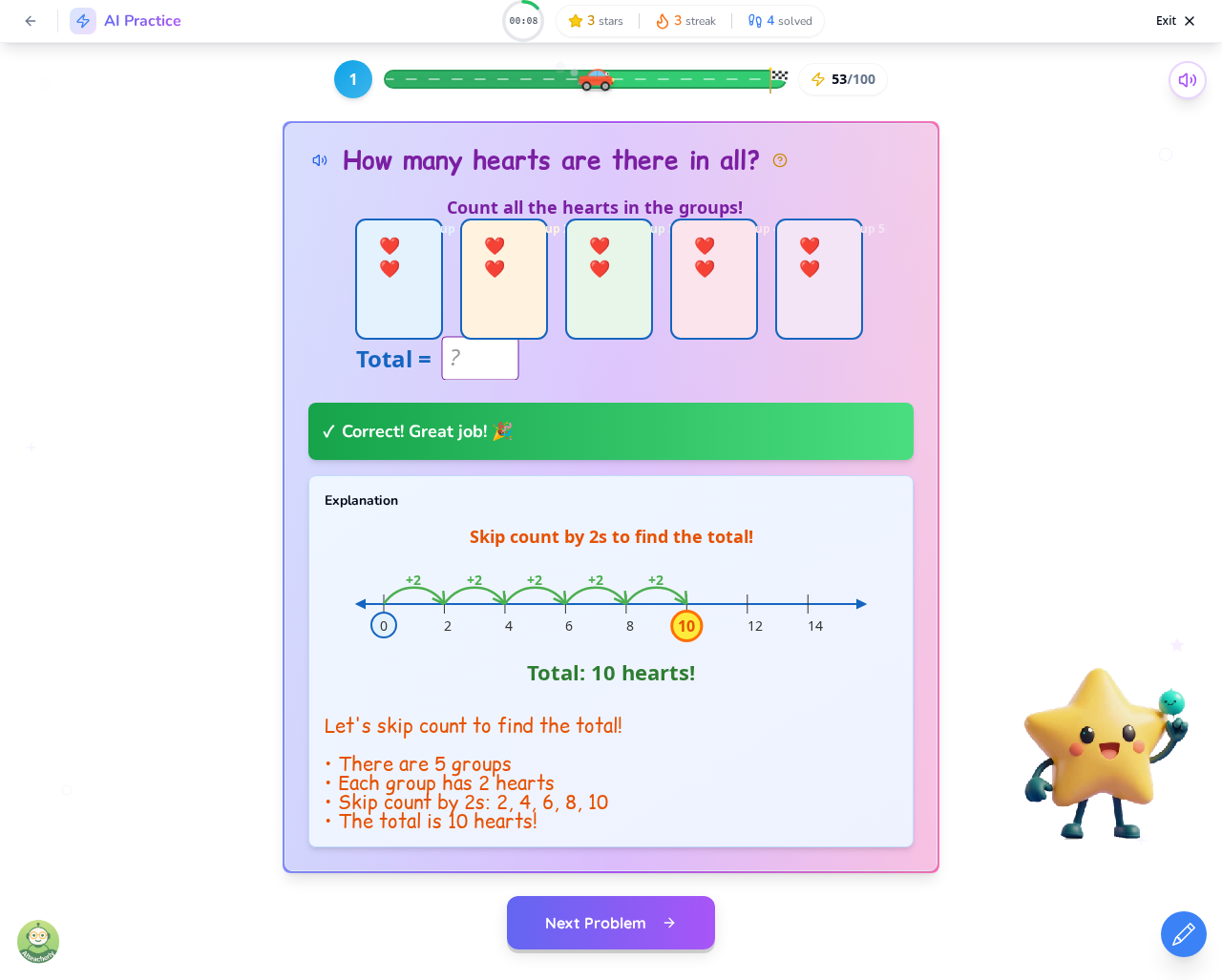
The interactive problem below shows exactly how children can practice identifying equal groups with visual objects.
Pro tip: Always ask the two key questions: "How many groups?" and "How many in each group?" This language mirrors classroom instruction and reinforces the foundational framework.
Keep practice sessions short (5-10 minutes) and positive. The goal is to build comfort with the concept, not to drill. When math feels like a game rather than homework, children engage willingly.
See How AI Teacherly Makes Equal Groups Click
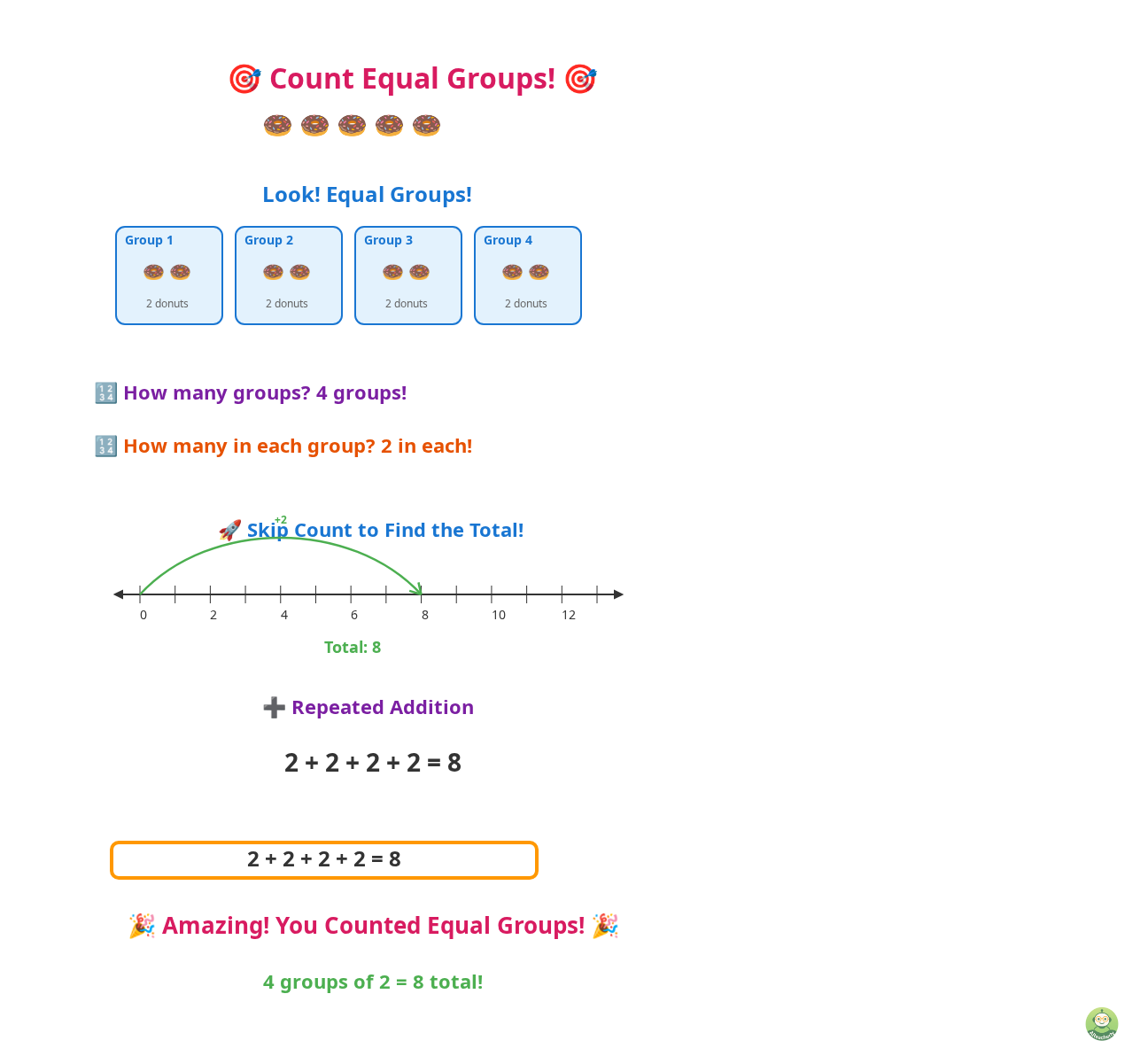
Understanding equal groups requires more than explanation; it requires interaction. That's where AI Teacherly's Count Equal Groups lesson shines. Designed specifically for 2nd graders, this 25-minute interactive experience transforms abstract concepts into hands-on learning.
Here's what the full interactive lesson looks like on AI Teacherly:
The lesson uses multiple visual approaches to cement understanding:
Visual Grouping Activities Students see colorful objects arranged in groups and identify: "How many groups? How many in each?" The immediate visual feedback helps children self-correct and build confidence.
Number Line Jumps Interactive number lines let children "hop" through skip counting. They physically see how each jump lands on the next multiple, making abstract counting concrete.
Repeated Addition Practice Children connect the dots between groups, skip counting, and addition sentences. The lesson explicitly shows that 3 + 3 + 3 = 9 is the same as "3 groups of 3."
Real-World Connections The lesson includes scenarios children recognize: objects on shelves, items in containers, and sets of everyday things. This builds transfer skills so children apply learning beyond the screen.
What sets AI Teacherly apart is the guided discovery approach. Rather than lecturing, the lesson asks questions that lead children to insights. The narration walks alongside your child: "To count equal groups, we need two numbers. First, how many groups? Now, how many in each group?"
Parents appreciate that the lesson handles the teaching while they supervise. No math expertise required; the platform does the heavy lifting.
Key Takeaways
- Equal groups are collections with the same number of items in each group, and recognizing them is the foundation of multiplication
- The two key questions for any equal groups problem: How many groups? How many in each group?
- Skip counting is the 'fast way' to count equal groups and builds pattern recognition for times tables
- Repeated addition (like 3+3+3=9) shows children that multiplication is just adding the same number multiple times
- Practice opportunities exist everywhere at home: snacks, toys, setting the table, and nature walks
- Understanding the concept behind multiplication prevents struggles later and builds flexible math thinking
- Interactive lessons with visual manipulatives help children 'see' equal groups in ways worksheets cannot
Frequently Asked Questions
What are equal groups in 2nd grade math?
Equal groups are collections of objects where each group contains the same number of items. For example, 3 baskets with 4 apples each shows 3 equal groups of 4. This concept is the foundation for understanding multiplication.
How do equal groups connect to multiplication?
Equal groups ARE multiplication. When children see 4 groups of 3, they're looking at 4 × 3. Understanding equal groups gives meaning to the multiplication symbol and prevents rote memorization without comprehension.
Why is skip counting important for multiplication?
Skip counting is the 'fast way' to count equal groups. Instead of counting one-by-one, children hop by the group size (3, 6, 9, 12). These skip counting patterns become the multiplication facts children later memorize.
What is repeated addition and how does it relate to multiplication?
Repeated addition means adding the same number multiple times, like 3+3+3+3=12. This equals 4×3 because there are 4 threes being added. It shows children that multiplication is a shortcut for repeated addition.
How can I practice equal groups at home with my child?
Use everyday objects! Divide snacks into equal groups on plates, organize toys into equal piles, or count items at the grocery store. Always ask: 'How many groups?' and 'How many in each group?'
At what age do kids learn about equal groups?
Most children learn equal groups in 2nd grade (ages 7-8) as preparation for formal multiplication in 3rd grade. Some curricula introduce the concept in late 1st grade with simpler numbers.
Is skip counting the same as multiplication?
Skip counting is a strategy FOR multiplication, not multiplication itself. When children skip count by 5s (5, 10, 15, 20), they're finding multiples of 5. This builds toward understanding 1×5, 2×5, 3×5, and so on.
What if my child struggles to identify equal vs. unequal groups?
Start with very clear visual differences using physical objects. Make groups obviously equal (4, 4, 4) or unequal (4, 2, 5). Practice sorting and ask 'Are these groups the same?' before introducing counting strategies.
Ready to make equal groups click for your 2nd grader? Try the interactive Count Equal Groups lesson free on AI Teacherly and watch multiplication foundations come to life!