Equal Groups and Arrays: The Visual Secret to Teaching 3rd Grade Multiplication
Discover how equal groups and arrays transform 3rd grade multiplication from confusing symbols into visual concepts your child can actually understand. Practical tips using everyday objects at home.
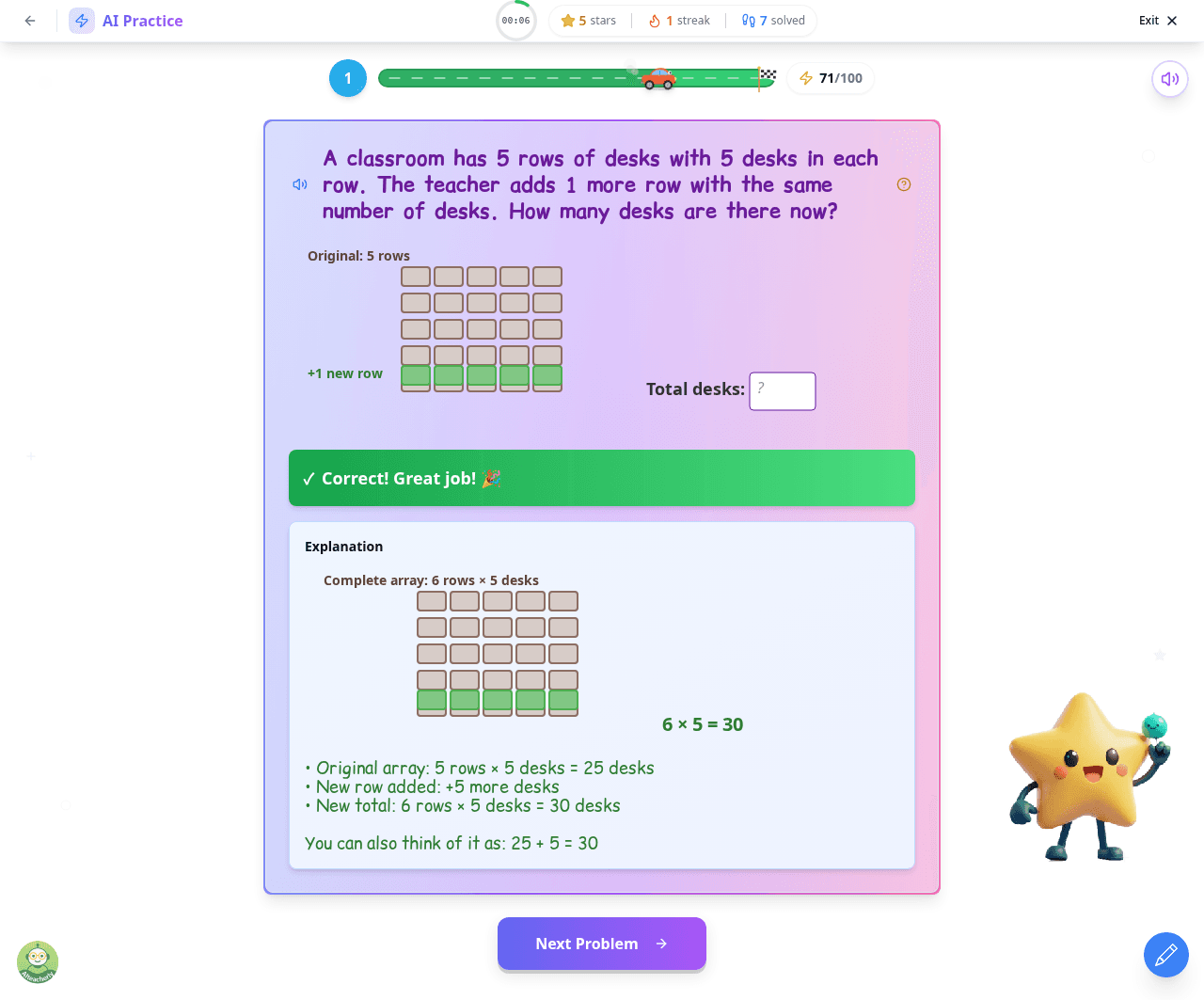
Why Multiplication Clicks When Kids Can See It
That moment when your child stares blankly at "3 × 4" on their homework doesn't mean they can't learn multiplication. It means they need to see it first.
Here's the truth most parents don't realize: multiplication isn't about memorizing mysterious symbols. It's about counting groups that have the same number of items, something children already do naturally when they share snacks or arrange toys.
Teaching multiplication with equal groups transforms this abstract concept into something tangible. When your 3rd grader can physically see 3 groups of 4 cookies sitting on the counter, the equation "3 × 4 = 12" suddenly makes perfect sense.
The challenge? Most math instruction jumps straight to memorization without building this visual foundation. That's why so many kids struggle, and why so many parents feel helpless watching their child's frustration grow.
This guide will show you exactly how equal groups and arrays work, why they're the foundation of multiplication understanding, and how you can use everyday objects at home to build your child's confidence. No math degree required.
What Are Equal Groups in Multiplication?
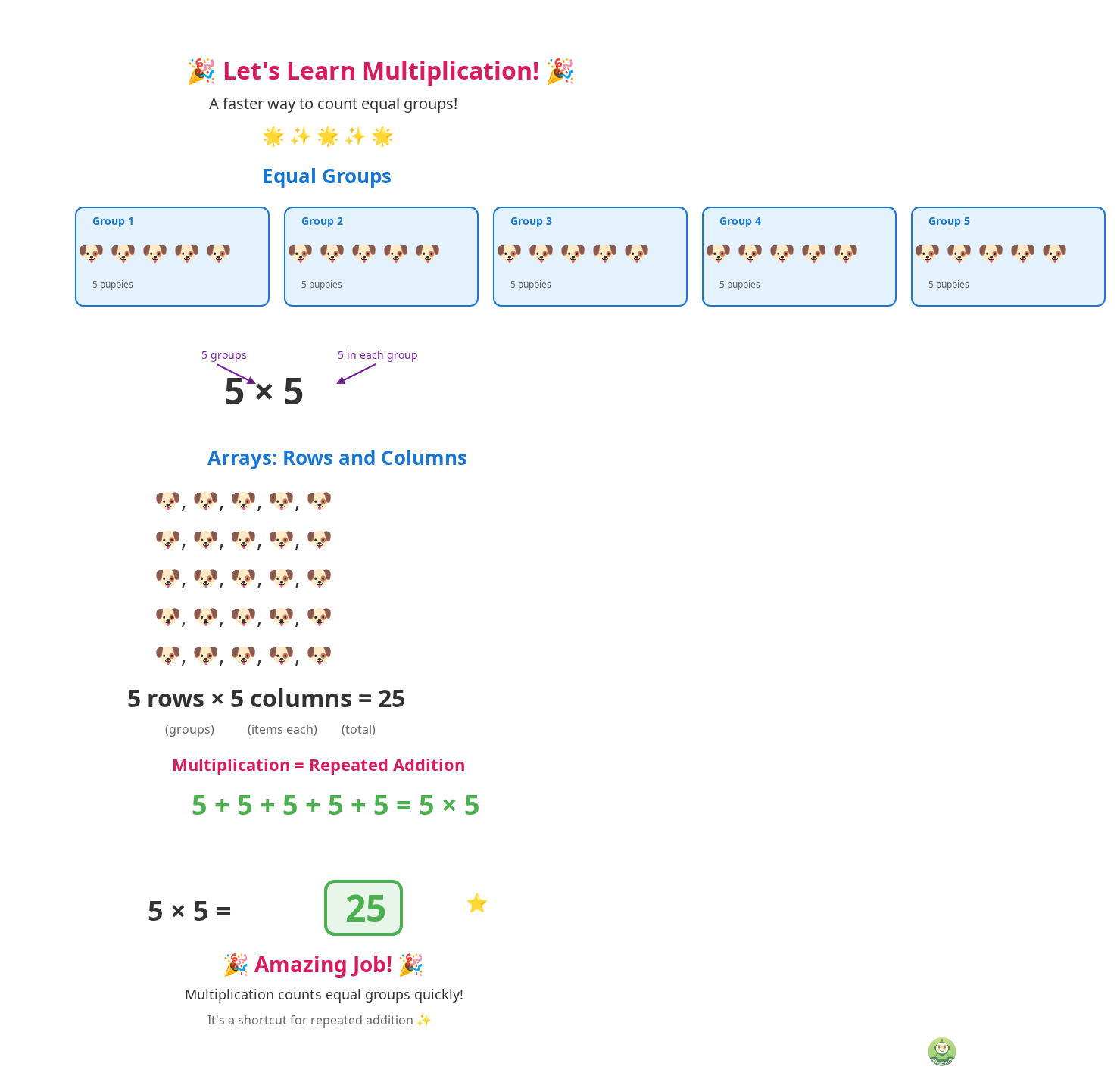
Equal groups are the foundation of multiplication, and understanding this concept unlocks everything else. When we talk about equal groups, we mean collections of items where every group contains the exact same number of things.
Think about it this way: if you have 3 baskets, and each basket holds exactly 4 apples, you have 3 equal groups of 4. That's multiplication!
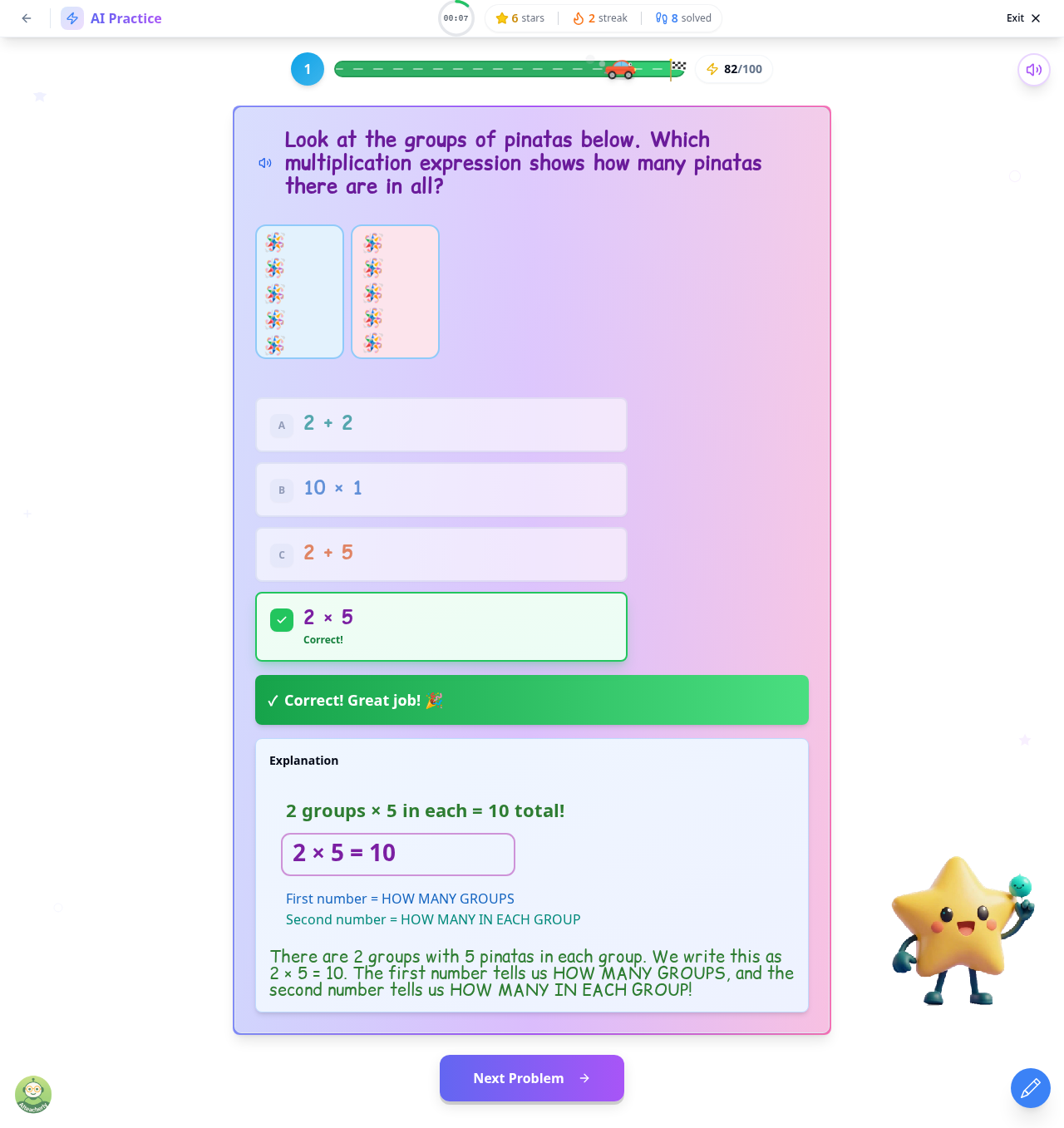
The first number in a multiplication equation tells us how many groups we have. The second number tells us how many items are in each group. So 3 × 4 literally means "3 groups of 4."
Why This Matters for Your Child
When children understand that multiplication is just a faster way to count equal groups, the anxiety around times tables starts to melt away. Instead of seeing "5 × 3" as a random fact to memorize, they recognize it as "5 groups of 3" and can visualize or even count to verify their answer.
This interactive problem below demonstrates exactly how equal groups work in practice:
Notice how the visual shows distinct groups, each containing the same number of items. Your child can count each group, see they're equal, and then either add them up or use multiplication as a shortcut.
At home, you can create equal groups with anything: crackers on plates, toys in containers, or coins in piles. The key is making sure each group has the identical amount.
How Do Arrays Help Children Understand Multiplication?
Arrays take the equal groups concept and organize it into rows and columns. This creates a powerful visual tool that makes multiplication even clearer.
An array is simply a set of objects arranged in equal rows and equal columns. Think of an egg carton (2 rows of 6), a muffin tin (3 rows of 4), or window panes on a building. Arrays are everywhere once you start looking!
The Row and Column Connection
In an array, the rows represent your groups, and the columns show how many items are in each group. A 3 × 4 array has 3 rows with 4 items in each row.
Here's what makes arrays magical for learning: they show the same multiplication fact two different ways. That 3 × 4 array can also be viewed as 4 rows of 3 (rotating it sideways). Either way, you still get 12 items total. This helps children understand that 3 × 4 and 4 × 3 give the same answer, an important property called the commutative property.
Finding Arrays at Home
Once your child learns to spot arrays, they'll see multiplication everywhere:
- Egg cartons: 2 × 6 = 12 eggs
- Muffin tins: 3 × 4 = 12 muffins
- Calendar grids: 7 × 5 = 35 days visible
- Keyboard number pad: 3 × 3 = 9 numbers
- Chocolate bars: Often 4 × 3 = 12 squares
Point these out during everyday activities. Ask your child, "How many rows? How many in each row? How can we write that as multiplication?"
The Repeated Addition Connection: Making Multiplication Feel Familiar
Here's a secret that instantly makes multiplication less intimidating: multiplication is just repeated addition with a shortcut.
Your child already knows how to add. They've been doing it for years. Multiplication simply takes that skill and makes it faster when you're adding the same number multiple times.
Consider this: 4 + 4 + 4 = 12. That's adding 4 three times. Multiplication gives us a faster way to write the same thing: 3 × 4 = 12.
Building the Bridge
When introducing a new multiplication fact, start with repeated addition:
- "What is 2 + 2 + 2 + 2?" (8)
- "You just added 2 four times. That's 4 groups of 2!"
- "In multiplication, we write that as 4 × 2 = 8"
This bridge helps children see that they're not learning something completely foreign. They're learning a more efficient way to do something they already know.
When to Use Each Method
Encourage your child to use repeated addition as a checking strategy. If they're unsure whether 6 × 3 is 18 or 21, they can add: 6 + 6 + 6 = 18. Over time, as facts become automatic, they won't need this step, but knowing it's available reduces anxiety.
The goal is building understanding first, fluency second. When kids understand that multiplication is just a counting shortcut, memorizing facts later becomes much easier because the facts actually make sense.
Special Rules: Why Multiplying by 0 and 1 Makes Sense
Two multiplication rules often confuse children when presented as abstract facts. But with visual understanding, they become obvious.
The Zero Property
Anything multiplied by zero equals zero. Written as a rule, it seems random. But visualize it:
- 5 × 0 means "5 groups of 0 items"
- If you have 5 empty baskets, how many items do you have?
- Zero! Five groups of nothing is still nothing.
You can also flip it:
- 0 × 5 means "0 groups of 5 items"
- If you have no baskets at all, how many items do you have?
- Zero! Having no groups means having nothing.
The Identity Property
Anything multiplied by one equals itself. Again, visualize:
- 7 × 1 means "7 groups of 1 item"
- If you have 7 baskets, and each basket holds 1 apple, you have 7 apples.
Or flip it:
- 1 × 7 means "1 group of 7 items"
- One basket with 7 apples means you have 7 apples.
Practice These at Home
Create silly scenarios to reinforce these concepts:
- "If we have 10 cookie jars and each jar is empty, how many cookies do we have?" (0)
- "If we have just 1 toy box with 8 toys inside, how many toys?" (8)
When children can visualize these rules with real objects, they never forget them.
Practice at Home: Everyday Objects That Teach Multiplication
You don't need expensive math manipulatives to teach multiplication. Your home is already full of perfect learning tools.
Kitchen Math
The kitchen offers endless multiplication opportunities:
- Setting the table: "We need forks for 4 people. If everyone gets 2 forks, how many do we need?" (4 × 2 = 8)
- Snack portions: "Let's put 5 grapes on each of these 3 plates. How many grapes total?" (3 × 5 = 15)
- Baking: "The recipe needs 2 cups of flour, but we're making 3 batches. How much flour total?" (3 × 2 = 6)
Organization Games
Turn cleanup into multiplication practice:
- Sorting toys: "Can you make 4 groups of cars with 3 cars in each group?"
- Organizing books: "Let's put these books in 3 stacks of 5."
- Arranging collections: "Make an array with your action figures, 4 rows of 6."
Outdoor Exploration
Arrays appear everywhere outside:
- Parking lot spaces arranged in rows
- Windows on buildings
- Tiles on sidewalks
- Plants in garden rows
Make it a game: "Who can spot the biggest array?" Then calculate together.
The 5-Minute Daily Practice
Consistency beats intensity. Just 5 minutes of multiplication talk each day builds strong foundations:
- Morning: "Your vitamins come in 2 rows of 7. How many is that?"
- Dinner: "We have 3 people and 4 tacos each. How many tacos should I make?"
- Bedtime: "You have 5 stuffed animals on 2 shelves. How many total?"
See How Interactive Learning Makes Multiplication Visual
While everyday practice at home is essential, interactive digital tools can accelerate your child's understanding by providing immediate feedback and engaging visual challenges.
Here's what the full interactive lesson looks like on AI Teacherly:
The Introduction to Multiplication: Equal Groups and Arrays lesson on AI Teacherly (Grade 3) brings these concepts to life through interactive problems that students can manipulate and explore.
What Makes Interactive Practice Different
Unlike worksheets, interactive lessons provide:
- Immediate feedback: Children know right away if their thinking is correct
- Visual scaffolding: Problems show equal groups and arrays that students can count and verify
- Scaffolded progression: Lessons start with concrete visuals and gradually build to abstract equations
- Engagement through discovery: Students uncover patterns themselves rather than being told rules
The Power of Visual Feedback
In the AI Teacherly lesson, students see equal groups represented with colorful visual items. They identify how many groups, how many in each group, and connect these to multiplication expressions.
The lesson teaches that "multiplication is just a shortcut for adding the same number over and over," using visual models that make this connection clear and memorable.
Building Toward Fluency
The goal isn't just understanding; it's confident fluency. Interactive practice helps children move from counting every item, to skip counting, to automatic recall. Each stage builds on visual understanding, so the facts actually stick.
Key Takeaways
- Equal groups are the foundation of multiplication: every group must contain the same number of items, and 3 × 4 simply means "3 groups of 4"
- Arrays organize equal groups into rows and columns, making multiplication visible and helping kids understand why 3 × 4 equals 4 × 3
- Multiplication is repeated addition: showing kids that 4 + 4 + 4 = 3 × 4 makes multiplication feel like a shortcut they already understand
- The zero and one rules become obvious when visualized: 5 groups of 0 is nothing, and 1 group of 7 is just 7
- Your home is full of multiplication tools: egg cartons, muffin tins, snack portions, and toy collections are all opportunities to practice
- Interactive lessons provide immediate feedback and visual scaffolding that worksheets cannot match
- 5 minutes of daily multiplication talk builds stronger foundations than occasional drilling sessions
Frequently Asked Questions
What are equal groups in multiplication?
Equal groups are collections of items where every group contains exactly the same number of things. In multiplication, the first number tells you how many groups, and the second tells you how many items in each group. So 3 × 4 means 3 groups with 4 items each.
How do I teach my child multiplication using arrays?
Start by showing arrays in everyday objects like egg cartons, muffin tins, or window panes. Point out the rows and columns, then help your child count: "3 rows of 4 equals 12." Practice writing this as 3 × 4 = 12 and let them discover arrays around your home.
Why do 3rd graders struggle with multiplication?
Most struggle because they're asked to memorize facts before understanding what multiplication means. When taught visually through equal groups and arrays first, children build conceptual understanding that makes memorization easier and less anxiety-inducing.
How is repeated addition related to multiplication?
Multiplication is simply a shortcut for repeated addition. Instead of writing 4 + 4 + 4, we can write 3 × 4. Both equal 12. Teaching this connection helps children see multiplication as a tool they already understand, not something completely new.
What everyday objects can I use to teach multiplication?
Use egg cartons (2 × 6), muffin tins (3 × 4), snacks on plates, toys in groups, calendar grids, windows on buildings, and chocolate bar squares. Any items you can arrange in equal groups or arrays work perfectly for multiplication practice.
Should my child memorize times tables or understand concepts first?
Understanding first, memorization second. When children understand that 6 × 3 means "6 groups of 3," they can figure out forgotten facts and the memorization that follows actually sticks. Rote memorization without understanding leads to frustration and forgetting.
How long should my 3rd grader practice multiplication each day?
Just 5-10 minutes of focused practice is ideal for 3rd graders. Short, consistent daily sessions are far more effective than long, occasional drilling. Make it conversational and part of everyday activities rather than formal study time.
What is the best way to explain multiplying by zero to a child?
Use visuals: "If you have 5 empty baskets, how many apples do you have? Zero!" This shows that 5 × 0 = 0 because 5 groups of nothing is still nothing. Children remember this much better than the abstract rule.
Ready to make multiplication visual and fun? Try the free Introduction to Multiplication: Equal Groups and Arrays lesson on AI Teacherly and watch your child's confidence grow!