Estimating Differences in 4th Grade Math: The Rounding Trick That Makes Subtraction Easy
Discover the simple 3-step method (round, round, subtract) that makes estimation word problems click for 4th graders. No more confusion about "friendly numbers" or when to use estimation!
The Mental Math Skill Every 4th Grader Needs
Your 4th grader doesn't always need the exact answer, and that's actually a good thing. Estimating differences is one of the most practical math skills children learn in elementary school, yet it often confuses both kids and parents alike.
Here's the truth: estimation isn't "lazy math." It's a critical thinking skill that helps kids verify their answers, solve real-world problems faster, and build the number sense they'll need for more advanced mathematics. When your child estimates, they're exercising the same mental muscles that adults use when budgeting, shopping, and making quick decisions.
In this guide, you'll learn:
- What estimating differences actually means (and why it matters)
- How to spot the secret signal words in estimation problems
- The simple 3-step method that makes estimation click
- Common mistakes to watch for and how to fix them
- How interactive practice builds lasting confidence
By the end, you'll have everything you need to support your child's estimation skills at home, even if you don't remember learning this yourself.
What Is Estimating Differences and Why Does It Matter?
Estimating a difference means finding an approximate answer to a subtraction problem by rounding the numbers first, then subtracting. Instead of calculating 487 - 213 exactly, your child would round to 500 - 200 and quickly get 300.
But why would we want an approximate answer instead of the exact one?
Real-world application: In everyday life, exact answers aren't always necessary. When you're checking if you have enough money for groceries, comparing prices between stores, or figuring out roughly how much time is left on a road trip, estimation is faster and more practical.
Answer checking superpower: Estimation helps kids verify their exact calculations. If a child calculates 487 - 213 = 574, estimation reveals something is wrong. Since 500 - 200 = 300, an answer of 574 doesn't make sense.
Builds number sense: Working with rounded "friendly numbers" helps children understand how numbers relate to each other. They develop intuition about whether answers are reasonable, a skill that becomes crucial in algebra and beyond.
Standardized test strategy: Many test questions ask students to estimate or identify reasonable answers. Children comfortable with estimation can quickly eliminate wrong choices and work more efficiently under time pressure.
How Do You Spot When Your Child Should Estimate?
One of the biggest hurdles with estimation is knowing when to use it. The good news? Word problems almost always give clear signals.
The magic word: "About"
When your child sees the word "about" in a math problem, that's the estimation signal. It tells them they don't need the exact answer, just a close approximation.
Examples:
- "About how many more points did Team A score?"
- "Approximately how much money is left?"
- "Estimate the difference between the two heights."
Other signal words include: approximately, roughly, close to, nearly, and around.
When exact answers don't make sense
Sometimes the context itself suggests estimation. If a problem asks about predicting, planning, or comparing in broad terms, estimation is likely the intended approach.
Practice spotting signals together
When helping with homework, ask your child: "What words tell us what kind of answer we need?" This builds their problem-reading skills and helps them become independent problem-solvers.
Once kids learn to recognize these cues, estimation problems become much less intimidating. They know exactly what the question is asking for.
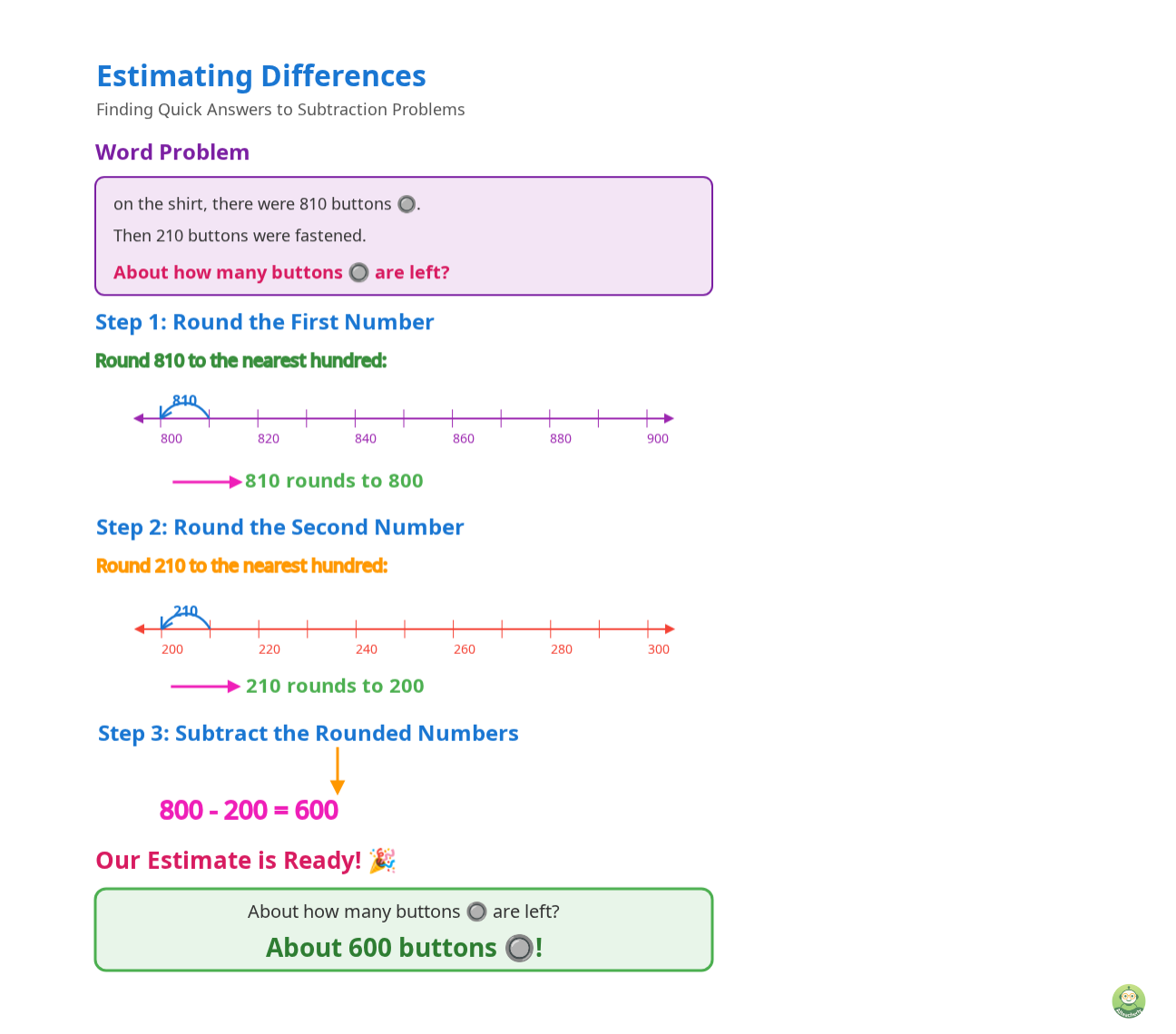
The 3-Step Method: Round, Round, Subtract
Here's the simple framework that makes estimating differences easy. Once your child masters these three steps, they can tackle any estimation word problem with confidence.
Step 1: Round the first number to the nearest hundred
Look at the tens digit. If it's 5 or higher, round up. If it's 4 or lower, round down.
- 487 → The tens digit is 8 (higher than 5) → Round up to 500
- 423 → The tens digit is 2 (lower than 5) → Round down to 400
Step 2: Round the second number to the nearest hundred
Apply the same rule to the number being subtracted.
- 213 → The tens digit is 1 (lower than 5) → Round down to 200
- 678 → The tens digit is 7 (higher than 5) → Round up to 700
Step 3: Subtract the friendly numbers
Now your child has two "friendly numbers" that are much easier to work with mentally.
- 500 - 200 = 300 ✓
- 400 - 700... wait, we'd be subtracting a bigger number! (This is a great teaching moment about which number should come first.)
Why this works
Rounding creates numbers that end in zeros, which are dramatically easier to subtract in your head. Instead of borrowing and regrouping across multiple place values, children can focus on the hundreds place and get their answer quickly.
The beauty of this method is its consistency. The same three steps work for any estimation problem involving subtraction.
Practice Estimation with Interactive Problems
Understanding the concept is one thing; building fluency requires practice. The key is finding practice that's engaging enough to hold your child's attention while reinforcing the right skills.
Effective estimation practice should:
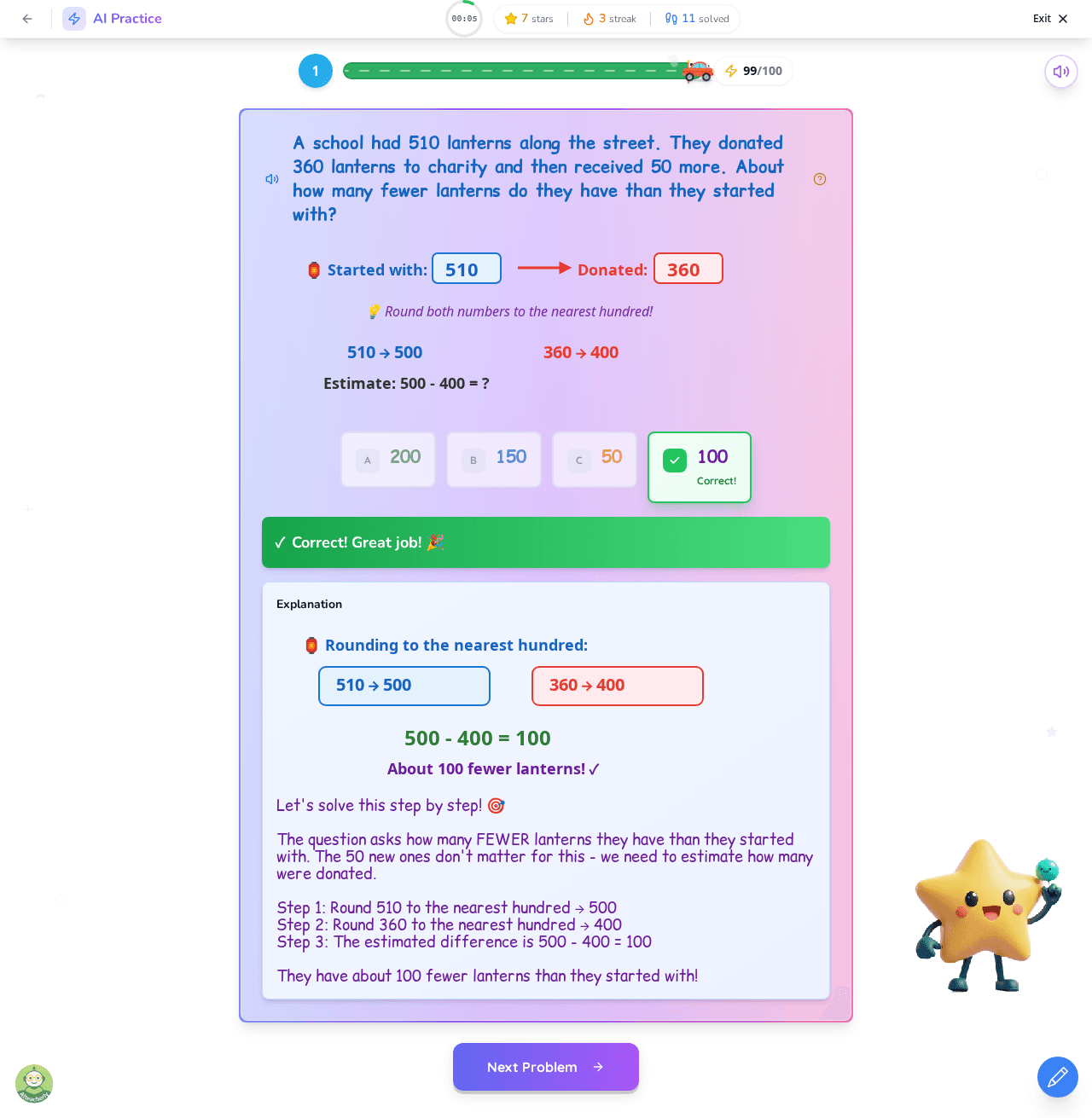
- Use visual supports: Number lines help children see where numbers fall between hundreds, making the rounding decision concrete rather than abstract.
- Provide immediate feedback: Kids need to know right away if their rounding is correct so they can adjust their thinking.
- Include word problem context: Real scenarios help children connect estimation to practical situations.
- Progress gradually: Start with simple two-step problems before adding complexity.
The interactive problem below shows exactly how estimation skills are practiced on AI Teacherly. Notice how the visual elements make abstract concepts concrete for young learners.
At-home practice ideas:
- Grocery store game: While shopping, ask "About how much more does this cost than that?"
- Sports statistics: Use game scores to estimate differences between teams.
- Road trip math: Estimate miles remaining or time differences between destinations.
- Allowance planning: Help your child estimate how much they'd have left after purchases.
The goal is making estimation feel natural and useful, not just another homework assignment.
See How AI Teacherly Makes Estimation Click
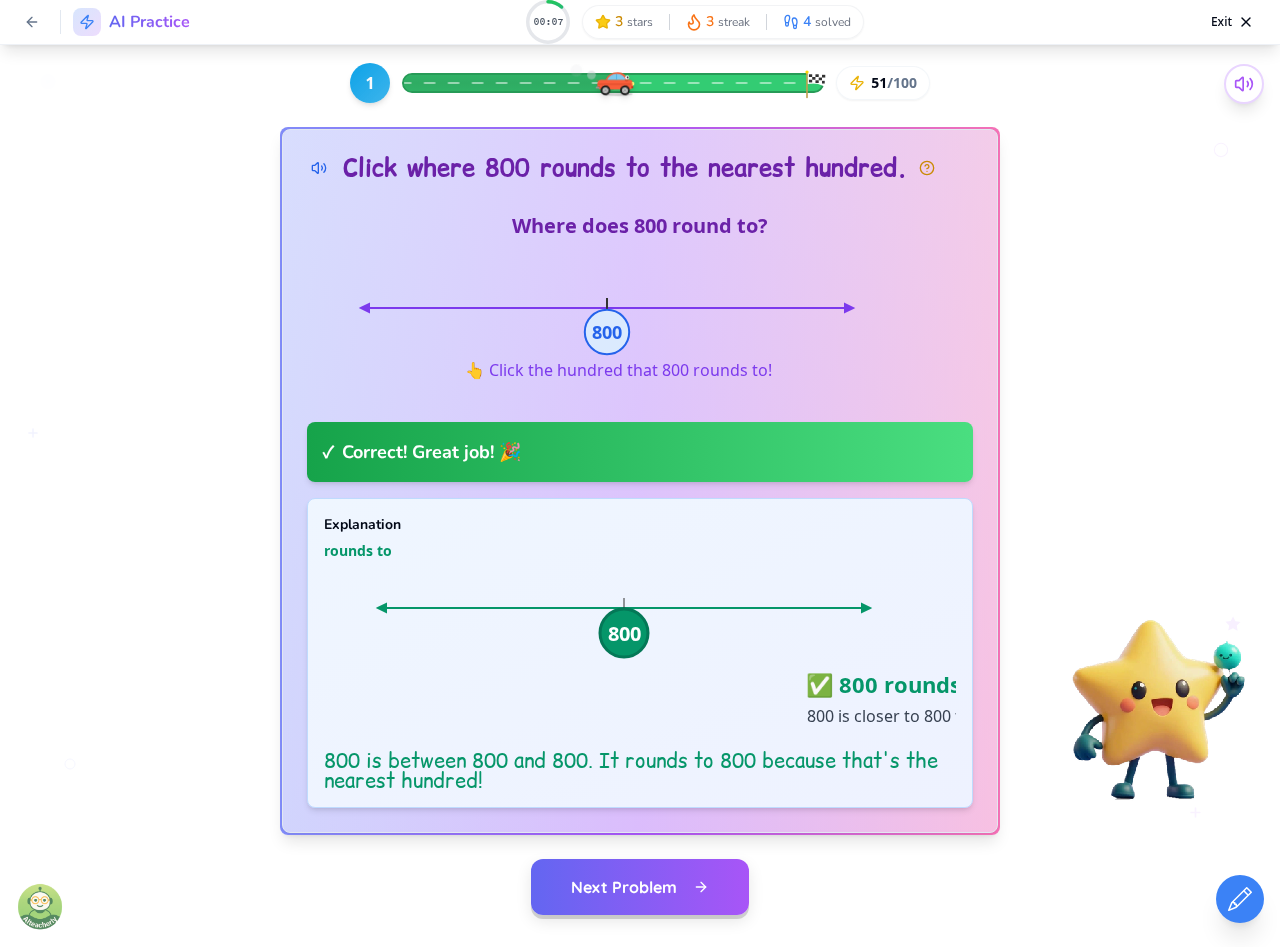
Learning estimation becomes much more engaging when children can interact with the concepts rather than just read about them. AI Teacherly's Estimating Differences in Word Problems lesson for Grade 4 is designed specifically to make this skill click.
Here's what the full interactive lesson looks like on AI Teacherly:
What makes this lesson effective:
- Step-by-step scaffolding: The lesson breaks down estimation into manageable pieces, teaching rounding first before combining skills.
- Visual number lines: Children see exactly where numbers fall between hundreds, making the rounding decision visual and intuitive.
- Real-world word problems: Every problem is set in a relatable context, from counting books to comparing distances, helping kids understand why estimation matters.
- Immediate feedback: Students know instantly whether they've rounded correctly, allowing them to self-correct and build confidence.
- Multiple problem types: The lesson includes input problems, selection activities, and multiple-choice questions to keep practice varied and engaging.
The best part? Children can work through the lesson at their own pace, repeating sections that challenge them and moving quickly through concepts they've mastered.
For parents, this means less frustration during homework time. When your child has already practiced estimation interactively, they come to their assignments with confidence and a clear method to follow.
Common Estimation Mistakes (And How to Fix Them)
Even after learning the 3-step method, children sometimes stumble. Here are the most common estimation mistakes and how to address them.
Mistake #1: Forgetting to round before subtracting
Some children try to subtract first, then round the answer. This defeats the purpose of estimation (making the subtraction easier) and often leads to errors.
Fix: Emphasize the order. "First we make friendly numbers, THEN we subtract."
Mistake #2: Rounding to the wrong place value
If the problem asks for rounding to the nearest hundred but your child rounds to the nearest ten, the answer will be different.
Fix: Have your child underline the place value they're rounding to before starting.
Mistake #3: Getting confused about which way to round
The "5 or more, round up" rule can be tricky at first.
Fix: Practice with a number line. Visually seeing that 450 is exactly halfway (round up) while 449 is just below (round down) makes the rule concrete.
Mistake #4: Thinking the estimate must match the exact answer
Some children feel they've done something wrong when their estimate differs from the exact calculation.
Fix: Explain that estimates are supposed to be different. They're close, not exact, and that's what makes them useful for quick thinking.
Mistake #5: Not recognizing estimation signal words
Fix: Create a "signal word" poster together. Include: about, approximately, estimate, roughly, close to, nearly, around.
Key Takeaways
- Estimation isn't lazy math; it's a critical thinking skill that helps kids verify answers and solve real-world problems faster
- The word "about" is the secret signal that tells your child an estimate (not an exact answer) is needed
- Master the 3-step method: Round the first number, round the second number, then subtract the friendly numbers
- Rounding to the nearest hundred creates "friendly numbers" ending in zeros that are much easier to subtract mentally
- Practice estimation in real life through grocery shopping, sports scores, road trips, and allowance planning
- Visual tools like number lines help children understand WHERE numbers fall, making rounding decisions concrete
- An estimate that doesn't match the exact answer isn't wrong; estimates are supposed to be close, not exact
Frequently Asked Questions
What does it mean to estimate a difference in math?
Estimating a difference means finding an approximate answer to a subtraction problem by rounding both numbers first, then subtracting. Instead of exact calculation, you get a "close enough" answer quickly.
How do you round a number to the nearest hundred?
Look at the tens digit. If it's 5 or higher, round up to the next hundred. If it's 4 or lower, round down. For example, 487 rounds to 500 (tens digit is 8), while 423 rounds to 400 (tens digit is 2).
Why is estimation important for 4th graders to learn?
Estimation builds number sense, helps children check if their exact answers are reasonable, and prepares them for real-world math like budgeting and quick decision-making. It's also tested on standardized assessments.
How do I know when my child should estimate vs. find the exact answer?
Look for signal words like "about," "approximately," "estimate," or "roughly" in the problem. These words indicate an estimate is expected rather than an exact calculation.
What are friendly numbers and why do they make subtraction easier?
Friendly numbers are rounded numbers that end in zeros (like 500 or 200). They're easier to subtract mentally because you don't need to borrow or regroup across multiple place values.
Is my child's estimate wrong if it doesn't match the exact answer?
No! Estimates are supposed to be different from exact answers. They should be close but not identical. That's what makes them useful for quick mental math and answer checking.
How can I practice estimation with my child at home?
Try the grocery store game (estimate price differences), use sports scores to estimate point differences, calculate rough distances on road trips, or help them estimate allowance spending.
What grade level is estimating differences taught?
Estimating differences by rounding to the nearest hundred is typically introduced in 3rd grade and mastered in 4th grade, aligning with Common Core standards for multi-digit arithmetic and number sense.
Ready to make estimation click for your 4th grader? Try the free interactive Estimating Differences lesson on AI Teacherly and watch their confidence grow!