Fact Families for 1st Graders: The Simple Trick That Makes Subtraction Click
Discover how fact families transform subtraction struggles into success for 1st graders. Learn the simple connection between addition and subtraction that builds lasting math confidence.
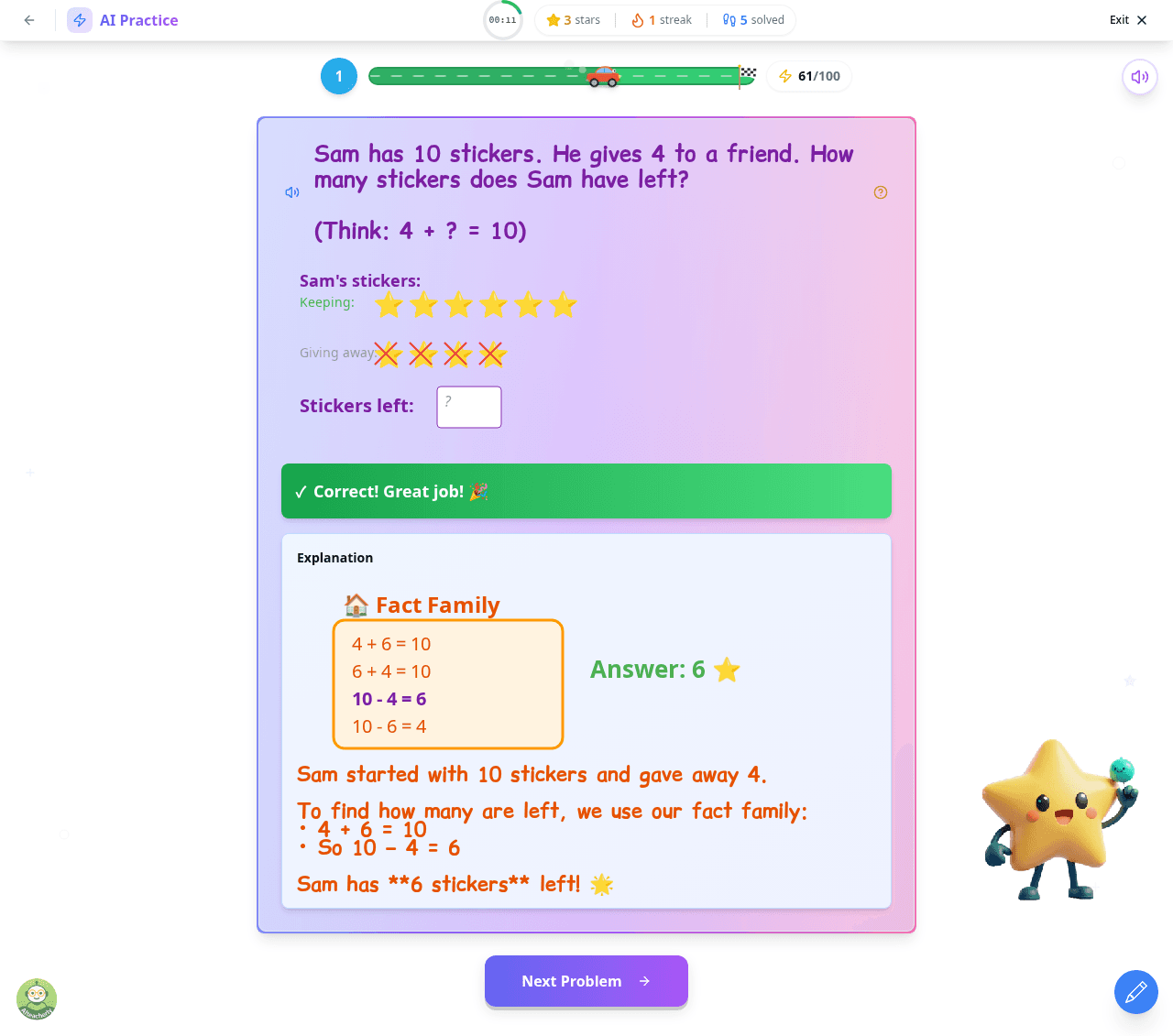
Introduction: The Math Trick That Makes Subtraction Easy
Picture this: your 1st grader breezes through addition problems at the dinner table, confidently announcing that 3 + 4 = 7. But the moment subtraction appears, they freeze. Sound familiar? You're not alone.
Here's the secret that experienced math teachers know: your child already has the tools to solve subtraction problems. They just don't realize it yet.
The concept that bridges this gap is called a fact family, and it's one of the most powerful math strategies your 1st grader will learn this year. Fact families show children that addition and subtraction aren't two separate skills to master. They're two sides of the same coin.
In this guide, you'll discover exactly what fact families are, why they're essential for building math confidence, and how to practice them at home using simple everyday activities. By the end, your child's subtraction struggles might just become a thing of the past.
What Is a Fact Family in 1st Grade Math?
A fact family is a group of related math facts that use the same three numbers. Think of it like a family portrait: three numbers that belong together, creating four mathematical equations (two addition facts and two subtraction facts).
Let's look at an example with the numbers 3, 4, and 7:
- 3 + 4 = 7 (addition)
- 4 + 3 = 7 (addition, numbers switched)
- 7 - 4 = 3 (subtraction)
- 7 - 3 = 4 (subtraction)
See the pattern? The same three numbers appear in every equation. That's why they're called a family. They belong together!
The magic of fact families lies in the parts and whole relationship. In our example, 3 and 4 are the parts, and 7 is the whole. When you combine the parts, you get the whole (addition). When you take a part away from the whole, you're left with the other part (subtraction).
This visual framework transforms subtraction from a scary new operation into something logical and predictable. Your child isn't learning four separate facts; they're learning one relationship that reveals four connected truths.
How Do Three Numbers Make Four Math Facts?
Understanding how fact families work is like learning a secret code. Once your child cracks it, they can unlock answers to problems they've never seen before.
The Addition Connection
First, let's look at the two addition facts. With numbers 5, 3, and 8:
- 5 + 3 = 8
- 3 + 5 = 8
Notice how switching the order of the numbers doesn't change the sum? This is called the commutative property, though your 1st grader doesn't need to know that fancy term. They just need to understand: "switched numbers, same answer!"
The Subtraction Revelation
Here's where the real magic happens. Those same three numbers create two subtraction facts:
- 8 - 3 = 5
- 8 - 5 = 3
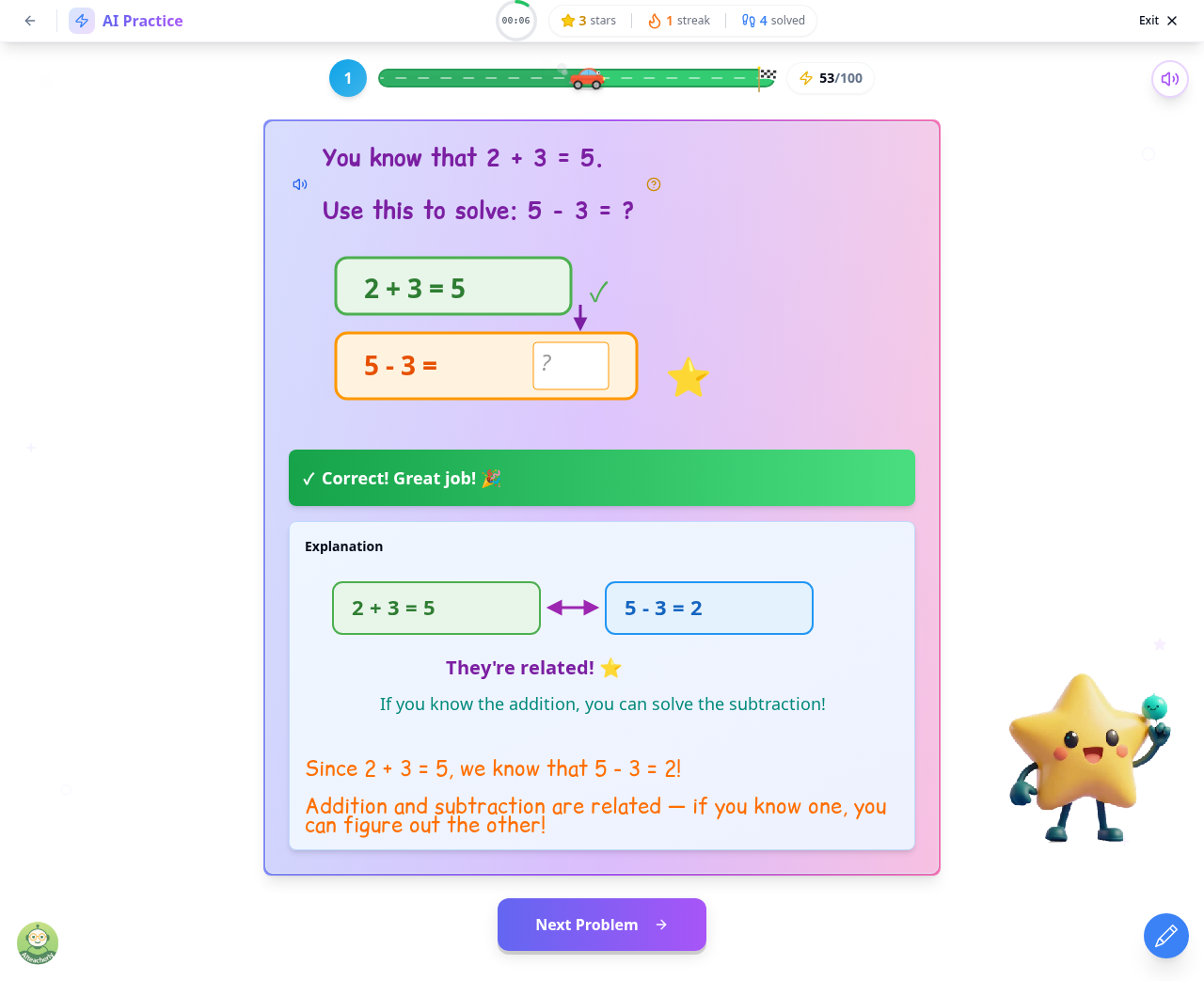
Subtraction is addition backwards! If your child knows that 5 + 3 = 8, they automatically know that 8 - 3 = 5. The answer is right there, hiding in the addition fact they already memorized.
The interactive problem below shows exactly how this works in practice:
This is the breakthrough moment for many children. Subtraction isn't a brand new skill to struggle with. It's just addition viewed from a different angle. When kids see this connection clearly, their math confidence often soars.
Why Fact Families Make Subtraction Less Scary
Many 1st graders find subtraction intimidating because it feels like going backwards. Addition builds things up; subtraction takes them away. That "taking away" concept can feel uncertain and confusing.
Fact families solve this problem by giving children an anchor. Instead of approaching each subtraction problem as a brand new puzzle, they can ask themselves: "What do I already know about these numbers?"
The Confidence Boost
When a child sees 9 - 4 = ?, they might normally panic. But a child who understands fact families thinks: "I know that 4 + 5 = 9, so 9 - 4 must equal 5!" They're not guessing. They're using logic and reasoning.
This approach offers several benefits:
- Reduces memorization load: Instead of memorizing addition AND subtraction facts separately, children recognize patterns
- Builds number sense: Kids develop a deeper understanding of how numbers relate to each other
- Creates problem-solving strategies: When stuck, children learn to use what they know to figure out what they don't
- Prepares for future math: This "inverse relationship" understanding is foundational for multiplication, division, and algebra
Addressing Parent Concerns
If you're wondering whether fact families are just extra memorization, the answer is no. Fact families actually reduce the amount children need to memorize by showing them that math facts are connected, not isolated. It's about understanding, not rote learning.
How to Practice Fact Families at Home
The best news? You don't need fancy materials or a teaching degree to reinforce fact families at home. Simple everyday objects work perfectly!
The Snack Method
Grab a small handful of crackers, grapes, or cereal pieces (8-10 items work well). Have your child split them into two groups and describe the fact family:
- "I have 4 goldfish and 5 goldfish. Together that's 9 goldfish!"
- "If I eat 4, I have 5 left. If I eat 5, I have 4 left."
The Toy Sort
Use LEGO bricks, toy cars, or stuffed animals. Build fact families by combining and separating groups:
- "3 red cars + 6 blue cars = 9 cars total"
- "9 cars - 6 blue cars = 3 red cars"
The Triangle Method
Draw a triangle with the "whole" number at the top and the two "parts" at the bottom corners. This visual helps children see all four facts at once.
Practice Tips for Success
- Keep sessions short: 5-10 minutes of focused practice beats 30 minutes of frustration
- Make it playful: Frame it as a detective game where you "discover" the family members
- Celebrate connections: When your child uses an addition fact to solve subtraction, praise that strategy specifically
- Be patient: Some children grasp this quickly; others need more time. Both are normal!
See How AI Teacherly Makes Fact Families Click
While hands-on activities at home are valuable, interactive digital lessons can accelerate understanding by providing immediate feedback and visual scaffolding.
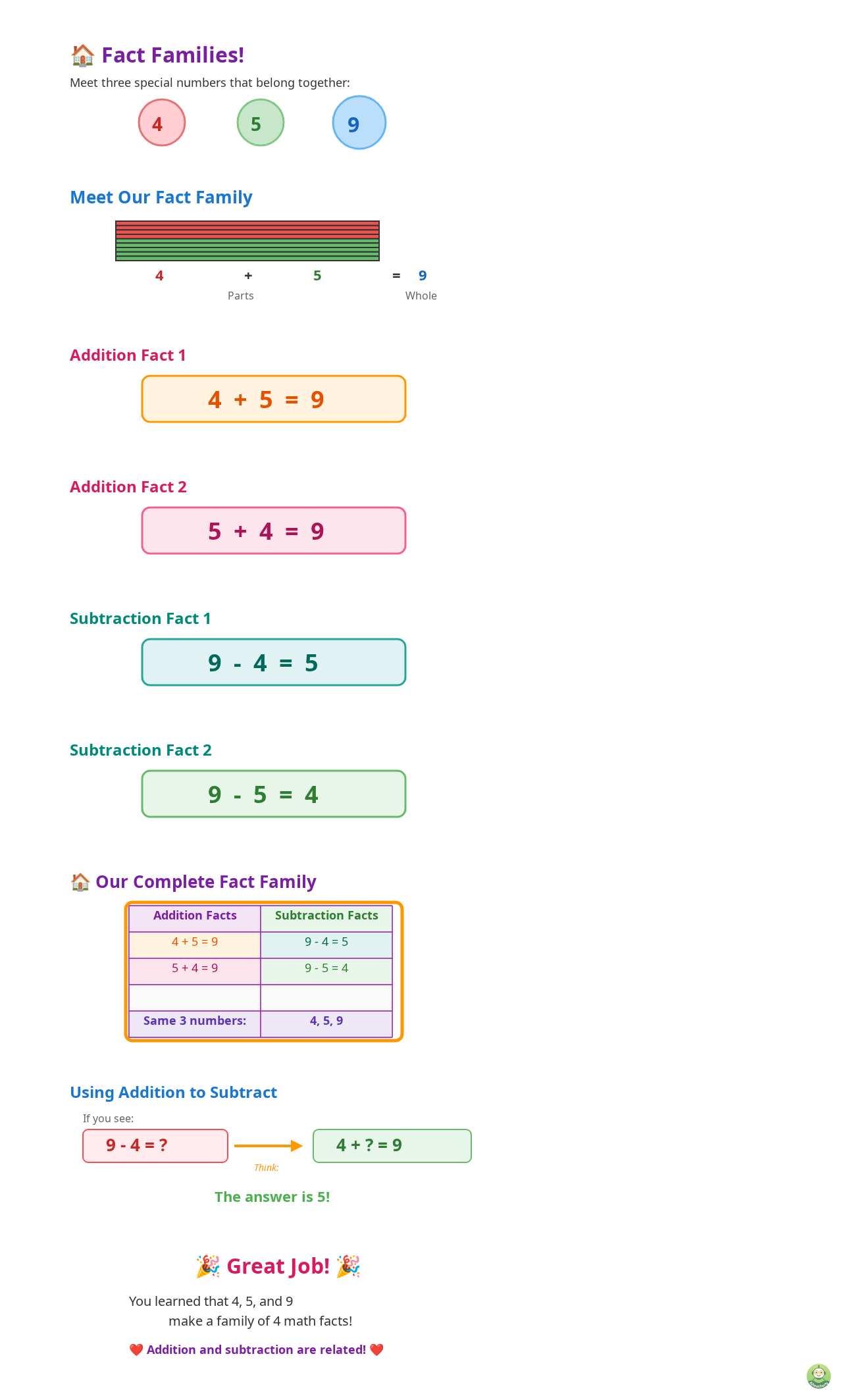
The Fact Families: Relating Addition and Subtraction lesson on AI Teacherly is designed specifically for 1st graders learning this essential concept. Here's what the full interactive lesson looks like on AI Teacherly:
What Makes This Lesson Effective:
- Visual part-whole models: Colorful representations show how two parts combine into one whole, making the abstract concept concrete
- Guided discovery: Instead of just telling kids the rules, the lesson helps them discover patterns themselves
- Interactive practice: Children drag, drop, and type answers, keeping them engaged and active
- Immediate feedback: Kids know right away if they're on track, preventing the practice of wrong methods
- Progressive difficulty: The lesson starts with simple number families and builds to word problems
The lesson takes approximately 25 minutes and covers everything from basic fact family recognition to using addition facts strategically to solve subtraction problems. It's aligned with Common Core standard 1.OA.B.4, which focuses on understanding subtraction as an unknown-addend problem.
For parents who feel unsure about explaining math concepts, having a structured, expert-designed lesson can be a game-changer. You can sit alongside your child, observe their learning, and then reinforce those same strategies during homework time.
Key Takeaways for Parents
Let's recap the essential points about fact families for 1st graders:
Fact families connect three numbers through four related equations (two addition, two subtraction), helping children see math as patterns rather than isolated problems
The inverse relationship between addition and subtraction means kids who know 3 + 4 = 7 already know 7 - 4 = 3; they just need to see the connection
Parts and whole thinking gives children a mental framework that makes subtraction feel logical instead of scary
Home practice doesn't require special materials: everyday objects like snacks, toys, or drawings work perfectly for building fact family understanding
This foundational skill pays off long-term: fact family fluency in 1st grade builds the number sense needed for multiplication, division, and algebra in later years
Interactive lessons can accelerate learning by providing visual models, immediate feedback, and guided discovery that reinforces home practice
Remember, every child learns at their own pace. If your 1st grader doesn't immediately grasp fact families, that's completely normal. Keep practice sessions short, positive, and focused on the connections between numbers. The "aha moment" will come!
Key Takeaways
- Fact families connect three numbers through four related equations, helping children see math as connected patterns
- Kids who know addition facts already have the tools to solve subtraction; fact families reveal this connection
- The parts-and-whole framework makes subtraction feel logical rather than intimidating for 1st graders
- Practice at home using everyday objects like snacks, toys, and simple drawings to reinforce fact families
- This foundational skill builds number sense essential for multiplication, division, and algebra later
- Interactive lessons with visual models and immediate feedback can accelerate fact family mastery
- Keep practice sessions short (5-10 minutes) and celebrate when children use addition to solve subtraction
Frequently Asked Questions
What is a fact family in math?
A fact family is a group of related math facts using the same three numbers. For example, 3, 4, and 7 create four facts: 3+4=7, 4+3=7, 7-4=3, and 7-3=4. The numbers 'belong together' as a family.
How many facts are in a fact family?
Most fact families contain four facts: two addition equations and two subtraction equations. However, doubles like 4+4=8 only have two unique facts since the addition facts are identical.
Why do 1st graders learn fact families?
Fact families teach children that addition and subtraction are connected, not separate skills. This understanding reduces memorization, builds number sense, and helps kids use addition knowledge to solve subtraction problems confidently.
How can I practice fact families at home with my child?
Use everyday objects like snacks, toys, or LEGO bricks. Have your child split items into two groups and describe all four facts. Drawing triangles with the whole at top and parts at bottom also helps visualize the relationship.
How do fact families help with subtraction?
Fact families show children that subtraction is addition backwards. If a child knows 5+3=8, they can figure out 8-3=5 without memorizing it separately. This strategy transforms subtraction from scary to logical.
When should my child know their fact families?
Fact families are typically introduced in 1st grade and mastered by the end of the year. By 2nd grade, children should fluently recognize related facts within 20. Every child develops at their own pace, so patience is key.
What if my child doesn't understand fact families yet?
That's completely normal! Use hands-on manipulatives, keep practice sessions short (5-10 minutes), and focus on the parts-and-whole relationship. Some children need more time to see the pattern. Consistency matters more than speed.
Are fact families just extra memorization for kids?
No, fact families actually reduce memorization by showing children that math facts are connected. Instead of memorizing addition and subtraction separately, kids learn one relationship that reveals four connected facts.
Ready to make fact families click for your 1st grader? Try the interactive Fact Families lesson free on AI Teacherly and watch subtraction transform from struggle to success!