Fact Families for 2nd Graders: The Math Shortcut That Unlocks Addition and Subtraction
Discover how fact families connect addition and subtraction for 2nd graders. Learn simple home activities and see why this math shortcut builds lasting number sense.
The Math Shortcut Every 2nd Grader Needs
Picture this: your 2nd grader is staring at their homework, pencil frozen above the page. They can add 3 + 5 without hesitation, but 8 - 5 feels like a completely different problem. Sound familiar?
Here's the good news: there's a simple concept that connects these problems and makes both feel easier. It's called a fact family, and it's one of the most powerful shortcuts in elementary math.
Fact families for 2nd graders reveal a beautiful secret: knowing one math fact means you actually know three more. When your child truly understands this relationship, subtraction stops feeling like a separate, harder skill. Instead, it becomes a natural extension of what they already know.
In this guide, you'll discover exactly what fact families are, why they matter for your child's math development, and simple ways to practice them at home. Whether homework time feels like a battle or you just want to give your child an extra boost, understanding fact families can transform how your 2nd grader approaches math.
What Is a Fact Family in Math?
A fact family is a group of related math facts that use the same three numbers. Think of it like a real family: the members are connected and belong together.
Let's look at an example with the numbers 3, 5, and 8:
- 3 + 5 = 8
- 5 + 3 = 8
- 8 - 3 = 5
- 8 - 5 = 3
See how all four equations use the same three numbers? That's a fact family! The two addition facts and two subtraction facts are all related because they describe the same relationship between those numbers.
Here's why this matters: if your child knows that 3 + 5 = 8, they automatically have the tools to figure out 8 - 5 and 8 - 3. They don't need to memorize four separate facts; they need to understand one relationship.
Teachers often use a "house" visual to help children picture fact families. Imagine three numbers living together in a house. They're related, just like a family! This concrete image helps young learners grasp an abstract mathematical concept in a way that sticks.
The beauty of fact families is that they reduce the memorization burden. Instead of drilling dozens of isolated facts, children learn to see patterns and connections. This builds genuine number sense rather than rote recall.
How Do Addition and Subtraction Connect in a Fact Family?
The magic of fact families lies in understanding that addition and subtraction are inverse operations. In simple terms, subtraction "undoes" addition, and they're two sides of the same coin.
Let's break this down with a concrete example your 2nd grader can visualize:
Imagine you have 4 red apples and 6 green apples. When you put them together, you have 10 apples total. That's addition: 4 + 6 = 10.
Now, if you start with those 10 apples and take away the 6 green ones, you're left with 4 red apples. That's subtraction: 10 - 6 = 4.
See how subtraction uses the same numbers as addition, just working backward? This is the core insight that fact families teach.
When children understand this connection, something wonderful happens. They stop seeing subtraction as a completely separate skill to master. Instead, they recognize it as the "reverse" of addition they already know.
This understanding becomes especially powerful when your child encounters a subtraction problem they don't immediately know. Instead of getting stuck, they can think: "What do I need to add to get this number?" For example, if they see 12 - 7 = ?, they can reframe it as "7 + what = 12?" and use their addition knowledge to find the answer.
This flexible thinking is exactly what mathematicians call number sense, and it's built through understanding relationships like fact families.
Why Are Fact Families Important for Your Child's Math Skills?
You might wonder whether fact families are just "new math" terminology for something simple. Here's the truth: understanding fact families builds a foundation that supports math learning for years to come.
1. Reduces Memorization, Increases Understanding
Instead of memorizing 100+ separate math facts, children who understand fact families can derive facts from what they know. Know one fact, and you know three more! This dramatically lightens the cognitive load.
2. Builds Mental Math Fluency
When children see the relationships between numbers, they develop strategies for mental calculation. They don't need to count on their fingers because they can use known facts to figure out unknown ones.
3. Prepares for Multiplication and Division
Here's something exciting: fact families don't stop with addition and subtraction! The same concept applies to multiplication and division. Children who master addition/subtraction fact families have an easier time understanding that 3 × 4 = 12 connects to 12 ÷ 4 = 3.
4. Creates Algebra Readiness
Understanding inverse operations is foundational for algebra. When your child later sees equations like x + 5 = 12, they'll intuitively understand that they need to "undo" the addition with subtraction. That intuition starts with fact families in 2nd grade.
5. Builds Math Confidence
When children understand why math works (not just how to get answers), they feel more confident. They become problem-solvers rather than answer-memorizers, and that confidence carries through their entire math education.
Simple Ways to Practice Fact Families at Home
The best news about fact families? You can reinforce this concept in just a few minutes using things you already have at home. Here are practical, parent-friendly activities that make fact families click:
The Snack Sort Game
Grab a handful of two types of snacks (like goldfish crackers and pretzels). Count each type, then count the total. Now ask your child to create all four facts in the family. For example: 7 goldfish + 4 pretzels = 11 snacks. What are the other three facts?
Fact Family Triangles
Draw a triangle and write one number in each corner (like 6, 9, and 15). Challenge your child to write all four equations using just those three numbers. This visual tool helps them see how the numbers relate.
The "Undo" Game
Give your child an addition problem (8 + 4 = 12). Then ask: "What subtraction problems can you make with these same numbers?" This directly practices the inverse relationship.
Number Bond Stories
Turn fact families into stories. "You had 5 toy cars. Your friend gave you 3 more. Now you have 8. If you gave 3 back, how many would you have?" Story contexts make abstract numbers meaningful.
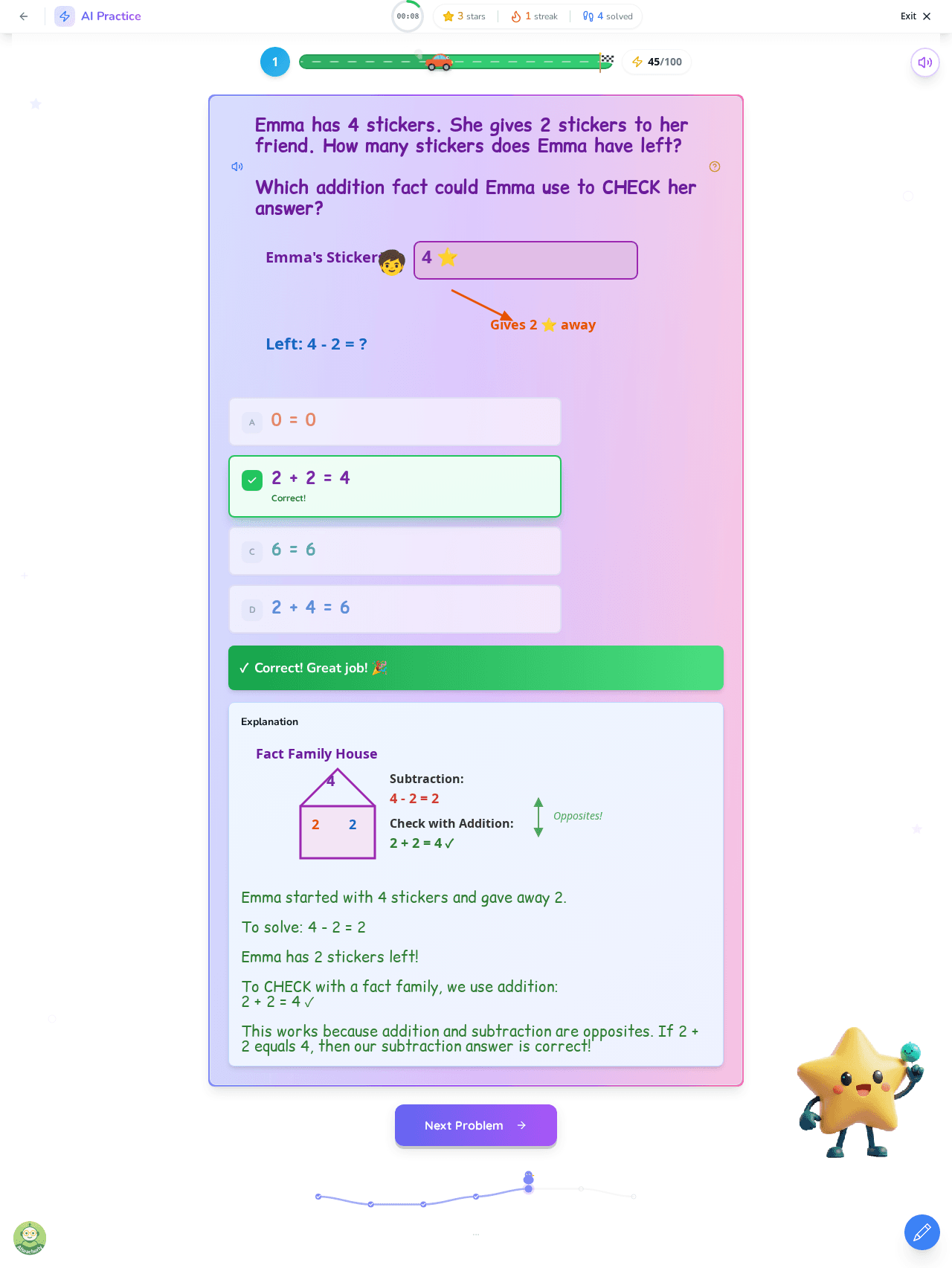
The interactive problem below shows how fact families come to life with visual practice:
Consistency Matters Most
Even five minutes of fact family practice three times a week makes a noticeable difference. The goal isn't drilling until it's boring; it's helping your child see patterns and feel successful.
See How AI Teacherly Makes Fact Families Click
While home activities are wonderful, sometimes children need structured practice with immediate feedback. That's where interactive lessons make a real difference.
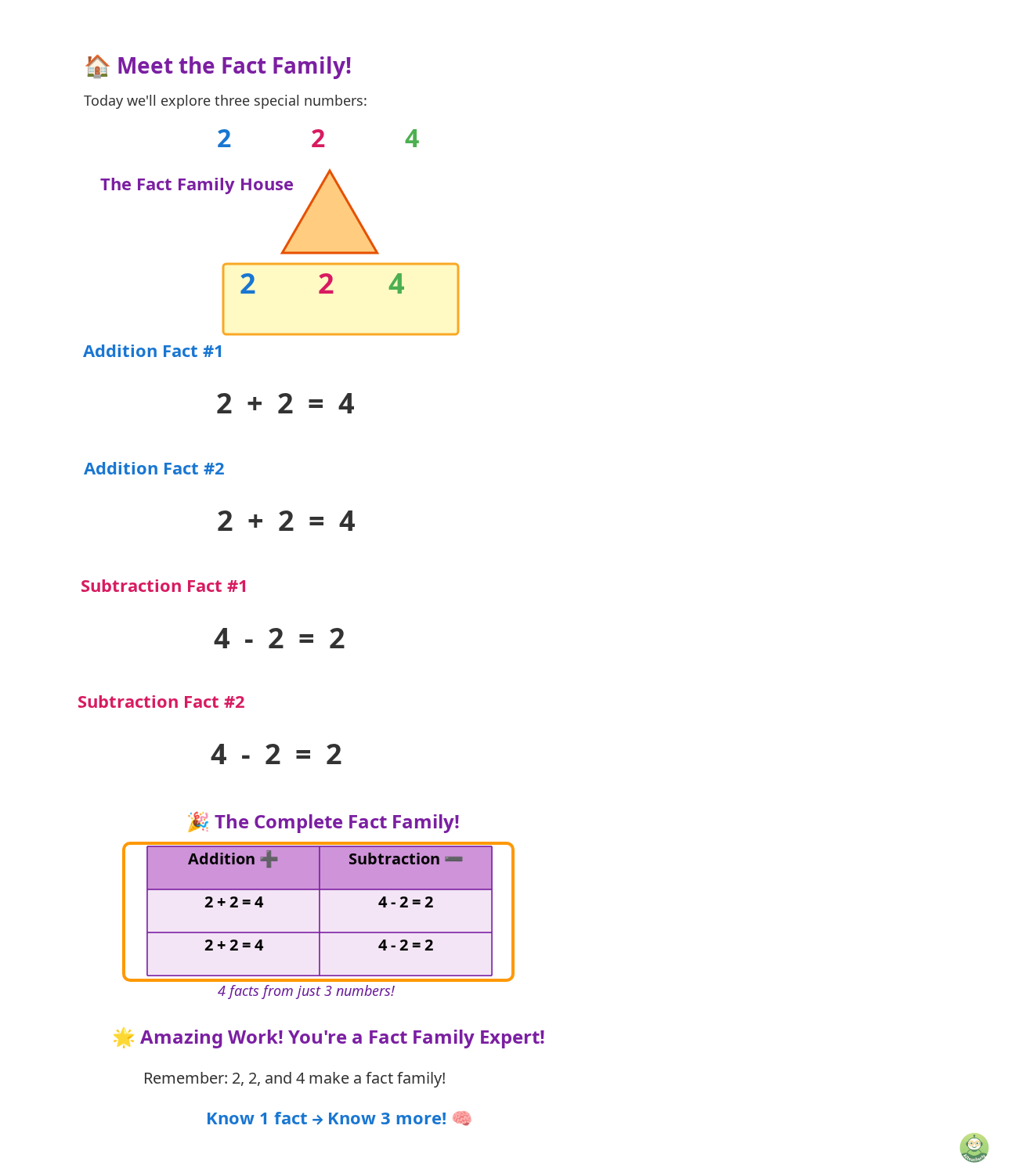
The Fact Families lesson on AI Teacherly is designed specifically for 2nd graders, with colorful visual models that bring the concept to life. Here's what the full interactive lesson looks like:
What makes interactive learning effective for fact families:
Visual Manipulatives: Children see the numbers as actual objects they can mentally (or physically) group and separate. This concrete-to-abstract progression matches how young minds learn best.
Immediate Feedback: When your child enters an answer, they know right away whether they're on track. No waiting for you to check their work, and no practicing mistakes.
Progressive Difficulty: The lesson starts with simpler number combinations and gradually introduces larger numbers and word problems. Your child builds confidence before tackling challenges.
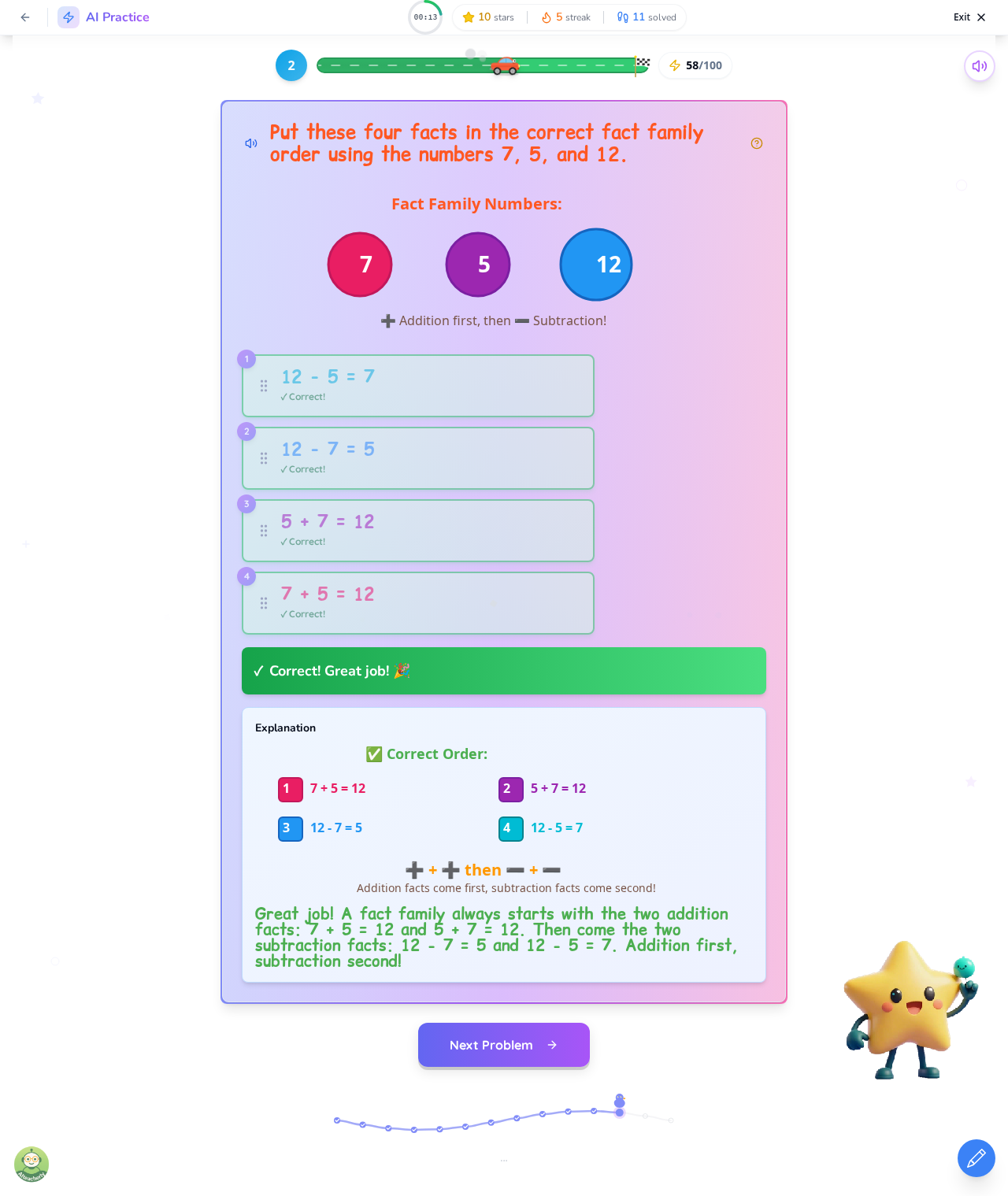
Multiple Problem Types: From ordering all four facts to filling in missing numbers to real-world word problems, the variety keeps practice engaging while reinforcing the same core concept.
One parent shared: "My daughter finally 'got' fact families after using this lesson. Seeing the same numbers in different equations made the connection click in a way my explanations couldn't."
The combination of at-home activities and structured practice gives your child the best chance to truly master fact families, not just memorize them temporarily.
Key Takeaways
- A fact family uses three numbers to create four related equations (two addition, two subtraction)
- Understanding fact families reduces memorization by showing children that knowing one fact means knowing three more
- Addition and subtraction are inverse operations, meaning subtraction undoes addition using the same numbers
- Practice fact families at home using snacks, triangles, and story problems for just five minutes a few times per week
- Mastering fact families in 2nd grade builds the foundation for multiplication/division fact families and algebra readiness
- Interactive lessons with visual models and immediate feedback help the concept click faster than worksheets alone
Frequently Asked Questions
What is a fact family in math?
A fact family is a group of related math facts using the same three numbers. For example, with 2, 5, and 7, the fact family includes: 2+5=7, 5+2=7, 7-2=5, and 7-5=2. Four facts, one relationship!
How many facts are in a fact family?
Most fact families have four facts: two addition equations and two subtraction equations. However, doubles (like 4+4=8) only have two facts since switching the addends doesn't create a new equation.
Why do kids learn fact families in 2nd grade?
Second grade is when children transition from counting to understanding number relationships. Fact families help them see how addition and subtraction connect, building the foundation for mental math and later multiplication/division.
How can I practice fact families at home with my child?
Try the snack sort game (count two snack types and make all four facts), draw fact family triangles, or play the 'undo' game where subtraction reverses addition. Even five minutes three times weekly helps!
Do fact families help with multiplication later?
Yes! The same concept applies to multiplication and division. Children who understand addition/subtraction fact families more easily grasp that 3×4=12 connects to 12÷4=3 and 12÷3=4.
What if my child only remembers one fact in the family?
That's actually the goal! If your child knows 6+3=9, they can figure out the other facts by understanding the relationship. Encourage them to use what they know rather than memorizing each fact separately.
Is this different from how I learned math?
Fact families aren't new math; they're just a clearer way to teach the addition-subtraction relationship. You likely learned this connection eventually, but explicit fact family instruction helps children understand it earlier and more deeply.
Are fact families part of Common Core standards?
Yes, understanding the relationship between addition and subtraction is a key 2nd grade Common Core math standard (2.OA.B.2). Fact families are a widely-used method for teaching this essential concept.
Ready to see fact families click for your 2nd grader? Try the interactive Fact Families lesson on AI Teacherly, where colorful visuals and instant feedback make math relationships come alive. Start your free lesson today!