Conquer Fractions of a Group in 3rd Grade Math With This Simple Two-Step Trick
Master fractions of a group 3rd grade math at home with a foolproof two-step strategy. Turn homework battles into confident learning moments today!
Introduction: Making 3rd Grade Fractions Click at Home
Homework time rolls around, math books open up, and suddenly the kitchen table becomes a battlefield. For many families, 3rd grade math marks a major turning point where arithmetic becomes more abstract. Among all the new concepts introduced this year, fractions of a group often spark the most confusion. If you have ever stared at a homework page asking to find three-quarters of twelve marbles and felt completely unprepared, you are certainly not alone.
The good news is that mastering fractions of a group does not require an advanced degree in education or hours of stressful drilling. When you break the concept down into a simple, visual routine, children light up with understanding. This guide walks you through the exact strategies teachers use to make fractions click, offering practical ways to support your student without tears or frustration.
What Are Fractions of a Group and Why Are They Tricky?
In earlier grades, children learn fractions by looking at a single shape, like a circle cut into four equal slices or a chocolate bar divided into squares. Those visual models work wonderfully for parts of a whole. However, 3rd grade introduces a brand new challenge: fractions of a set or group.
Instead of dividing one object, students must now divide a collection of separate items, such as flowers in a garden, players on a soccer team, or pieces of fruit in a bowl. This transition trips up many young learners because they struggle to see how twelve distinct objects can be split into equal fractional piles. When a child is asked to find 1/4 of 12, they might try to cut an individual item in half rather than grouping the collection. Understanding this shift is the first step toward transforming homework stress into confident problem-solving.
The Foolproof Two-Step Strategy: Divide Then Multiply
The secret to conquering fraction word problems lies in a foolproof two-step method: divide by the bottom number, then multiply by the top number. Once children memorize this rhythm, complex fraction problems become simple arithmetic puzzles.
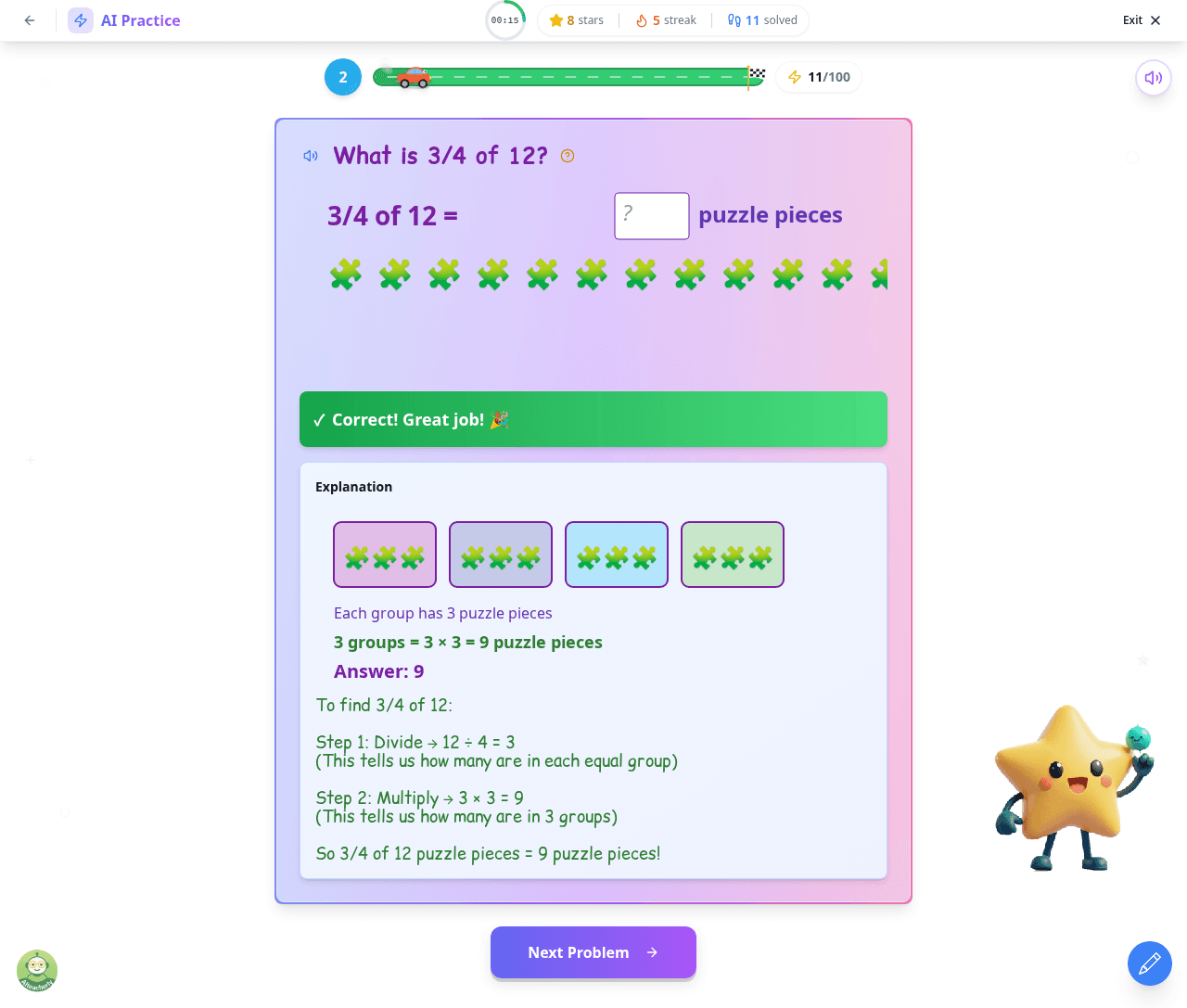
Let us walk through an example. Suppose a word problem asks: There are 12 apples in a basket, and 3/4 of them are red. How many red apples are there?
Step one: Look at the denominator (the bottom number, which is 4). Divide the total number of items (12) by that denominator. Twelve divided by four equals three. This tells us that each fourth of the group contains 3 apples. Step two: Look at the numerator (the top number, which is 3). Multiply the result from step one (3) by that numerator. Three times three equals nine. There are 9 red apples!
The interactive problem below shows exactly how PEMDAS and grouping principles work in practice with clear visual shapes.
Fun Hands-On Activities to Practice Fractions Using Snacks and Toys
While worksheets have their place, nothing beats tactile learning when introducing new mathematical thinking. You can turn everyday moments into powerful math lessons using items you already have around the house.
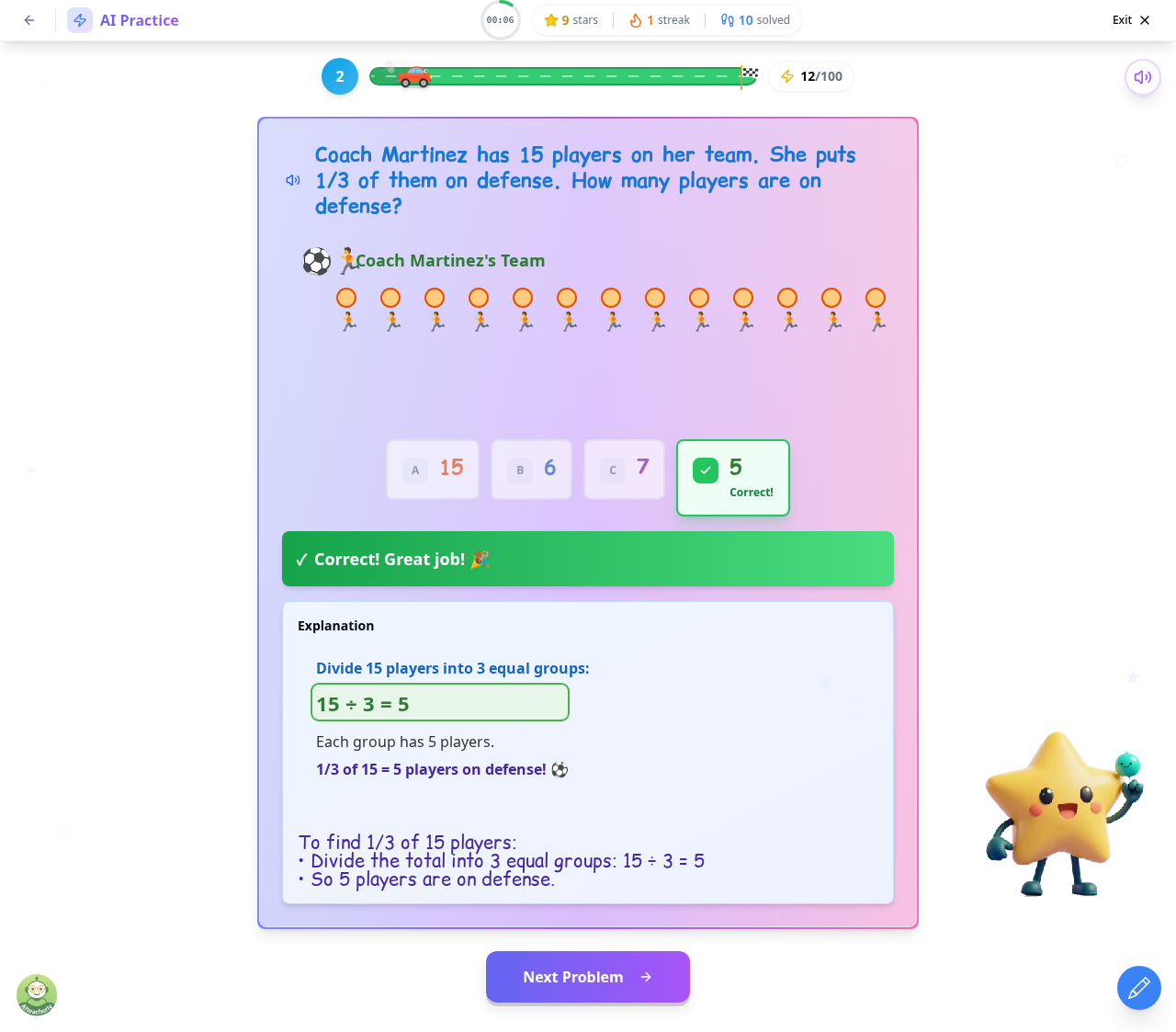
Try setting out a dozen crackers, grapes, or building blocks. Ask your child to find 1/3 of the total. Watch as they physically separate the items into three equal piles on the table. Once the piles are even, ask, "How many are in one pile?" When they answer four, they have successfully discovered what a unit fraction looks like in the real world. You can then ask for 2/3 by combining two of those piles. This hands-on sorting builds muscle memory in the brain, making abstract textbook questions much easier to visualize later on.
How AI Teacherly Turns Homework Battles Into Win Moments
Even with great snacks and kitchen table practice, consistency can be a challenge for busy parents. Managing school schedules, work, and extracurriculars leaves little room for lengthy tutoring sessions. This is where interactive digital learning platforms provide incredible value.
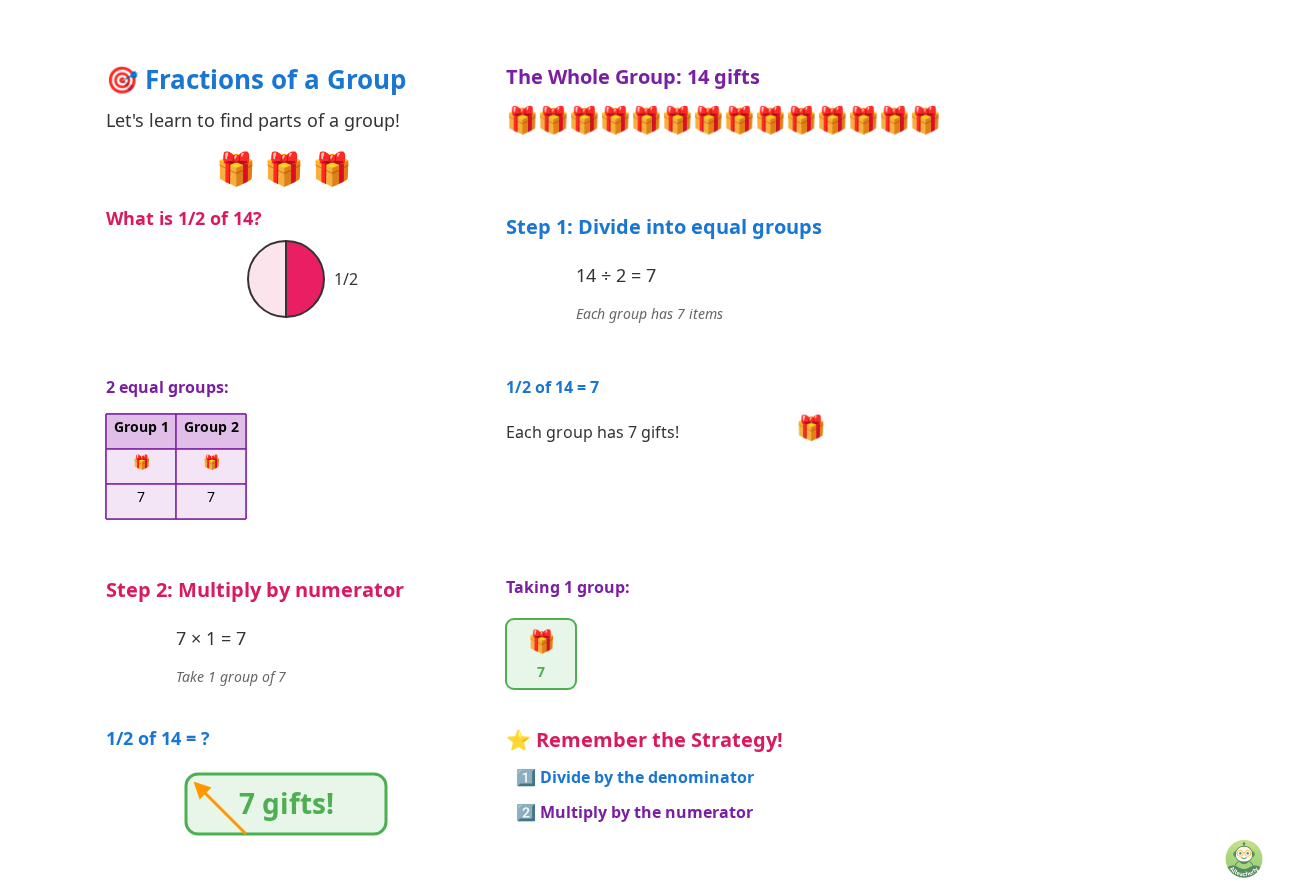
Here's what the full interactive lesson looks like on AI Teacherly:
Key Takeaways for Parents
Helping your 3rd grader succeed in math does not mean you have to become a certified school teacher. By focusing on foundational fraction concepts, utilizing tactile household objects, and applying a reliable divide-then-multiply method, you can turn confusion into confidence.
Remember to keep sessions short, celebrate small victories, and let interactive tools handle the repetitive practice. With patience and the right approach, your child will master fractions of a group and approach math homework with a smile.
Key Takeaways
- Fractions of a group shift children from looking at single whole shapes to managing collections of items.
- The foolproof two-step method requires dividing the total by the denominator, then multiplying by the numerator.
- Tactile objects like snacks or building blocks make abstract fraction concepts concrete and fun at home.
- Interactive digital platforms reduce homework friction by providing guided practice and immediate feedback.
- Short, consistent daily sessions yield much better math retention than long, exhausting study marathons.
Frequently Asked Questions
What does finding a fraction of a group mean in 3rd grade math?
Finding a fraction of a group means taking a collection of items (like 12 cookies) and figuring out how many belong to a specific fractional part (such as 1/4 of them). Instead of looking at one single whole pizza, 3rd graders look at multiple items as a single set.
How do I explain the divide-then-multiply strategy to my child?
The divide-then-multiply method is simple: first, divide the total number of items by the bottom number (the denominator) of the fraction. Second, multiply that result by the top number (the numerator). For example, to find 3/4 of 12: divide 12 by 4 to get 3, then multiply 3 by 3 to get 9.
Why does my 3rd grader struggle with word problems involving fractions?
Word problems become tricky when children try to guess operations instead of visualizing the set. To solve this, have your child draw circles for groups on paper, physically sorting items into equal piles before calculating. Visual platforms like AI Teacherly also make this connection clear.
Can we practice fractions using everyday objects at home?
Absolutely! Real-world items like grapes, Lego bricks, or playing cards work wonders. If you have 12 grapes and want to find 1/3, ask your child to sort them into 3 equal piles and count one pile. Tactile practice bridges abstract math into concrete understanding.
Is it normal for my child to confuse numerators and denominators in groups?
Yes, it is entirely normal. Children often mix up denominators (the total number of equal groups) and numerators (how many groups we are counting). Consistent, low-pressure practice using interactive lessons helps solidify these vocabulary terms naturally over time.
Ready to make math homework stress-free? Try interactive 3rd-grade math lessons free on AI Teacherly today!