Help Your Child Master Multi-Digit Multiplication: A Parent's Complete Guide
Struggling to help with your 5th grader's multiplication homework? Learn simple strategies to understand the standard algorithm and support multi-digit multiplication at home.
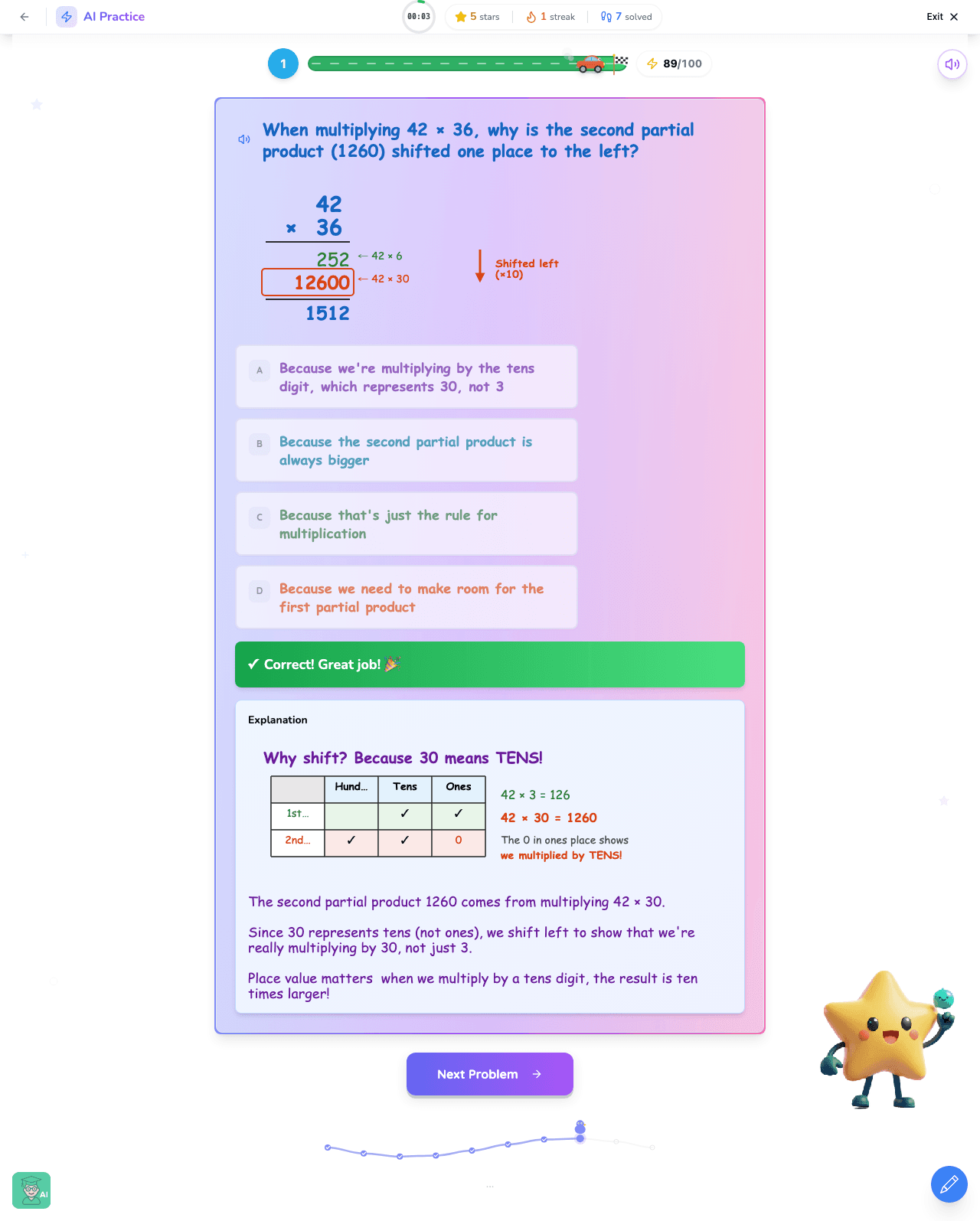
Why Multi-Digit Multiplication Trips Up Parents (And How to Fix It)
You sit down to help with math homework, and suddenly you're staring at a problem that looks nothing like how you remember learning multiplication. Your child is frustrated, you're second-guessing yourself, and the kitchen table has become a battlefield.
If this sounds familiar, you're not alone. Multi-digit multiplication is one of the most common pain points for parents helping with 5th grade math. The "standard algorithm" your child is learning might look different from what you learned decades ago, and that disconnect creates anxiety for everyone involved.
But here's the good news: you don't need to remember your own 5th grade math class to help your child succeed. With a few simple concepts under your belt, you can become your child's best homework helper. This guide will walk you through exactly how multi-digit multiplication works, why those confusing "extra steps" exist, and practical ways to practice at home without turning homework time into a power struggle.
Whether your child is just starting with 2-digit by 2-digit multiplication or moving up to 3-digit problems, you'll leave this article feeling confident and equipped to support their learning journey.
What Is Multi-Digit Multiplication and Why Does It Look Different Now?
Multi-digit multiplication simply means multiplying numbers that have two or more digits, like 47 × 36 or 234 × 52. While the basic concept hasn't changed, the way schools teach it has evolved to emphasize understanding over memorization.
In the past, many of us learned multiplication as a series of steps to follow without really understanding why they worked. Today's approach focuses on place value reasoning: helping students understand that when we multiply 47 × 36, we're actually working with 40 + 7 and 30 + 6.
This "new math" isn't actually new at all. It's the same mathematics, but with more emphasis on the "why" behind the process. The goal is for students to truly understand multiplication so they can apply it flexibly to different situations, catch their own errors, and build a foundation for algebra.
When do kids learn multi-digit multiplication?
Most students encounter 2-digit by 1-digit multiplication in 4th grade, then progress to 2-digit by 2-digit problems in 5th grade. By the end of 5th grade, students should be comfortable multiplying 3-digit numbers as well. This progression builds gradually, with each step adding complexity while using the same underlying principles.
The key insight for parents: if you understand place value (what each digit represents based on its position), you can understand and explain any multi-digit multiplication problem.
How Does the Standard Algorithm Actually Work?
The standard algorithm for multiplication follows a predictable pattern that, once you see it, makes perfect sense. Let's break it down step by step using 47 × 36 as our example.
Step 1: Estimate First
Before calculating, round each number to the nearest ten: 47 rounds to 50, and 36 rounds to 40. So 50 × 40 = 2,000. This gives you a ballpark answer to check your final result against. If your child gets 168 or 16,800, they'll know something went wrong.
Step 2: Multiply by the Ones Digit
Multiply 47 by 6 (the ones digit of 36). That's 47 × 6 = 282. Write this as your first partial product.
Step 3: Multiply by the Tens Digit (with the shift)
Now multiply 47 by 3 (the tens digit of 36). But here's the crucial part: since that 3 actually represents 30, we're really calculating 47 × 30 = 1,410. In the traditional setup, we write 141 and shift it one place to the left (or add a zero placeholder).
Step 4: Add the Partial Products
Add 282 + 1,410 = 1,692. That's your answer!
Step 5: Check Against Your Estimate
Your estimate was 2,000, and your answer is 1,692. These are reasonably close, so your answer makes sense.
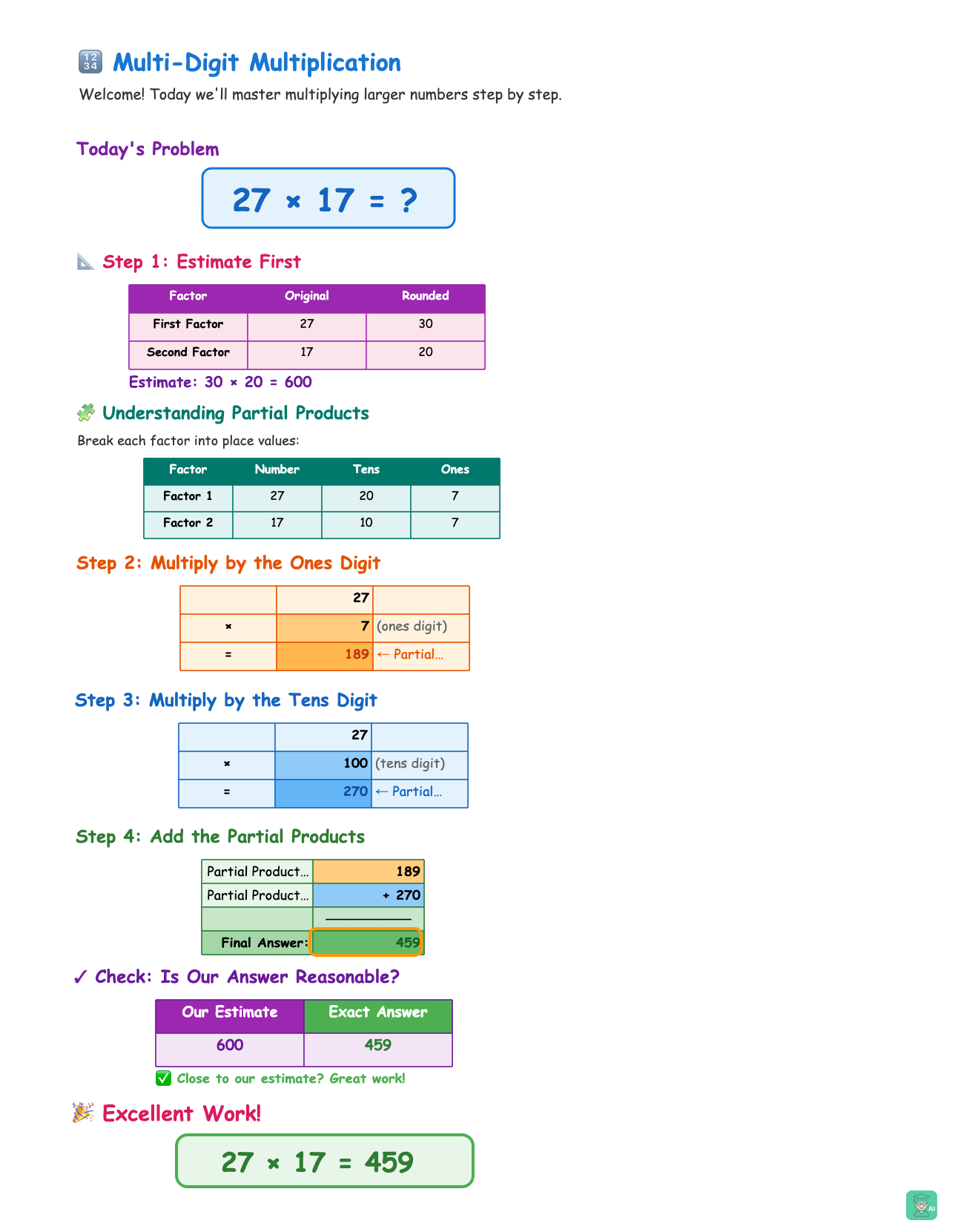
The interactive problem below shows how AI Teacherly walks students through this exact process step by step:
Why Do We 'Shift' the Second Row? (The Place Value Secret)
This is the question that confuses more parents and students than any other aspect of multi-digit multiplication. Why do we "add a zero" or "shift over" when we multiply by the tens digit?
The answer lies in place value, and once you understand it, you can explain it to your child in a way that actually sticks.
The Simple Explanation
When we multiply 47 × 36, the "3" in 36 isn't just 3. It's in the tens place, so it represents 30. When we multiply 47 × 30, we get a number that's 10 times bigger than 47 × 3.
- 47 × 3 = 141
- 47 × 30 = 1,410 (ten times bigger)
That's why we shift! We're not doing a magic trick. We're accounting for the fact that the tens digit is worth ten times more than the ones digit.
Partial Products Make It Clear
Some teachers use the "partial products" method to make this even more explicit. Instead of shifting, students write out each multiplication with its full value:
- 47 × 6 = 282
- 47 × 30 = 1,410
- Total: 282 + 1,410 = 1,692
Both methods give the same answer. The partial products method shows the place value more clearly, while the traditional algorithm is faster once students understand why it works.
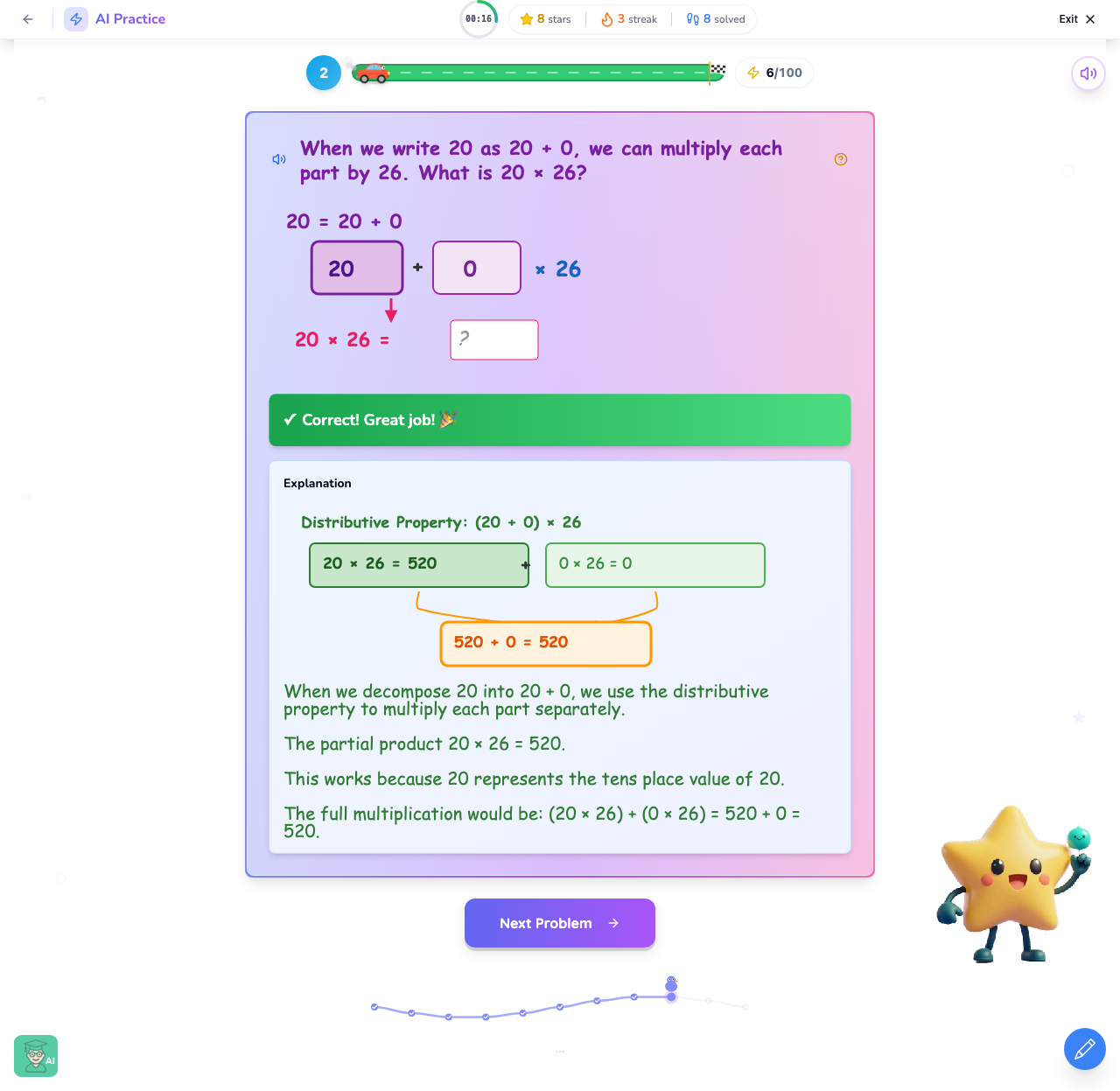
Here's an interactive problem that demonstrates the place value breakdown:
How Can Parents Practice Multi-Digit Multiplication at Home?
You don't need worksheets or flashcards to help your child build multiplication fluency. Here are practical strategies that fit into everyday life:
Use Real-World Scenarios
Multiplication is everywhere once you start looking for it:
- "If each row in the movie theater has 28 seats and there are 15 rows, how many seats are there?"
- "We're buying 24 packs of juice boxes with 12 in each pack. How many juice boxes is that?"
- "The parking lot has 35 rows of cars with 18 spaces in each row. How many cars can fit?"
These problems feel more engaging than abstract numbers and help your child see why multiplication matters.
Emphasize Estimation
Before your child calculates, always ask: "What do you think the answer will be close to?" This builds number sense and gives them a way to self-check. If they estimate 600 but get 6,000, they know to look for an error.
Break Down the Problem Together
When your child gets stuck, don't just show them the answer. Instead, ask guiding questions:
- "Can you break this number into tens and ones?"
- "What's the first partial product?"
- "Does your answer make sense compared to your estimate?"
Try Interactive Practice
Platforms like AI Teacherly offer interactive lessons where students work through problems step by step with immediate feedback. This takes the pressure off parents to be the expert and gives students guided practice they can do independently.
Celebrate the Process, Not Just the Answer
Praise your child for showing their work, using estimation, and catching their own mistakes. These skills matter more than getting every problem right on the first try.
From 2-Digit to 3-Digit: Helping Your Child Level Up
Once your child masters 2-digit by 2-digit multiplication, they'll encounter 3-digit problems like 234 × 52. The good news? The exact same strategy applies.
It's the Same Process, Extended
With 3-digit multiplication, students simply have more partial products to keep track of:
- 234 × 2 (ones) = 468
- 234 × 50 (tens) = 11,700
- Total: 468 + 11,700 = 12,168
The key insight for your child: "You already know how to do this. There are just more digits to work with."
Common Challenges and Solutions
Challenge 1: Keeping track of partial products Solution: Use graph paper or lined paper turned sideways to keep digits aligned.
Challenge 2: Forgetting to shift Solution: Have your child say out loud: "I'm multiplying by the tens digit, so I need to shift."
Challenge 3: Regrouping errors Solution: Write carried digits small but clearly above the correct column.
When to Seek Extra Help
If your child consistently struggles with place value concepts or makes the same errors repeatedly, they might benefit from additional visual instruction. Interactive lessons that show each step visually can help cement understanding in ways that paper practice sometimes can't.
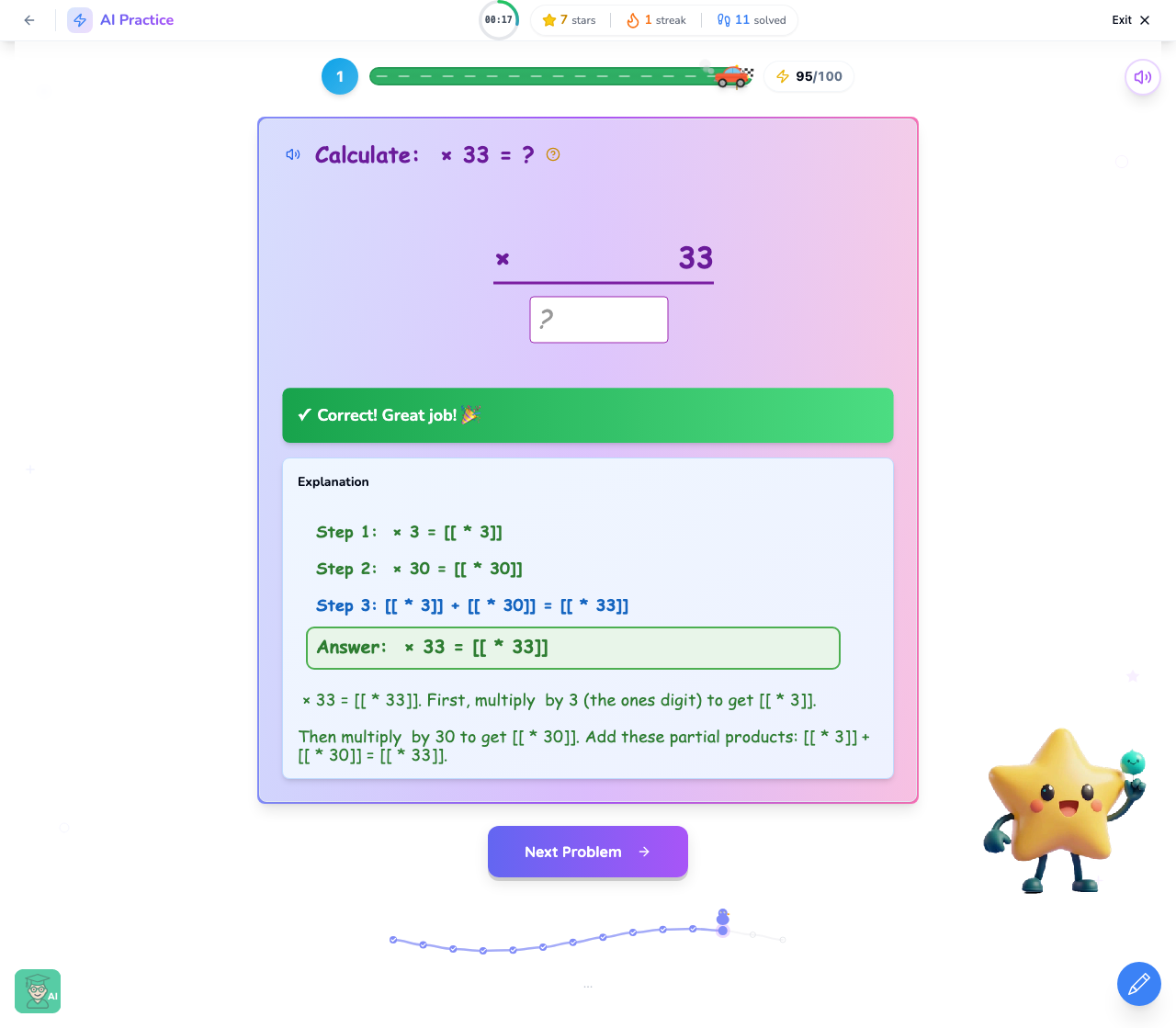
The problem below shows how 3-digit multiplication works on AI Teacherly:
Key Takeaways
- Start every multiplication problem with an estimate to give your child a way to check their answer
- The 'shift' in multiplication isn't a trick; it's because the tens digit is worth 10 times more than the ones digit
- Break numbers into place value parts (47 = 40 + 7) to make the process clearer for your child
- Real-world problems like calculating seats in a theater make multiplication more engaging than worksheets
- Ask guiding questions instead of showing answers to build your child's problem-solving confidence
- 3-digit multiplication uses the exact same strategy as 2-digit; there are just more partial products to add
- Interactive practice with immediate feedback helps students learn independently and takes pressure off parents
Frequently Asked Questions
What grade do kids learn multi-digit multiplication?
Most students learn 2-digit by 1-digit multiplication in 4th grade, then progress to 2-digit by 2-digit in 5th grade. By the end of 5th grade, students should be comfortable with 3-digit multiplication as well.
Why do we add a zero when multiplying by the tens digit?
The zero (or 'shift') accounts for place value. The tens digit represents a value 10 times greater than the ones digit, so the partial product must also be 10 times greater. We're not adding a random zero; we're showing the true value.
What is the partial products method in multiplication?
Partial products is a method where you multiply each place value separately and then add the results. For 47 × 36, you'd calculate 47 × 6 = 282 and 47 × 30 = 1,410, then add them for 1,692. It shows the place value reasoning explicitly.
How can I help my child with multiplication without confusing them?
Focus on place value concepts rather than just steps. Ask your child to explain their thinking, use estimation to check answers, and let them practice with interactive lessons that provide immediate feedback so you don't have to be the expert.
Is it normal for 5th graders to struggle with multi-digit multiplication?
Yes, it's very common. Multi-digit multiplication requires holding multiple steps in memory while applying place value concepts. With consistent practice and a focus on understanding (not just memorizing steps), most students improve significantly.
What's the difference between the standard algorithm and partial products?
Both methods give the same answer. The standard algorithm is more compact and faster once mastered. Partial products explicitly shows why each step works by writing out full values. Many teachers start with partial products to build understanding, then transition to the standard algorithm.
How long should my 5th grader practice multiplication each day?
For 5th graders, 15-20 minutes of focused practice is ideal. Short, consistent sessions are more effective than hour-long cramming. Interactive practice keeps students engaged and makes this time more productive.
Why does my child's math homework look different from how I learned?
Today's math instruction emphasizes understanding why methods work, not just following steps. The math itself hasn't changed, but the teaching approach helps students develop flexible thinking and stronger problem-solving skills for more advanced math later.
Ready to make multiplication practice stress-free? Explore our interactive Multi-Digit Multiplication lesson on AI Teacherly, where your child can work through problems step by step with instant feedback. Try it free today!