Master 3rd Grade Multiplication and Division Word Problems Without Tears
Discover simple strategies to conquer 3rd grade multiplication and division word problems at home using fun clue words, detective tricks, and inverse checks.
Introduction: Why 3rd Grade Word Problems Trip Up Kids And How to Fix It
Third grade brings an exciting leap in mathematics, moving away from simple addition and subtraction into the world of multiplication and division. For many children, the moment numbers turn into word stories, anxiety sets in. Staring at a paragraph about apples, baskets, or toy boxes can freeze even a bright student. Parents often find themselves wondering how to explain why one sentence requires multiplication while another demands division. The good news is that you do not need a teaching degree to transform your kitchen table into a place of mathematical confidence. By changing how children read and interpret these story problems, you can turn confusion into a fun detective challenge.
What Is the Difference Between Multiplication and Division Word Problems?
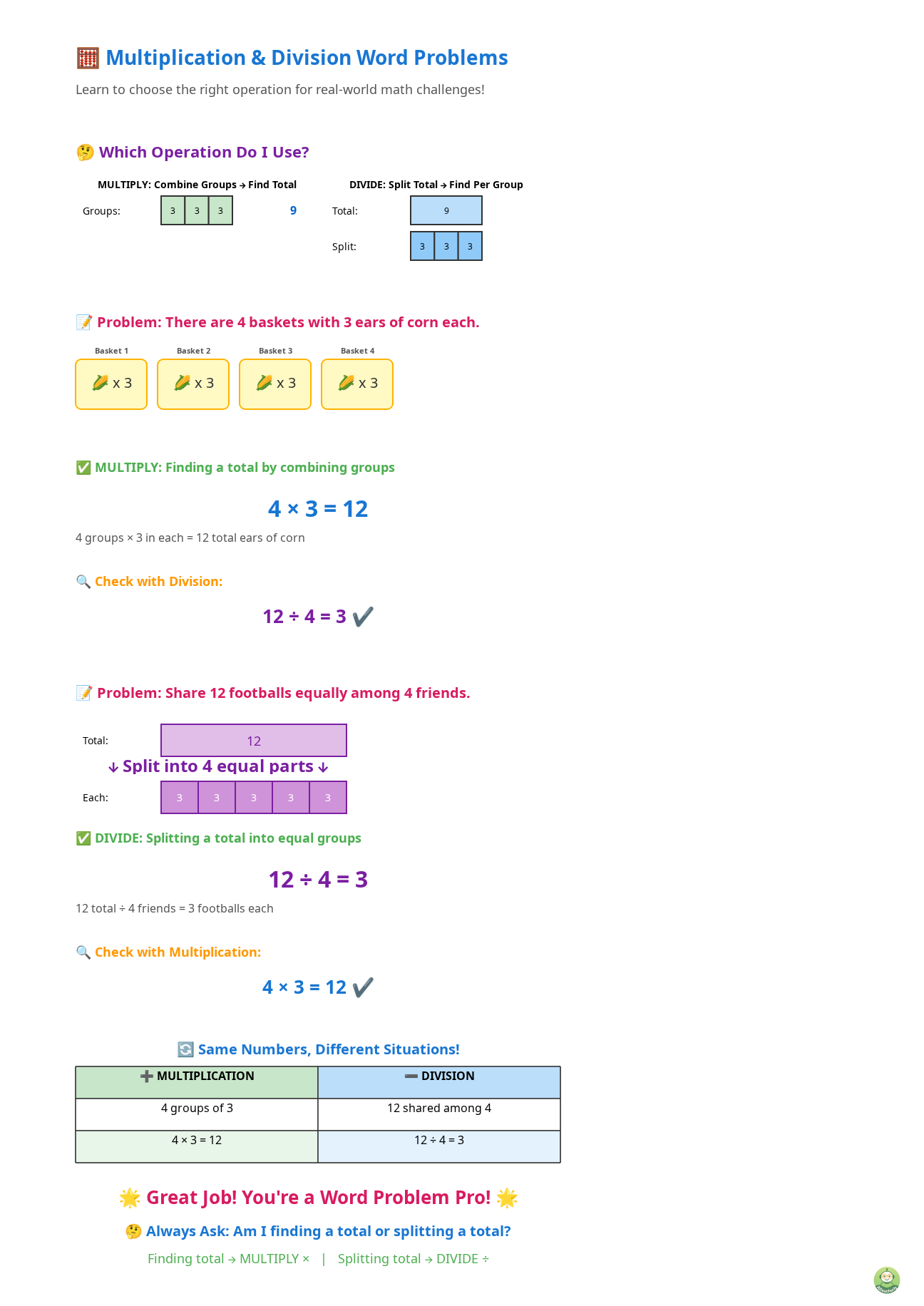
At its core, a multiplication word problem asks your child to combine equal groups to find a total amount. For example, if 4 boxes each hold 5 crayons, you are finding the grand total by multiplying 4 times 5. Conversely, a division word problem provides a total amount and asks how many are in each group or how many groups can be formed. If you have 20 crayons and want to put 5 into each box, you divide 20 by 5. Understanding this fundamental difference is the breakthrough moment for third-grade math students. Both operations rely on the exact same fact families and numbers, but they look at different parts of the story.
The Golden Rule: Are You Finding a Total or Splitting a Total?
When your third grader encounters a tricky word problem, teach them the golden rule of operational detective work by asking one simple question: Are we finding a total, or are we splitting a total? If the story describes separate groups coming together to form a bigger number, you multiply. If the story starts with a big total and shares it out into equal piles or boxes, you divide. Scanning for clue words provides an extra layer of security. Words like 'each', 'in all', and 'combined' wave a green flag for multiplication, while phrases like 'shared equally', 'divided among', and 'split' signal division.
3 Fun Ways to Practice Mixed Operations at Home
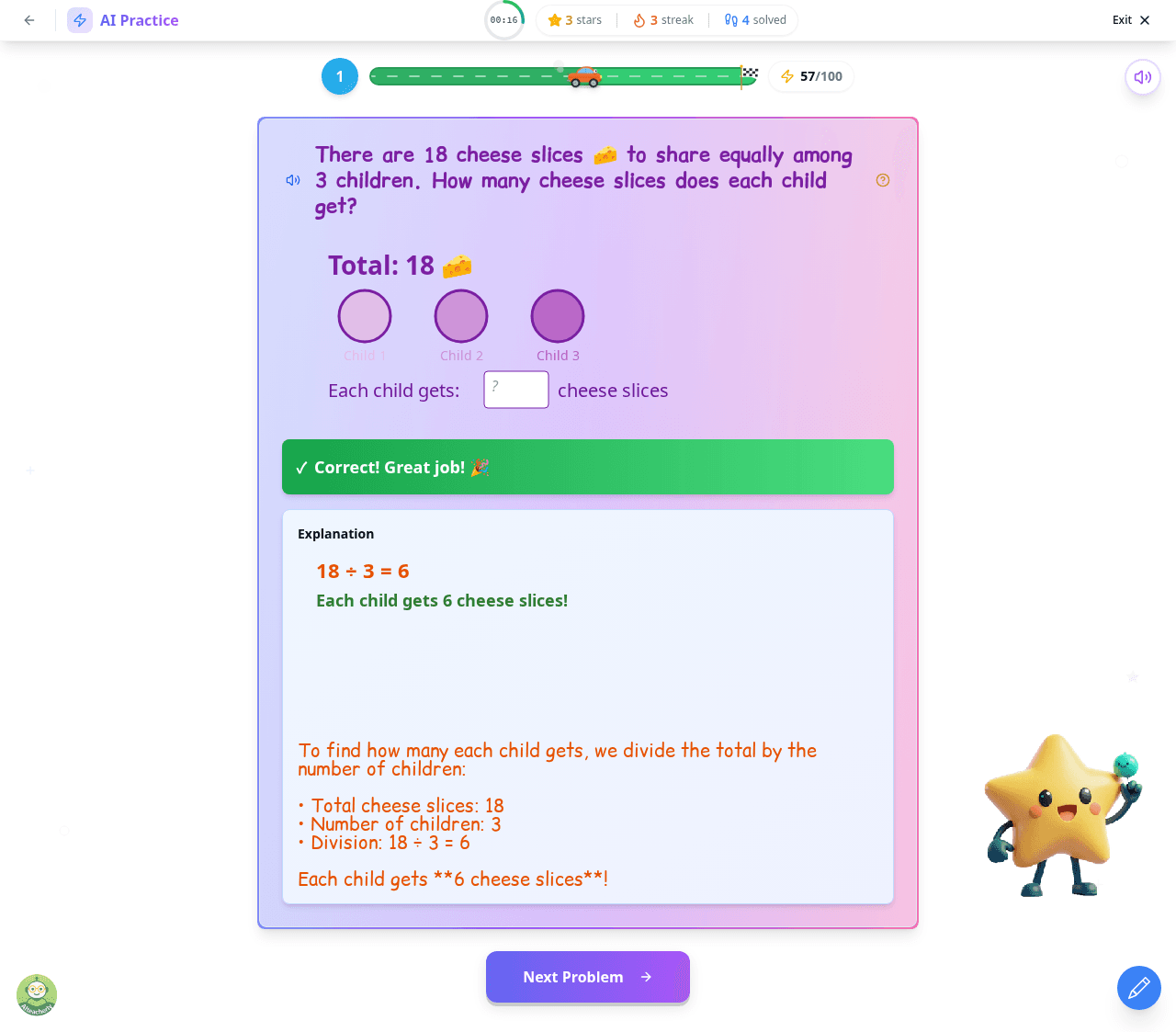
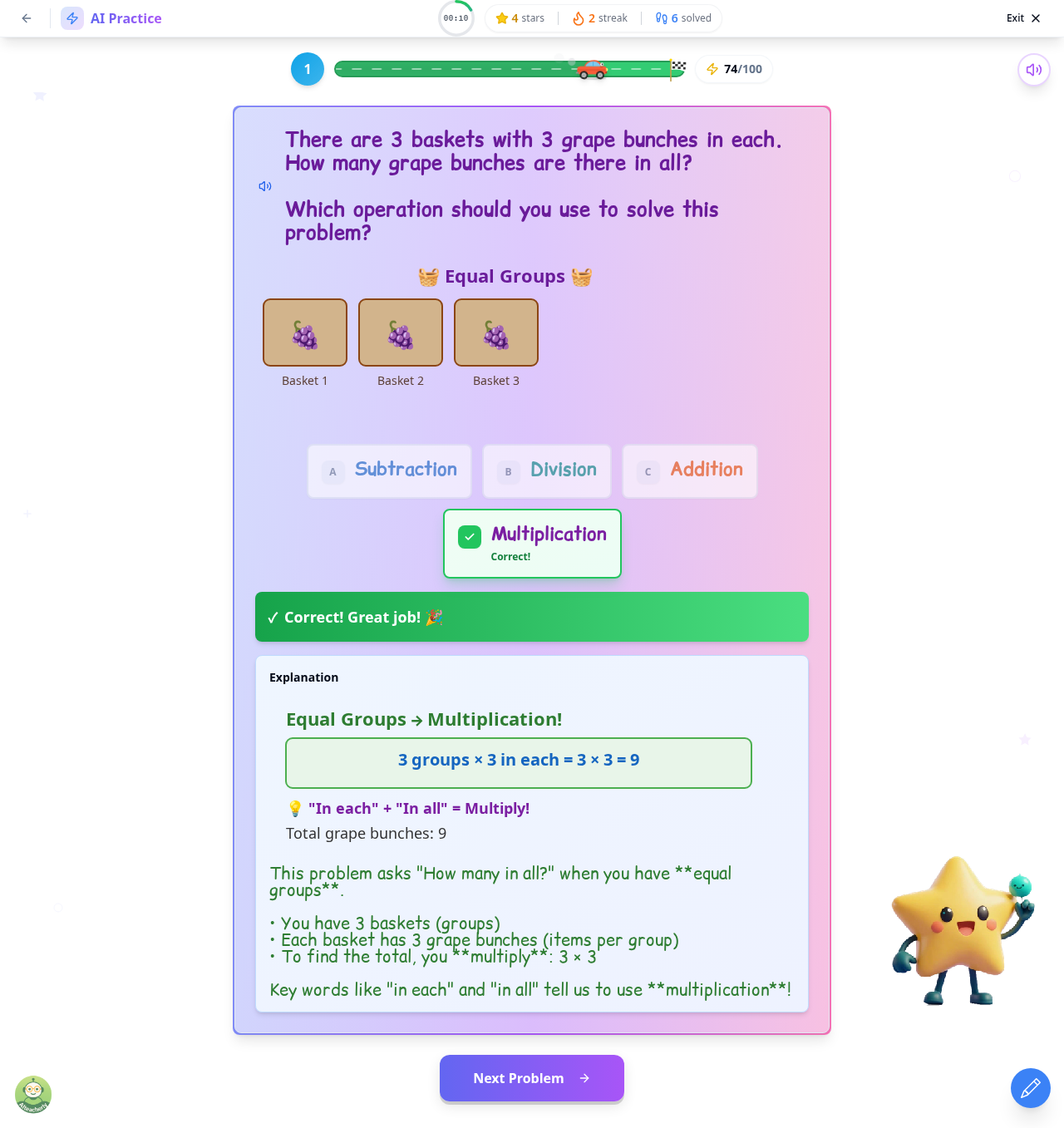
Practicing mixed operations does not have to feel like a chore. You can use everyday items like cereal pieces, buttons, or playing cards to act out math stories right on the kitchen table. Ask your child to build 3 groups of 4 crackers, then count the total. Next, take those 12 crackers and ask them to share them equally among 3 plates. Physical manipulation bridges the gap between abstract text and concrete mathematical reasoning. The interactive problem below shows exactly how children practice identifying operations in equal group scenarios.
The interactive problem below shows exactly how multiplication and division word problems work in practice.
How to Use Inverse Operations to Check Math Answers
One of the greatest gifts you can give a third grader is the ability to check their own work without asking for adult approval. In third-grade math, inverse operations are your secret weapon. If a student solves a division problem like 24 divided by 4 equals 6, they can verify their answer by multiplying the quotient by the divisor, 6 times 4 equals 24. If the starting total reappears, their answer is correct. Teaching children to double-check their multiplication using division builds incredible independence, reduces test anxiety, and teaches lifelong critical thinking skills.
See How AI Teacherly Makes Math Practice Stress-Free
Bringing interactive digital tools into your study routine takes the pressure off parents and keeps children genuinely engaged. Platforms like AI Teacherly turn traditional worksheets into dynamic learning experiences with instant feedback and visual problem-solving guides. Here's what the full interactive lesson looks like on AI Teacherly:
Here's what the full interactive lesson looks like on AI Teacherly:
Frequently Asked Questions About 3rd Grade Word Problems
To teach multiplication and division word problems, start by asking your child if the problem is asking to find a total or split a total into equal groups. Visualizing the story using small objects like buttons or counters builds instant conceptual clarity.
Key Takeaways
- Turn word problems into a detective game by asking whether you are finding a total or splitting a total.
- Look for clue words like 'each' and 'altogether' for multiplication, or 'shared equally' and 'split' for division.
- Use everyday household objects like crackers or buttons to physically model equal groups at the kitchen table.
- Teach children to use inverse operations to verify their answers independently.
- Keep study sessions short, consistent, and stress-free with interactive digital practice tools.
Frequently Asked Questions
How do I teach my 3rd grader how to choose between multiplication and division?
To teach multiplication and division word problems, start by asking your child if the problem is asking to find a total or split a total into equal groups. Visualizing the story using small objects like buttons or counters builds instant conceptual clarity.
What are the key words that signal multiplication in word problems?
Key words signaling multiplication include 'each', 'in all', 'total groups', and 'altogether'. Division key words include 'shared equally', 'split among', 'divided into', and 'each group gets'.
How can my child use division to check multiplication answers?
Children can use inverse operations by taking their multiplication product and dividing it by one of the factors. If the resulting quotient matches the other factor, their answer is correct.
Why do third graders confuse multiplication and division word problems?
Third graders often confuse these operations because both involve the exact same numbers and fact families. Without visualizing the story context, numbers feel interchangeable to young learners.
How many word problem practice sessions should we do per week?
Aim for 3 short practice sessions per week, lasting about 15 to 20 minutes each. Consistency and interactive problem-solving are far more effective than long, frustrating weekend cram sessions.
Are interactive math platforms effective for homework help?
Yes, interactive digital platforms provide immediate feedback and visual aids that transform abstract word problems into engaging problem-solving adventures.
Ready to make math practice stress-free? Explore interactive multiplication and division lessons free on AI Teacherly today!