Master 4-Digit Addition With Regrouping: A Parent's Guide
Master 4 digit addition with regrouping! Discover simple parent strategies, step-by-step place value guides, and easy ways to conquer math homework tonight.

Introduction: Mastering 4-Digit Addition Without the Tears
Fourth-grade mathematics brings a significant leap in complexity, and nothing triggers evening homework panic quite like multi-digit addition. When your child brings home a worksheet filled with large vertical equations, you might suddenly realize that school math has evolved quite a bit since you were sitting in those same desks. Words like regrouping, carrying, and place-value alignment take center stage in almost every nightly assignment. \n\nIf you have ever stared at a 4-digit addition problem wondering how best to explain it without causing tears or frustration, you are definitely not alone. Many parents feel unequipped to teach modern arithmetic methods because classrooms now emphasize conceptual understanding over rote memorization. Fortunately, mastering 4-digit addition with regrouping does not require an advanced teaching degree. With the right visual framework and a structured approach, you can transform evening math battles into moments of genuine confidence and success. This comprehensive guide walks you through everything you need to know to support your fourth-grader effortlessly, ensuring homework time becomes a peaceful bonding experience rather than a nightly struggle.
What Is 4-Digit Addition With Regrouping?
At its core, 4-digit addition with regrouping involves adding numbers in the thousands, hundreds, tens, and ones places while managing sums that exceed nine in any given column. When two digits in a single column add up to 10 or more, students cannot fit both digits into that single space. Instead, they must perform regrouping, which is traditionally known as carrying. \n\nFor example, if the tens column totals 14 tens, that is equal to 1 hundred and 4 tens. The 4 stays in the tens column, while the 1 hundred is carried over to join the hundreds column as an extra visitor. This process reinforces foundational place-value understanding, teaching children that our number system is built entirely on groups of ten. Understanding this underlying logic prevents math from feeling like an arbitrary set of confusing rules and turns it into a logical puzzle that makes complete sense. When children grasp why carrying happens rather than just following steps blindly, their retention and problem-solving skills soar to new heights.
Why Do Kids Struggle With Carrying in Column Addition?
Even bright fourth-graders frequently stumble when tackling multi-digit addition. One of the most common pitfalls is poor alignment. If numbers are scribbled hastily on lined paper and the ones column does not line up directly above the ones column below it, calculation errors multiply quickly. Another frequent stumble is forgetting to add the carry digit. A student might successfully calculate a column sum, remember to carry the extra one, and then completely ignore that little floating number when adding the digits in the next column. \n\nFurthermore, children often try to add from left to right out of reading habit, which makes incorporating carries nearly impossible since you do not yet know what is coming from the right. Recognizing these common stumbling blocks allows you to spot precisely where your child gets stuck. Instead of writing off mistakes as carelessness, you can gently redirect their attention back to place-value alignment and proper right-to-left sequencing. Patience and consistent guidance go a long way during these tricky learning phases.
Step-by-Step Guide: How to Add 4-Digit Numbers Correctly
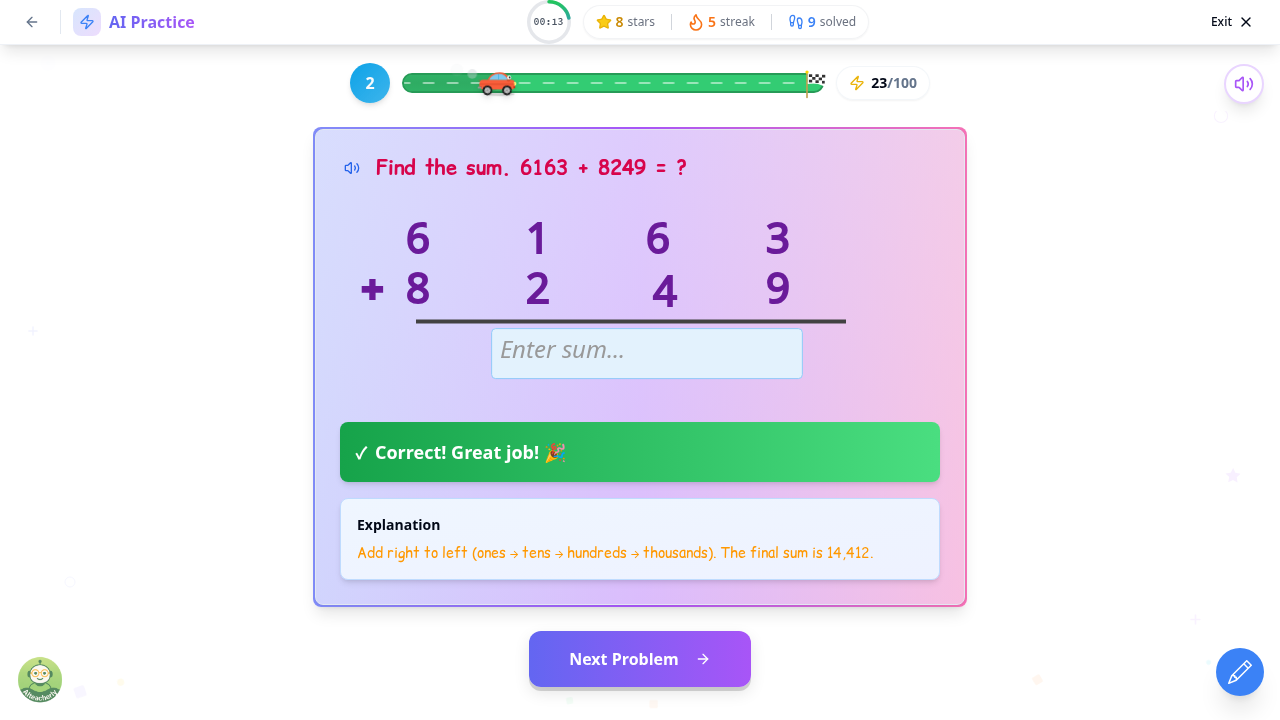
Successfully solving 4-digit addition problems requires a dependable, repeatable step-by-step routine. Breaking the calculation process down into discrete, manageable actions prevents cognitive overload and builds steady confidence. The interactive problem below shows exactly how standard vertical addition works in practice.\n\nFirst, make sure both numbers are neatly aligned in vertical columns by place value: thousands, hundreds, tens, and ones. Second, always start on the far right with the ones column. Add the two digits together. If the sum is 9 or less, write it down below the line. If the sum is 10 or more, write the second digit below the line and carry the first digit to the top of the adjacent tens column. Third, move left to the tens column, add the two given digits, and then add your carry digit on top. Repeat this exact process for the hundreds and thousands columns until the entire equation is fully solved. Checking your work by repeating the addition from bottom to top is also a fantastic habit to instill early.
Top Tips for Stress-Free Math Homework at Home
Homework time does not have to be a nightly battleground filled with sighs and slammed books. To keep things calm and productive, establish a predictable, low-pressure routine. Set aside 15 to 20 minutes of focused practice rather than pushing through hour-long exhaustion sessions where focus evaporates. Use physical or digital visual aids when your child struggles to visualize why a number is being carried. Instead of saying 'that's wrong' when an error occurs, ask guiding questions like, 'What does this column add up to, and does that number fit in a single place value space?' \n\nCelebrate small wins, whether it is successfully remembering a carry digit or neatly aligning four rows of numbers. When children feel supported rather than pressured, their math anxiety drops and their natural curiosity flourishes. Pairing these intentional at-home habits with structured digital learning tools ensures your child receives consistent, positive reinforcement that bridges the gap between school instruction and home practice.
See How Interactive Learning Makes Math Easier
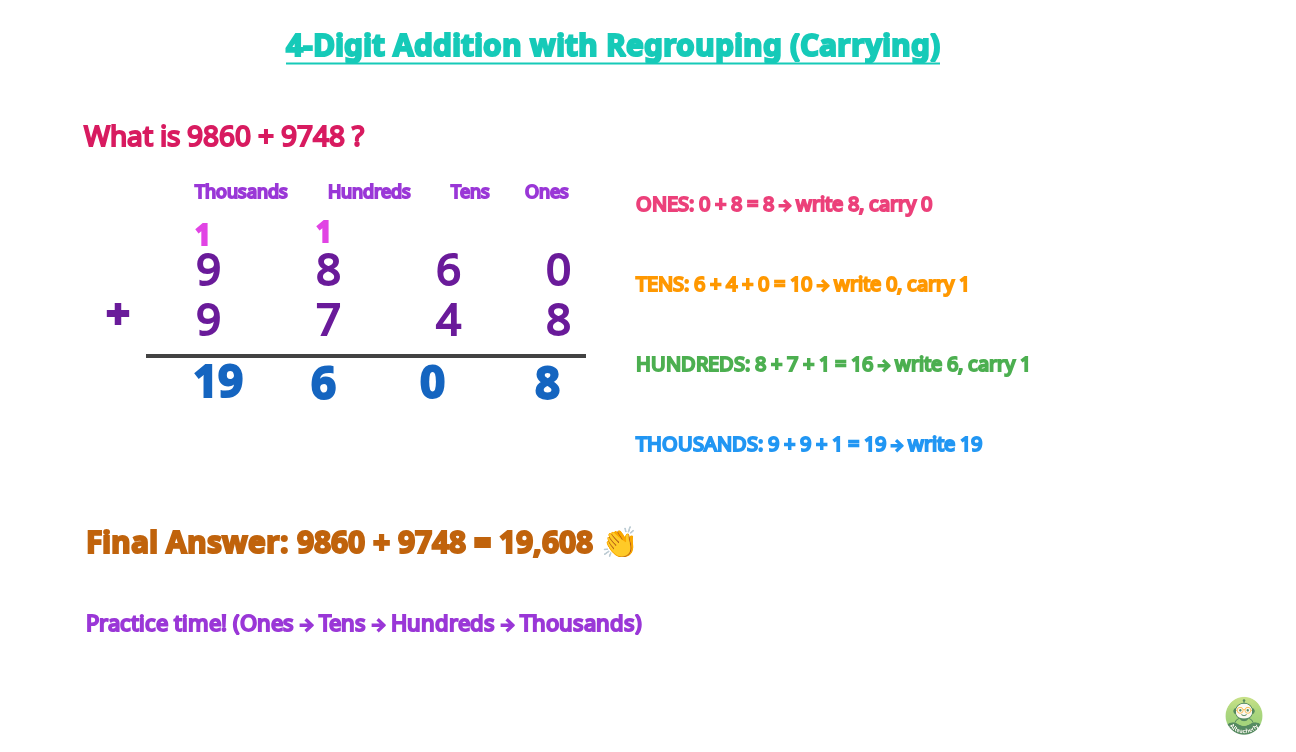
Traditional paper worksheets can feel monotonous and frustrating for active learners who crave stimulation and instant feedback. Integrating interactive technology into your child's study routine bridges the gap between passive reading and active mastery. Here's what the full interactive lesson looks like on AI Teacherly:\n\nPlatforms designed specifically for K-8 learners use visual manipulatives, instant feedback, and gamified problem-solving to make math enjoyable and rewarding. In interactive lessons covering 4-digit addition, students manipulate place-value blocks directly on screen, watch carry digits animate smoothly into their proper places, and receive gentle guidance the moment they make a calculation error. This turns necessary screen time into highly productive learning time, building long-term mathematical fluency without causing parental burnout or homework exhaustion.
Key Takeaways
- Always align numbers vertically by place value before beginning any addition calculation.
- Always start calculating from the rightmost column (ones) and move left toward the thousands.
- When a column sum reaches 10 or greater, write the single digit below and carry the tens value to the top of the next column.
- Make sure your child remembers to include the carry digit when adding the numbers in the next column.
- Use digital interactive platforms like AI Teacherly to turn repetitive drill practice into an engaging, low-stress game.
Frequently Asked Questions
How do you add 4 digit numbers with regrouping?
You add two 4-digit numbers with regrouping by aligning them vertically by place value (ones, tens, hundreds, thousands). Add the ones column first. If the sum is 10 or more, write the ones digit below and carry the tens digit over to the next column before adding the tens.
What is carrying in addition for 4th grade?
Carrying is the process of moving an excess value of 10 or more from one place-value column into the next higher column. For example, if your ones column adds up to 14, you write 4 in the ones place and carry a 1 into the tens column.
Why do kids struggle with column addition?
Kids often struggle with column addition because they forget to add the carry digit, align columns incorrectly, or lose track when moving from right to left across multiple large place values.
How to teach place value addition at home?
Start by reviewing place value using visual charts or base-ten blocks. Practice adding small numbers first, emphasizing that every time a column hits 10, a new ten or hundred moves over to the next neighbor column.
Why do we start adding from the ones column instead of the thousands?
We start adding from the ones column on the far right because any regrouped values (carries) must flow naturally into the next available place value column on the left. If you started on the left, you would have no way to incorporate carries from right-hand columns.
Is vertical addition the only way to solve 4-digit addition problems?
Yes, mental math and number line estimation are great for approximating sums, but the vertical standard algorithm is the most reliable method for accurately computing exact totals with large 4-digit numbers.
Ready to make math homework stress-free? Explore engaging interactive lessons and practice 4-digit addition free on AI Teacherly today!