Mastering 5th Grade Fraction Division: A Visual Guide for Parents
Master 5th-grade fraction division with simple visual models. Discover how to explain why dividing fractions makes numbers bigger without tears or confusing rules.
Introduction: The Great Fraction Division Paradox
When children encounter fraction division in fifth grade, a wave of panic often ripples through the household. For years, students have learned a reassuring rule: division makes numbers smaller. You start with ten candies, divide by two, and you have five. It is neat, predictable, and logical. Then fifth-grade math introduces fraction division, and suddenly dividing 4 by one-half results in 8.
The immediate reaction from students and parents alike is utter confusion. How can dividing a number possibly make it bigger? Traditional homework help often relies on chanting the mysterious rule of keep-change-flip without explaining why it works. When children do not understand the underlying concept, math turns into a frustrating memory test. Fortunately, you do not need an advanced degree to guide your child. By shifting away from rote algorithms and turning to visual models, you can help your fifth grader unlock the true logic behind fraction division. Here is how to make those tricky math concepts click at home.
Why Does Dividing by a Fraction Make Numbers Bigger?
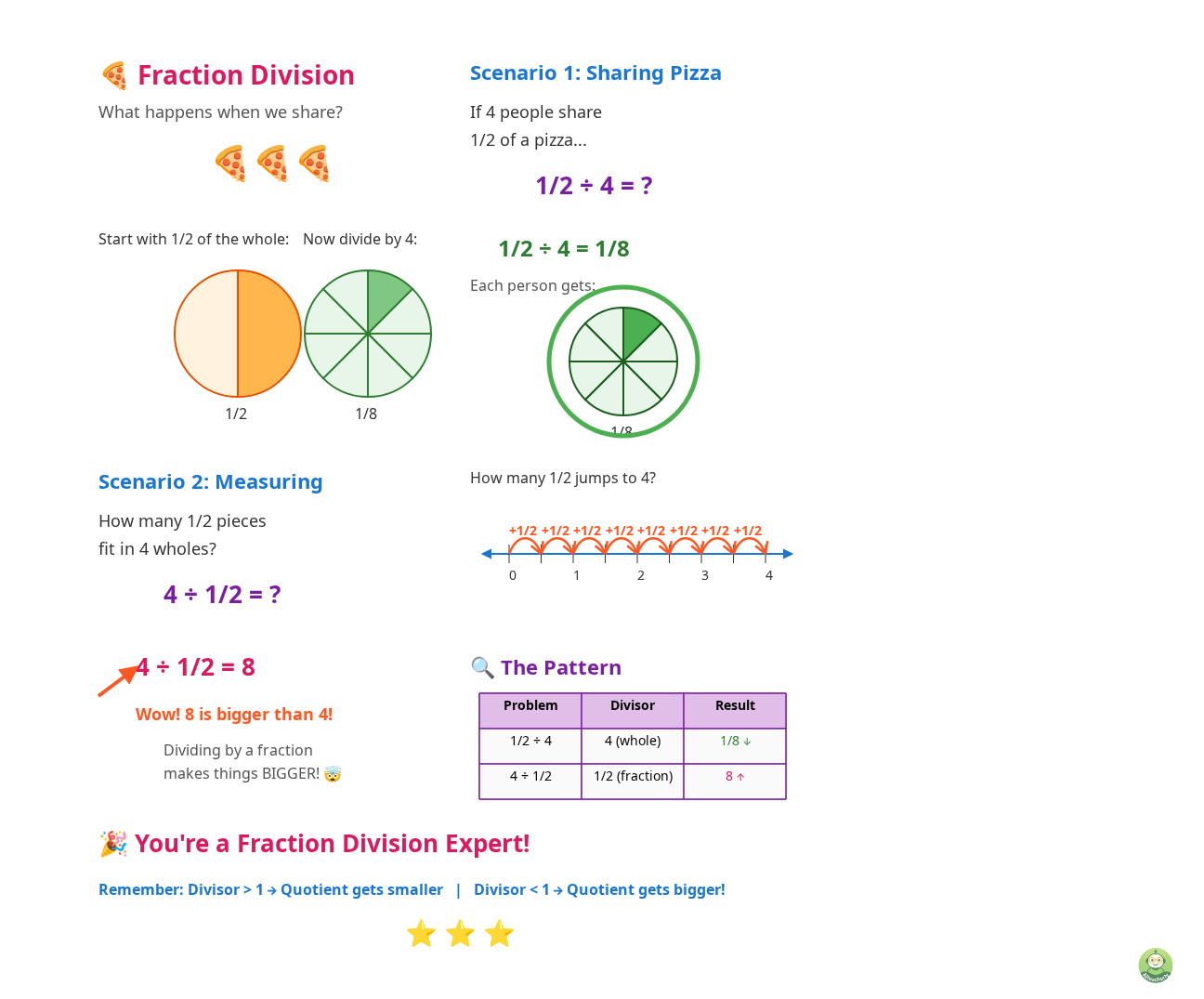
To understand fraction division, we first have to address the elephant in the room: why does the answer get larger? In elementary school arithmetic, division is almost always taught as sharing or partitioning. If you share one pizza among four friends, each person gets one-fourth. The total amount shrinks.
Fraction division, specifically dividing a whole number by a fraction, works differently. It uses measurement division, which asks a completely different question: 'How many of these fractional chunks fit inside my total?' Imagine you have 4 whole pizzas and you cut every pizza in half. How many slices do you have now? Eight slices! You divided the pizzas into halves, and your total count jumped from 4 to 8. Once children realize they are counting how many fractional pieces fit into a whole rather than sharing a single object, the paradox disappears. Understanding this fundamental shift is the secret to helping your child conquer fifth-grade math.
Method 1: Splitting Fractions with Area Models
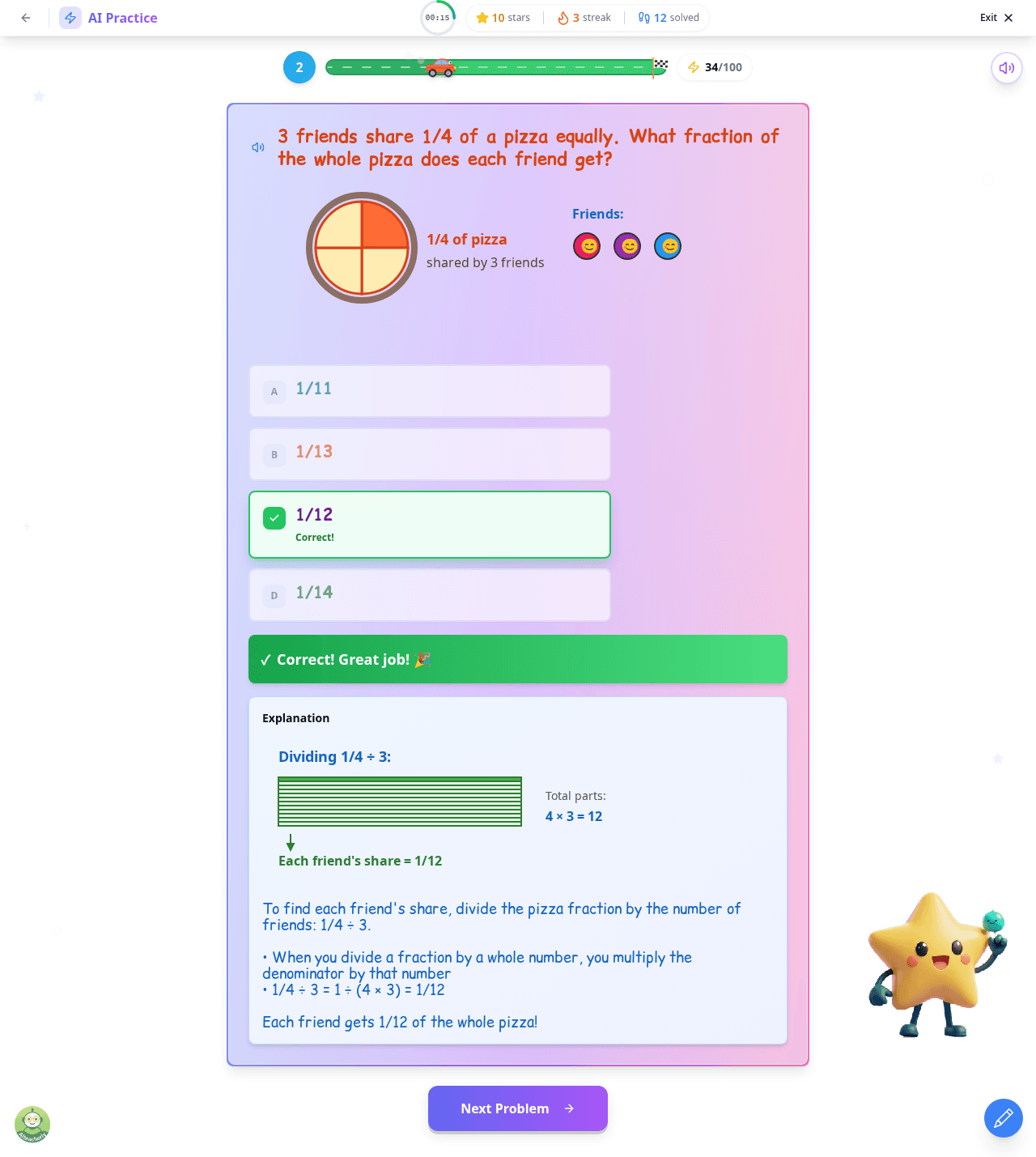
Area models are one of the most powerful tools in modern education for making abstract math visible. Instead of forcing children to memorize abstract steps, area models let them shade grids and rectangles to see the math in action. In the Understanding Fraction Division with Visual Models lesson on AI Teacherly, students interact with colorful grids that demonstrate how fractions are partitioned and measured. Here's what the full interactive lesson looks like on AI Teacherly:
When students divide a unit fraction by a whole number, such as one-third divided by four, they use an area model to shade one-third of a rectangle and then split that section into four equal parts. By physically seeing that each new piece is one-twelfth of the whole, children connect multiplication and division naturally. They realize that dividing a fraction by a whole number actually creates smaller pieces, while dividing a whole number by a fraction creates more pieces. Area models remove the mystery by giving students a tangible picture they can trust.
Method 2: Counting Jumps on Number Lines
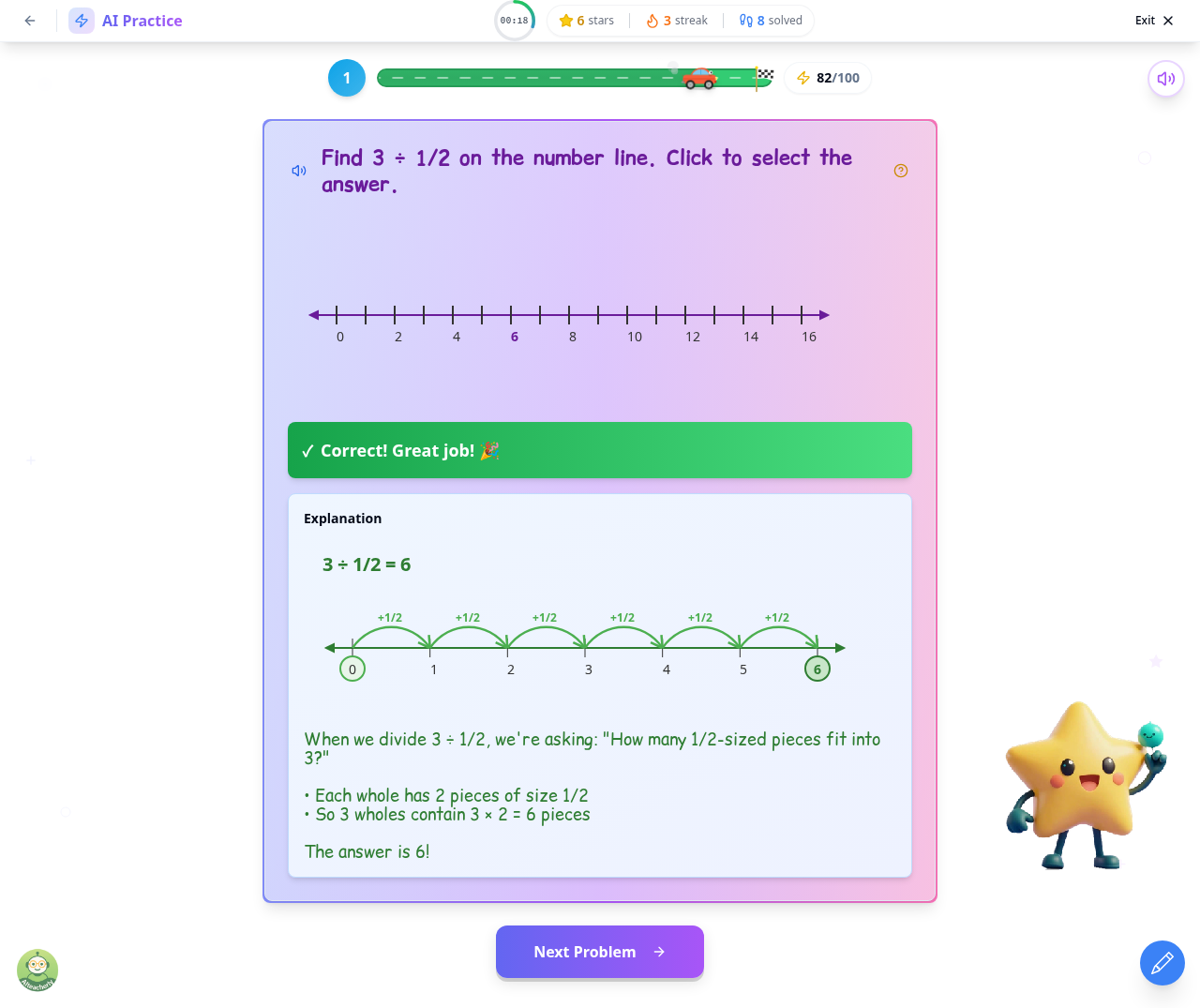
Another fantastic visual strategy for fifth graders is the number line. While area models excel at showing parts of a whole, number lines are champions of measurement division. They allow students to hop across intervals and literally count how many fractional steps fit into a given distance. The interactive problem below shows exactly how PEMDAS works in practice.
Imagine your child needs to solve 3 divided by one-fourth. On an interactive number line, they draw a line from zero to three. Then, they divide each whole number unit into four equal segments representing fourths. By counting how many one-fourth jumps it takes to travel from zero to three, they land directly on 12. There is no guessing and no arbitrary rule memorization required. They simply count the jumps. Using number lines transforms a confusing abstract equation into a fun game of distance and counting, building immense confidence in students who usually feel intimidated by fractions.
3 Ways to Practice Fraction Division at Home Without Tears
Helping your fifth grader master fraction division does not require sitting at a kitchen table with heavy workbooks for hours. In fact, short and engaging sessions work best. Here are three practical ways you can reinforce these visual concepts at home without tears:
First, use real food. Pizza, brownies, and chocolate bars are natural fraction manipulatives. Ask your child questions like, 'If we have two whole brownies and cut them into quarters, how many pieces do we have?' Connecting math to snacks grounds abstract numbers in physical reality.
Second, embrace interactive digital learning platforms. Tools like AI Teacherly provide guided visual exercises where students can drag pieces, test hypotheses, and get instant supportive feedback. This eliminates the frustration of waiting until the next school day to find out if an answer was correct.
Third, ask your child to teach you. When a child explains why dividing by one-half results in a larger number using their own words, you immediately know whether they have grasped the concept. Teaching builds deep ownership and turns homework time into an empowering conversation rather than a battle of wills.
Common Parent FAQs on 5th Grade Fractions
Parents often have questions about how fraction division fits into the broader 5th-grade curriculum. Here are direct answers to the most common questions families ask:
Is it normal for kids to struggle with fraction division? Absolutely. The rule that division always makes numbers smaller applies to whole numbers, but fraction division shatters that assumption. Confusion is a normal part of building deep mathematical intuition.
Do kids need to memorize keep-change-flip right away? Rote memorization often leads to mistakes because students forget whether to flip the first or second fraction. Visual models build long-term conceptual understanding so the steps finally make sense before algorithms are introduced.
How long should my child practice daily? For fifth graders, twenty to thirty minutes of focused, interactive practice is ideal. Short, consistent sessions beat hour-long cramming every single time.
Conclusion and Key Takeaways
Fifth-grade fraction division does not have to be a source of evening anxiety. By stepping away from rote memorization and embracing visual area models and number lines, children can finally see why dividing by a fraction yields a larger number. Whether you use real-world pizza slices or interactive digital lessons on AI Teacherly, making math visual transforms confusion into confidence. Try these strategies today and watch your child master fractions with ease!
Key Takeaways
- Fraction division often produces larger numbers because you are measuring how many small fraction parts fit into a total.
- Area models transform abstract fractions into colorful visual grids that make partitioning intuitive and fun.
- Number lines help children visualize measurement division by counting jumps of fractional sizes.
- Skipping rote rules like keep-change-flip in favor of visual exploration prevents math anxiety and builds lasting confidence.
- AI Teacherly provides interactive 5th-grade math lessons that guide students through fraction division step-by-step.
Frequently Asked Questions
Why does dividing a fraction make the number bigger?
When you divide by a fraction less than one, you are asking how many fractional parts fit into a given amount. Because those parts are smaller than a whole, more of them fit inside, resulting in a larger quotient.
How do you explain fraction division to a 5th grader?
Start with real-world objects like pizza slices or chocolate bars. Instead of jumping straight to algorithms, use visual area models and number lines so they can actually see the fractions being divided into groups.
What is an area model for dividing fractions?
An area model is a visual grid representing a whole quantity where rows and columns are shaded to show fractions. It helps students physically see how dividing a fraction results in larger parts or smaller sections.
Can I use number lines to teach fraction division at home?
Yes! Number lines are fantastic for measurement division. For example, to divide 4 by 1/2, students can count how many half-step jumps fit into 4 whole units, arriving at an answer of 8.
Is it normal for kids to struggle with fraction division?
Absolutely. The rule that division always makes numbers smaller applies to whole numbers, but fraction division shatters that assumption. Confusion is a normal part of building deep mathematical intuition.
Do kids need to memorize keep change flip right away?
Rote memorization often leads to mistakes because students forget whether to flip the first or second fraction. Visual models build long-term conceptual understanding so the steps finally make sense.
Ready to make math click for your child? Explore interactive lessons on fraction division and more, completely free on AI Teacherly!