Missing Number Addition for 1st Graders: 2 Simple Strategies Every Parent Can Teach
Discover two simple strategies to teach your 1st grader missing number addition. From counting on to using subtraction, these parent-friendly tips turn homework confusion into math confidence.
Your Child's First Algebra Problem (Yes, Really!)
That blank box in your 1st grader's math homework might look simple, but it's actually your child's first taste of algebra. Problems like 5 + ___ = 9 aren't just about finding a missing number; they're teaching your child to think like a mathematician by solving for unknown values.
If you've ever felt stumped when your child brings home these "missing addend" problems, you're not alone. Many parents wonder how to explain this concept without just giving away the answer. The good news? You don't need to be a math expert to help. In this guide, you'll discover two powerful strategies that make missing number addition click for 1st graders.
By the end of this post, you'll know exactly how to explain the counting on strategy, show how subtraction and addition work together as a team, practice these skills at home in just 5 minutes a day, and recognize why these problems matter for your child's long-term math success.
What Is a Missing Addend and Why Does It Matter?
A missing addend is simply a number that's hiding in an addition equation. Instead of solving 5 + 4 = ___, your child sees 5 + ___ = 9 and must figure out what number goes in the blank.
This might seem like a small twist, but it's actually a fundamental shift in mathematical thinking. When children learn to find missing addends, they're developing early algebraic reasoning, which is a skill they'll use all the way through high school math and beyond.
Why do 1st graders learn missing number problems?
These problems teach children that equations are balanced (both sides must be equal), numbers can be unknown and discovered through reasoning, addition and subtraction are connected operations, and math is about problem-solving rather than just memorizing facts.
Research shows that students who master missing addend concepts in early grades have stronger algebra skills later on. So when your child works on these problems, they're building a foundation that will serve them for years to come.
Strategy 1: How to Use Counting On to Find Missing Numbers
The counting on strategy is often the first method 1st graders learn for missing addend problems. It's visual, concrete, and easy to practice anywhere.
Here's how it works:
Let's say your child sees: 5 + ___ = 9
- Start at the number you know (5)
- Count forward until you reach the answer (9)
- The number of "hops" you made is the missing number
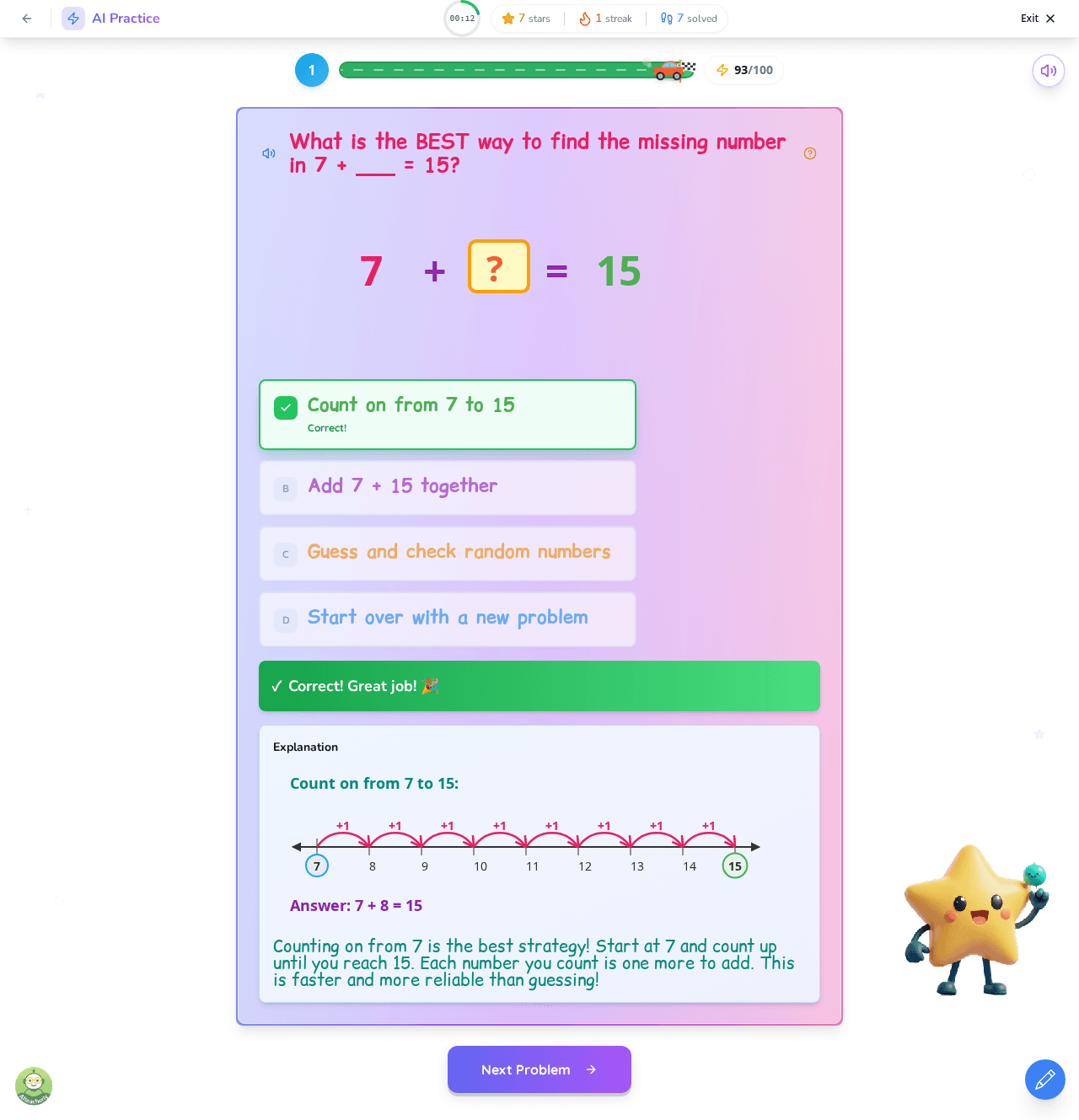
So counting from 5: "6, 7, 8, 9" takes 4 hops. The missing number is 4!
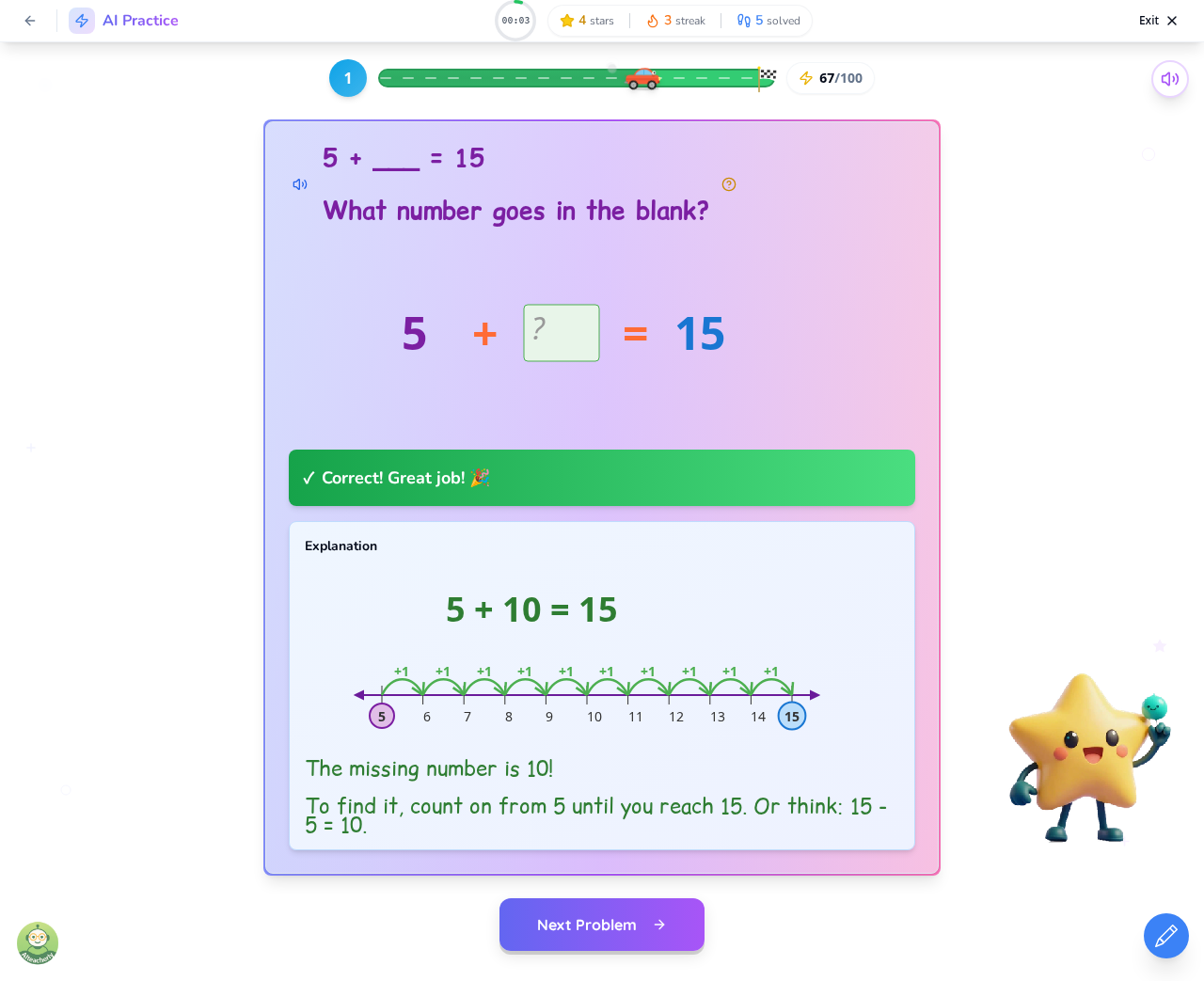
Using a number line makes this even clearer. Draw a simple line with numbers 0 through 10. Have your child put their finger on 5, then hop to each number while counting until they land on 9. Those four hops become visible and tangible.
The interactive problem below shows exactly how this counting on strategy works in practice:
Tips for practicing counting on at home:
- Use your fingers to count the hops
- Draw number lines on paper or use a ruler
- Practice while walking: "We're on step 5, how many more to step 9?"
- Make it a game: "I'm thinking of a number. 3 plus my number equals 7. Can you count on to find it?"
Strategy 2: How Subtraction Solves Addition Problems
Here's where the magic happens. Once your child understands that addition and subtraction are a team, missing number problems become much easier.
The secret: To find a missing addend, you can subtract!
For 5 + ___ = 9, your child can think: "What's 9 minus 5?" The answer, 4, is the missing number.
Why does this work?
Addition and subtraction are inverse operations (they undo each other). This relationship is called a fact family. For the numbers 5, 4, and 9, the fact family includes:
- 5 + 4 = 9
- 4 + 5 = 9
- 9 - 5 = 4
- 9 - 4 = 5
When children see that these four equations all use the same three numbers, a lightbulb goes off. They realize math isn't about memorizing hundreds of separate facts; it's about understanding how numbers relate to each other.
How to explain this to your child:
"Remember how we can take apart what we put together? If 5 and something make 9, we can take 5 away from 9 to find that something!"
Practice by giving your child addition problems and asking them to write the subtraction fact that helps solve it. This builds flexible thinking and strengthens their number sense.
See Missing Number Practice in Action on AI Teacherly
Interactive practice makes all the difference when learning missing addend problems. On AI Teacherly, the Find the Missing Number in Addition lesson for Grade 1 turns these concepts into an engaging, game-like experience.
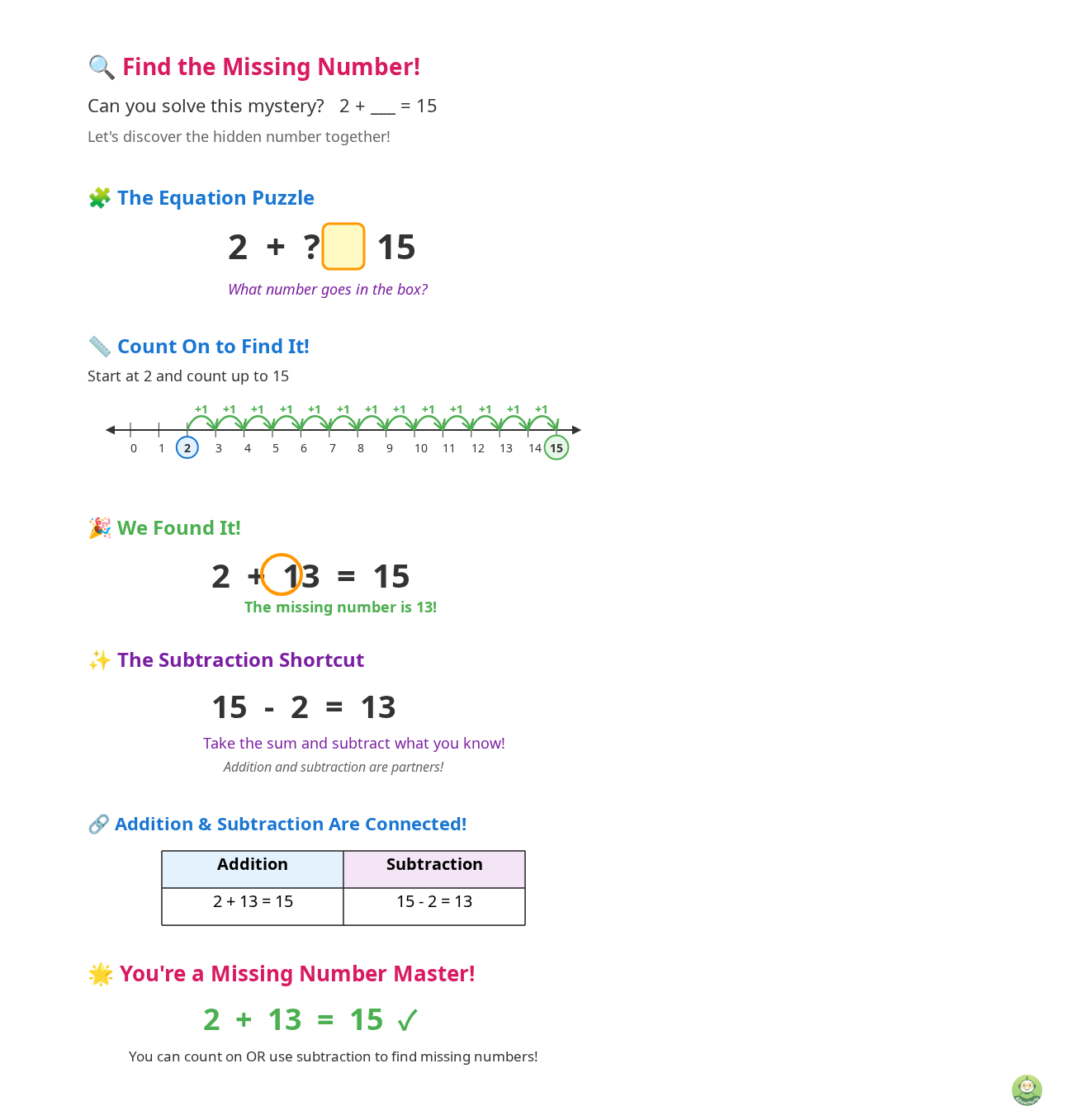
Here's what the full interactive lesson looks like on AI Teacherly:
What makes this lesson special:
Visual number lines: Students don't just hear about counting on; they see animated hops on a number line that make the strategy concrete and memorable.
Number detective framing: The lesson introduces problems by saying, "Today we're number detectives! See the equation? One number is hiding. Let's find it together!" This playful approach reduces math anxiety and builds curiosity.
Strategy connections: The lesson explicitly teaches that "Addition and subtraction are connected. They're a team!" helping students see the relationship between operations.
Real-world word problems: Problems like "Sam has 3 stickers but needs 8 total" show children how missing addend math applies to everyday situations.
Immediate feedback: When students answer, they get instant encouragement and correction, reinforcing learning in real-time.
The lesson takes about 25 minutes and covers everything from basic missing addend equations to word problems, giving your child comprehensive practice with both strategies.
Tips for Practicing Missing Addend Problems at Home
You don't need fancy materials to reinforce missing number addition. Here are practical ways to practice in just 5 to 10 minutes a day:
1. Kitchen Math While cooking: "We need 8 crackers for our snack. I've put 3 on the plate. How many more do we need?" This is a missing addend problem in disguise!
2. Toy Counting "You have 4 toy cars. You want 10 total for your race. How many more do you need to find?"
3. Stair Steps "We're on step 2. The top is step 7. How many more steps do we need to climb?" Count together as you go up.
4. Card Games Use a deck of cards (remove face cards). Pick two cards. One is the starting number, one is the total. Find the missing addend!
5. Daily Check-Ins During homework time, ask your child to explain their strategy. "How did you figure that out?" This builds metacognition and helps you identify any confusion early.
What to do if your child struggles:
- Go back to concrete objects (use blocks, coins, or snacks)
- Slow down and use smaller numbers first (sums to 5 before sums to 10)
- Celebrate effort, not just correct answers
- Keep practice sessions short and positive
Remember, some children take longer to grasp missing addend concepts, and that's completely normal. Consistent, low-pressure practice is more effective than long, stressful sessions.
Key Takeaways
- Missing addend problems (like 5 + ___ = 9) are your child's introduction to algebraic thinking and build skills they'll use through high school
- The counting on strategy uses a number line or finger counting to hop from the known number to the answer
- Subtraction can solve addition problems because addition and subtraction are inverse operations (a fact family)
- Interactive practice with visual tools like number lines helps make abstract concepts concrete and memorable
- Just 5-10 minutes of daily practice using everyday situations (cooking, toys, stairs) reinforces these skills naturally
- If your child struggles, use smaller numbers and concrete objects before moving to abstract equations
Frequently Asked Questions
What is a missing addend problem in 1st grade math?
A missing addend problem is an addition equation where one number is unknown, like 5 + ___ = 9. Instead of finding the sum, children find the missing number that makes the equation true.
How do I explain missing number addition to my child?
Use the phrase 'number detective' and explain that one number is hiding. Show two strategies: count on from the known number, or subtract to find what's missing. Use objects like blocks to make it concrete.
What is the counting on strategy for finding missing numbers?
Start at the known addend, then count forward until you reach the sum. The number of counts (or 'hops') is the missing number. For 5 + ___ = 9, count '6, 7, 8, 9' which is 4 hops, so the answer is 4.
How does subtraction help solve missing addend problems?
Since addition and subtraction are inverse operations, you can subtract to find a missing addend. For 5 + ___ = 9, think '9 - 5 = 4' to find the missing number is 4.
Why are missing addend problems important for my child's math development?
These problems introduce algebraic thinking, teaching children that unknown values can be found through reasoning. This foundational skill builds number sense and prepares them for solving equations in higher grades.
What if my child struggles with missing number problems?
Go back to concrete objects like blocks or counters. Use smaller numbers (sums to 5) before progressing to larger ones. Keep practice sessions short (5-10 minutes) and positive. Consistent practice helps more than long sessions.
Are missing number problems the same as early algebra?
Yes! Finding unknown values in equations is the core of algebra. When 1st graders solve 5 + ___ = 9, they're using the same reasoning they'll apply to solve x + 5 = 9 in later grades.
How can I practice missing addend problems at home without worksheets?
Use everyday situations: 'We have 3 apples, we need 7. How many more?' Practice on stairs, with toys, during cooking, or with playing cards. These real-world contexts make math meaningful and fun.
Ready to make missing number practice fun? Try the interactive Find the Missing Number in Addition lesson free on AI Teacherly and watch your 1st grader become a confident number detective!