Number Line Multiplication for 2nd Graders: The Visual Jumping Method That Makes Times Tables Click
Discover how the jumping method makes multiplication visual and fun for 2nd graders. Learn why number lines connect addition skills to times tables, with easy at-home activities.
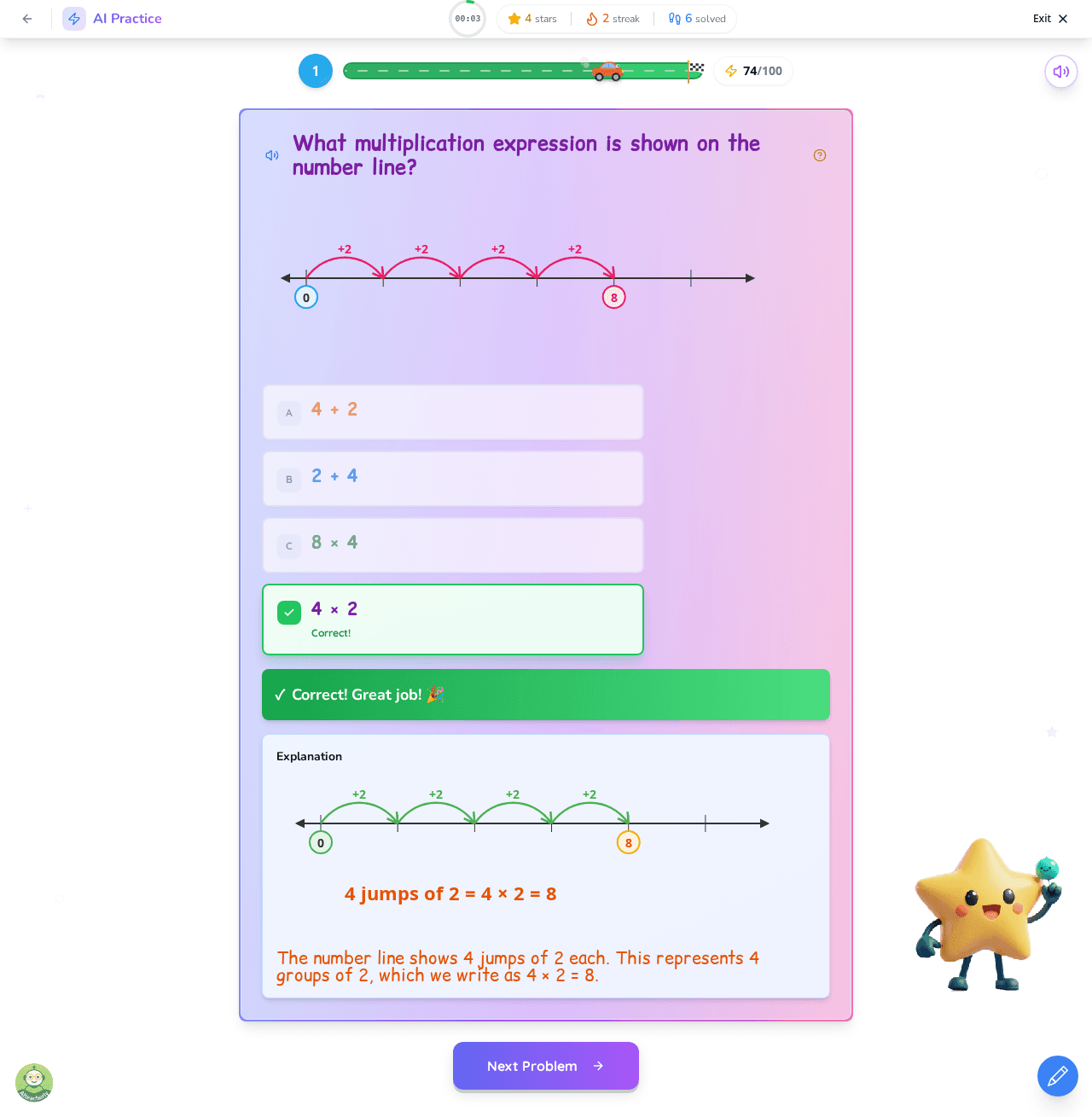
Why Number Lines Make Multiplication Click for 2nd Graders
If your 2nd grader is just starting to learn multiplication, you might notice something familiar in their homework: the number line. This simple tool, which your child has been using since kindergarten, is now becoming the key to unlocking a whole new math skill.
Here's the good news: your child already knows how to add. And that existing skill is exactly what makes number line multiplication so powerful. Instead of memorizing abstract facts like "4 times 3 equals 12," children physically see what multiplication means by making equal jumps along the number line.
Many parents remember learning times tables through repetition and flash cards. While memorization has its place, research shows that children who first understand why multiplication works have an easier time memorizing facts later. The number line provides that crucial "why" by showing multiplication as a visual pattern.
Think of it this way: when your child adds 3 + 3 + 3 + 3, they're already doing multiplication. They just don't know the shortcut yet. The number line method reveals this connection, transforming something unfamiliar into something they recognize. That "aha moment" builds both confidence and genuine understanding.
What Is Number Line Multiplication? (The Jumping Method Explained)
Number line multiplication, often called the "jumping method," teaches children to visualize multiplication as making equal-sized hops along a number line. Each jump represents one group, and the size of each jump represents how many are in that group.
Let's break it down with an example. If your child needs to solve 4 × 3, they would:
- Start at zero on the number line
- Make 4 jumps (because the first number tells us how many jumps)
- Each jump is 3 spaces (because the second number tells us the jump size)
- Land on 12 (the answer!)
The magic of this method is that children can literally count their way to the answer while building a mental picture of what "4 groups of 3" actually means. They're not just memorizing that 4 × 3 = 12; they're seeing it happen.
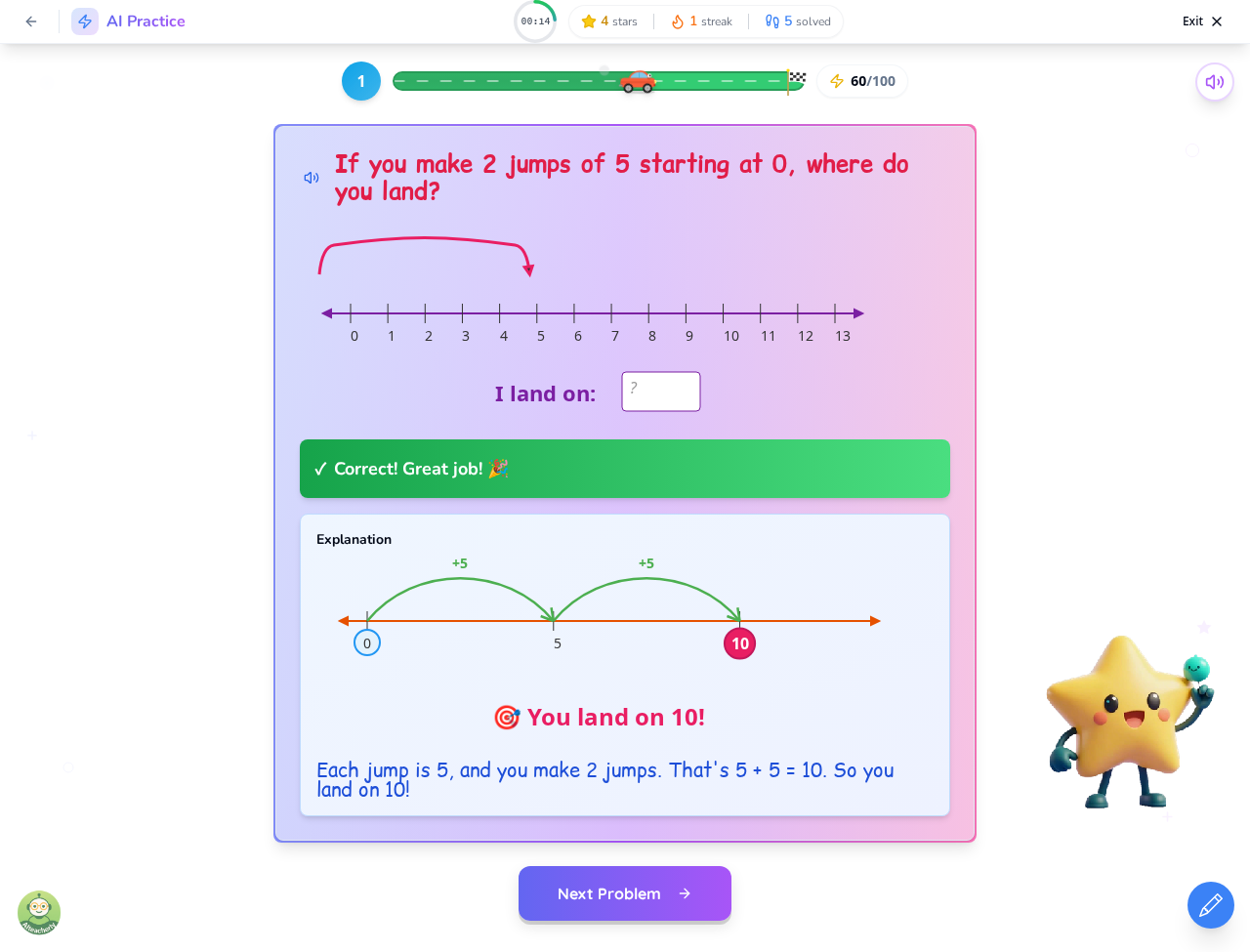
The interactive problem below demonstrates exactly how the jumping method works in practice:
What makes this approach so effective is the consistency: each jump is always the same size. This reinforces the concept of "equal groups," which is the foundation of multiplication. When children internalize that multiplication means "same-sized groups," they've grasped one of the most important concepts in elementary math.
How Does Repeated Addition Connect to Multiplication?
Here's a secret that makes multiplication much less scary: multiplication is just a shortcut for repeated addition. And your 2nd grader is already an expert at addition.
When your child adds 5 + 5 + 5, they're essentially doing 3 × 5. The multiplication symbol is just a faster way to write "add this number this many times." The number line makes this connection crystal clear because children can see both representations simultaneously.
Consider this progression:
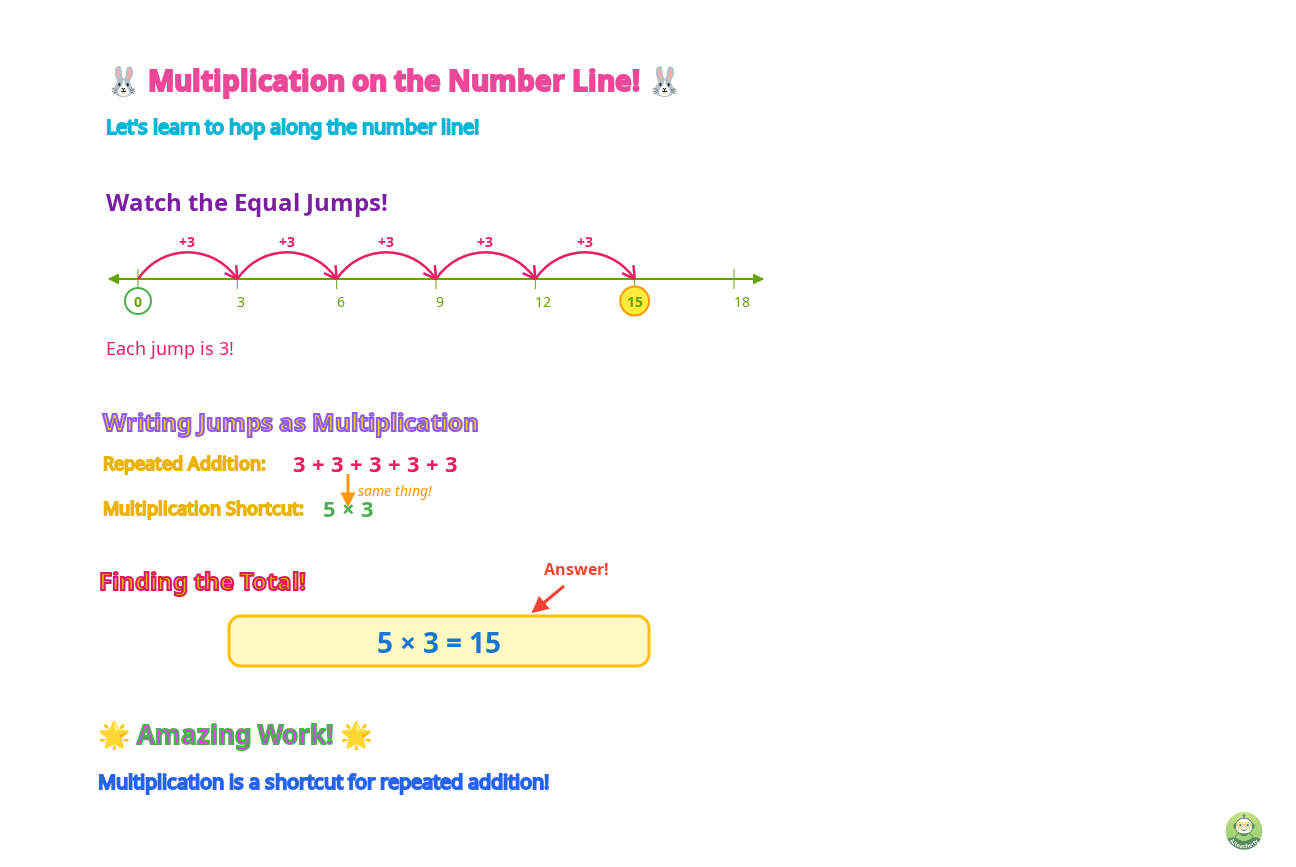
- Repeated addition: 3 + 3 + 3 + 3 = 12
- Counting jumps: Start at 0, jump by 3 four times, land on 12
- Multiplication notation: 4 × 3 = 12
All three expressions mean exactly the same thing! When children see this connection, multiplication stops being a mysterious new operation and becomes a natural extension of something they already know.
This is why educators love the number line approach. Instead of presenting multiplication as an entirely new concept that requires memorizing 100+ facts, it builds on existing knowledge. Children gain confidence because they have a fallback strategy. If they ever forget a multiplication fact, they can always use repeated addition or visualize the jumps to figure it out.
As your child's teacher might say: "Multiplication is just a quicker way to add the same number over and over again." The number line proves this statement true in a way children can see and touch.
Why This Visual Method Works Better Than Memorization First
You might be wondering: "Shouldn't my child just memorize the times tables?" Eventually, yes. But research consistently shows that understanding before memorizing leads to better long-term retention and problem-solving skills.
Here's why the visual number line method creates stronger mathematicians:
1. It Builds Number Sense Children who use number lines develop a stronger intuition for how numbers relate to each other. They understand that 6 × 4 is bigger than 6 × 3 because they've seen the jumps go further.
2. It Reduces Math Anxiety When children have a visual strategy they can rely on, they feel less anxious about getting the "wrong answer." They know they can always draw a number line and figure it out.
3. It Creates Connections The jumping method connects multiplication to addition, subtraction (jumping backwards), and even division (how many jumps to reach a number?). This interconnected understanding is exactly what mathematicians use.
4. It Makes Memorization Easier Later Here's the paradox: children who spend time understanding multiplication visually often memorize facts faster than those who start with rote memorization. Why? Because the facts make sense to them. They're not random combinations of numbers; they're patterns with meaning.
So when your child's teacher uses number lines, they're not avoiding "real math." They're building the foundation that makes "real math" stick.
See Number Line Multiplication in Action on AI Teacherly
Reading about number line multiplication is helpful, but seeing it in action is even better. On AI Teacherly, the Multiplication on the Number Line lesson brings this concept to life with interactive visuals that let children practice the jumping method at their own pace.
Here's what the full interactive lesson looks like on AI Teacherly:
In this lesson, 2nd graders work through problems where they:
- Make jumps on animated number lines and see exactly where they land
- Connect their jumps to multiplication expressions (translating visual to written math)
- Practice with varying jump sizes and counts to build fluency
- Get immediate feedback that reinforces correct understanding
What parents love about this approach is that children can practice independently. The visual format means they don't need an adult standing over them explaining each problem. The animated number lines show the jumps happening, so children can self-correct and learn from their attempts.
The lesson also progresses naturally from easier problems (fewer jumps, smaller numbers) to more challenging ones, building confidence along the way. By the end, most children are starting to recognize patterns: "Oh, 3 jumps of 5 always lands on 15!"
This is exactly how memorization should happen: through pattern recognition, not flash cards.
5 Easy Ways to Practice Number Line Jumps at Home
The best part about number line multiplication? You can practice it anywhere, without worksheets or screens. Here are five parent-approved activities:
1. Sidewalk Chalk Number Lines Draw a number line from 0 to 30 on your driveway or sidewalk. Have your child physically jump along it while you call out problems: "Show me 4 jumps of 3!" The full-body movement helps kinesthetic learners internalize the concept.
2. Tape on the Floor No outdoor space? Use painter's tape to create a number line on your hallway floor. Small toys can "hop" along instead of your child jumping.
3. The Staircase Game If you have stairs, each step can represent a number. "Start at the bottom. Take 3 steps, 4 times. Where do you end up?" (Make sure to supervise for safety!)
4. Snack Time Math Arrange crackers or grapes in groups. "We have 5 groups of 2 crackers. Let's count by 2s to see how many total." Then show how this becomes 5 × 2 = 10.
5. Story Problems Make up simple scenarios: "If a bunny takes 4 hops and each hop is 3 feet, how far did the bunny go?" Children love imagining animals jumping along an invisible number line.
The key is keeping it playful. These activities shouldn't feel like homework. When children associate multiplication with fun movement and games, they develop a positive relationship with math that lasts.
Key Takeaways
- Number line multiplication works because it connects what your child already knows (addition) to what they're learning (multiplication)
- The "jumping method" shows multiplication as equal-sized hops, making the concept of "groups of" visual and concrete
- Repeated addition is the key insight: 3 + 3 + 3 + 3 is the same as 4 × 3, and the number line proves it
- Understanding before memorizing leads to better long-term retention and less math anxiety
- Interactive lessons like AI Teacherly's Multiplication on the Number Line let children practice visually at their own pace
- Home activities like sidewalk chalk number lines make practice fun and reinforce learning through movement
- When children see WHY multiplication works, memorizing facts becomes easier and more meaningful
Frequently Asked Questions
What is number line multiplication and how does it work?
Number line multiplication is a visual method where children make equal-sized jumps along a number line. For 4 × 3, they start at zero, make 4 jumps of 3 spaces each, and land on 12. It shows multiplication as repeated addition in a visual way.
Why do schools teach multiplication with number lines instead of flash cards?
Number lines build conceptual understanding before memorization. Research shows children who understand WHY multiplication works have better long-term retention and less math anxiety than those who only memorize facts.
How do I explain 'groups of' to my 2nd grader?
Use the jumping method! Show that 3 × 4 means '3 jumps of 4.' Each jump is a group. You can also use physical objects: '3 groups of 4 crackers.' The number line makes groups visible as equal-sized hops.
Is it normal for 2nd graders to struggle with multiplication?
Absolutely! Multiplication is one of the biggest conceptual leaps in early math. It's completely normal for children to need visual supports like number lines before they can work with abstract multiplication facts.
What's the connection between repeated addition and multiplication?
They're the same thing! 5 + 5 + 5 is identical to 3 × 5. Multiplication is simply a shortcut for adding the same number multiple times. The number line shows both representations at once, making the connection clear.
How can I practice number line multiplication at home without worksheets?
Try sidewalk chalk number lines where your child physically jumps, use painter's tape on the floor with toy figures, play staircase counting games, or arrange snacks in groups. Movement and play make multiplication memorable.
Should my child memorize times tables or understand the concept first?
Understanding first, then memorization. Children who grasp what multiplication means through visual methods often memorize facts faster because the facts make sense. They also have a fallback strategy if they forget a fact.
What age is appropriate for number line multiplication?
Number line multiplication is typically introduced in 2nd grade (ages 7-8) when children have solid addition skills. It bridges the gap between addition they know and multiplication they're learning.
Ready to see number line multiplication in action? Try AI Teacherly's interactive Multiplication on the Number Line lesson free and watch your 2nd grader's confidence grow with every jump!