PEMDAS with Decimals: A Parent's Guide to 5th Grade Mixed Operations
When 5th grade math problems combine decimals with multiple operations, PEMDAS is the key. This parent-friendly guide breaks down the order of operations into simple steps anyone can teach at home.
Why Mixed Decimal Operations Trip Up 5th Graders
When your 5th grader brings home a math problem like (2.5 + 1.3) × 4 − 0.8, it can feel overwhelming for everyone at the kitchen table. What should they solve first? The addition? The multiplication? And why do decimals make everything seem harder?
Here's the reassuring truth: there's a simple, universal system called PEMDAS that tells your child exactly what to do, step by step. Once they understand this "math code," even the most intimidating expressions become manageable puzzles.
5th grade marks a critical turning point in mathematics. Students move from straightforward arithmetic into pre-algebraic thinking, where they must juggle multiple operations in a single problem. Add decimals to the mix, and many kids feel lost. But this challenge is also an opportunity. Mastering mixed decimal operations now prevents the frustrating gaps that compound in middle school.
The good news? You don't need to be a math expert to support your child through this. This guide breaks down PEMDAS with decimals into clear, parent-friendly steps. By the end, you'll have practical strategies to turn homework frustration into confidence-building practice sessions.
What Is PEMDAS and How Does It Work with Decimals?
PEMDAS stands for Parentheses, Exponents, Multiplication, Division, Addition, Subtraction. It's the order of operations that mathematicians worldwide use to ensure everyone gets the same answer to the same problem. Think of it as the traffic rules of math: without them, chaos ensues.
Here's how the order works:
- Parentheses (P): Solve anything inside parentheses first
- Exponents (E): Handle powers and roots next
- Multiplication and Division (M/D): Work left to right
- Addition and Subtraction (A/S): Work left to right
Important note for parents: Multiplication doesn't always come before division, and addition doesn't always come before subtraction. Operations at the same level (M/D or A/S) are solved left to right, like reading a sentence.
Does PEMDAS Change with Decimals?
Here's great news: PEMDAS works exactly the same way with decimals as it does with whole numbers. The order of operations doesn't change based on what type of numbers you're using. If your child can apply PEMDAS with whole numbers, they already have the foundation for decimals.
The challenge isn't the order itself; it's keeping track of decimal points while performing each operation. That's where practice and visual tools become essential. Many parents remember learning PEMDAS with the phrase "Please Excuse My Dear Aunt Sally." This mnemonic still works perfectly for helping kids remember the sequence.
How to Break Down a Complex Decimal Expression Step by Step
Let's walk through a real example together. Imagine your child faces this problem:
Solve: (3.2 + 1.8) × 2.5 − 0.75
Here's the detective approach that makes PEMDAS click:
Step 1: Identify and Solve Parentheses
Look for parentheses first. We have (3.2 + 1.8).
- 3.2 + 1.8 = 5.0
- The expression becomes: 5.0 × 2.5 − 0.75
Step 2: Perform Multiplication (Before Addition/Subtraction)
Next, we handle multiplication before moving to subtraction.
- 5.0 × 2.5 = 12.5
- The expression becomes: 12.5 − 0.75
Step 3: Finish with Subtraction
Now we can complete the final operation.
- 12.5 − 0.75 = 11.75
Pro tip for parents: Encourage your child to rewrite the expression after each step. This "show your work" habit prevents careless errors and makes it easy to spot where things went wrong if the answer doesn't check out.
The "Circle and Conquer" Method
Teach your child to circle operations in order of priority:
- First, circle everything in parentheses (solve those first)
- Then underline multiplication and division
- Finally, box addition and subtraction
This visual system transforms a jumbled expression into a clear roadmap. Many 5th graders find that simply organizing the problem this way reduces anxiety and increases accuracy.
Real-World Practice: Shopping Problems Your Child Can Relate To
Abstract math problems can feel disconnected from real life. But PEMDAS with decimals shows up constantly in everyday situations, especially when money is involved. Shopping scenarios are perfect for making these skills stick.
Consider this scenario: Your family is buying snacks at the store. You pick up 3 bags of chips at $2.75 each and 2 bottles of juice at $1.50 each. How much do you spend in total?
The mathematical expression looks like this: (3 × 2.75) + (2 × 1.50)
Using PEMDAS:
- Parentheses first: 3 × 2.75 = 8.25 and 2 × 1.50 = 3.00
- Then addition: 8.25 + 3.00 = $11.25
Make It a Family Activity
Next time you're shopping, challenge your child to calculate the total before you reach the register. This turns mundane errands into engaging math practice. You can gradually increase complexity:
- Beginner: Calculate cost of multiple identical items
- Intermediate: Add items at different prices
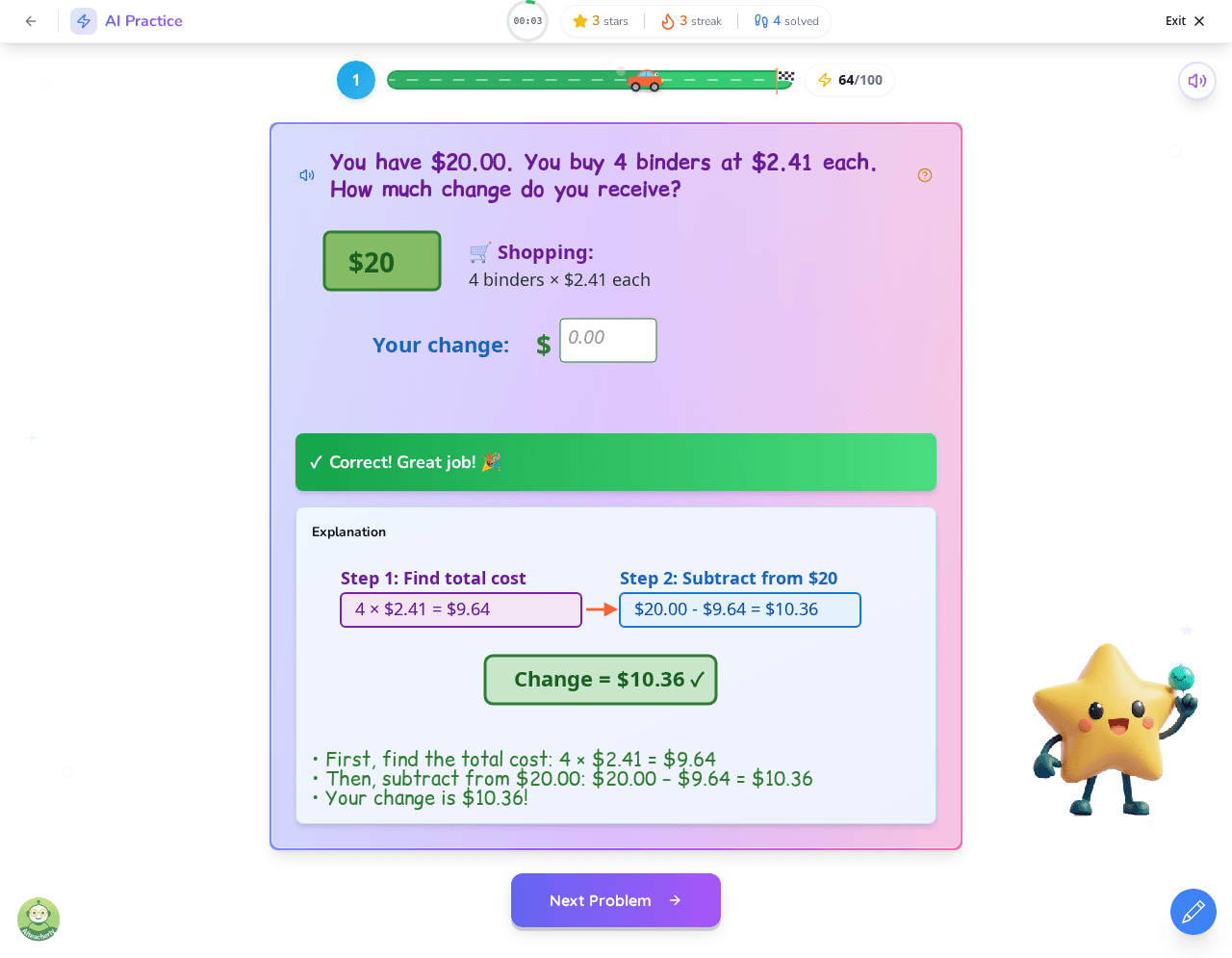
- Advanced: Figure out change from a $20 bill
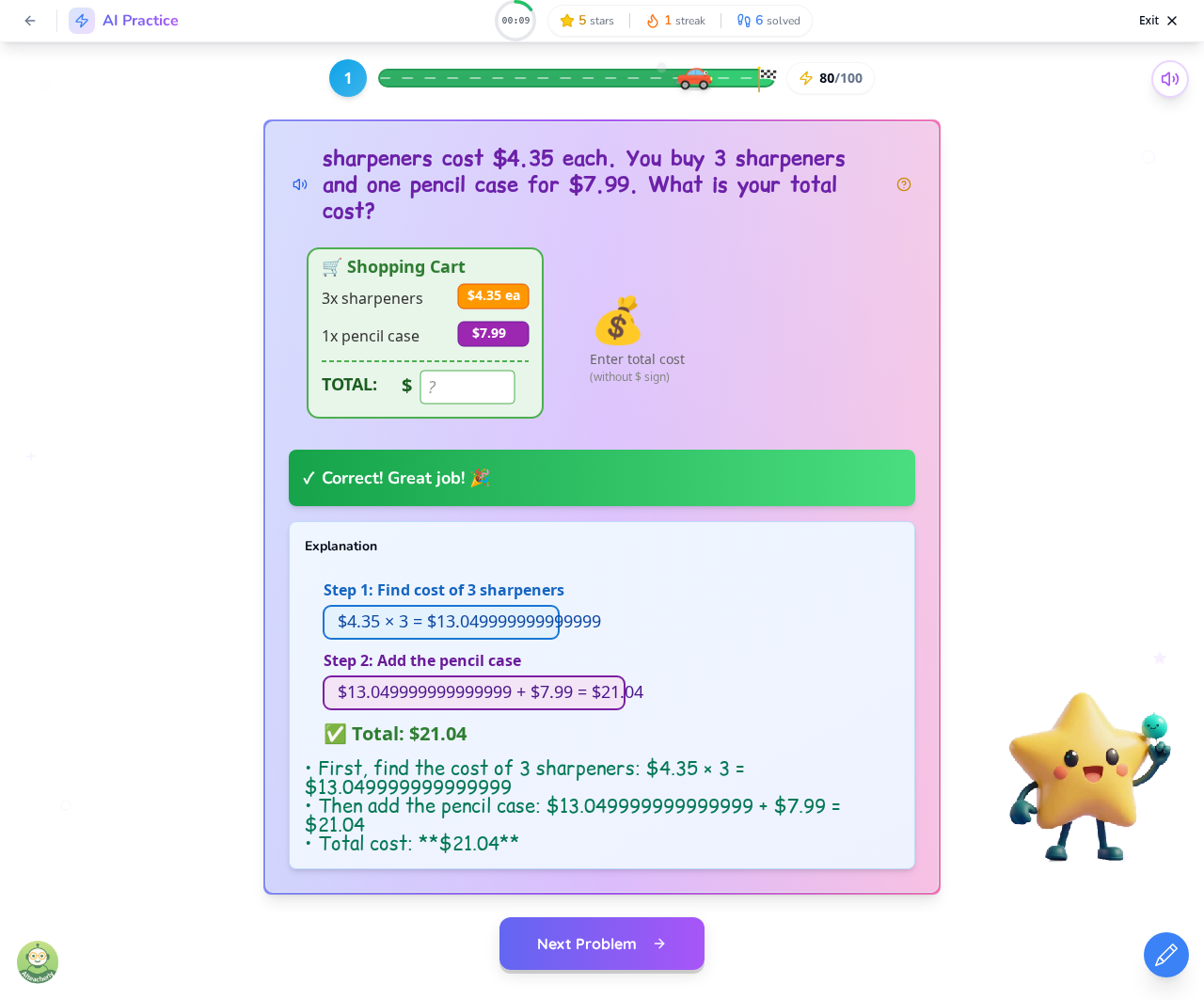
The interactive problem below shows exactly how AI Teacherly presents these real-world shopping scenarios to students:
Why Real-World Problems Matter
When kids see PEMDAS solving actual problems they care about (like figuring out if they have enough allowance for that new game), the abstract rules suddenly have purpose. Research consistently shows that contextualized math learning improves both understanding and retention. Your child isn't just memorizing steps; they're building skills they'll use for life.
The Detective Trick: Teaching Kids to Check Their Own Answers
One of the most valuable skills your 5th grader can develop is self-checking. Instead of asking "Is this right?" after every problem, teach them to verify their own work. This builds mathematical independence and confidence.
The "Decimal Detectives" approach uses a simple technique: evaluate both sides of an equation separately and see if they match.
How It Works
If your child solved (2.4 + 0.6) × 3 = 9, they can check by:
- Solving the left side fresh: 2.4 + 0.6 = 3.0, then 3.0 × 3 = 9 ✓
- Confirming: Does 9 = 9? Yes!
This technique also works for identifying errors. If the sides don't match, something went wrong, and your child can retrace their steps to find the mistake.
True or False Equations
A fun variation: Give your child completed equations and ask them to determine if each is true or false. For example:
- (1.5 × 2) + 3.0 = 6.0 → True or False?
- 4.2 + (0.8 × 2) = 5.8 → True or False?
This flips the script from "solve this" to "investigate this," which many kids find more engaging. They become math detectives hunting for correct and incorrect solutions.
Building a Checking Habit
Encourage your child to check at least two problems per homework session using this method. Over time, self-verification becomes automatic. The payoff extends far beyond 5th grade: students who routinely check their work make fewer careless errors on tests and develop stronger mathematical reasoning overall.
See How AI Teacherly Makes PEMDAS Practice Interactive
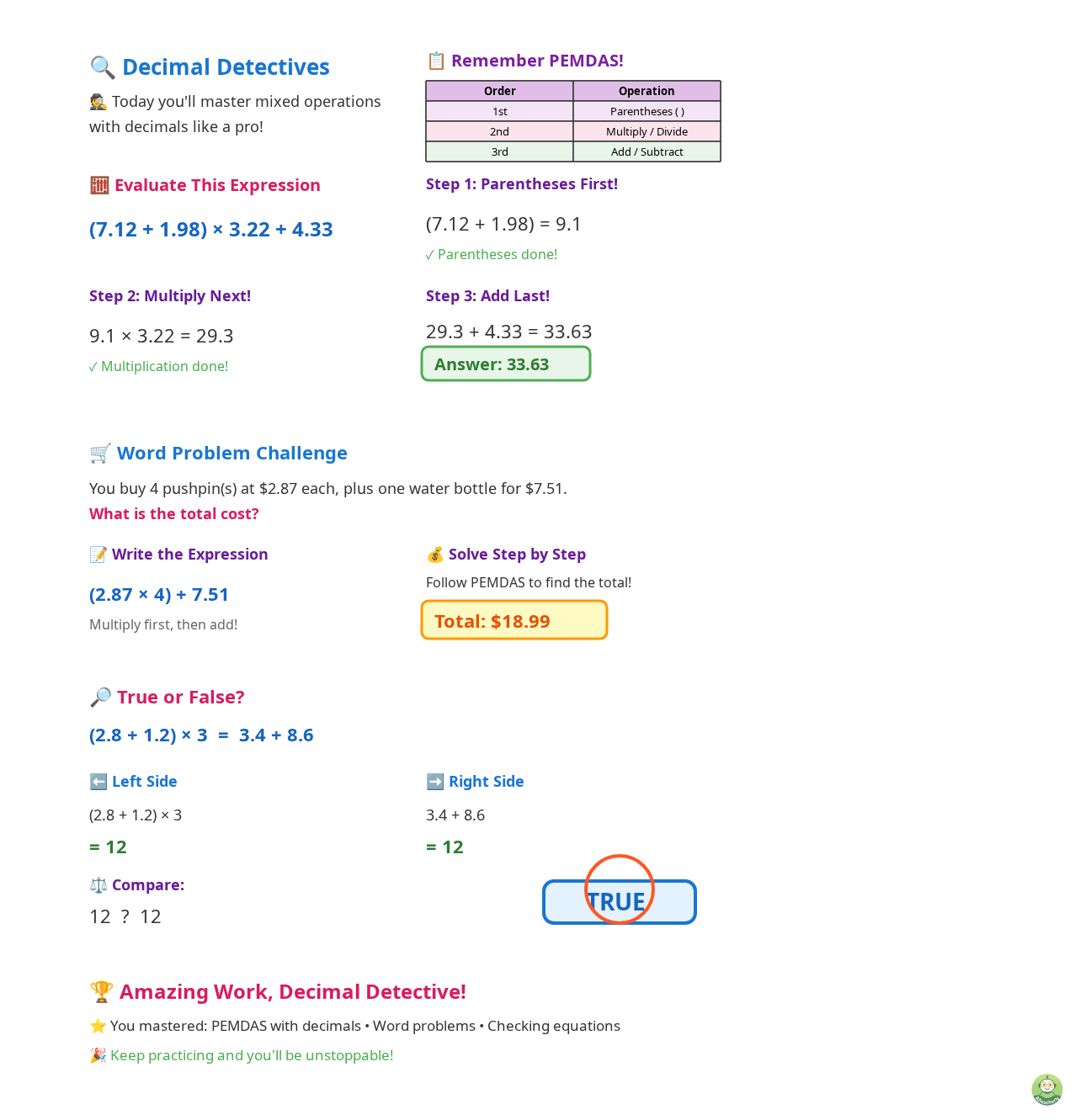
Traditional worksheets have their place, but interactive learning takes understanding to another level. AI Teacherly's Mixed Operations with Decimals lesson transforms PEMDAS practice into an engaging, step-by-step journey.
Here's what the full interactive lesson looks like on AI Teacherly:
What Makes Interactive Learning Different
Unlike static worksheets, the AI Teacherly platform provides:
- Immediate feedback: Students know right away if they're on track
- Visual scaffolding: Problems break down into manageable steps
- Real-world contexts: Shopping scenarios, money calculations, and practical applications
- Adaptive difficulty: Challenges grow as confidence builds
The lesson guides students through concepts like a patient tutor would, starting with foundational PEMDAS review before introducing decimal complexity. One parent described it as "having a math tutor available 24/7 without the cost."
The "Decimal Detectives" Theme
The lesson frames students as mathematical investigators, "cracking cases" by following PEMDAS clues. This playful approach turns what could feel like tedious drill into an adventure. Kids don't just memorize rules; they apply them to solve mysteries.
Progress You Can See
As your child works through the lesson, they build skills progressively:
- Reviewing PEMDAS fundamentals
- Applying order of operations to decimal expressions
- Translating word problems into mathematical expressions
- Self-checking with true/false equation evaluation
By the end, students have practiced exactly the skills that 5th grade standards require, but in a format that feels more like play than work.
Key Takeaways
- PEMDAS (Parentheses, Exponents, Multiplication/Division, Addition/Subtraction) works exactly the same with decimals as whole numbers
- Teach the "Circle and Conquer" method: circle parentheses, underline multiplication/division, box addition/subtraction
- Use real-world shopping scenarios to make decimal operations meaningful and memorable
- Encourage self-checking with the "evaluate both sides" technique to build mathematical independence
- Break complex expressions into one step at a time, rewriting after each operation to prevent errors
- Interactive practice (like AI Teacherly lessons) provides immediate feedback that accelerates learning
- Consistent short practice sessions (15-20 minutes) beat occasional long cramming sessions
Frequently Asked Questions
What is PEMDAS and why is it important for 5th graders?
PEMDAS stands for Parentheses, Exponents, Multiplication, Division, Addition, Subtraction. It's the universal order of operations that ensures everyone solves math problems consistently. Fifth graders need PEMDAS to handle increasingly complex multi-step problems.
Does PEMDAS work the same way with decimals as whole numbers?
Yes! The order of operations is identical whether you're working with whole numbers, decimals, or fractions. The rules don't change based on number type. The challenge with decimals is simply keeping track of decimal points during each step.
What's the most common mistake kids make with mixed operations?
The biggest mistake is solving left to right without considering operation priority. Many kids add before multiplying because addition appears first in the problem. Teaching them to identify operation types before calculating prevents this error.
How can I help my child practice decimal operations at home?
Turn shopping trips into math practice! Have your child calculate totals, figure out change, or compare unit prices. Real-world money problems use the exact same PEMDAS skills they need for homework, but feel more relevant and engaging.
Why does my child get different answers when solving the same problem?
Usually this happens when they solve operations in different orders each time. Reinforce that PEMDAS provides ONE correct sequence. Encourage them to write out each step and circle operations in order of priority before calculating.
Are there tricks to remember the order of operations?
The classic mnemonic is "Please Excuse My Dear Aunt Sally" (Parentheses, Exponents, Multiplication, Division, Addition, Subtraction). Just remember that M/D and A/S are solved left to right when at the same level, not strictly M before D.
When do kids learn PEMDAS in school?
Most students are introduced to order of operations in 3rd or 4th grade with whole numbers. By 5th grade, they apply PEMDAS to decimals and more complex expressions. Mastery at this level is essential for middle school pre-algebra.
How long should my child practice PEMDAS each day?
Short, consistent sessions of 15-20 minutes are more effective than hour-long cramming. Interactive practice with immediate feedback (like AI Teacherly lessons) maximizes learning in minimal time. Aim for 3-4 sessions per week.
Ready to turn PEMDAS practice into an adventure? Try the free Mixed Operations with Decimals lesson on AI Teacherly and watch your 5th grader become a confident decimal detective!