PEMDAS with Decimals: A Parent's Guide to 5th Grade Order of Operations
Struggling with 5th grade math homework? Learn how PEMDAS with decimals works and discover simple strategies to support your child's order of operations success.
Why 5th Grade Math Suddenly Feels Harder
If you've noticed that homework time has become more challenging this year, you're not alone. 5th grade marks a critical turning point where math shifts from straightforward calculations to multi-step problems that require strategic thinking.
Your child is now expected to look at expressions like (3.5 + 2.8) × 4.2 + 1.6 and know exactly which operation to tackle first. It's not just about getting the right answer anymore; it's about understanding why the order matters.
The good news? PEMDAS with decimals for 5th graders isn't the mystery it might seem. It's actually a logical, step-by-step system that, once understood, makes even complex problems feel manageable. And you don't need to be a math expert to guide your child through it.
In this guide, you'll discover exactly how order of operations works with decimals, the most common mistakes to watch for, and practical ways to support your 5th grader's math journey at home. Whether homework ends in tears or triumph often comes down to understanding these foundational rules.
What Is PEMDAS and Why Does Order Matter with Decimals?
PEMDAS is an acronym that tells us the exact order to solve mathematical expressions. It stands for:
- Parentheses (solve what's inside first)
- Exponents (powers and roots)
- Multiplication and Division (left to right)
- Addition and Subtraction (left to right)
Think of PEMDAS as a roadmap. Without it, everyone would solve the same problem differently and get different answers. With decimals, this becomes even more critical because small errors compound quickly.
Here's why order matters: Consider the expression 3.5 + 2.8 × 4. If you solve left-to-right (adding first), you get 6.3 × 4 = 25.2. But following PEMDAS (multiplying first), you get 3.5 + 11.2 = 14.7. Same numbers, completely different answers!
Many parents worry that "new math" is different from what they learned. Here's the reassuring truth: PEMDAS hasn't changed. The rules your child learns today are the same rules you learned. The only difference is that 5th grade now applies these rules to decimals and more complex, real-world scenarios.
As the lesson reminds students: "Remember PEMDAS? It tells us which operations to do first. Parentheses come first, then multiply or divide, and last, add or subtract. Follow this order, and you'll always get the right answer."
How Do You Solve Multi-Step Decimal Problems Step by Step?
Breaking down multi-step decimal problems into manageable pieces is the key to success. Here's the systematic approach that works every time:
Step 1: Identify all operations
Look at the problem and circle or underline each operation. For (4.2 + 1.8) × 3.5 - 2.1, you have parentheses, multiplication, and subtraction.
Step 2: Follow PEMDAS order
- First, solve the parentheses:
4.2 + 1.8 = 6.0 - Then multiply:
6.0 × 3.5 = 21.0 - Finally, subtract:
21.0 - 2.1 = 18.9
Step 3: Write each step clearly Encourage your child to show their work by rewriting the expression after each operation. This builds good habits and makes it easier to spot mistakes.
Step 4: Check the answer Teach your child to be a "math detective" by verifying their work. For equations, evaluate both sides independently to confirm they're equal.
Pro tip for parents: When helping with homework, resist the urge to solve the problem yourself. Instead, ask guiding questions like:
- "What operation should we do first according to PEMDAS?"
- "Can you rewrite the problem after solving that part?"
- "Does your answer make sense in the context of the problem?"
This approach builds independence and deepens understanding, rather than creating reliance on your help.
Real-World Examples: From Shopping Carts to Movie Nights
One of the best ways to make PEMDAS click for kids is connecting it to situations they actually care about. When math feels relevant, motivation follows.
The Shopping Scenario
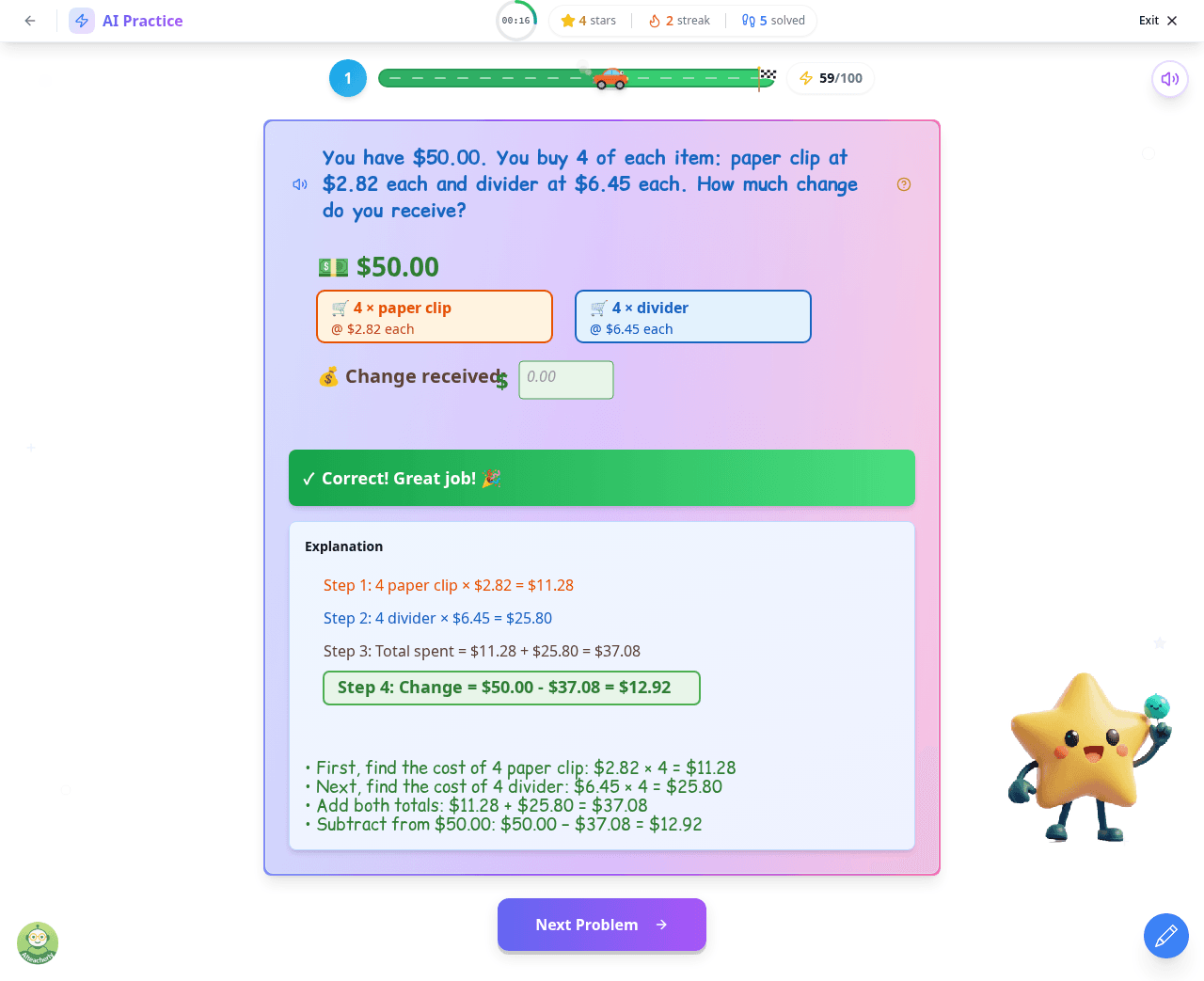
Imagine you're buying 3 notebooks at $4.50 each, plus a single pencil case for $2.75. The expression looks like this: 3 × 4.50 + 2.75. Following PEMDAS, you multiply first (3 × 4.50 = 13.50), then add (13.50 + 2.75 = $16.25). If you added first (incorrectly), you'd get a very wrong total!
The Movie Night Problem
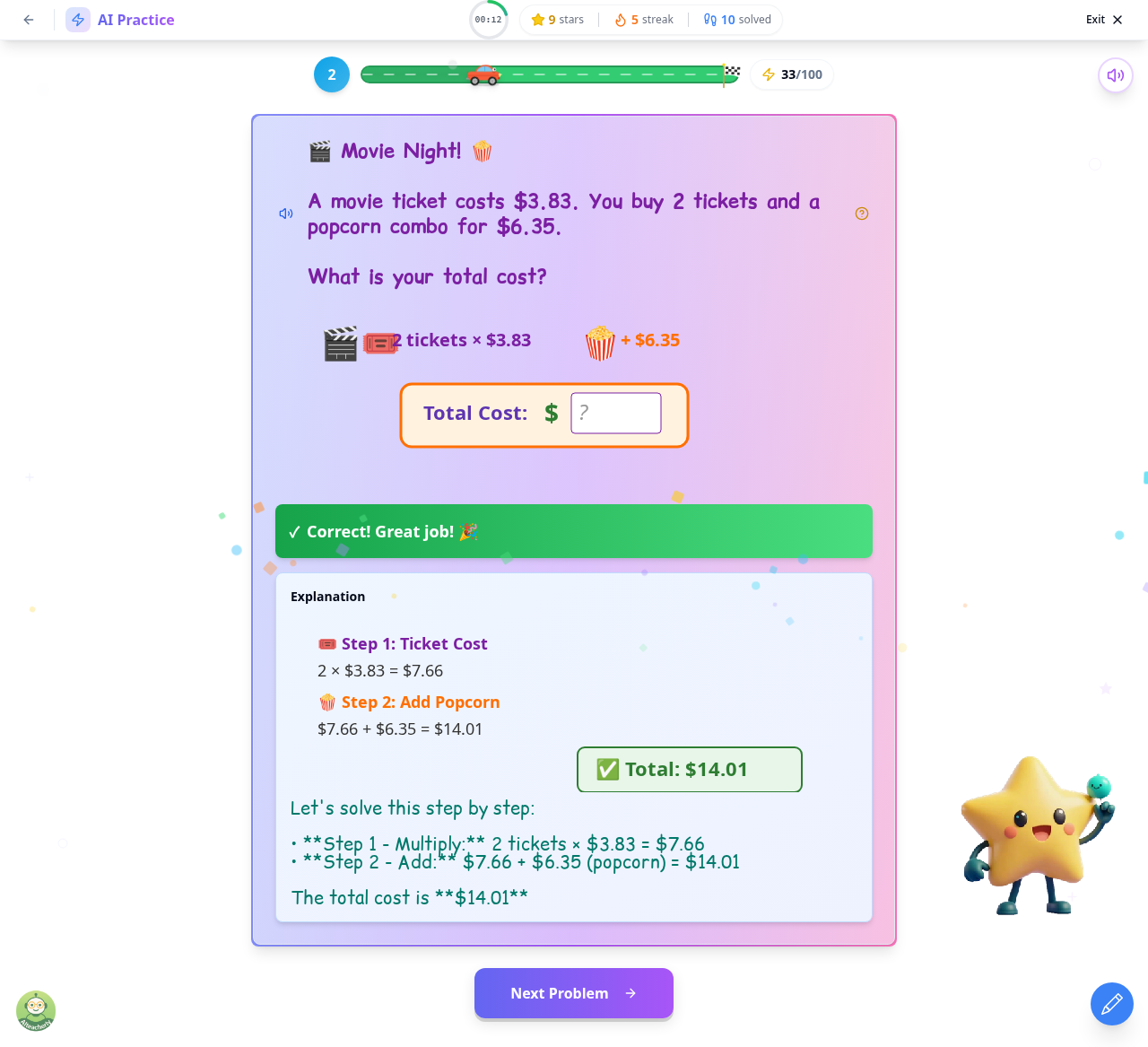
Your child might see a problem like this: "Movie tickets cost $8.50 each. You buy 4 tickets and a large popcorn for $6.25. How much do you spend?" This translates to 4 × 8.50 + 6.25, requiring the same PEMDAS thinking.
The interactive problem below shows exactly how these real-world scenarios appear in practice:
Why Real-World Context Matters Research shows that students who practice with contextual problems develop stronger number sense and retain concepts longer. When your child sees that PEMDAS isn't just abstract rules but tools for real life, homework resistance often decreases.
Try creating your own word problems together using situations from your family's life: grocery shopping, planning activities, or calculating game scores. This transforms PEMDAS from a classroom concept into a life skill.
See How Interactive Practice Makes PEMDAS Click
Traditional worksheets have their place, but interactive practice offers something worksheets can't: immediate feedback and engaging visuals that keep 5th graders motivated.
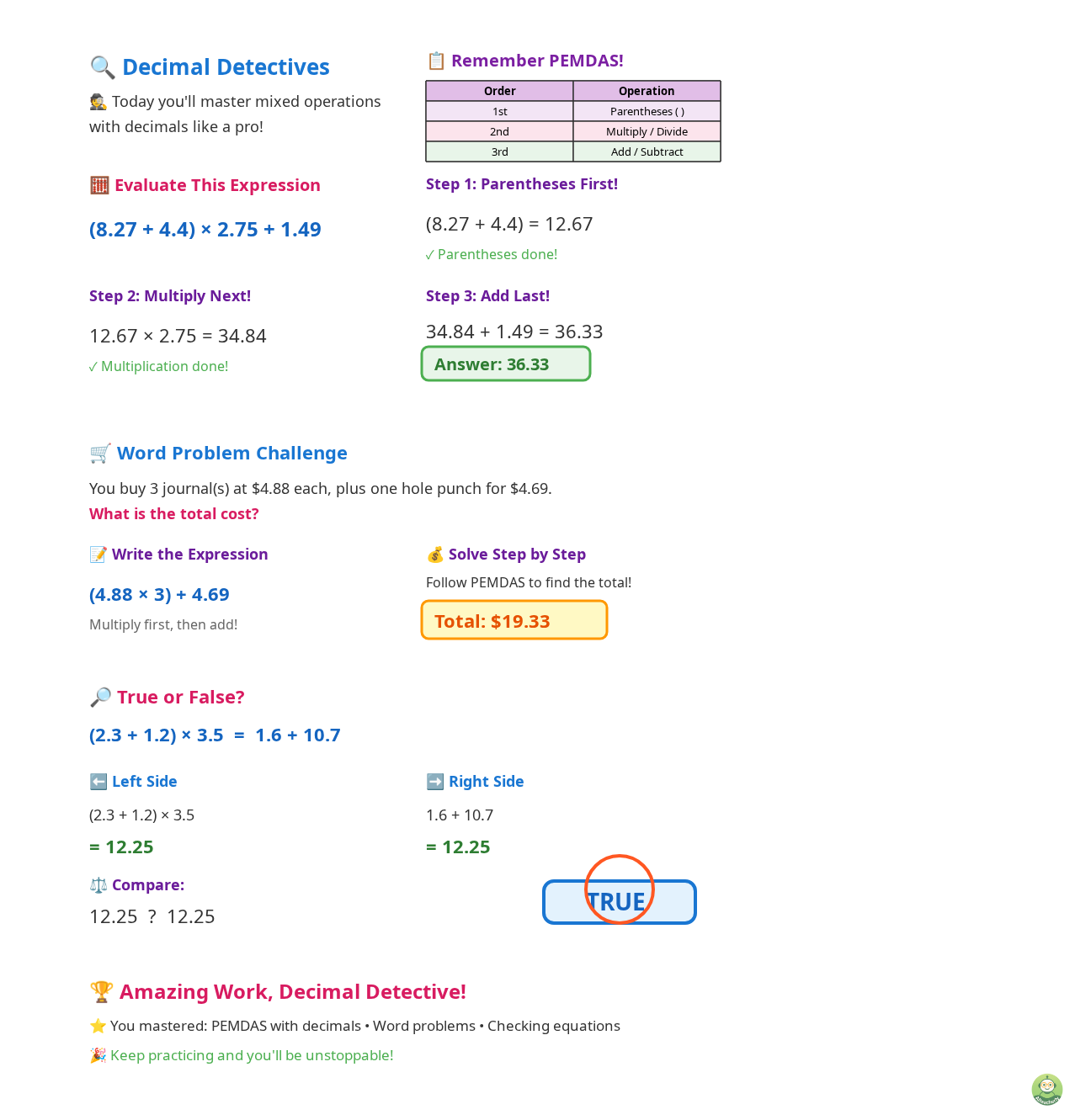
The Mixed Operations with Decimals lesson on AI Teacherly uses a "Decimal Detectives" theme that transforms abstract math into an investigation. Students don't just solve problems; they "crack cases" and verify equations as true or false, making order of operations feel like puzzle-solving rather than tedious drills.
Here's what the full interactive lesson looks like on AI Teacherly:
What Makes Interactive Practice Different:
- Immediate feedback catches mistakes before they become habits
- Varied question types (input, ordering, true/false) keep engagement high
- Progressive difficulty builds confidence step by step
- Real-world scenarios make the "why" behind PEMDAS clear
As the lesson tells students at the end: "You mastered PEMDAS with decimals, turned word problems into equations, and checked your answers like a pro. You're a true decimal detective!"
For parents: Consider setting aside 15-20 minutes, 3-4 times per week for focused practice. Short, consistent sessions are far more effective than hour-long cramming sessions that lead to frustration. Interactive platforms make this time feel less like "extra homework" and more like productive screen time.
Common PEMDAS Mistakes and How to Avoid Them
Understanding where 5th graders typically stumble helps you catch and correct issues early. Here are the most common PEMDAS mistakes and how to address them:
Mistake #1: Solving Left-to-Right Instead of Following PEMDAS
This is the most frequent error. Kids naturally want to read math like English, from left to right. When they see 5 + 3 × 2, they add first and get 16 instead of the correct answer, 11.
How to help: Have your child underline or highlight multiplication and division operations first, as a visual reminder to tackle those before addition and subtraction.
Mistake #2: Forgetting That Multiplication and Division Are Equal PEMDAS can be misleading because it lists multiplication before division. In reality, they have equal priority and should be solved left to right. The same applies to addition and subtraction.
How to help: Teach the phrase "MD left to right, AS left to right" to clarify that these pairs work together, not in strict sequence.
Mistake #3: Decimal Point Errors
When multiplying decimals, students often misplace the decimal point in their answer. For 2.5 × 4, they might write 100 instead of 10.0.
How to help: Encourage estimation before solving. "2.5 is about 2 or 3, and 3 × 4 = 12, so our answer should be close to 10, not 100."
Mistake #4: Rushing Through Multi-Step Problems Anxiety or impatience leads to skipped steps and careless errors.
How to help: Normalize writing out every single step. Explain that showing work isn't "extra"; it's what mathematicians do, and it actually saves time by preventing mistakes.
Key Takeaways
- PEMDAS is a consistent roadmap: Parentheses first, then Exponents, then Multiplication/Division (left to right), then Addition/Subtraction (left to right)
- Real-world connections make decimals meaningful: Use shopping, cooking, and activity planning to show why order of operations matters
- Watch for left-to-right solving: The most common 5th grade mistake is ignoring PEMDAS and solving problems in reading order
- Estimation is your friend: Having your child estimate answers first helps catch decimal point errors
- Short, consistent practice beats cramming: 15-20 minutes of interactive practice several times a week builds lasting skills
- Show every step: Encourage your child to write out each operation, which prevents errors and builds mathematical thinking
- You don't need to be a math expert: Asking guiding questions builds your child's independence better than providing answers
Frequently Asked Questions
What does PEMDAS stand for and why is it important?
PEMDAS stands for Parentheses, Exponents, Multiplication, Division, Addition, and Subtraction. It ensures everyone solves math problems the same way and gets the same correct answer.
How do I help my child remember the order of operations?
Use the phrase 'Please Excuse My Dear Aunt Sally' as a memory aid. Practice with real-world examples like shopping totals to reinforce why the order matters.
Why does my 5th grader struggle with multi-step math problems?
Multi-step problems require strategic thinking about which operation to do first. Many kids instinctively solve left-to-right instead of following PEMDAS rules, leading to wrong answers.
Should my child use a calculator for decimal operations?
For learning PEMDAS concepts, work without calculators first to build understanding. Calculators can be used later to check work or for very complex decimal calculations.
What is the most common PEMDAS mistake 5th graders make?
Solving left-to-right instead of following operation priority. For example, in 5 + 3 × 2, students often add first (getting 16) instead of multiplying first (correct answer: 11).
How can I make PEMDAS practice more engaging at home?
Create word problems from daily life like shopping or cooking. Interactive platforms with games and immediate feedback also keep 5th graders motivated longer than worksheets.
When do kids learn order of operations in school?
Order of operations is introduced in 4th grade with whole numbers and expanded in 5th grade to include decimals and more complex multi-step problems.
Is PEMDAS the same as BODMAS or BEDMAS?
Yes! These are regional variations of the same rules. BODMAS (Brackets, Orders) is used in UK/India, BEDMAS in Canada, and PEMDAS in the US. The mathematical order is identical.
Ready to transform your 5th grader into a confident "Decimal Detective"? Try the Mixed Operations with Decimals lesson free on AI Teacherly and watch PEMDAS clicks into place!