PEMDAS Made Simple: A Parent's Guide to 5th Grade Order of Operations
PEMDAS doesn't have to be confusing. Learn how order of operations works in 5th grade math with clear steps, real examples, and the estimation trick that catches errors every time.
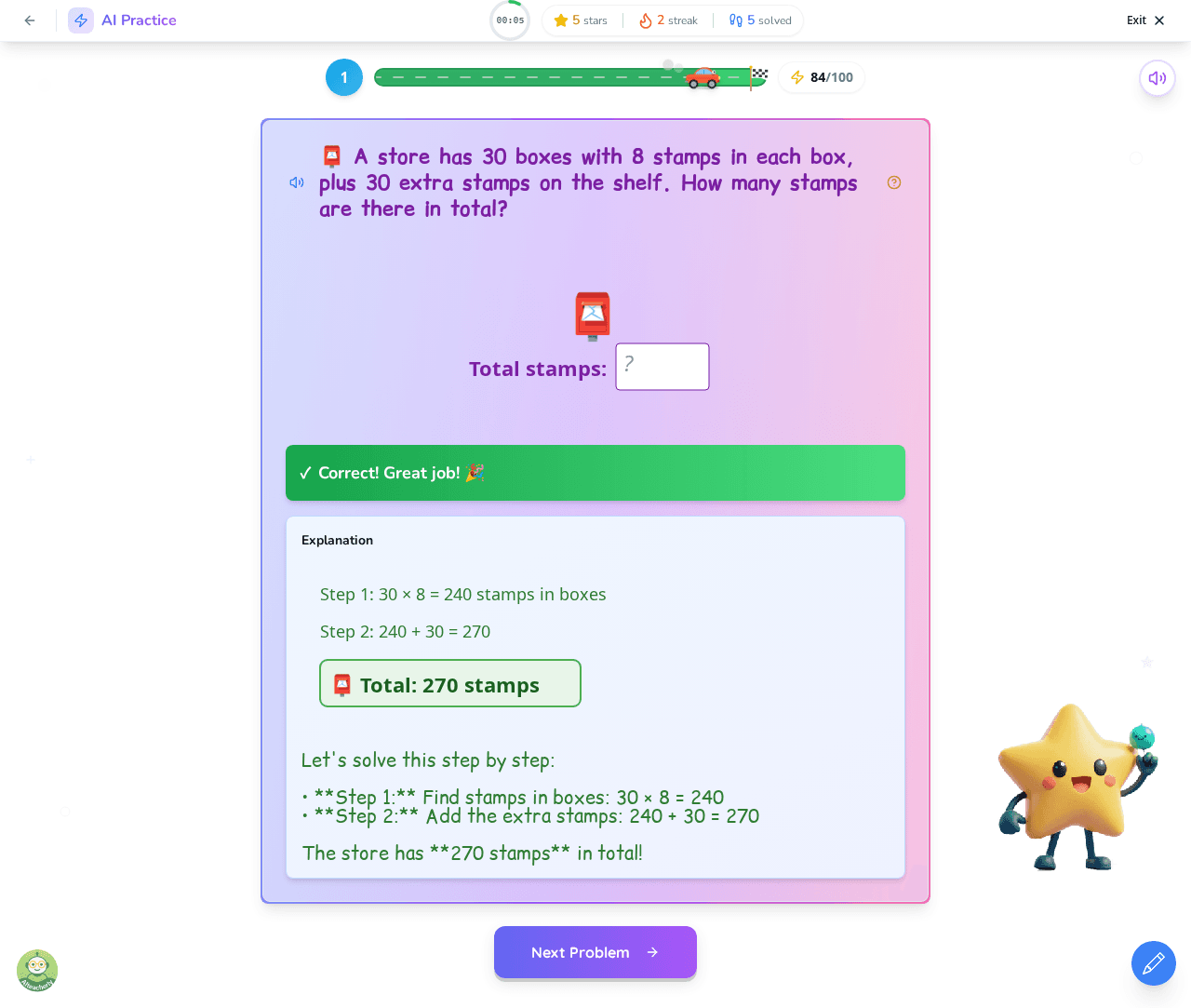
Why PEMDAS Trips Up 5th Graders (And Their Parents)
You're sitting at the kitchen table, and your 5th grader slides their math homework over with a hopeful look. Then you see it: an equation with multiple operations, parentheses, and numbers that need solving in a specific order. Your heart sinks a little.
You're not alone. PEMDAS for 5th graders explained in simple terms is one of the most common searches parents make during homework time. The good news? Order of operations isn't "new math" or some complicated system you never learned. It's the same logical approach you probably used in school, just packaged with a memorable acronym.
The challenge is that 5th grade marks a turning point. Math becomes more abstract, and students must now juggle multiple operations in a single problem. Without a clear system, two people can look at the same equation and get completely different answers, both believing they're correct.
This guide will give you everything you need to understand PEMDAS, recognize the patterns in multi-step problems, and confidently support your child's math learning. No teaching degree required.
What Is PEMDAS and Why Does Order Matter?
PEMDAS is an acronym that tells us which mathematical operations to perform first when solving an expression with multiple operations. Here's what each letter stands for:
- P = Parentheses (solve what's inside first)
- E = Exponents (powers and square roots)
- M = Multiplication
- D = Division
- M & D = Work left to right (whichever comes first)
- A = Addition
- S = Subtraction
- A & S = Work left to right (whichever comes first)
Why does this matter? Consider this simple example: 3 + 4 × 2. If you add first (3 + 4 = 7, then 7 × 2 = 14), you get the wrong answer. Using PEMDAS correctly, you multiply first (4 × 2 = 8, then 3 + 8 = 11).
A helpful phrase many kids remember is "Please Excuse My Dear Aunt Sally." Each word corresponds to an operation in order. When your child learns this rule, they have a reliable system for tackling any multi-step problem.
As the lesson teaches: "Follow this order, and you'll always get the right answer." It really is that straightforward once the pattern clicks.
How to Spot Clue Words in Multi-Step Word Problems
Before your child can apply PEMDAS, they need to translate word problems into mathematical expressions. This is where many students struggle, but there's a secret code hidden in the problem's language.
Addition clue words:
- Total, sum, altogether, combined, in all, plus, more than
Subtraction clue words:
- Difference, left over, remaining, less than, fewer, take away
Multiplication clue words:
- Each, every, times, product, groups of, per
Division clue words:
- Split equally, share, divided, per group, quotient, separated into
As the interactive lesson explains: "These keywords are your secret code! Use them to crack any word problem."
Here's a practical example: "A store received 6 boxes with 8 items each, plus 5 extra items. How many items total?"
- "Each" signals multiplication: 6 × 8
- "Plus" signals addition: + 5
- "Total" confirms we're adding everything together
- Expression: 6 × 8 + 5
- Apply PEMDAS: Multiply first (48), then add (48 + 5 = 53)
Once your child learns to identify these clue words, word problems become puzzles to solve rather than walls to hit.
Breaking Down a PEMDAS Problem Step-by-Step
The most effective approach for multi-step math problems in grade 5 is a four-step framework: Read, Plan, Solve, Check. This systematic method builds mathematical reasoning and prevents careless errors.
Step 1: Read Carefully Read the entire problem before doing anything. Identify the key information, the question being asked, and the clue words that indicate operations.
Step 2: Plan Your Approach Write out the mathematical expression. Decide which operations are needed and in what order based on PEMDAS rules. This planning phase is where most mistakes are prevented.
Step 3: Solve Systematically Work through the expression following PEMDAS strictly. Show each step clearly. Many teachers require students to show their work, and it helps catch errors too.
Step 4: Check Your Answer Does the answer make sense? Is it reasonable given the context? Use estimation to verify (more on this in the next section).
The interactive problem below shows exactly how PEMDAS works in practice, with students ordering the steps correctly to solve multi-operation expressions.
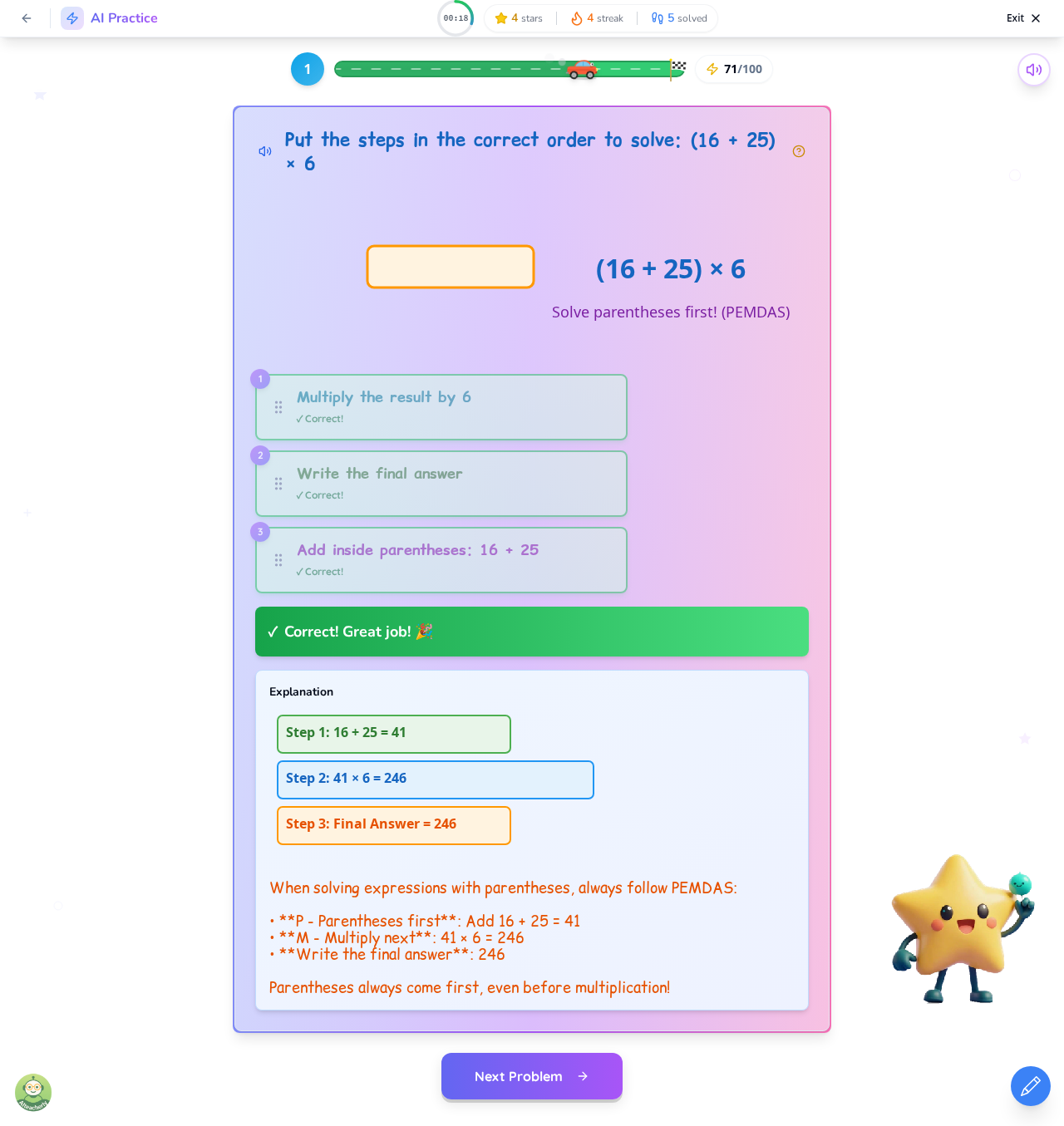
This step-by-step approach transforms intimidating problems into manageable chunks. Your child learns not just to get the right answer, but to understand why it's right.
The Estimation Trick: How to Check Your Child's Work
Here's a strategy that separates confident math students from those who second-guess themselves: estimation as verification.
As the lesson teaches: "Here's a smart trick—we can check our answer using estimation. Round the numbers, then calculate."
This method works beautifully for catching errors without re-solving the entire problem. Here's how:
Example: Your child solves 38 × 4 + 17 and gets 169.
Estimation check:
- Round 38 to 40
- Round 17 to 20
- Estimate: 40 × 4 + 20 = 160 + 20 = 180
- Compare: 169 is close to 180 ✓ The answer is reasonable!
If the estimate and answer were wildly different (say, 169 vs. 1,800), that's a red flag to re-check the work.
Why estimation matters beyond homework:
- Builds number sense and mathematical intuition
- Helps in real-world situations (quick mental math at stores)
- Catches calculator entry errors
- Develops confidence in mathematical reasoning
Encourage your child to estimate before solving too, not just after. This creates a target range for their answer, making the solving process feel more purposeful and less like guessing in the dark.
See How Interactive PEMDAS Practice Works
Traditional worksheets have their place, but research consistently shows that interactive learning significantly improves retention and understanding. When students can manipulate, experiment, and receive immediate feedback, abstract concepts like PEMDAS become concrete.
On AI Teacherly, the Mixed Operations with Whole Numbers lesson guides 5th graders through PEMDAS using:
- Narrated explanations that break down each concept step by step
- Visual word problems with real-world scenarios (like store deliveries and group activities)
- Interactive exercises where students can practice at their own pace
- Immediate feedback that corrects misconceptions before they become habits
Here's what the full interactive lesson looks like on AI Teacherly:
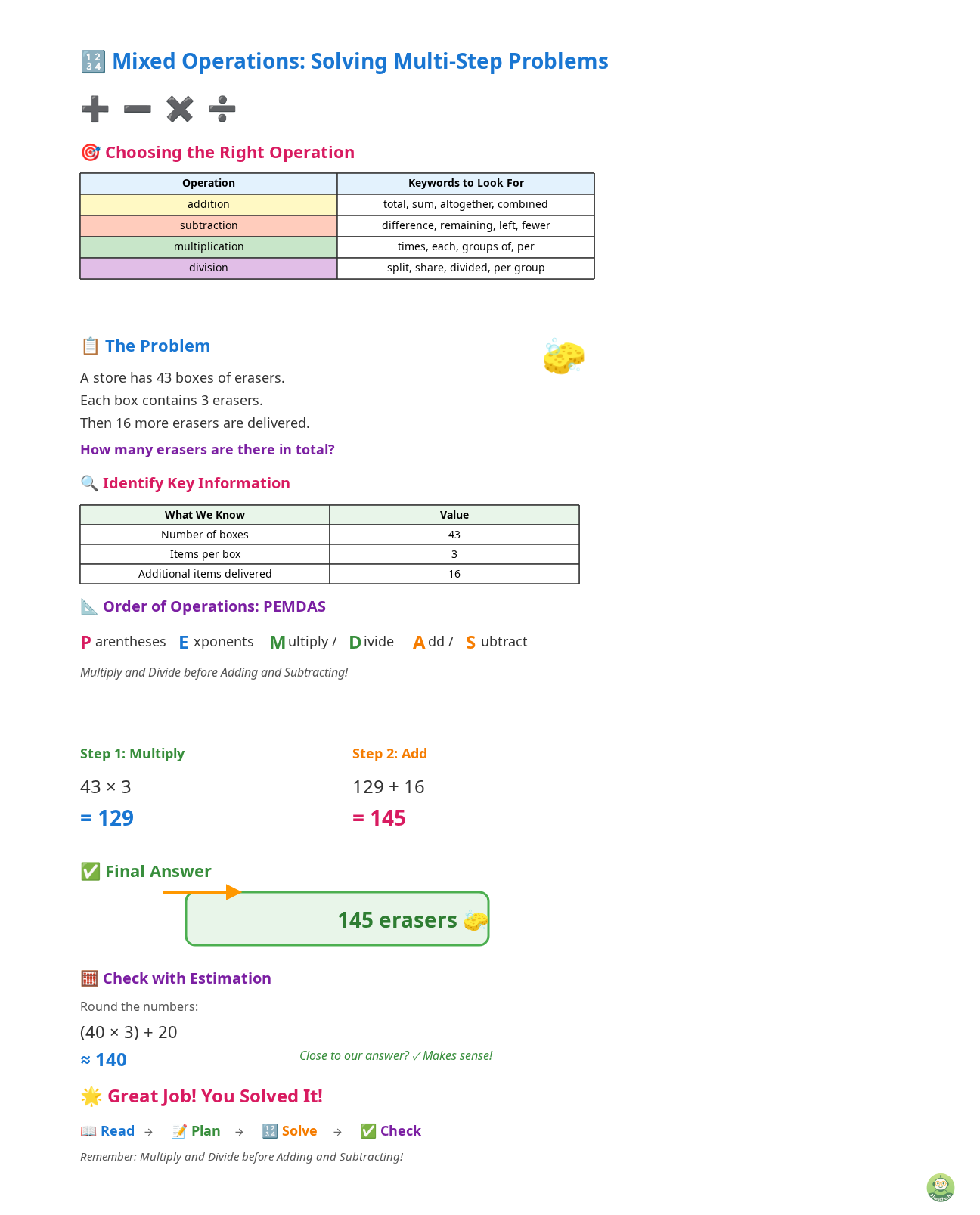
The lesson uses the same Read, Plan, Solve, Check framework discussed in this article, reinforced through practice problems that adapt to your child's learning pace. Parents can feel confident that the instruction aligns with what teachers expect in the classroom.
What makes interactive practice particularly effective for PEMDAS is the ability to see consequences immediately. When a child solves operations in the wrong order, they see why the answer is incorrect, not just that it's wrong.
Common PEMDAS Mistakes and How to Avoid Them
Understanding where students typically go wrong helps parents provide targeted support. Here are the most common PEMDAS errors 5th graders make:
Mistake #1: Treating Multiplication and Division as Separate Levels Many students believe multiplication always comes before division. In reality, M and D are on the same level and should be solved left to right.
Incorrect: 24 ÷ 4 × 2 → 24 ÷ 8 = 3 Correct: 24 ÷ 4 × 2 → 6 × 2 = 12 (left to right)
Mistake #2: Same Issue with Addition and Subtraction Addition and subtraction are also equal in priority. Work left to right.
Incorrect: 10 - 3 + 2 → 10 - 5 = 5 Correct: 10 - 3 + 2 → 7 + 2 = 9 (left to right)
Mistake #3: Forgetting Parentheses Take Priority When problems include parentheses, everything inside must be solved first, even if it contains lower-priority operations.
Mistake #4: Rushing Through Word Problems Skipping the planning phase leads to setting up the wrong expression entirely. Encourage your child to write out the expression before calculating.
Mistake #5: Not Checking with Estimation Students who don't estimate often miss obvious errors. A quick mental check catches most mistakes.
When you notice these patterns in your child's work, you can address the specific misconception rather than re-teaching everything from scratch.
Key Takeaways
- PEMDAS stands for Parentheses, Exponents, Multiplication, Division, Addition, Subtraction, and provides a consistent order for solving multi-step problems
- Multiplication and division are equal priority (work left to right), and so are addition and subtraction
- Clue words in word problems signal which operations to use: 'each' means multiply, 'left over' means subtract, 'total' means add
- The Read, Plan, Solve, Check framework helps students approach any multi-step problem systematically
- Estimation is a powerful verification tool that catches errors and builds number sense
- Common mistakes include treating M/D and A/S as separate levels instead of working left to right
- Interactive practice with immediate feedback helps cement PEMDAS rules faster than worksheets alone
Frequently Asked Questions
What does PEMDAS stand for and why is it important?
PEMDAS stands for Parentheses, Exponents, Multiplication, Division, Addition, and Subtraction. It's important because it ensures everyone solves math expressions in the same order, getting consistent, correct answers.
How do I explain order of operations to a 5th grader?
Use the phrase 'Please Excuse My Dear Aunt Sally' as a memory tool. Explain that math has rules about which operations to do first, just like reading left to right. Practice with simple examples before tackling word problems.
What's the difference between PEMDAS and BODMAS?
They're the same concept with different names. BODMAS (Brackets, Orders, Division, Multiplication, Addition, Subtraction) is used in the UK and other countries. The order of operations is identical.
Why does my child get different answers when solving the same problem?
This usually happens when they're not following PEMDAS consistently. The most common errors are doing multiplication before division regardless of position, or adding before subtracting. Both M/D and A/S should be worked left to right.
How can I help my 5th grader with multi-step word problems?
Teach them to identify clue words first: 'each' signals multiplication, 'total' signals addition, 'left over' signals subtraction. Then use the Read, Plan, Solve, Check framework before calculating.
Should my child use a calculator for PEMDAS problems?
Not initially. Building mental math skills and understanding the process is more valuable in 5th grade. Calculators can verify answers, but students should learn to solve and estimate manually first.
How can estimation help check math answers?
Round the numbers to easier values and quickly calculate an estimate. If your child's exact answer is close to the estimate, it's likely correct. If they're wildly different, re-check the work for errors.
What are the most common PEMDAS mistakes 5th graders make?
The biggest mistakes are treating multiplication as higher priority than division (instead of equal, left-to-right) and the same with addition/subtraction. Also common: forgetting parentheses come first and skipping the planning step in word problems.
Ready to make PEMDAS click for your 5th grader? Try the interactive Mixed Operations with Whole Numbers lesson free on AI Teacherly and watch multi-step math problems become second nature!