PEMDAS Made Simple: A Parent's Guide to 6th Grade Order of Operations
Confused when your 6th grader's math answer doesn't match yours? PEMDAS is likely the culprit. Discover simple explanations and interactive ways to master order of operations together.
Why Your 6th Grader's Math Answer Might Differ From Yours
You sit down to help with homework, work through a problem carefully, and get an answer. Your child gets a completely different answer. The calculator confirms your child is right. What happened?
This frustrating scenario plays out in countless homes, and the culprit is almost always order of operations (also known as PEMDAS). It's one of the most important math concepts your 6th grader is mastering this year, and honestly, many parents learned it differently or simply forgot the rules.
Here's the good news: order of operations for 6th graders isn't complicated once you understand the logic behind it. This guide will refresh your memory, show you the common mistakes to watch for, and give you practical ways to support your child's learning. No math degree required.
By the end, you'll confidently check homework, spot errors before they become habits, and maybe even enjoy doing math together. Let's get you both on the same page.
What Is PEMDAS and Why Does Order of Operations Matter?
PEMDAS is an acronym that helps students remember the correct sequence for solving math problems with multiple operations. It stands for:
- P = Parentheses (solve what's inside first)
- E = Exponents (powers like 2² or 3³)
- M = Multiplication
- D = Division
- A = Addition
- S = Subtraction
Why do we need these rules? Without a standard order, the same math problem could produce different answers. Consider this simple expression:
3 + 4 × 2 = ?
If you add first (3 + 4 = 7), then multiply (7 × 2), you get 14. If you multiply first (4 × 2 = 8), then add (3 + 8), you get 11.
Same numbers, two completely different answers! That's exactly why mathematicians created order of operations: so everyone, everywhere, gets the same result. The correct answer is 11 because multiplication comes before addition in PEMDAS.
Think of it like a recipe. If the instructions say to mix ingredients before baking, you can't bake first and mix later. Order of operations is math's recipe for consistency.
How to Solve Order of Operations Problems Step by Step
The key to mastering order of operations for 6th graders is following PEMDAS systematically. Here's a step-by-step approach you can use with your child:
Step 1: Handle Parentheses First Look for anything inside parentheses (or brackets) and solve those expressions completely before moving on.
Step 2: Calculate Exponents Evaluate any powers, like 2³ = 8 or 5² = 25.
Step 3: Multiplication and Division (Left to Right) Here's where many mistakes happen. Multiplication and division are at the same level. You don't do all multiplication first! Instead, work from left to right, handling whichever comes first.
Step 4: Addition and Subtraction (Left to Right) Similarly, addition and subtraction share a level. Work left to right.
Example Problem: Solve: (4 + 6)² × 3 + 8
- Parentheses: (4 + 6) = 10
- Exponents: 10² = 100
- Multiplication: 100 × 3 = 300
- Addition: 300 + 8 = 308
Notice how we tackled one step at a time. This "one operation at a time" approach prevents confusion and helps your child show their work clearly on tests.
Common PEMDAS Mistakes (And How to Help Your Child Avoid Them)
Even bright students make predictable errors with order of operations. Here are the most common mistakes to watch for:
Mistake #1: Adding Before Multiplying Students see 5 + 3 × 2 and naturally want to work left to right. They get 5 + 3 = 8, then 8 × 2 = 16. Wrong! The correct approach is 3 × 2 = 6, then 5 + 6 = 11.
Mistake #2: Thinking Multiplication Always Comes Before Division PEMDAS can be misleading. The M doesn't come "before" D in priority; they're equal. In 12 ÷ 3 × 2, you work left to right: 12 ÷ 3 = 4, then 4 × 2 = 8. Not 12 ÷ 6 = 2.
Mistake #3: Ignoring What's Inside Parentheses Sometimes students see (3 + 5) × 2 and multiply 5 × 2 first because multiplication feels more important. Parentheses always win.
Mistake #4: Forgetting Left-to-Right for Same-Level Operations When your child sees 8 - 3 + 2, they might subtract and add in any order. The rule is left to right: 8 - 3 = 5, then 5 + 2 = 7.
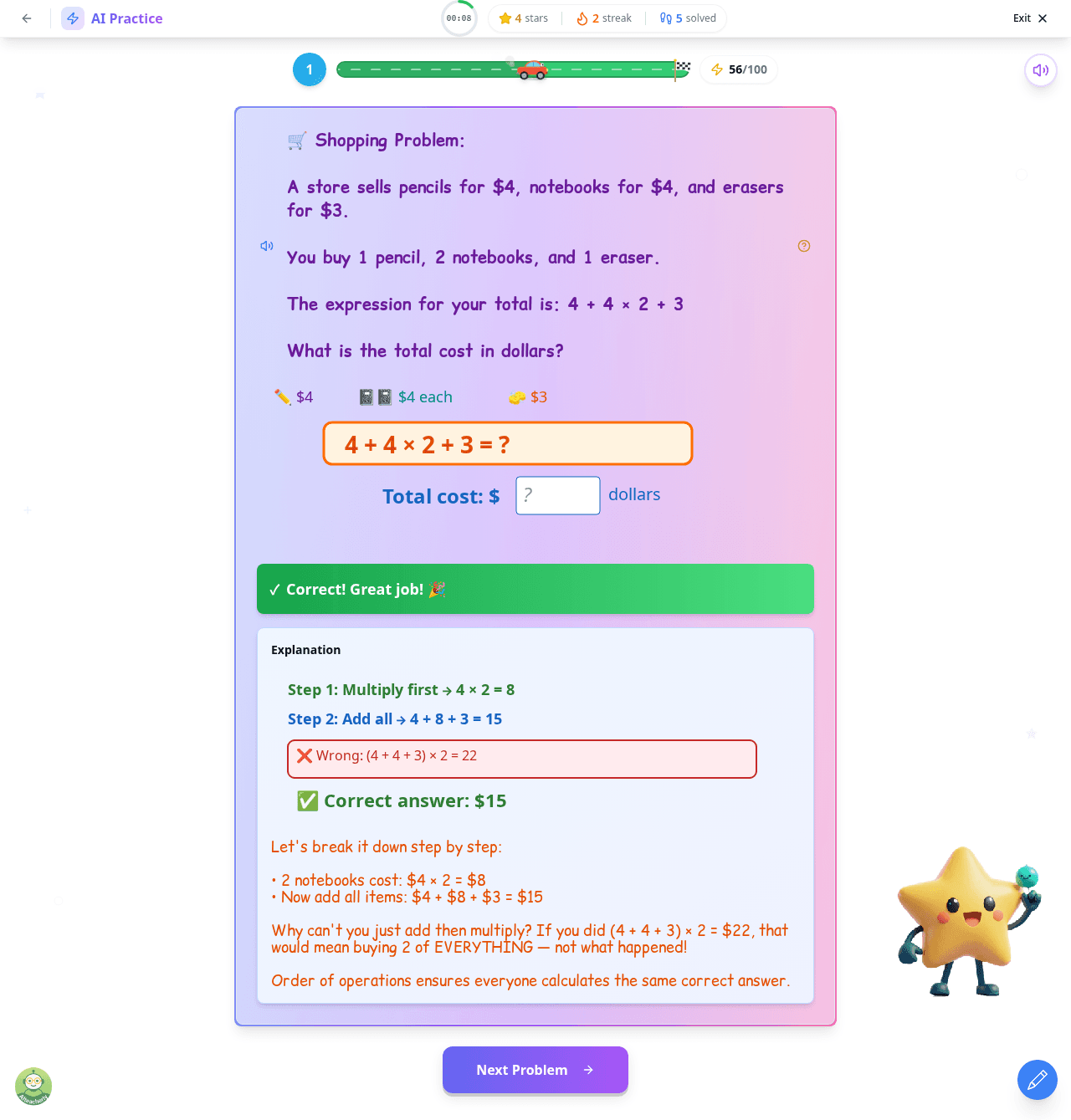
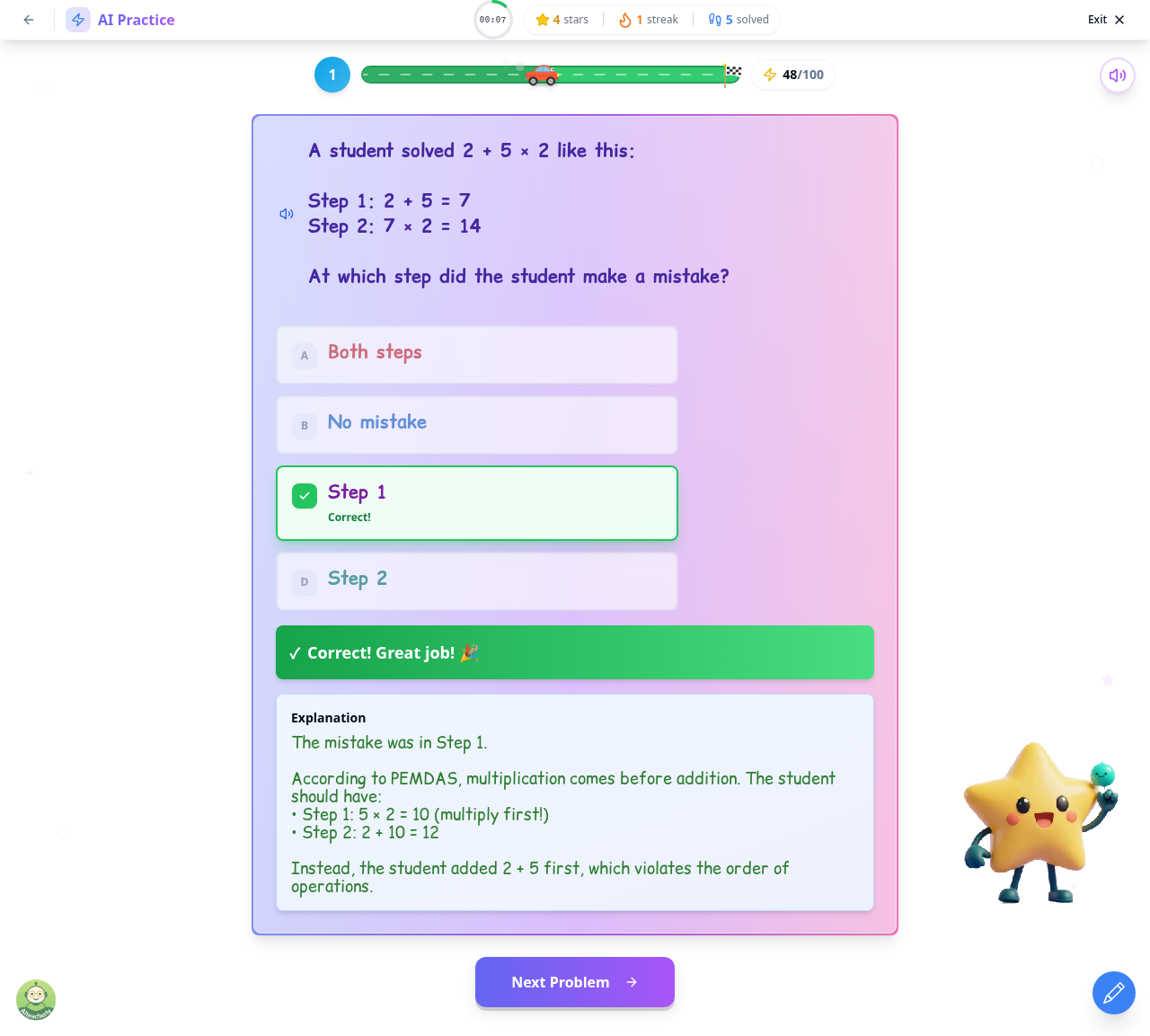
The interactive problem below demonstrates exactly how these mistakes happen and how to identify them:
Quick Parent Check: Ask your child to solve 2 + 3 × 4. If they say 20, they added first (mistake). If they say 14, they've got it right!
See How Interactive Learning Makes PEMDAS Click
Traditional worksheets can make order of operations feel like endless repetition. That's where interactive lessons change the game.
On AI Teacherly's Order of Operations with Whole Numbers lesson (Grade 6), students don't just calculate answers. They:
- See visual comparisons of right vs. wrong approaches, with color-coded feedback showing exactly where mistakes happen
- Work through real-world problems like calculating shopping totals that require PEMDAS
- Get instant feedback so they know immediately if they're on track
- Practice at their own pace without the pressure of classroom time limits
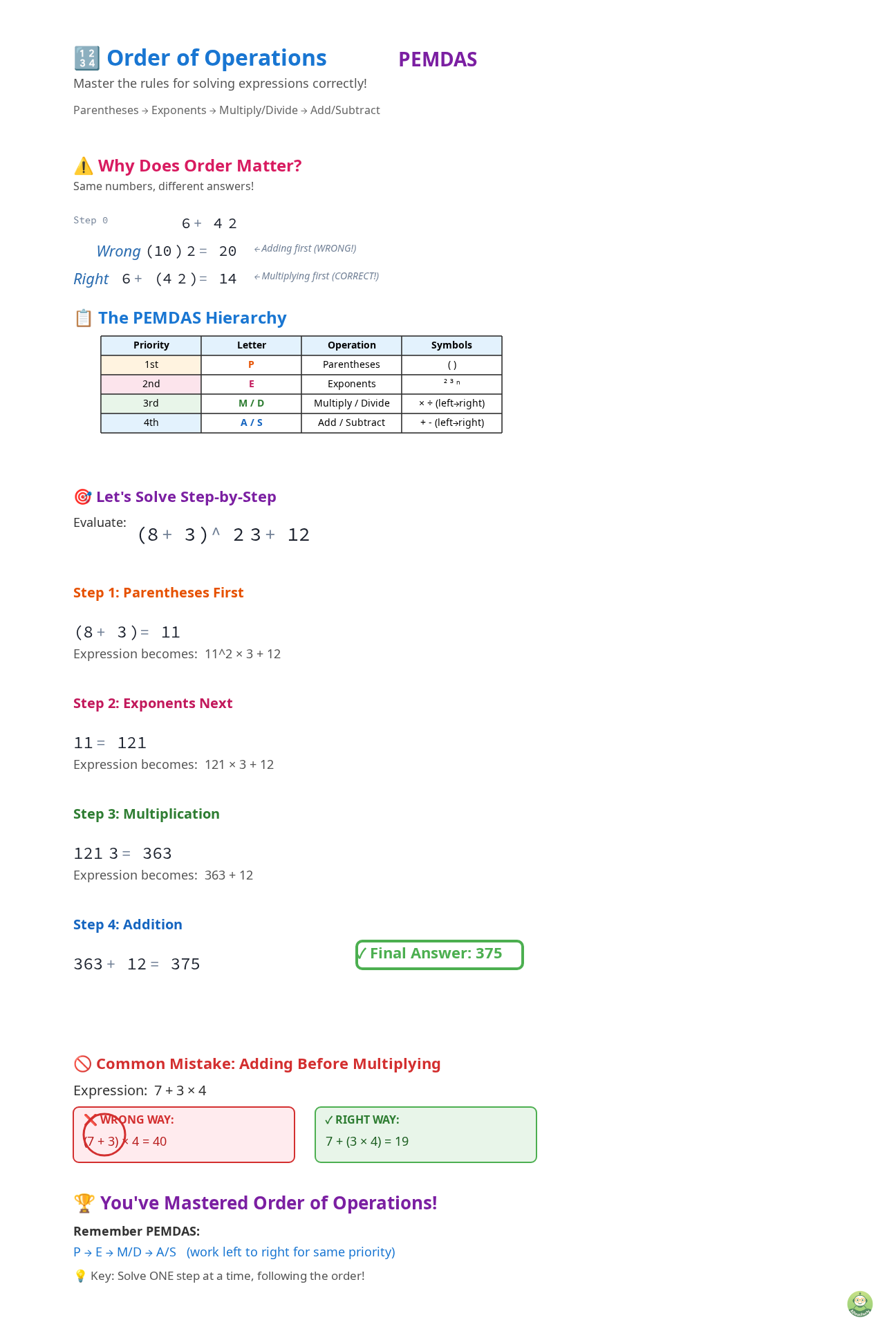
Here's what the full interactive lesson looks like on AI Teacherly:
The lesson starts by demonstrating why order matters (the "same numbers, different answers" problem), then builds systematically through each PEMDAS component. By the end, students aren't just memorizing rules; they understand the logic behind them.
What makes this approach effective is the immediate correction. When your child makes the common "add before multiply" error, they see it flagged right away. This prevents wrong methods from becoming ingrained habits that are harder to fix later.
Parents often tell us their children actually enjoy practicing because it feels more like a puzzle than homework.
Quick Tips for Practicing Order of Operations at Home
You don't need to be a math teacher to support your 6th grader's PEMDAS skills. Here are practical ways to reinforce learning at home:
1. Use the "Please Excuse My Dear Aunt Sally" Mnemonic This classic memory trick helps: Parentheses, Exponents, Multiplication, Division, Addition, Subtraction. Better yet, have your child create their own silly sentence.
2. Create Real-World Problems Together Shopping scenarios work brilliantly. "You buy 3 notebooks at $2 each and a $5 backpack. What's the total?" (Answer: 3 × 2 + 5 = $11). This shows PEMDAS isn't abstract; it's practical.
3. Play "Spot the Mistake" Work a problem incorrectly on purpose and challenge your child to find your error. Kids love catching grown-ups making mistakes, and it reinforces their understanding.
4. Emphasize Showing Work Encourage your child to write each step separately. This habit reduces errors and makes it easier to find where things went wrong.
5. Use Parentheses for Clarity Teach your child that when they're unsure, parentheses can help organize their thinking: (3 × 2) + 5 makes the order crystal clear.
6. Practice a Little Daily Five minutes of order of operations practice is more effective than a one-hour weekend cram session. Consistency builds fluency.
7. Celebrate the Process, Not Just Answers When your child shows correct steps but makes a small arithmetic error, acknowledge the strong PEMDAS understanding. Build confidence around the method.
Key Takeaways
- PEMDAS stands for Parentheses, Exponents, Multiplication, Division, Addition, Subtraction and ensures everyone gets the same answer to a math problem
- Multiplication and division share the same priority level; work left to right, not multiplication first
- The most common 6th grade mistake is adding before multiplying (solve 3 + 4 × 2 as 11, not 14)
- Addition and subtraction also share a level; always work left to right for same-level operations
- Interactive lessons with instant feedback help prevent wrong methods from becoming habits
- Real-world problems like shopping calculations make PEMDAS relevant and memorable
- Five minutes of daily practice beats one long weekly study session for building fluency
Frequently Asked Questions
What does PEMDAS stand for and what does each letter mean?
PEMDAS stands for Parentheses, Exponents, Multiplication, Division, Addition, and Subtraction. It's the standard order for solving math expressions with multiple operations to ensure everyone gets the same answer.
Why do we need order of operations in math?
Without standard rules, the same problem could have different answers. Order of operations ensures consistency so 3 + 4 × 2 always equals 11 (not 14) whether solved in Texas or Tokyo.
Do you always multiply before dividing in PEMDAS?
No! Multiplication and division have equal priority. Solve them left to right in the order they appear. For 12 ÷ 3 × 2, divide first (getting 4), then multiply (getting 8).
What is the most common order of operations mistake students make?
Adding or subtracting before multiplying or dividing. Students see 5 + 3 × 2 and calculate 8 × 2 = 16 instead of correctly getting 5 + 6 = 11.
How can I help my child remember PEMDAS?
Use the mnemonic 'Please Excuse My Dear Aunt Sally' or have your child create their own silly sentence. Consistent practice with real-world problems also builds lasting memory.
Does PEMDAS apply to all math problems?
PEMDAS applies to any expression with multiple operations. Even advanced algebra and calculus follow order of operations, making this 6th grade skill foundational for all future math.
Why might my answer differ from my child's calculator?
Calculators follow PEMDAS automatically. If your mental math gives a different answer, you likely performed operations in the wrong order. The calculator is probably correct!
What comes first when there are only addition and subtraction?
Work left to right. For 10 - 4 + 2, subtract first (10 - 4 = 6), then add (6 + 2 = 8). Don't rearrange based on operation type.
Ready to make order of operations click for your 6th grader? Try AI Teacherly's interactive PEMDAS lesson free and watch those homework frustrations disappear!