PEMDAS Made Easy: The Complete Parent's Guide to 6th Grade Order of Operations
Remember "Please Excuse My Dear Aunt Sally"? Your 6th grader is mastering the same PEMDAS rules now. Discover the common mistakes to avoid and simple ways to practice together at home.
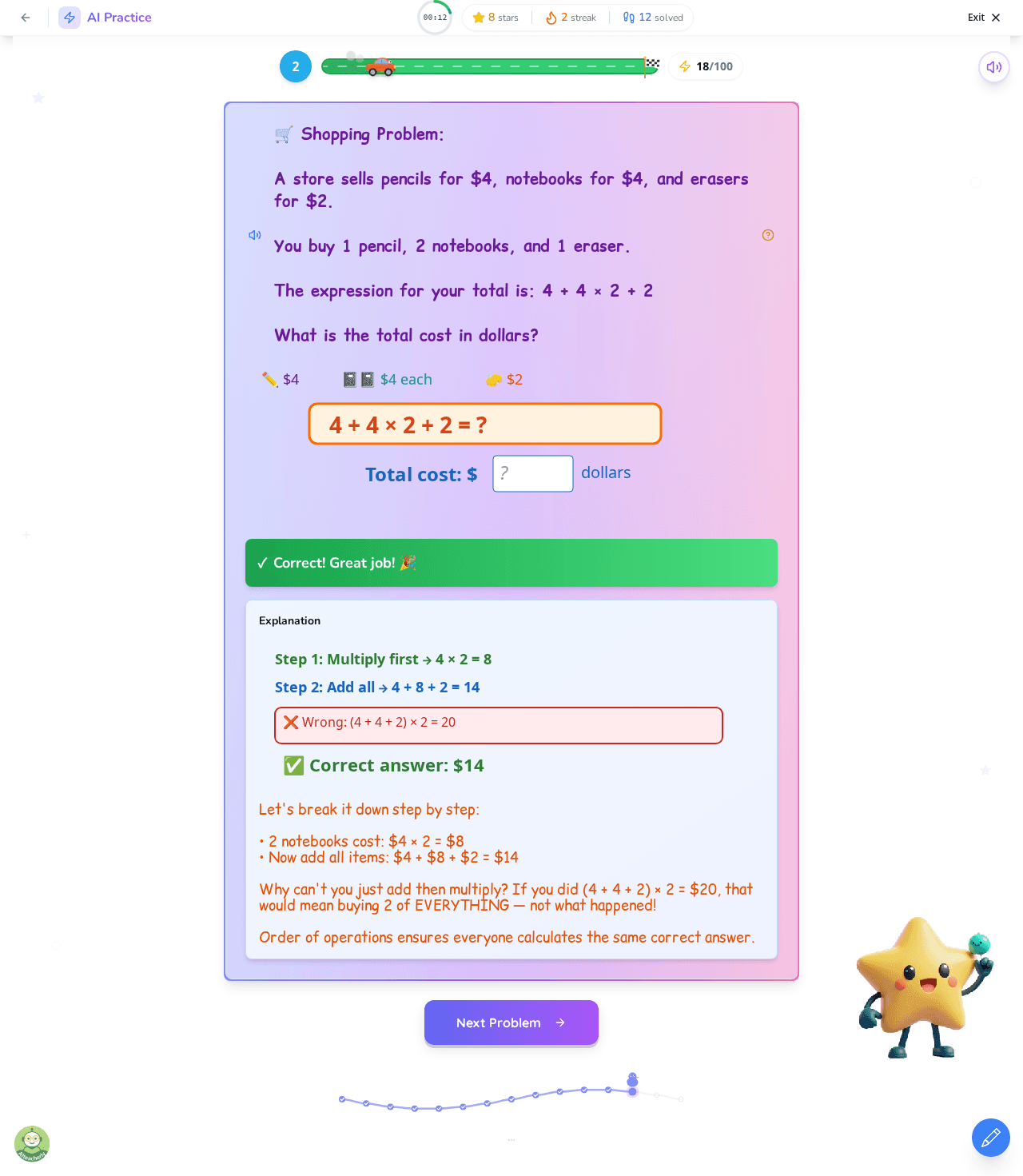
Why PEMDAS Trips Up So Many 6th Graders
Remember learning "Please Excuse My Dear Aunt Sally" back in school? That familiar mnemonic is still going strong, but for your 6th grader, the stakes are higher than ever. Order of operations isn't just another math topic to memorize; it's a foundational skill that will follow your child through algebra, geometry, and beyond.
Here's the frustrating reality many parents face: your child might understand each individual operation perfectly well, yet still get problems wrong. They know how to add. They know how to multiply. So why does 3 + 4 × 5 keep causing confusion?
The answer lies in understanding that math has its own grammar rules. Just like sentences need proper punctuation and word order to make sense, mathematical expressions need a consistent order of operations so everyone arrives at the same answer. Without these rules, the same numbers could produce wildly different results depending on who's solving the problem.
In this guide, you'll discover exactly how PEMDAS works, the sneaky mistakes that catch most students (and plenty of adults!), and practical ways to practice together at home. Whether you're refreshing your own memory or looking for ways to support your 6th grader, you're in the right place.
What Is Order of Operations and Why Does It Matter?
Order of operations is the set of rules that determines which calculations to perform first when an expression contains multiple operations. Without these standardized rules, mathematical communication would break down completely.
Consider this simple expression: 3 + 4 × 5
If you work from left to right (adding first), you get: 7 × 5 = 35
If you multiply first, you get: 3 + 20 = 23
Same numbers, two completely different answers! That's precisely why mathematicians developed order of operations. These aren't arbitrary rules someone invented to make math harder. They exist so that scientists in Japan, engineers in Germany, and students in your kitchen all get the same answer when solving the same problem.
For 6th graders specifically, mastering order of operations is critical because:
- Pre-algebra readiness: Variables and equations require flawless operation sequencing
- Standardized testing: PEMDAS problems appear on virtually every math assessment
- Real-world applications: From calculating discounts to programming computers, operation order matters
- Building confidence: Getting consistent, correct answers builds mathematical self-assurance
The correct answer to 3 + 4 × 5 is 23 because multiplication comes before addition. Once your child truly understands why these rules exist, memorizing them becomes much easier.
The PEMDAS Rules Explained Simply
PEMDAS is the mnemonic that helps students remember the correct order of operations. Each letter represents a step, but there's a crucial detail many students miss. Let's break it down:
P - Parentheses First Always start with whatever is inside parentheses (or brackets). If there are nested parentheses, work from the innermost set outward.
E - Exponents Second After parentheses, evaluate any exponents (powers). So 3² becomes 9 before you do anything else with that number.
M & D - Multiplication and Division (Left to Right) Here's where many students stumble: multiplication and division are equal partners. You don't do all multiplication first, then all division. Instead, work from left to right, handling whichever operation comes first.
A & S - Addition and Subtraction (Left to Right) Same principle applies here. Addition and subtraction share the same priority level. Work left to right through both operations.
The Memory Trick Most Students Miss
Think of PEMDAS as having four levels, not six:
- Parentheses
- Exponents
- Multiplication/Division (left to right)
- Addition/Subtraction (left to right)
When your child sees this as four steps instead of six, the left-to-right rule suddenly makes more sense. You can even use the phrase: "Please Excuse My Dear Aunt Sally, but M-D and A-S are twins who share everything."
What Are the Most Common Order of Operations Mistakes?
Understanding where students typically go wrong can help you spot and correct errors before they become habits. Here are the mistakes 6th graders make most often with PEMDAS:
Mistake #1: Treating M-D and A-S as Strictly Sequential
Many students think they must complete ALL multiplication before ANY division. Wrong! When you see 24 ÷ 4 × 2, you work left to right: 6 × 2 = 12, not 24 ÷ 8 = 3.
Mistake #2: Forgetting About Parentheses That Contain Multiple Operations
Students sometimes do what's inside parentheses but forget that PEMDAS still applies within those parentheses. For (6 + 2 × 3), you still multiply first inside: (6 + 6) = 12.
Mistake #3: Adding Before Multiplying Out of Habit
Our brains naturally want to work left to right through everything. Seeing 5 + 3 × 4, many students instinctively add first because that's what comes first visually. Consistent practice rewires this habit.
Mistake #4: Mishandling Exponents
With expressions like 2 × 3², students sometimes multiply first (getting 6²) instead of evaluating the exponent first (getting 2 × 9).
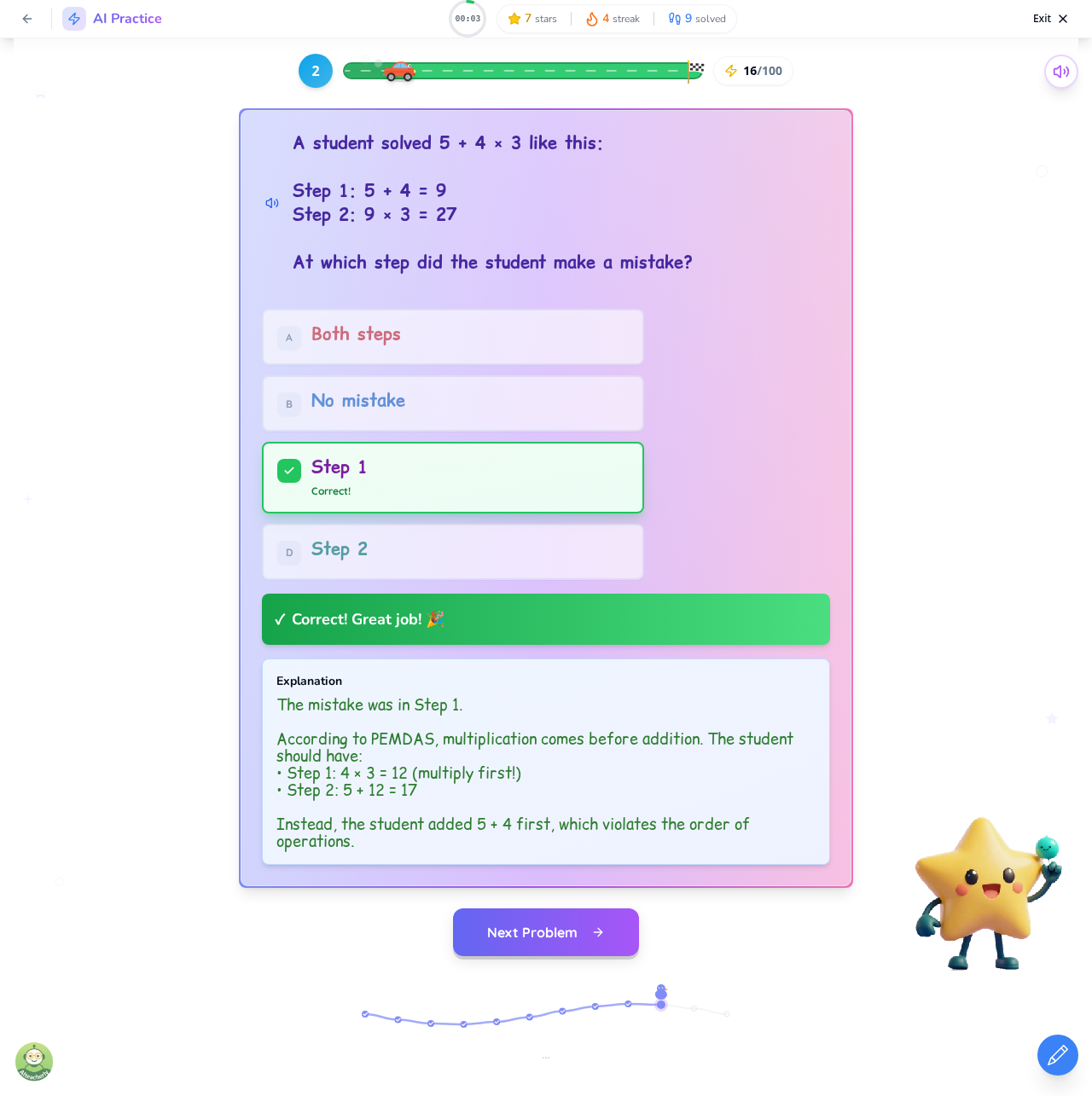
The interactive problem below shows exactly how AI Teacherly helps students identify and analyze these common errors step by step.
Mistake #5: Skipping Steps
Rushing through problems leads to skipped operations. Encourage your child to write out each step, even when they think they can do it mentally.
How to Practice PEMDAS at Home with Your Child
The good news? Order of operations is one of those math skills that improves dramatically with the right kind of practice. Here are strategies that actually work:
Start with Expression Spotting
Before solving anything, have your child identify all the operations in an expression and verbally state which to do first. This builds the habit of pausing to plan before calculating.
Use the "Underline Method"
Teach your child to underline the operation they'll do first, solve just that part, rewrite the expression, then underline the next operation. This visual tracking prevents skipped steps.
Create Real-World Problems Together
Make PEMDAS relevant with scenarios like:
- "You buy 3 books at $8 each and use a $5 coupon. What's your total?" (3 × 8 - 5)
- "If you have 20 stickers and give away 4 to each of 3 friends, how many are left?" (20 - 4 × 3)
Practice Error Analysis
Show your child an incorrect solution and ask them to find the mistake. This builds critical thinking and reinforces what not to do.
Keep Sessions Short and Consistent
Ten to fifteen minutes of focused PEMDAS practice beats an hour of frustrated cramming. Consistency builds automaticity; your child's brain will eventually follow the rules without conscious effort.
Celebrate the Process, Not Just Answers
When your child writes out every step clearly, praise that effort. Process-oriented praise builds mathematical resilience.
See How Interactive PEMDAS Practice Works
Traditional worksheets have their place, but interactive lessons take PEMDAS practice to another level. When students can manipulate expressions, see immediate feedback, and work through guided examples, the rules stick faster and longer.
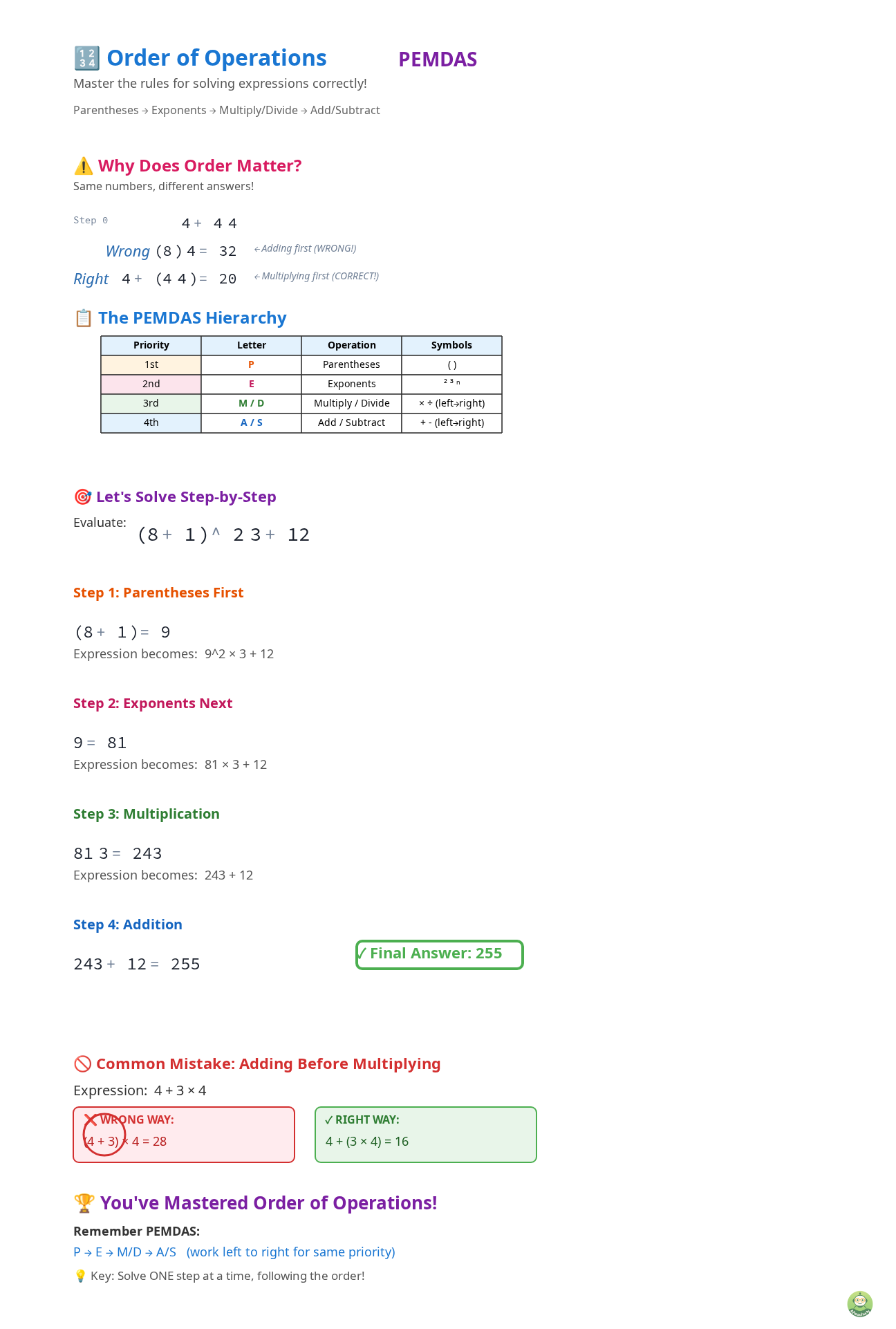
Here's what the full interactive lesson looks like on AI Teacherly:
The Order of Operations with Whole Numbers lesson on AI Teacherly is designed specifically for 6th graders who need to master this foundational skill. Here's what makes it effective:
Guided Discovery Approach
Instead of simply stating rules, the lesson starts by showing why order of operations matters. Students see how the same expression yields different answers without consistent rules, creating an "aha moment" that makes memorization meaningful.
Step-by-Step Breakdowns
Complex expressions like (num1 + num2)² × num3 + num4 are broken into manageable steps. Students learn to tackle parentheses first, then exponents, working methodically through each level.
Instant Feedback
Unlike paper worksheets where students might practice errors repeatedly, interactive problems provide immediate correction. This prevents wrong methods from becoming ingrained habits.
Multiple Problem Types
From ordering operations to evaluating expressions to real-world shopping scenarios, the variety keeps practice engaging while building flexible understanding.
Progress Tracking
Parents can see exactly which concepts their child has mastered and where additional practice might help.
Key Takeaways
- PEMDAS has four priority levels, not six: Parentheses, Exponents, Multiplication/Division (left to right), Addition/Subtraction (left to right)
- Multiplication and division share equal priority; work left to right through both, not all multiplication first
- The most common 6th grade PEMDAS mistake is treating M-D and A-S as strictly sequential instead of same-level pairs
- Short, consistent practice sessions (10-15 minutes) build order of operations fluency better than long cramming sessions
- Have your child write out every step to prevent skipped operations and build clear mathematical thinking
- Real-world word problems make PEMDAS relevant and help your child understand why these rules matter
- Interactive lessons with immediate feedback prevent students from practicing errors repeatedly
Frequently Asked Questions
What does PEMDAS stand for and what does each letter mean?
PEMDAS stands for Parentheses, Exponents, Multiplication, Division, Addition, and Subtraction. It's the order you follow when solving math expressions with multiple operations.
Why do we need order of operations in math?
Without order of operations, the same expression could give different answers depending on how you solve it. These rules ensure everyone gets the same correct answer, making mathematical communication consistent worldwide.
Do you always multiply before dividing in PEMDAS?
No! Multiplication and division have equal priority. Work left to right through both operations in the order they appear. The same applies to addition and subtraction.
What is the most common order of operations mistake students make?
The most common mistake is doing all multiplication before any division (or all addition before subtraction). Remember: M/D and A/S are same-level partners worked left to right.
Is PEMDAS the same as BODMAS or GEMDAS?
Yes, they're equivalent! BODMAS (Brackets, Orders) is used in UK/Australia, GEMDAS (Grouping, Exponents) in some US regions. All follow the same mathematical rules.
How can I help my 6th grader practice order of operations at home?
Use the underline method (mark which operation to do first), create real-world word problems, practice error analysis together, and keep sessions short (10-15 minutes) but consistent.
What happens if you don't follow order of operations?
You'll get the wrong answer. For example, 3 + 4 × 5 equals 23 (multiply first), not 35 (adding first). Following PEMDAS ensures mathematical accuracy.
At what grade level should kids know PEMDAS?
PEMDAS is typically introduced in 5th grade and mastered in 6th grade. It's foundational for pre-algebra, so solid understanding by the end of 6th grade is essential for math success.
Ready to make PEMDAS practice engaging for your 6th grader? Try the interactive Order of Operations lesson free on AI Teacherly and watch those math confidence levels soar!