PEMDAS Made Easy: A Parent's Complete Guide to Teaching Order of Operations in 5th Grade
That moment when your 5th grader asks for homework help and you freeze at "3 + 5 × 2"? You're not alone. Discover the simple PEMDAS secret code that makes order of operations click.
Why Order of Operations Trips Up So Many Kids (And Parents)
Picture this: Your 5th grader brings home a worksheet with the problem 3 + 5 × 2. They confidently write 16 as the answer, and honestly, that looks right to you too. After all, 3 plus 5 is 8, and 8 times 2 is 16. Simple, right?
Except the correct answer is actually 13.
If that surprises you, you're in excellent company. This exact problem trips up students, parents, and even some teachers every single day. The culprit? A misunderstanding of the order of operations, often remembered by the acronym PEMDAS.
Here's the reassuring truth: PEMDAS hasn't changed since you learned it in school. The rules are exactly the same. What has changed is how we teach it, with more emphasis on understanding why the rules exist rather than just memorizing them. This blog will give you everything you need to confidently guide your child through order of operations, whether you're helping with homework or simply want to stay one step ahead.
By the end, you'll understand exactly why 3 + 5 × 2 equals 13, how to explain it to your child, and how interactive practice can make these concepts stick for good.
What Is PEMDAS and Why Does It Matter?
PEMDAS is what mathematicians call a "secret code" for solving math problems. It stands for:
- P = Parentheses
- E = Exponents
- M = Multiplication
- D = Division
- A = Addition
- S = Subtraction
This sequence tells us the order in which to perform operations when a math expression contains more than one type. Without this universal standard, the same problem could have multiple "correct" answers depending on who solved it.
Imagine if there were no rules for traffic lights. Some drivers would go on green, others on red, and chaos would ensue. PEMDAS works the same way for math: it ensures that everyone, everywhere, gets the same answer when solving the same problem.
The Critical Detail Most People Miss
Here's something important that often gets overlooked: Multiplication and Division are equals. They sit at the same level and should be performed left to right as they appear. The same applies to Addition and Subtraction. They're partners at the same level.
So the order is really:
- Parentheses (and brackets)
- Exponents
- Multiplication AND Division (left to right)
- Addition AND Subtraction (left to right)
This "left to right" rule within each level is where many students stumble. When your child understands this nuance, they'll avoid the most common order of operations errors.
The Most Common Order of Operations Mistake (And How to Fix It)
Let's return to our problem: 3 + 5 × 2
The most common mistake is solving from left to right without considering operation priority. Here's what that looks like:
❌ Wrong approach: 3 + 5 = 8, then 8 × 2 = 16
✅ Correct approach using PEMDAS: First, look for multiplication or division. We have 5 × 2 = 10. Then add: 3 + 10 = 13
The difference is dramatic: 16 versus 13. And on a test, that wrong answer costs points even though the child performed all the arithmetic correctly.
How to Help Your Child Avoid This Mistake
Teach them to scan the entire expression before picking up their pencil. Ask questions like:
- "Do you see any parentheses?"
- "What about exponents?"
- "Are there any multiplication or division signs?"
This scanning habit builds awareness of operation priority. Many children rush to solve left to right because that's how we read. Breaking this habit requires deliberate practice.
A Simple Trick That Works
Have your child lightly circle or underline multiplication and division operations first. This visual cue reminds them which operations take priority before they start calculating. It's a small step that prevents big errors.
How to Solve Expressions with Parentheses: Step-by-Step
Parentheses are powerful tools in mathematics. They're like a VIP section at a concert: whatever's inside gets handled first, no matter what.
Let's walk through an example: (4 + 3) × 2
Step 1: Identify the parentheses. We have (4 + 3).
Step 2: Solve inside the parentheses first. 4 + 3 = 7.
Step 3: Replace the parentheses with the result. Now we have 7 × 2.
Step 4: Solve the remaining operation. 7 × 2 = 14.
Notice how the parentheses changed everything. Without them, 4 + 3 × 2 would equal 10 (because we'd multiply 3 × 2 first, getting 6, then add 4). With parentheses, the answer is 14.
Parentheses Give Power
Help your child understand that parentheses are a way to control math. Mathematicians use them intentionally to change the order of operations. When your child sees parentheses, they should think: "These operations need my attention first."
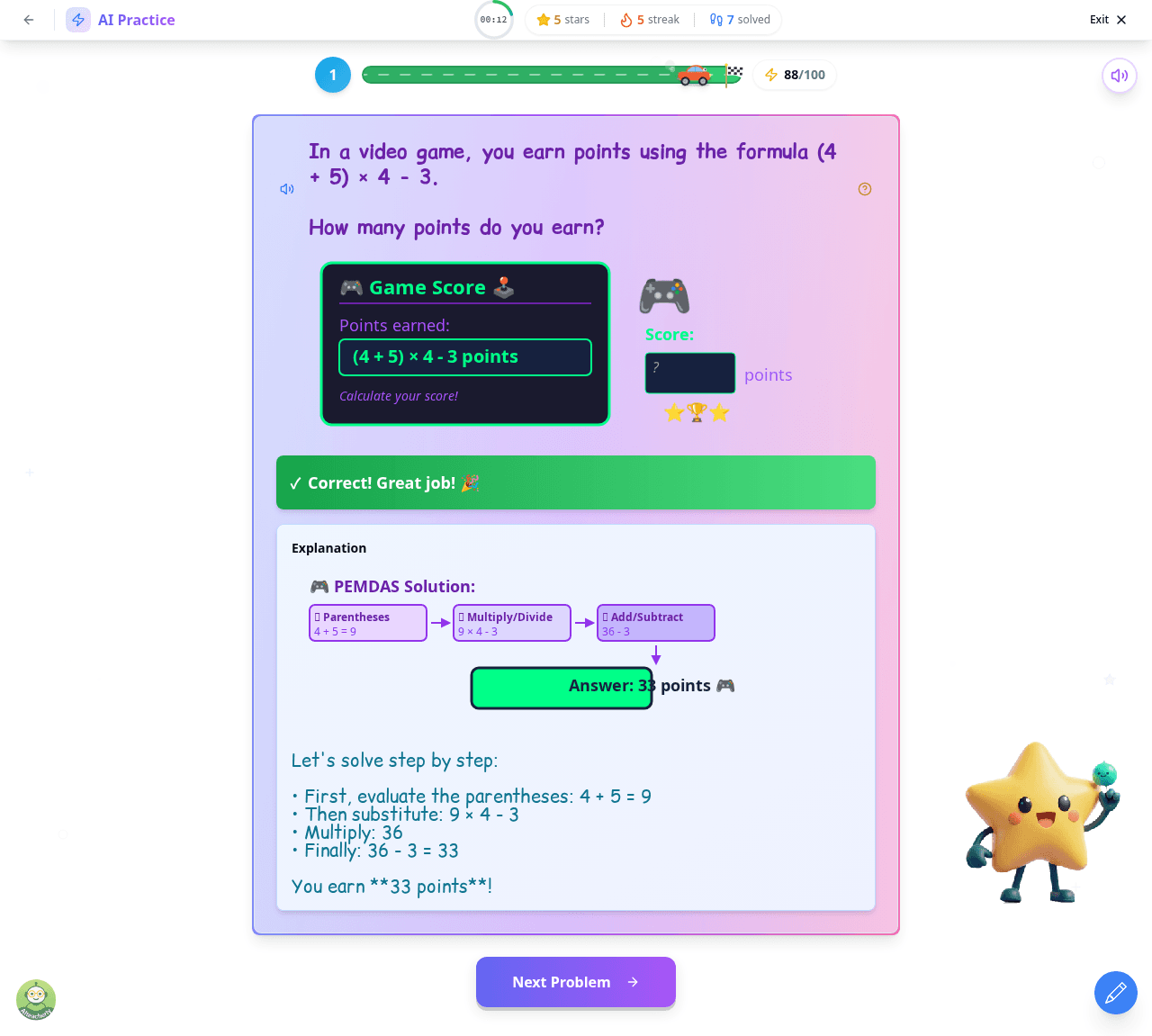
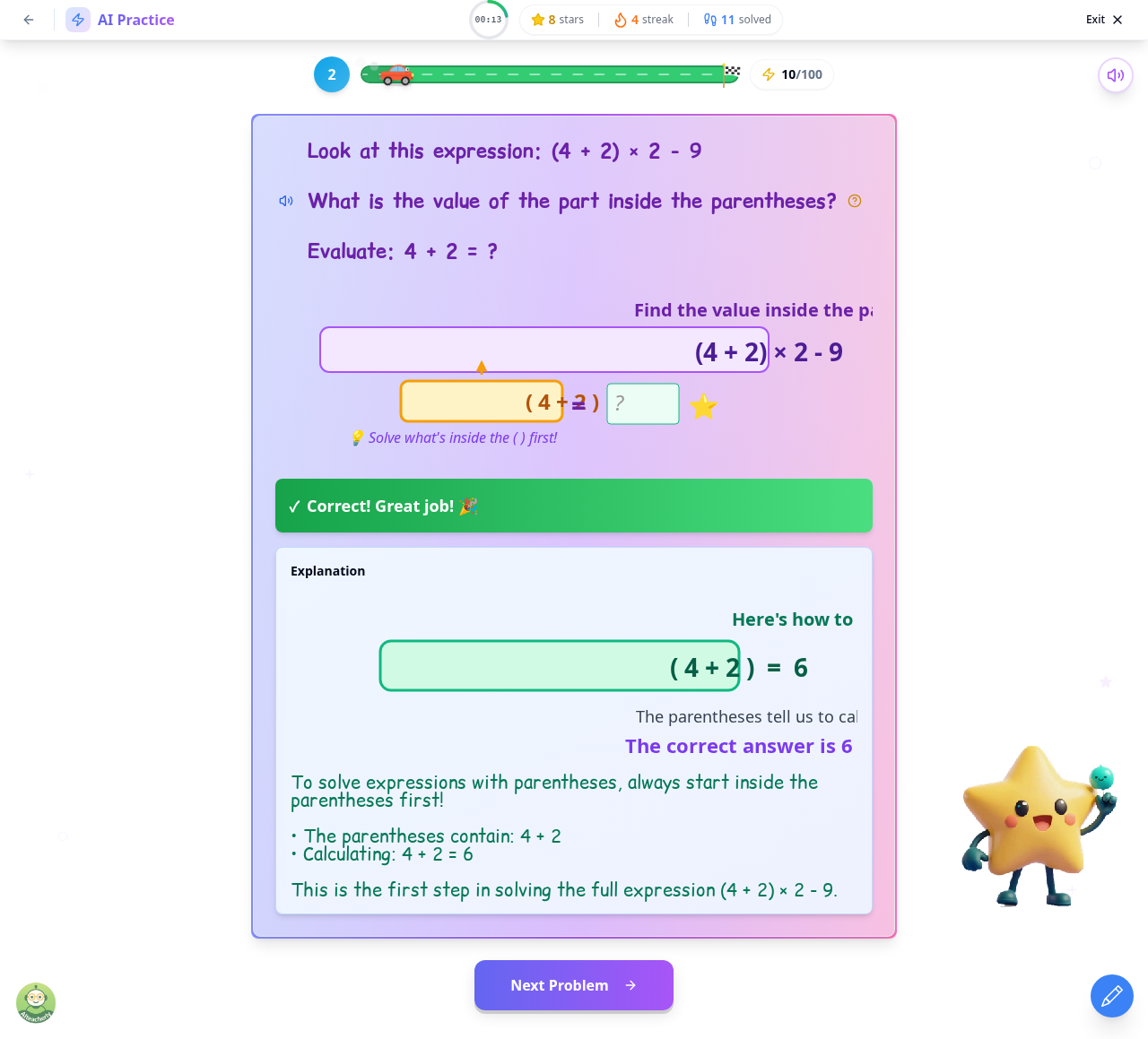
The interactive problem below shows exactly how to evaluate expressions with parentheses step by step:
Practice Makes Perfect
Real understanding comes from working through multiple examples. Have your child verbalize each step as they solve: "First I solve inside the parentheses... then I multiply... then I add." This verbal processing reinforces the sequence.
Nested Parentheses and Brackets: Working from the Inside Out
As your 5th grader advances, they'll encounter expressions with multiple layers of grouping symbols. These might look intimidating, but there's a simple rule: always work from the inside out.
Consider this expression: 2 × [3 + (4 - 1)]
Here's how to solve it:
Step 1: Find the innermost grouping. That's (4 - 1) inside the brackets.
Step 2: Solve the innermost first. 4 - 1 = 3.
Step 3: Rewrite the expression. Now we have 2 × [3 + 3].
Step 4: Solve the next grouping. 3 + 3 = 6. Now we have 2 × 6.
Step 5: Complete the final operation. 2 × 6 = 12.
Understanding the Hierarchy
In most 5th grade math, you'll see three types of grouping symbols:
- Parentheses ( ) — the most common
- Brackets [ ] — usually contain parentheses
- Braces { } — the outermost layer (less common in elementary)
Think of it like Russian nesting dolls. You open the smallest one first (innermost parentheses), then work your way out to the larger dolls (brackets, then braces).
A Helpful Analogy for Kids
Tell your child: "It's like unwrapping a present. You take off the outer wrapping paper first, then the box, then the tissue paper inside. With math, we go the other way: start with what's deepest inside and work outward."
See How Interactive Learning Makes PEMDAS Click
One reason order of operations feels confusing on paper is that it's abstract. Students are asked to follow rules without seeing why those rules lead to different answers. Interactive learning changes this by making the consequences of each choice visible and immediate.
On AI Teacherly's Order of Operations with Parentheses lesson for Grade 5, students don't just memorize PEMDAS. They experience it through:
Visual Step-by-Step Breakdowns
Each problem guides students through the correct sequence, highlighting which operation to tackle first. When a student makes a mistake, they see exactly where their approach diverged from the correct path.
Real-World Scenarios
The lesson uses contexts that matter to kids: calculating video game scores, figuring out shopping totals, and managing sticker collections. These scenarios show that order of operations isn't just a school rule; it's how real math works in the real world.
Immediate Feedback
Unlike worksheets where students might repeat the same mistake 20 times before getting feedback, interactive lessons catch errors immediately. This prevents bad habits from forming and builds confidence through quick wins.
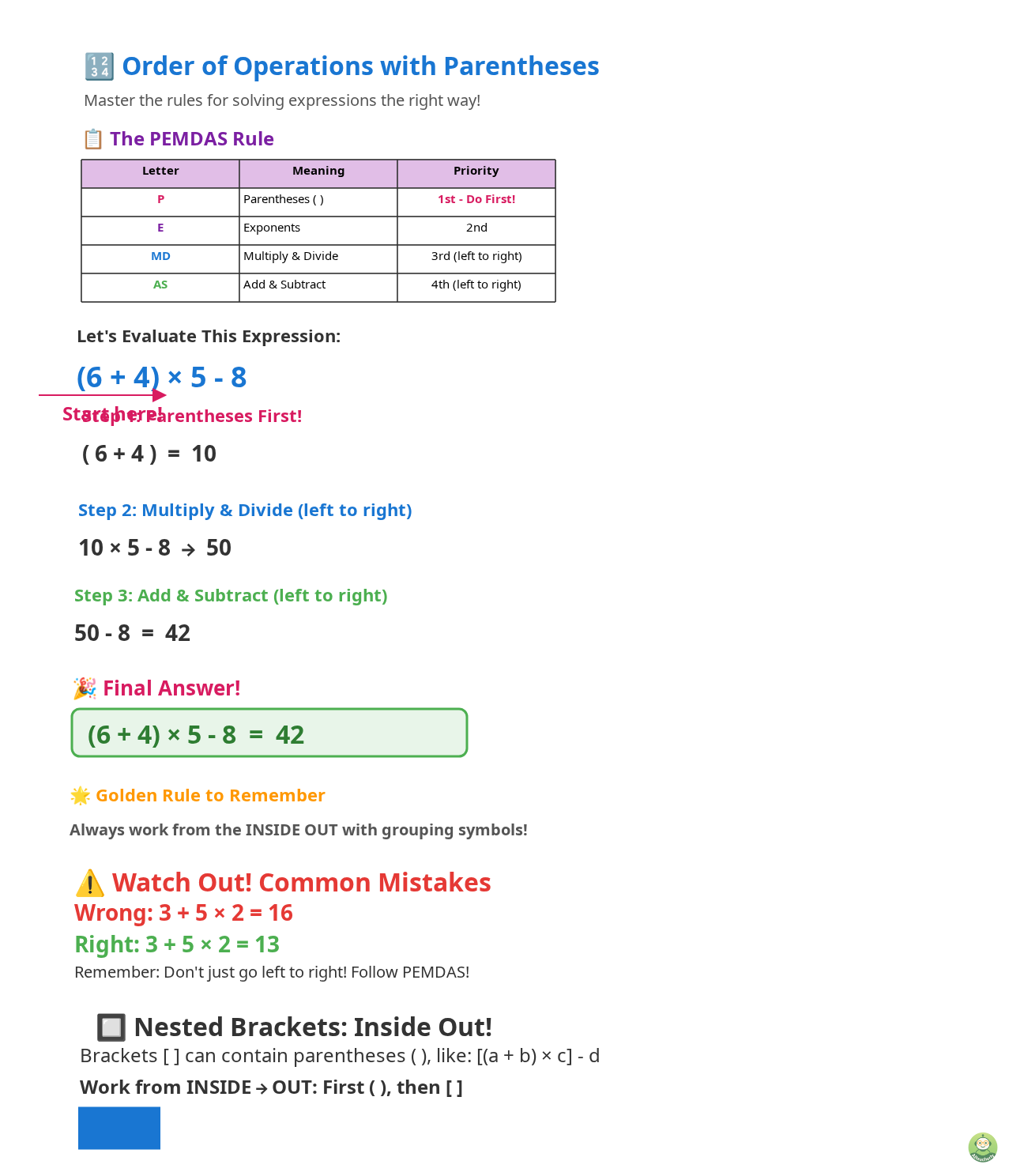
Here's what the full interactive lesson looks like on AI Teacherly:
Why This Matters for Parents
When your child practices with interactive tools, they're not just drilling problems. They're building intuition. The "aha moment" when they realize why multiplication comes before addition sticks with them far longer than memorized rules.
Key Takeaways
- PEMDAS is a universal 'secret code' ensuring everyone gets the same answer: Parentheses, Exponents, Multiplication/Division (left to right), Addition/Subtraction (left to right)
- The most common mistake is solving left to right instead of following operation priority, turning 3 + 5 × 2 into 16 instead of the correct answer, 13
- Teach your child to scan the entire expression first before calculating, identifying parentheses, exponents, and multiplication/division operations
- Parentheses always come first; think of them as the VIP section where operations inside get priority treatment
- For nested parentheses and brackets, always work from the inside out, like unwrapping layers of a present in reverse
- Have your child verbalize each step out loud ('First I solve the parentheses, then I multiply...') to reinforce the correct sequence
- Interactive practice with immediate feedback prevents bad habits and builds lasting understanding faster than worksheets alone
Frequently Asked Questions
What does PEMDAS stand for and what does each letter mean?
PEMDAS stands for Parentheses, Exponents, Multiplication, Division, Addition, and Subtraction. It's the standard order for solving math expressions, ensuring everyone calculates the same result.
Why can't you just solve math problems from left to right?
Math has operation hierarchy rules. Multiplication and division take priority over addition and subtraction. Solving left to right ignores this priority and produces wrong answers.
What's the difference between parentheses and brackets in math?
Parentheses ( ) and brackets [ ] both group operations that should be solved first. Brackets typically contain parentheses in complex expressions. Solve the innermost grouping first.
How do I help my child remember the order of operations?
Use the phrase 'Please Excuse My Dear Aunt Sally' for PEMDAS. Also teach them to scan expressions for parentheses first, then look for multiplication/division before adding/subtracting.
What are the most common order of operations mistakes kids make?
The biggest mistake is solving left to right without checking for multiplication/division first. Another common error is forgetting that M/D and A/S are solved left to right at their respective levels.
When do you multiply before dividing in PEMDAS?
Multiplication and division are equal priority. Solve them left to right in the order they appear. The same rule applies to addition and subtraction at their level.
At what grade do kids learn order of operations?
Order of operations is typically introduced in 4th grade and mastered in 5th grade. Students continue using PEMDAS throughout middle school, high school, and beyond.
How do you solve expressions with nested parentheses?
Work from the inside out. Solve the innermost parentheses first, replace with the result, then move to the next outer grouping. Continue until no grouping symbols remain.
Ready to make order of operations click for your child? Try the interactive PEMDAS lesson free on AI Teacherly and watch those 'aha moments' happen in real time!