PEMDAS Made Simple: A Parent's Guide to Order of Operations in 6th Grade Math
Confused by PEMDAS? This step-by-step guide helps parents understand order of operations so homework time becomes less stressful and more productive.
Why Does Math Homework Feel Like a Foreign Language?
That moment when your 6th grader slides their math worksheet across the table and asks, "Can you help me with this?" You look down at an expression like (3 + 2)² × 4 + 5 and suddenly wish you had somewhere else to be.
You're not alone. Order of operations is one of those topics that trips up parents everywhere. Maybe you learned it decades ago and forgot the rules. Maybe you remember something about "Please Excuse My Dear Aunt Sally" but can't quite recall what it means. Or perhaps you never felt confident with it in the first place.
Here's the good news: PEMDAS is simpler than it looks once you understand the system. This guide will walk you through everything you need to know to confidently help your child with order of operations problems. No math degree required.
By the end of this article, you'll understand exactly why mathematicians created these rules, how to apply them step-by-step, and how to spot the common mistakes that trip up most 6th graders. Let's turn homework time from stressful to successful.
What Is PEMDAS and Why Does Order of Operations Matter?
PEMDAS is an acronym that tells us the order to perform math operations. Each letter represents a step:
- P = Parentheses (do these first)
- E = Exponents (like 2² or 3³)
- M = Multiplication
- D = Division
- A = Addition
- S = Subtraction
But why do we need rules at all? Here's the problem: without a standard order, the same expression could give different answers.
Take the expression 3 + 2 × 4. If you work left to right, you'd calculate 3 + 2 = 5, then 5 × 4 = 20. But if you multiply first, you'd get 2 × 4 = 8, then 3 + 8 = 11.
Same numbers. Two completely different answers. That's mathematical chaos!
The order of operations exists so that everyone, everywhere, gets the same answer when solving the same problem. It's like traffic rules for math. Without them, there would be collisions everywhere.
The rule most parents forget: Multiplication and division share the same priority level, as do addition and subtraction. When operations are on the same level, you work left to right. This is the number one thing adults misremember about PEMDAS.
How to Apply PEMDAS Step-by-Step (With Examples)
Let's walk through a problem together using the exact method your child is learning. We'll solve: (5 + 3)² × 2 + 6
Step 1: Parentheses First Look for anything inside parentheses and solve it first. (5 + 3) = 8 Now our expression is: 8² × 2 + 6
Step 2: Exponents Next Handle any exponents (powers). 8² = 64 Now we have: 64 × 2 + 6
Step 3: Multiplication and Division (Left to Right) Do any multiplication or division, working from left to right. 64 × 2 = 128 Now we have: 128 + 6
Step 4: Addition and Subtraction (Left to Right) Finally, handle addition and subtraction. 128 + 6 = 134
The key is tackling one operation at a time and rewriting the expression after each step. This prevents errors and helps your child see their progress.
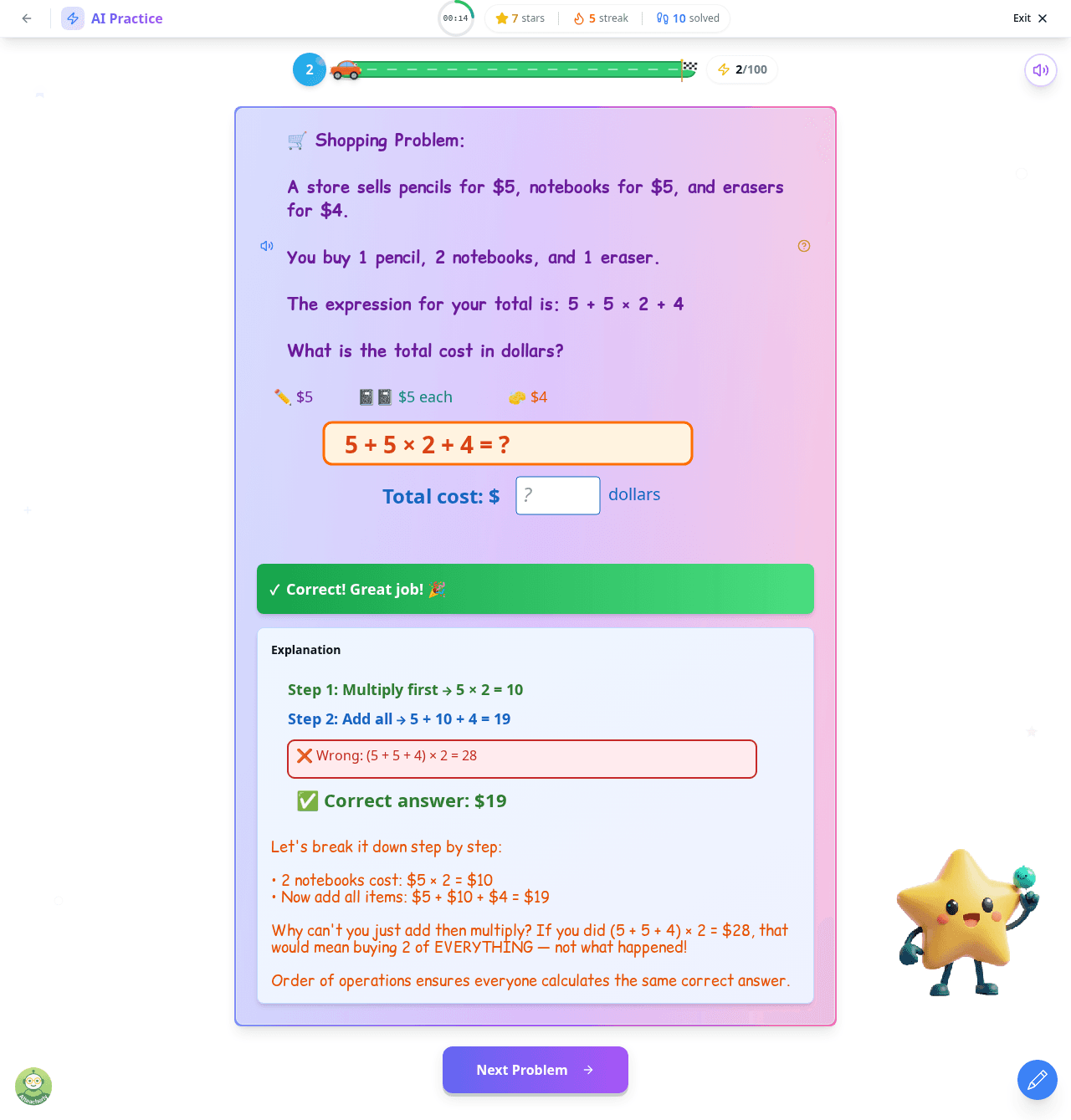
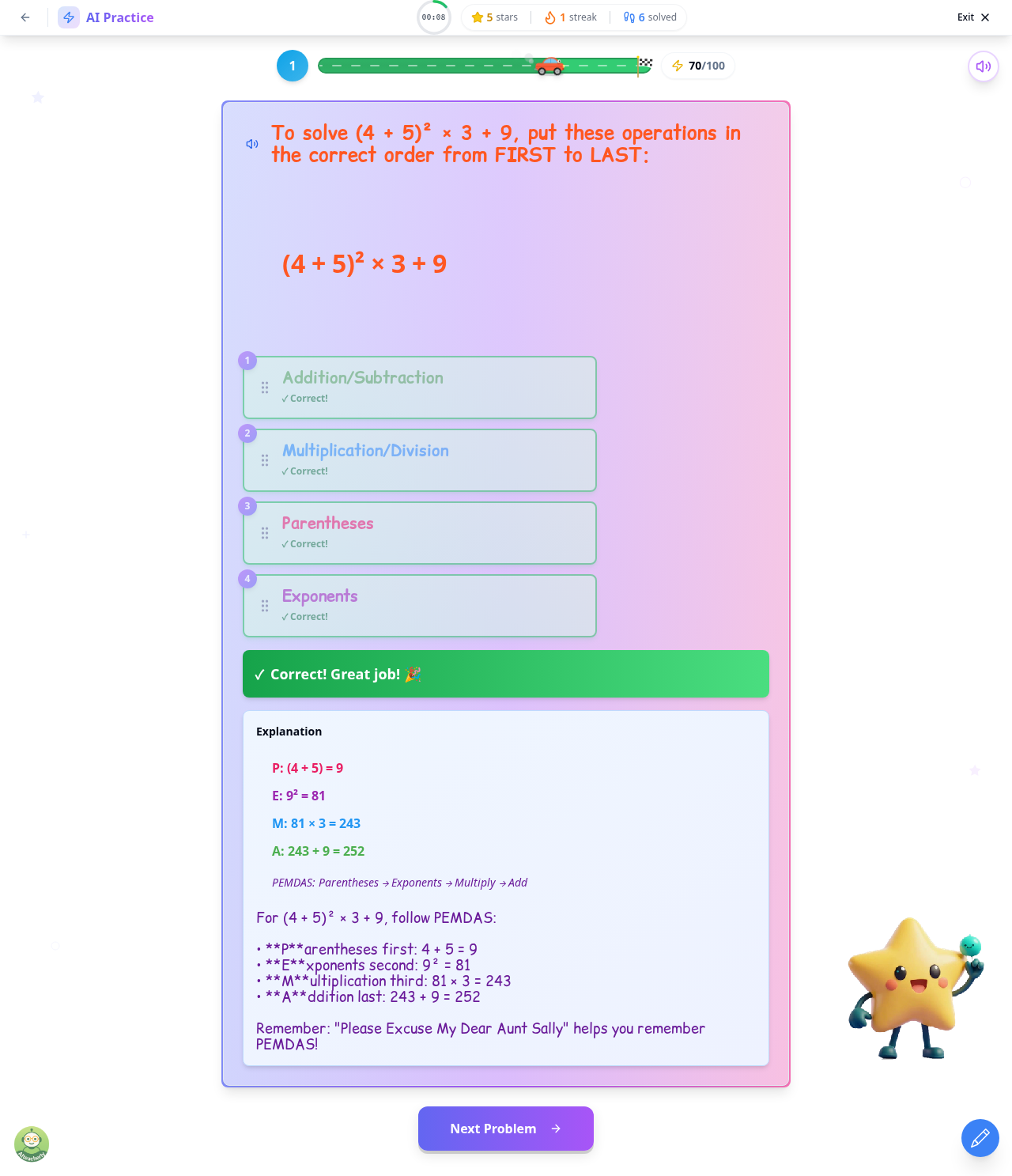
The interactive problem below shows exactly how PEMDAS works in practice. Notice how students arrange the steps in the correct sequence:
Pro tip for parents: When helping with homework, ask your child, "What operation should we do first?" rather than jumping in to solve. This builds their independence while you guide them through the process.
What Are the Most Common Order of Operations Mistakes?
Knowing where students typically go wrong helps you spot errors in your child's homework. Here are the top mistakes 6th graders make with PEMDAS:
Mistake #1: Adding Before Multiplying In 3 + 4 × 2, many students add 3 + 4 first to get 7, then multiply by 2 for 14. The correct approach: multiply first (4 × 2 = 8), then add (3 + 8 = 11).
Mistake #2: Forgetting Left-to-Right Rule Students often think multiplication always comes before division. In 8 ÷ 2 × 4, they might do 2 × 4 first. Wrong! Work left to right: 8 ÷ 2 = 4, then 4 × 4 = 16.
Mistake #3: Ignoring Parentheses Inside Parentheses When there are nested parentheses like (2 × (3 + 1)), students must start with the innermost parentheses: (3 + 1) = 4, then 2 × 4 = 8.
Mistake #4: Rushing Through Multi-Step Problems The biggest error is trying to do too much at once. Your child should rewrite the expression after each step. It takes longer but dramatically reduces mistakes.
How to help at home: When your child gets an answer wrong, don't just point out the error. Ask, "Walk me through your steps one at a time." Often, they'll catch their own mistake when they slow down and explain their thinking.
How to Support Your 6th Grader Without Doing the Work for Them
The goal isn't to become your child's personal calculator. It's to help them build confidence and independence. Here's how to guide without taking over:
Ask Questions Instead of Giving Answers Try these coaching prompts:
- "What does PEMDAS tell us to do first?"
- "I see parentheses here. What should we handle next?"
- "Are multiplication and division on the same level? Which one comes first in this expression?"
Use Real-World Examples PEMDAS isn't abstract. It's how we calculate everyday things correctly. Imagine buying 3 shirts at $15 each and adding a $5 shipping fee: 3 × $15 + $5. If you added first (15 + 5 = 20, times 3 = 60), you'd overpay! The correct total is $45 + $5 = $50.
Celebrate the Process, Not Just the Answer When your child works through each step correctly, acknowledge that: "Great job identifying that you needed to do the exponent first!" This reinforces the method they'll need for harder problems later.
Know When to Step Back If homework becomes a battle, it's okay to write a note to the teacher explaining where your child got stuck. Teachers would rather know about confusion than see work that was actually done by a parent.
See PEMDAS in Action: Interactive Practice on AI Teacherly
Understanding the rules is one thing. Building confidence through practice is another. That's where interactive learning makes a difference.
On AI Teacherly, the Order of Operations with Whole Numbers lesson for Grade 6 takes students through PEMDAS step-by-step with immediate feedback. Instead of just reading about the rules, students actively apply them by:
- Watching side-by-side comparisons of correct vs. incorrect approaches
- Practicing with expressions that gradually increase in complexity
- Getting instant feedback when they make a mistake (and understanding why)
- Working through real-world word problems like calculating shopping totals
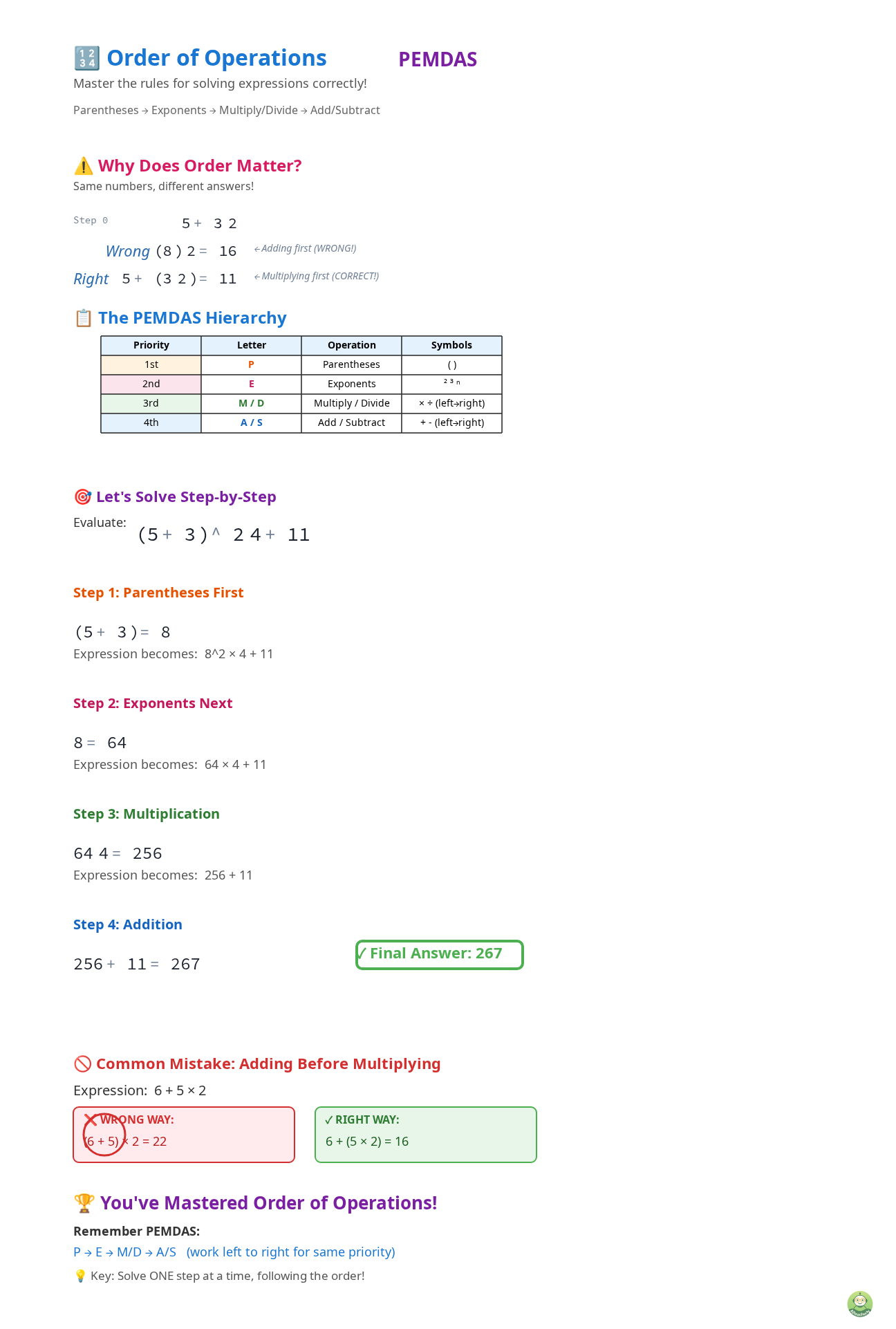
Here's what the full interactive lesson looks like on AI Teacherly:
The lesson starts by showing why order of operations matters (preventing that "same numbers, different answers" confusion), then builds systematically through parentheses, exponents, multiplication/division, and addition/subtraction.
What makes interactive practice valuable is the immediate correction. Your child doesn't have to wait for a teacher to grade their homework to find out they've been making the same mistake repeatedly. They learn and adjust in real-time.
For parents who want to preview what their child is learning, or for students who want extra practice beyond homework, the lesson is available anytime on the AI Teacherly platform.
Key Takeaways
- PEMDAS stands for Parentheses, Exponents, Multiplication, Division, Addition, Subtraction (in that priority order)
- Multiplication and division have equal priority; work left to right when both appear
- Addition and subtraction also share equal priority; solve left to right
- The most common mistake is adding before multiplying in expressions like 3 + 4 × 2
- Rewriting the expression after each step helps prevent errors
- Ask guiding questions instead of solving problems for your child
- Interactive practice with immediate feedback builds confidence faster than worksheets alone
Frequently Asked Questions
What does PEMDAS stand for and what does each letter mean?
PEMDAS stands for Parentheses, Exponents, Multiplication, Division, Addition, and Subtraction. It tells you the order to perform operations in a math expression so everyone gets the same answer.
Why do we need order of operations in math?
Without a standard order, the same expression like 3 + 2 × 4 could equal 20 or 11 depending on which operation you do first. Order of operations ensures everyone gets the same correct answer.
Do you always do multiplication before division?
No! Multiplication and division have equal priority. When both appear in an expression, work from left to right. The same rule applies to addition and subtraction.
What is the left-to-right rule in PEMDAS?
When operations share the same priority level (like multiplication and division, or addition and subtraction), you solve them in order from left to right instead of one always coming before the other.
What are the most common PEMDAS mistakes students make?
The top mistakes are: adding before multiplying (in expressions like 3 + 4 × 2), forgetting the left-to-right rule for same-level operations, and trying to do too many steps at once instead of one at a time.
Is PEMDAS the same as BODMAS or GEMDAS?
Yes, they're different names for the same rules. BODMAS (Brackets, Orders, Division, Multiplication, Addition, Subtraction) is used in the UK. GEMDAS uses 'Grouping' instead of Parentheses. The actual math rules are identical.
How can I help my child remember the order of operations?
The phrase 'Please Excuse My Dear Aunt Sally' helps many students remember PEMDAS. For practice, have them solve one step at a time and rewrite the expression after each operation.
When do parentheses change the order of operations?
Parentheses are always solved first, which lets you override the normal order. For example, in (3 + 2) × 4, you add first because it's in parentheses, giving 5 × 4 = 20 instead of 3 + 8 = 11.
Ready to make order of operations click for your child? Try the interactive PEMDAS lesson free on AI Teacherly and watch their confidence grow!