PEMDAS Made Simple: A Parent's Complete Guide to 6th Grade Order of Operations
Struggling with PEMDAS homework? Discover why 6th graders get different answers for the same problem and learn a simple step-by-step method any parent can use to help.
Why Does My Child Keep Getting Different Answers?
Picture this scenario: your 6th grader sits down to solve 3 + 4 × 2. They confidently write down 14. The answer key says 11. They try again, get 14 again, and frustration sets in.
Sound familiar? You're definitely not alone. This exact situation plays out in households across the country every school night. The problem isn't that your child can't do math; it's that they haven't yet mastered the order of operations, one of the most critical math skills they'll learn in middle school.
Here's the thing: without consistent rules for which operations to do first, the same expression can legitimately produce different answers. That's chaos for mathematicians, scientists, programmers, and yes, 6th graders trying to pass their homework.
The good news? Order of operations follows a simple, predictable pattern. Once your child understands the "why" behind these rules, the "how" becomes much easier. And with the right practice tools, they can move from frustrated to confident in just a few sessions.
In this guide, we'll break down everything you need to know about PEMDAS in plain English. No math degree required.
What Is PEMDAS and Why Does Order of Operations Matter?
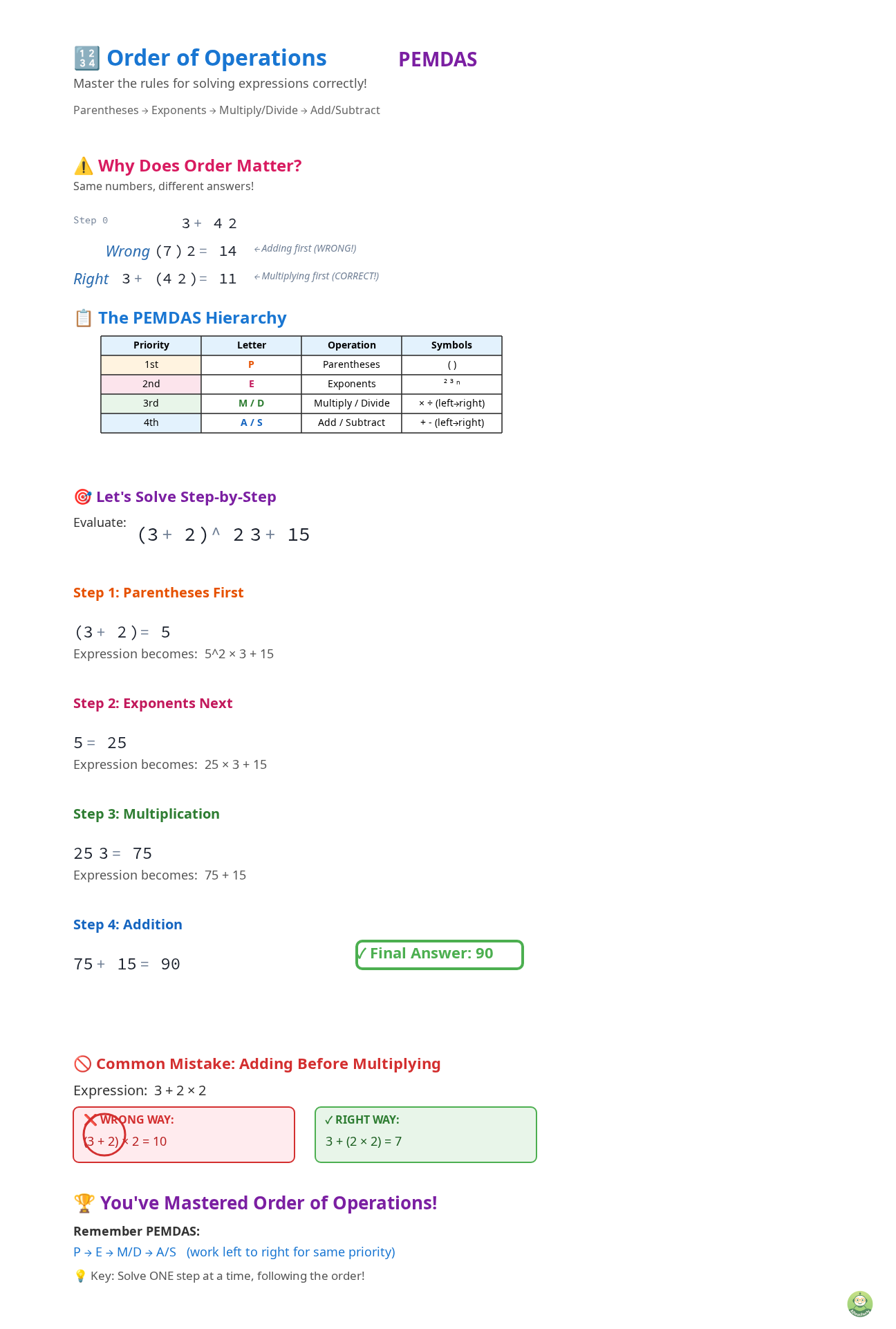
PEMDAS is an acronym that helps students remember the correct sequence for solving mathematical expressions. Each letter represents a step:
- P = Parentheses (solve what's inside first)
- E = Exponents (powers and square roots)
- M = Multiplication
- D = Division
- A = Addition
- S = Subtraction
But here's what trips up most students (and many parents!): Multiplication and Division have EQUAL priority. So do Addition and Subtraction. When operations share the same level, you simply work left to right.
So why does this matter beyond homework? Order of operations is the universal language of mathematics. When engineers design bridges, when accountants calculate taxes, when programmers write code, everyone needs to interpret expressions the same way. Without these rules, 2 + 3 × 4 could mean 20 to one person and 14 to another. Imagine the chaos!
For your 6th grader, mastering PEMDAS is also the gateway to algebra. Every equation they'll solve in 7th grade and beyond depends on applying these rules correctly. Getting it right now saves significant struggle later.
The key insight to share with your child: PEMDAS isn't arbitrary. It exists so that everyone, everywhere gets the same answer. That's actually pretty cool when you think about it.
How to Explain Each Step of PEMDAS to Your 6th Grader
When sitting down with your child, try explaining each step in practical terms they can relate to:
Parentheses First: "The VIP Section"
Tell your child that parentheses are like VIP passes at a concert. Whatever is inside gets handled first, no matter what. In 5 × (3 + 2), you MUST add 3 + 2 before multiplying. The parentheses demand it.
Exponents Next: "The Power Players"
After clearing parentheses, handle any exponents. Remind your child that 3² means 3 × 3, not 3 × 2. A common confusion point!
Multiplication and Division: "Equal Partners, Left to Right"
Here's where the memorized phrase "My Dear" can mislead students. Multiplication does NOT always come before division. If you see 12 ÷ 4 × 3, work left to right: 12 ÷ 4 = 3, then 3 × 3 = 9. Not 1!
Addition and Subtraction: "The Clean-Up Crew"
Same rule applies here. In 10 - 3 + 2, go left to right: 10 - 3 = 7, then 7 + 2 = 9. Don't add first just because A comes before S in the acronym.
Pro tip for parents: When checking homework, have your child talk through each step out loud. If they say "I added first because addition comes before subtraction," you've found the misconception to address.
The #1 Mistake Students Make (And How to Fix It)
After years of teaching this concept, educators agree on the most common PEMDAS mistake: students add or subtract before multiplying or dividing.
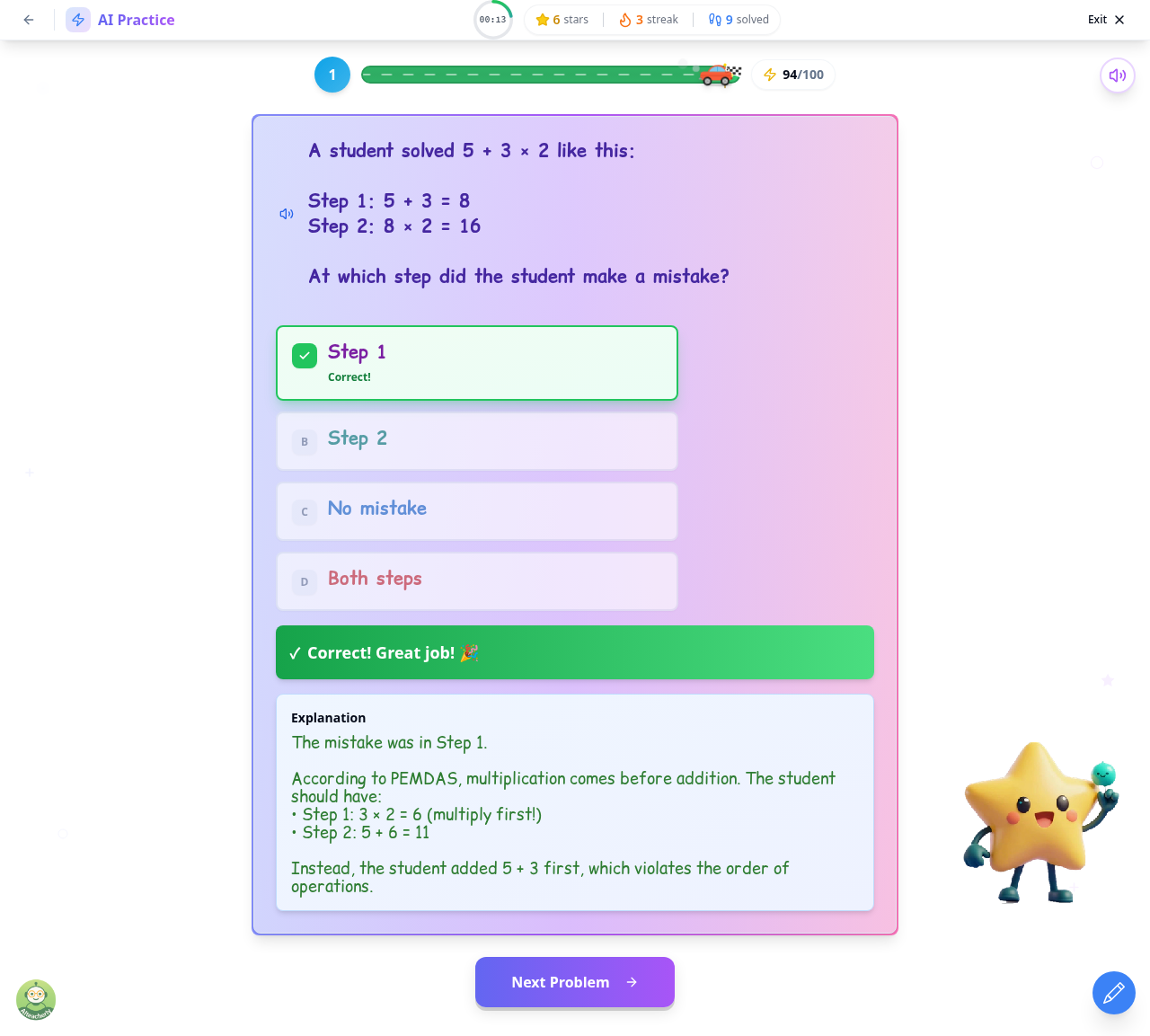
Why does this happen? It's actually intuitive. Addition and subtraction feel "easier" and more familiar. When a 6th grader sees 6 + 4 × 2, their brain wants to tackle the simple addition first. 6 + 4 = 10, then 10 × 2 = 20. Wrong answer.
The correct approach: 4 × 2 = 8 first (multiplication before addition), then 6 + 8 = 14.
The interactive problem below demonstrates exactly how this mistake appears in practice:
How to help your child catch this mistake:
- Circle the multiplication and division first before doing anything else
- Ask them: "Which operations are 'higher priority' in this problem?"
- Have them rewrite the expression with only addition/subtraction left, then solve
- Use a two-pass approach: First pass for × and ÷, second pass for + and −
The key is building the habit of scanning the entire expression before writing anything. Speed comes later; accuracy comes first.
See PEMDAS in Action: Interactive Practice Examples
Understanding PEMDAS conceptually is one thing. Applying it consistently is another. That's where practice becomes essential.
The best practice for order of operations includes:
- Immediate feedback so mistakes get corrected right away
- Varied problem types including word problems, not just naked numbers
- Visual cues that highlight which operation to do next
- Real-world contexts that show why PEMDAS matters outside homework
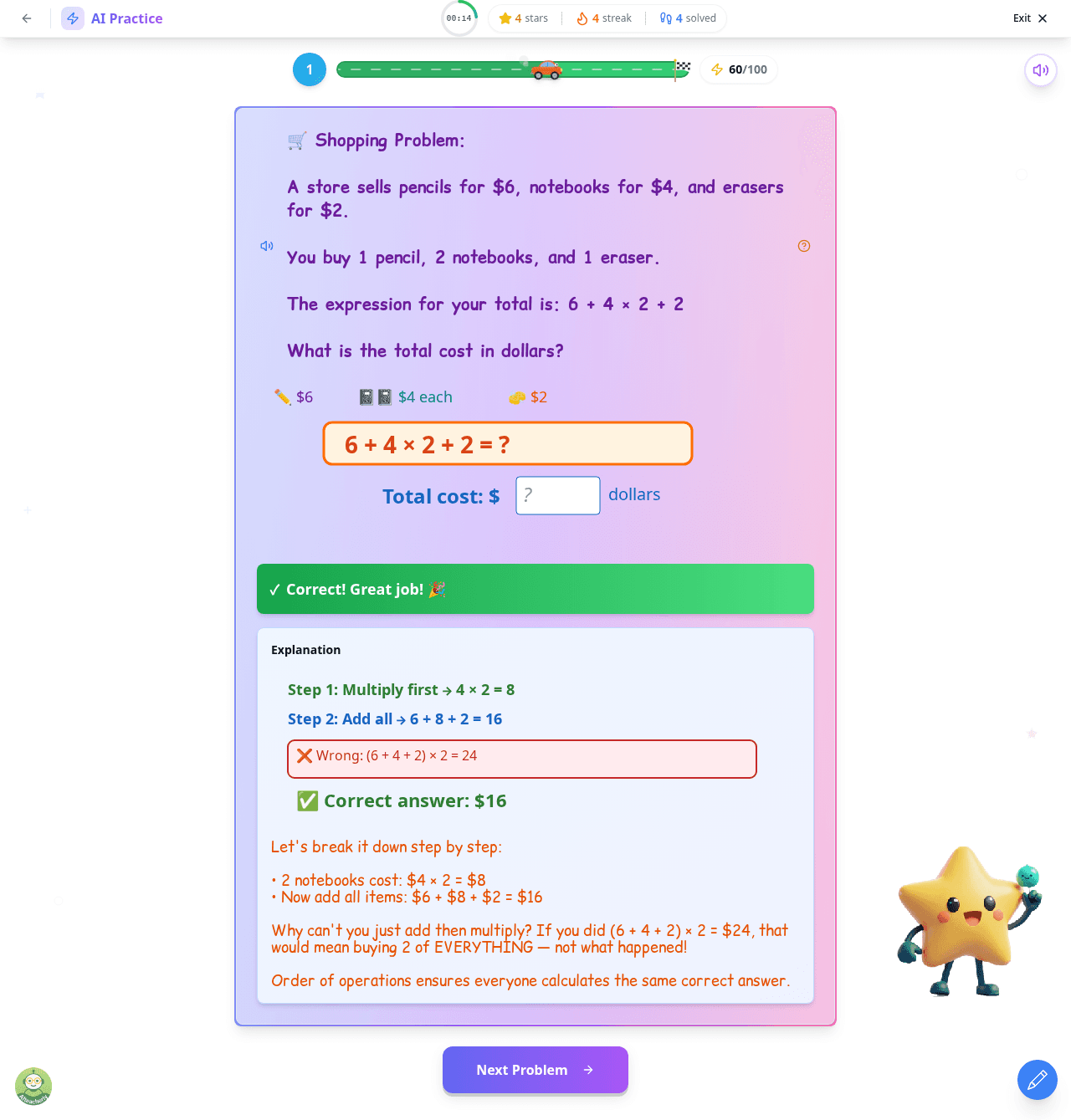
Here's what the full interactive lesson looks like on AI Teacherly:
Notice how the platform guides students through multi-step expressions systematically. Each problem builds on the previous one, starting with simpler expressions and working up to complex ones with parentheses, exponents, and all four operations.
What makes interactive practice more effective than worksheets? When your child enters a wrong answer, they get immediate feedback explaining where they went wrong. No waiting until tomorrow when the teacher grades the paper. No reinforcing the wrong method through repetition.
Real-world application matters too. Shopping problems that calculate total costs with discounts and taxes show students that PEMDAS isn't just a school exercise. Adults use these rules every day without even thinking about it.
Tips for Practicing Order of Operations at Home
You don't need to be a math teacher to support your 6th grader's PEMDAS practice. Here are practical strategies any parent can use:
Make It Visual
Use colored pencils or highlighters. Have your child:
- Circle all parentheses in blue
- Underline exponents in green
- Box multiplication and division in red
- Leave addition and subtraction unmarked
Then solve in that color order. The visual system builds the habit.
Create Real-World Problems Together
Turn everyday situations into PEMDAS practice:
- "We're buying 3 notebooks at $2 each plus a $5 binder. What's the total?"
- "If you have $20 and spend $3 × 4 on snacks, how much is left?"
Use the "Explain It Back" Method
After your child solves a problem, ask them to teach YOU how they did it. Teaching cements learning. If they can't explain their steps clearly, that's where the confusion lies.
Celebrate Small Wins
Order of operations requires building a new mental habit. When your child catches themselves about to add before multiplying and self-corrects, that's huge! Acknowledge the progress, not just the final answer.
Keep Sessions Short
15-20 minutes of focused practice beats an hour of frustrated struggle. Interactive platforms like AI Teacherly make short, effective practice sessions easy to fit into busy schedules.
Key Takeaways
- PEMDAS stands for Parentheses, Exponents, Multiplication, Division, Addition, Subtraction, but multiplication/division and addition/subtraction have EQUAL priority within their pairs
- The most common 6th grade mistake is adding or subtracting before multiplying or dividing; teach your child to scan for × and ÷ first
- When operations have equal priority (M and D, or A and S), always work left to right
- Order of operations exists so everyone gets the same answer, making it essential for math, science, and everyday calculations
- Interactive practice with immediate feedback helps correct mistakes faster than traditional worksheets
- Short, consistent practice sessions (15-20 minutes) are more effective than long, frustrating homework marathons
- Real-world problems like shopping calculations make PEMDAS relevant and memorable
Frequently Asked Questions
What does PEMDAS stand for and what does each letter mean?
PEMDAS stands for Parentheses, Exponents, Multiplication, Division, Addition, and Subtraction. It tells you the order to solve math expressions: parentheses first, then exponents, then multiply/divide left to right, finally add/subtract left to right.
Does multiplication always come before division in PEMDAS?
No! Multiplication and division have equal priority. When both appear in an expression, work left to right. For example, in 12 ÷ 4 × 3, you divide first (getting 3), then multiply (getting 9).
Why does my child get different answers for the same math problem?
Your child is likely doing operations in the wrong order. Without following PEMDAS rules, 3 + 4 × 2 could be calculated as 14 (wrong) or 11 (correct). The order of operations ensures everyone gets the same answer.
What is the most common PEMDAS mistake 6th graders make?
The number one mistake is adding or subtracting before multiplying or dividing. Students see 6 + 4 × 2 and instinctively add first. Teach your child to scan for multiplication and division first before doing any addition or subtraction.
How can I help my child remember the order of operations?
Use the phrase 'Please Excuse My Dear Aunt Sally' as a memory aid. Even better, practice with colored pencils: circle parentheses in blue, underline exponents in green, box multiplication/division in red, then solve in that order.
When do students learn order of operations in school?
Order of operations is typically introduced in 5th grade and mastered in 6th grade. It becomes essential for algebra in 7th grade and beyond, making 6th grade the critical time to build this foundation.
What happens if you don't follow the order of operations?
Without consistent rules, the same expression produces different answers. This would make math, science, programming, and financial calculations impossible to communicate clearly. PEMDAS ensures universal consistency.
Are there real-world examples of order of operations?
Yes! Calculating shopping totals (3 items at $5 plus $2 tax), figuring out game scores, computing tips at restaurants, and programming computers all require order of operations to get correct results.
Ready to watch your 6th grader master PEMDAS with confidence? Try the interactive Order of Operations lesson free on AI Teacherly. Our step-by-step practice with instant feedback turns frustration into understanding, one problem at a time.