PEMDAS with Decimals: The 6th Grade Math Skill Your Child Must Master
PEMDAS doesn't change with decimals, but precision does. Discover the step-by-step approach to order of operations with decimals and how interactive practice helps 6th graders succeed.
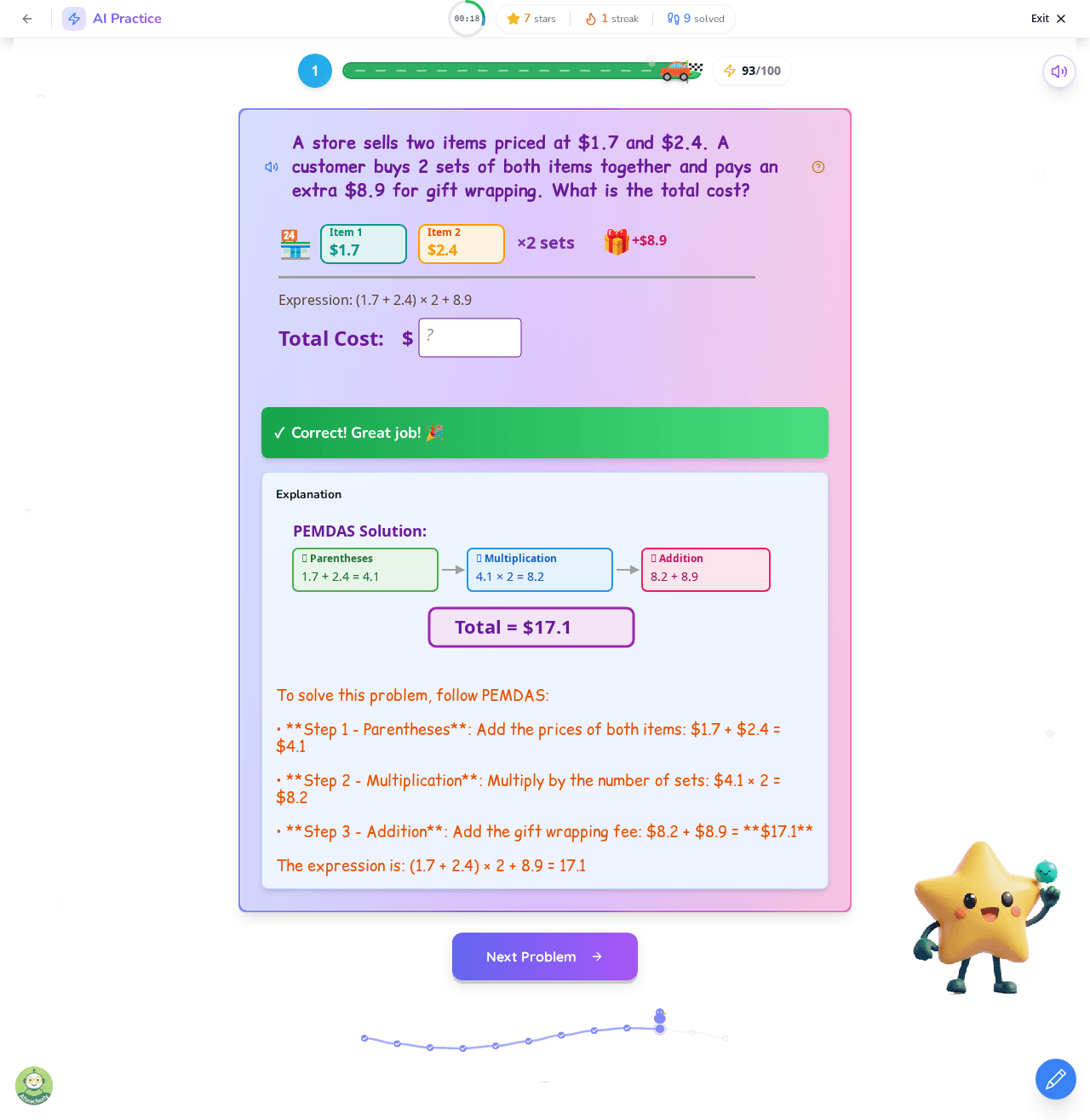
Why 6th Grade Decimal Math Feels Tricky (But Isn't)
Remember learning PEMDAS years ago? Parentheses, Exponents, Multiplication, Division, Addition, Subtraction. It seemed straightforward back then. Now your 6th grader is using PEMDAS with decimals, and suddenly the homework looks a lot more complicated.
Here's the good news: PEMDAS works exactly the same with decimals as it does with whole numbers. The rules haven't changed since you learned them. What has changed is the precision required at each step. One misplaced decimal point can throw off an entire answer, which is why so many 6th graders (and their parents) find this topic challenging.
The transition from whole number operations to decimal operations marks a critical milestone in your child's math journey. This skill directly impacts their readiness for pre-algebra and beyond. But with the right approach, you can confidently guide your child through it, no math degree required.
In this guide, you'll learn exactly how PEMDAS applies to decimal expressions, the most common mistakes to avoid, and practical ways to practice at home. By the end, you'll feel equipped to be your child's math coach.
What Is PEMDAS and How Does It Work with Decimals?
PEMDAS is the acronym that tells us the correct order to solve mathematical expressions. Without a consistent order, the same problem could have multiple answers, and math would be chaos!
Here's the order of operations:
- P - Parentheses (solve everything inside parentheses first)
- E - Exponents (calculate powers and roots)
- M/D - Multiplication and Division (left to right)
- A/S - Addition and Subtraction (left to right)
The key insight? Multiplication and Division are equal partners. You don't do all multiplication before division. Instead, you work left to right, handling whichever comes first. The same applies to addition and subtraction.
When decimals enter the picture, the PEMDAS rules stay identical. However, each operation requires careful decimal handling:
- For addition and subtraction: Align the decimal points vertically before computing
- For multiplication: Count the total decimal places in both numbers; the answer has that many decimal places
- For division: Move the decimal point to make the divisor a whole number, then move it the same distance in the dividend
As your child's lesson explains: "PEMDAS works the same with decimals, we just need to watch our decimal points." This simple reminder can reduce a lot of anxiety.
The Step-by-Step Process for Solving Decimal Expressions
Let's walk through exactly how to solve a PEMDAS problem with decimals. Following this process every time builds the procedural fluency your child needs.
Example: Solve 4.5 + 2.3 × 1.5
Step 1: Identify all operations Look at the expression and name each operation. Here we have addition (+) and multiplication (×).
Step 2: Determine the order using PEMDAS There are no parentheses or exponents. Multiplication comes before addition in PEMDAS. So we multiply first.
Step 3: Perform multiplication 2.3 × 1.5 = 3.45 (one decimal place times one decimal place equals two decimal places)
Step 4: Perform addition 4.5 + 3.45 = 7.95 (align decimal points when adding)
The correct answer is 7.95.
Now, what if your child solved this left to right, ignoring PEMDAS?
4.5 + 2.3 = 6.8, then 6.8 × 1.5 = 10.2
That's a completely different answer! This demonstrates why order matters so much.
Pro tip: Have your child verbalize which operation comes next before they solve it. Saying "I need to multiply first because multiplication comes before addition" builds metacognitive awareness and reduces careless errors.
What Happens When PEMDAS Gets Ignored? (The Costly Mistake)
One of the most powerful teaching moments in your child's PEMDAS learning is understanding why order matters, not just memorizing that it does.
Consider this expression: 8 + 4 × 2.5
Following PEMDAS (the right way):
- Multiply first: 4 × 2.5 = 10
- Then add: 8 + 10 = 18
Ignoring PEMDAS (the wrong way):
- Add first: 8 + 4 = 12
- Then multiply: 12 × 2.5 = 30
The difference between 18 and 30 is significant! In real-world terms, imagine this was a shopping calculation for a purchase. Getting the wrong answer could mean being $12 short at the register.
As the lesson highlights: "What if we ignored PEMDAS? The correct answer is the final answer. But without PEMDAS, we'd get a wrong answer. That's a big difference! Order of operations matters."
This "what if" comparison is a powerful way to help your child internalize why PEMDAS isn't just a rule teachers made up; it's a system that ensures everyone gets the same answer to the same problem. Mathematicians, scientists, and programmers worldwide rely on this shared understanding.
See How Interactive Practice Makes PEMDAS Click
Understanding PEMDAS conceptually is one thing. Building fluency through practice is another. The challenge many parents face is finding practice materials that keep their child engaged, not just worksheets that feel like punishment.
Interactive lessons transform decimal practice from tedious to engaging. When students can visualize each step, receive immediate feedback, and see their progress, the concepts stick better.
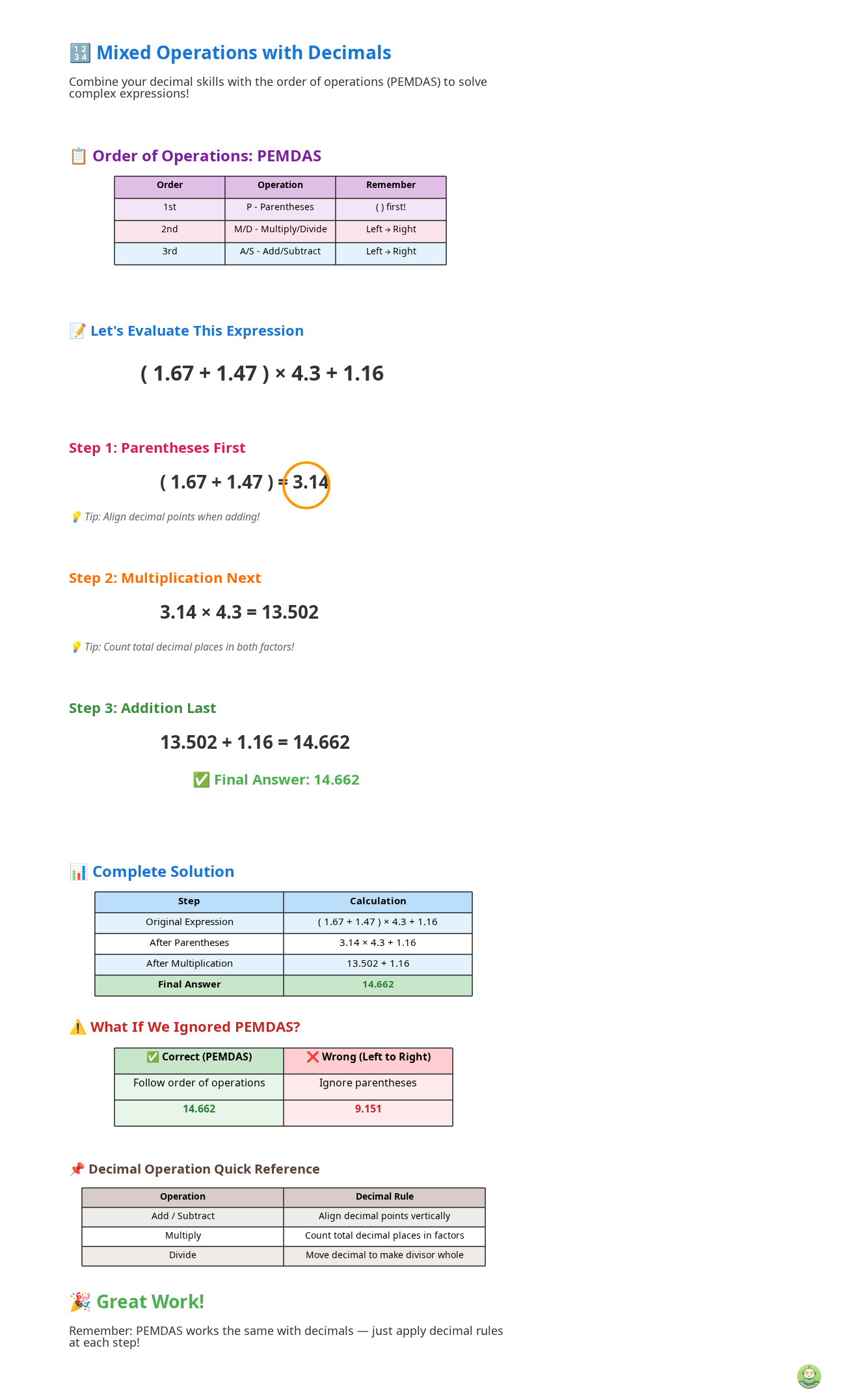
Here's what the full interactive lesson experience looks like on AI Teacherly:
The Mixed Operations with Decimals lesson on AI Teacherly is designed specifically for 6th graders working on this exact skill. It walks students through:
- Guided instruction explaining PEMDAS rules with decimals
- Step-by-step worked examples showing the correct process
- Interactive problems with increasing difficulty
- Immediate feedback so mistakes become learning opportunities
- Real-world word problems that connect math to everyday situations
What makes interactive practice different from traditional worksheets? Students can't just skip to the answer. They engage with each step, which builds deeper understanding. And because the feedback is instant, they correct misconceptions immediately rather than practicing errors.
Real-World Decimal Problems Your Child Will Actually Use
One of the best ways to make PEMDAS meaningful is connecting it to real situations your child encounters. Decimal operations aren't just classroom exercises; they appear everywhere in daily life.
Shopping scenarios: Calculating the total cost when buying multiple items at different prices, applying discounts, or figuring out sales tax all require mixed operations with decimals.
Splitting costs: When your child eventually splits a restaurant bill or divides an expense among friends, they'll use division with decimals.
Cooking and recipes: Adjusting ingredient quantities when halving or doubling recipes involves multiplying and dividing decimals.
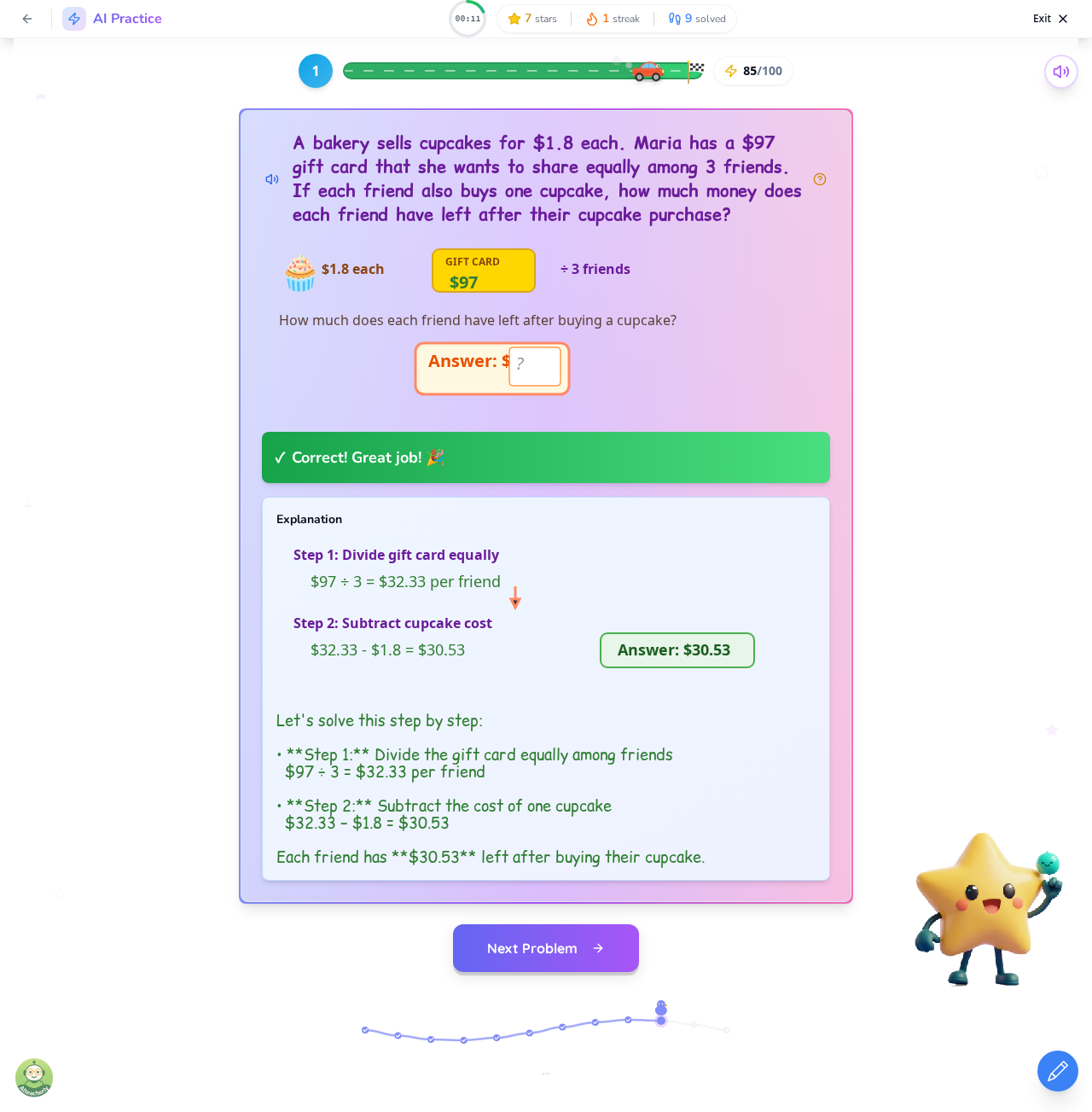
The interactive problem below shows exactly how these skills apply to a real bakery scenario that kids can relate to:
This type of word problem helps students see that PEMDAS isn't arbitrary; it's the tool that makes real calculations work correctly. When your child can connect the classroom skill to a scenario they might actually experience, motivation increases.
Encourage your child to spot decimal math in the real world. Next time you're shopping together, ask them to estimate the total before checkout. These small moments reinforce classroom learning in powerful ways.
Quick Tips for Practicing PEMDAS with Decimals at Home
You don't need to be a math teacher to support your child's learning. Here are practical strategies you can use right away:
1. Use the "Talk It Out" method Before your child writes anything, have them explain which operation they'll do first and why. Verbalizing the thought process catches errors before they happen.
2. Create a PEMDAS checklist Write the order of operations on an index card. Your child can physically check off each step as they complete it. This prevents skipping steps.
3. Practice decimal skills separately If your child struggles with PEMDAS and decimal operations together, break it down. Practice decimal multiplication and division on their own first, then combine with order of operations.
4. Make it a game Give your child an expression and ask them to find both the correct answer (using PEMDAS) and the wrong answer (ignoring PEMDAS). Comparing the two reinforces why order matters.
5. Keep sessions short For 6th graders, 20-30 minutes of focused practice is more effective than hour-long cramming sessions. Consistency beats intensity.
6. Celebrate the process, not just the answer When your child explains their reasoning correctly, praise that, even if they make a calculation error. Process mastery leads to accuracy over time.
Key Takeaways
- PEMDAS rules stay exactly the same with decimals; only the precision requirements change at each step
- Always perform multiplication and division before addition and subtraction, working left to right within each pair
- Ignoring order of operations leads to dramatically different (and wrong) answers, as shown by comparing results
- Align decimal points for addition/subtraction; count decimal places for multiplication; adjust decimals for division
- Verbalizing the next step before solving builds metacognitive awareness and reduces careless errors
- Interactive practice with immediate feedback helps concepts stick better than traditional worksheets
- Real-world connections (shopping, cooking, splitting costs) make PEMDAS meaningful and boost motivation
Frequently Asked Questions
Does PEMDAS work the same way with decimals as with whole numbers?
Yes, the order of operations is identical. Parentheses, exponents, multiplication/division (left to right), then addition/subtraction (left to right). The only difference is you must carefully track decimal placement at each step.
What is the most common mistake kids make with decimal order of operations?
Solving left to right without following PEMDAS order. Students often add before multiplying because addition appears first in the expression, leading to completely wrong answers.
How do I explain PEMDAS to my 6th grader in simple terms?
Tell them it's the agreed-upon order for solving math problems so everyone gets the same answer. Parentheses first, then exponents, then multiply/divide left to right, then add/subtract left to right.
Why does the order of operations matter so much with decimals?
Because doing operations in the wrong order gives a completely different answer. In real-world scenarios like shopping or budgeting, this could mean being significantly over or under in your calculations.
Should my child use a calculator for decimal PEMDAS problems?
Initially, no. Working problems by hand builds understanding. Once they demonstrate mastery, calculators can check work. Most calculators follow PEMDAS automatically, so students still need to enter expressions correctly.
How can I tell if my child truly understands order of operations?
Ask them to explain WHY they're doing each step, not just WHAT they're doing. If they can verbalize the reasoning before solving, they understand. If they guess or only follow memorized steps, more practice is needed.
What real-life situations use mixed operations with decimals?
Shopping (calculating totals with discounts), splitting restaurant bills, adjusting recipes, calculating tips, budgeting allowance money, and comparing unit prices all require PEMDAS with decimals.
Ready to make decimal math click for your 6th grader? Try the Mixed Operations with Decimals lesson free on AI Teacherly and watch their confidence grow!