Prime and Composite Numbers Made Simple: The Factor-Counting Trick Every 4th Grader Needs
Discover the simple factor-counting trick that makes prime and composite numbers easy for 4th graders. Perfect for parents looking to turn math homework into a fun number detective game!
Introduction: Become a Number Detective with Your Child
That moment when your 4th grader asks "Is 17 prime or composite?" and you freeze. We've all been there. Maybe it's been a few decades since you last thought about prime and composite numbers for kids, and suddenly you're supposed to be the expert.
Here's the good news: there's one simple trick that makes identifying prime and composite numbers surprisingly easy, and you can master it in minutes. Even better, you can turn this math concept into a fun detective game that your child will actually enjoy.
In this guide, you'll discover the factor-counting method that takes all the confusion out of prime and composite numbers. Whether you're reviewing homework, preparing for a test, or just want to support your child's math learning at home, this approach will have both of you classifying numbers with confidence.
Let's become number detectives together and crack the code on one of 4th grade math's trickiest topics.
What Are Prime and Composite Numbers?
Before we dive into the trick, let's get crystal clear on what these terms actually mean. Understanding prime vs composite numbers explained simply comes down to counting factors.
Prime Numbers are special numbers that have exactly 2 factors: the number 1 and the number itself. That's it. No other numbers divide into them evenly.
For example, the number 7 is prime because:
- 7 ÷ 1 = 7 ✓
- 7 ÷ 7 = 1 ✓
- No other whole numbers divide evenly into 7
Composite Numbers have more than 2 factors. This means they can be divided evenly by numbers other than just 1 and themselves.
For example, the number 12 is composite because:
- 12 ÷ 1 = 12 ✓
- 12 ÷ 2 = 6 ✓
- 12 ÷ 3 = 4 ✓
- 12 ÷ 4 = 3 ✓
- 12 ÷ 6 = 2 ✓
- 12 ÷ 12 = 1 ✓
That's 6 factors! Way more than 2, so 12 is definitely composite.
The beauty of this definition is that it gives us a foolproof method for classification: just count the factors. Prime numbers have exactly 2 factors. Composite numbers have more than 2. That simple rule is the foundation of everything else your child needs to know.
The Simple Factor-Counting Trick That Makes It Easy
Now for the trick that will transform how you and your child approach prime and composite numbers. It's called the factor-counting method, and it works every single time.
Step 1: List All Factor Pairs
Instead of randomly dividing, teach your child to find factor pairs systematically. Factor pairs are two numbers that multiply together to make your target number.
Let's try it with 24:
- 1 × 24 = 24 (first pair)
- 2 × 12 = 24 (second pair)
- 3 × 8 = 24 (third pair)
- 4 × 6 = 24 (fourth pair)
Once the pairs start repeating (like 6 × 4, which is the same as 4 × 6), you've found them all.
Step 2: Count the Unique Factors
From our pairs, the factors of 24 are: 1, 2, 3, 4, 6, 8, 12, 24
That's 8 factors, which is definitely more than 2. So 24 is composite.
Step 3: Apply the Rule
- Exactly 2 factors → Prime
- More than 2 factors → Composite
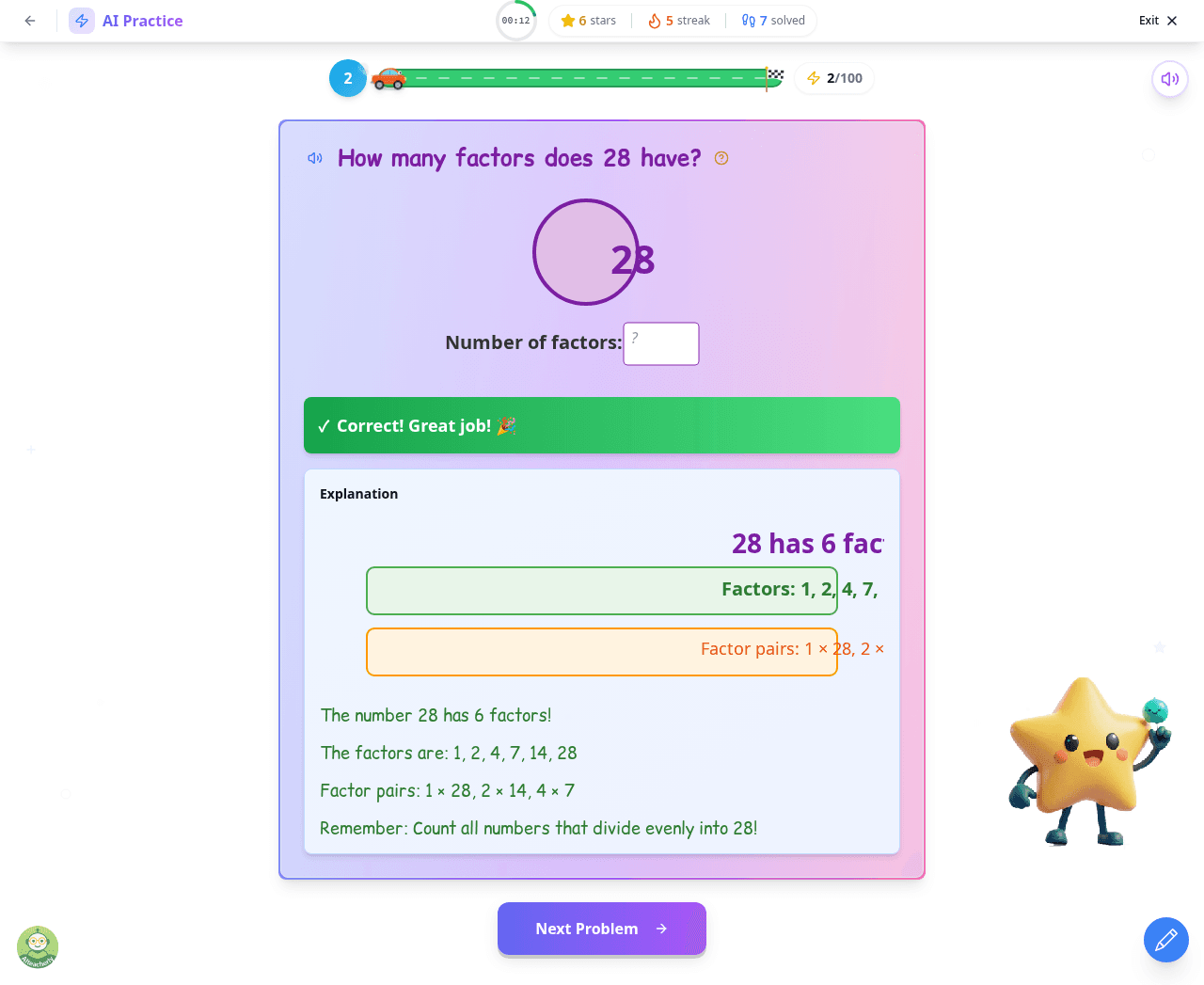
The interactive problem below shows exactly how this factor-counting method works in practice.

Why Is 1 Neither Prime Nor Composite?
Here's the question that stumps most parents and kids alike: Is 1 prime or composite?
The answer? Neither! And here's the simple explanation your child will actually understand.
Remember our rule:
- Prime = exactly 2 factors
- Composite = more than 2 factors
Now let's look at the number 1:
- 1 ÷ 1 = 1 ✓
That's the only factor. The number 1 has just ONE factor (itself). Since it doesn't have exactly 2 factors, it can't be prime. And since it doesn't have more than 2 factors, it can't be composite.
The number 1 is special. It's in a category all by itself.
This is actually a common test question, so make sure your child understands this exception. You can explain it simply: "Prime numbers need exactly 2 different factors, but 1 only has itself. So 1 is special; it gets its own category!"
Pro tip: Another special number to know is 2. It's the only even prime number! Why? Because 2 only has factors of 1 and 2 (exactly 2 factors = prime), but every other even number can be divided by 2, giving them more factors.
See How Interactive Learning Makes Math Click
Understanding prime and composite numbers becomes much easier when kids can see the concepts visually and practice with immediate feedback. That's where interactive lessons make a real difference.
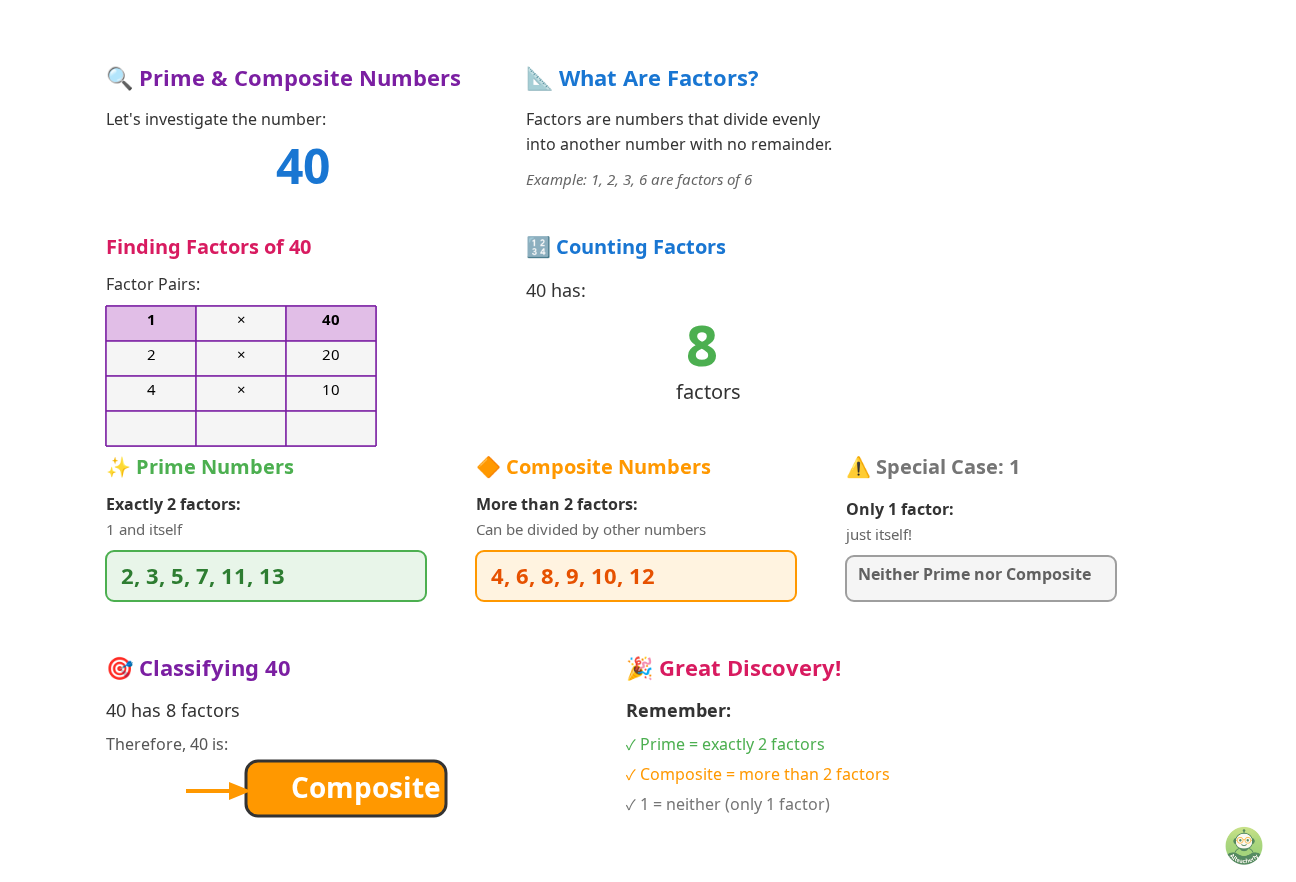
On AI Teacherly, the "Prime and Composite Numbers" lesson for 4th graders uses a detective theme that turns factor-finding into an engaging investigation. Students discover whether numbers are prime or composite by counting factor pairs like clues.
Here's what the full interactive lesson looks like on AI Teacherly:
What makes interactive practice so effective:
Visual Learning: Instead of just memorizing rules, kids see factor pairs represented visually. They can manipulate objects and see how numbers break down.
Immediate Feedback: When your child makes a mistake, they find out right away and can learn from it, rather than practicing the wrong method over and over.
Engagement Through Theme: The "number detective" approach transforms an abstract math concept into a fun challenge. Kids aren't just doing math problems; they're solving mysteries.
Scaffolded Difficulty: The lesson starts with simpler numbers and builds confidence before introducing trickier cases like distinguishing between numbers that look similar.
This combination of visual, interactive, and themed learning helps concepts stick in ways that worksheets simply can't match.
Common Mistakes Kids Make (And How to Fix Them)
Even with the factor-counting trick, kids often make predictable mistakes with prime and composite numbers. Here's what to watch for and how to correct them:
Mistake #1: "All Odd Numbers Are Prime"
This is the most common misconception. Kids notice that many prime numbers are odd (3, 5, 7, 11, 13...) and assume all odd numbers must be prime.
The fix: Try 9. Is it odd? Yes. Is it prime? Let's count factors: 1, 3, 9. That's 3 factors, so 9 is composite! Other odd composite numbers include 15, 21, 25, and 27. Have your child test a few to break this misconception.
Mistake #2: "All Even Numbers Are Composite"
Almost true, but not quite!
The fix: The number 2 is the exception. It's even AND prime. Its only factors are 1 and 2 (exactly 2 factors). This makes 2 the only even prime number.
Mistake #3: Forgetting 1 and the Number Itself
Kids sometimes forget to count 1 and the number itself as factors.
The fix: Every number has at least 1 and itself as factors. Remind your child to always start their factor list with these two.
Mistake #4: Stopping the Factor Search Too Early
Some kids find one factor pair and stop, potentially missing others.
The fix: Use the systematic approach. Start with 1 × [number], then try 2, then 3, and keep going until the factor pairs start repeating.
Practice these tricky cases together, and your child will develop a solid understanding that avoids these common pitfalls.
Key Takeaways
- Prime numbers have exactly 2 factors (1 and the number itself); composite numbers have more than 2 factors
- The number 1 is special: it's neither prime nor composite because it only has one factor
- The number 2 is the only even prime number
- Use factor pairs to systematically find all factors of a number
- Not all odd numbers are prime (9, 15, 21, 25 are all odd and composite)
- Counting factors is the most reliable way to classify any number
- Interactive practice with immediate feedback helps these concepts stick
Frequently Asked Questions
What is a prime number in simple terms for kids?
A prime number is a special number that can only be divided evenly by two numbers: 1 and itself. Examples include 2, 3, 5, 7, 11, and 13. Think of them as numbers that can't be split into equal groups except by 1.
What is a composite number and how is it different from prime?
A composite number has more than two factors, meaning it can be divided evenly by numbers besides just 1 and itself. For example, 12 is composite because it divides by 1, 2, 3, 4, 6, and 12. Prime numbers only have exactly 2 factors.
Why is 1 not considered a prime or composite number?
The number 1 only has one factor: itself. Since prime numbers need exactly 2 factors and composite numbers need more than 2 factors, 1 doesn't fit either definition. Mathematicians classify it as neither prime nor composite.
What are the prime numbers up to 100?
The prime numbers from 1 to 100 are: 2, 3, 5, 7, 11, 13, 17, 19, 23, 29, 31, 37, 41, 43, 47, 53, 59, 61, 67, 71, 73, 79, 83, 89, and 97. That's 25 prime numbers total.
How do you find all the factors of a number?
Start with 1 × the number, then try 2, 3, 4, and so on. Write down each number pair that multiplies to your target. Stop when pairs start repeating. For 24: 1×24, 2×12, 3×8, 4×6 gives you factors 1, 2, 3, 4, 6, 8, 12, 24.
Is 2 the only even prime number?
Yes! The number 2 is the only even prime number. Every other even number can be divided by 2, which gives them at least three factors (1, 2, and the number itself), making them composite.
What's the easiest way to tell if a number is prime?
Count its factors using the factor pair method. If the number has exactly 2 factors (1 and itself), it's prime. If it has more than 2 factors, it's composite. This simple counting trick works for any number.
Why do kids struggle with prime and composite numbers?
Most kids struggle because they try to memorize lists instead of understanding the factor-counting rule. They also make assumptions like 'all odd numbers are prime.' Teaching the simple rule (2 factors = prime, more = composite) with hands-on practice solves this.
Ready to make math click for your 4th grader? Try the interactive Prime and Composite Numbers lesson free on AI Teacherly and watch your child become a confident number detective!