Rounding to the Nearest Hundred Made Easy: A Parent's Guide to 4th Grade Estimation
Struggling with 4th grade estimation homework? Learn the simple tens-digit rule that makes rounding to the nearest hundred predictable and easy for your child.
Why Estimation Feels Like Guessing (And Why It's Actually a Math Superpower)
Picture this: your 4th grader stares at a math problem asking them to "estimate the sum." Instead of confidently solving it, they freeze. The question feels like a trick. Why would a math problem want an approximate answer when there's a "right" answer?
This is one of the most common struggles parents face when helping with rounding to nearest hundred 4th grade homework. Children often confuse estimation with guessing, and guessing feels wrong in math. But here's the truth that transforms everything: estimation isn't guessing at all. It's a deliberate, strategic skill that mathematicians and everyday people use constantly.
Think about the last time you went grocery shopping. Did you calculate the exact total of every item in your cart? Probably not. You estimated. You rounded prices to get a rough total, making sure you stayed within budget. That's exactly what your 4th grader is learning to do with numbers.
In this guide, you'll discover the simple rule that makes rounding to the nearest hundred predictable and easy. You'll learn how to explain it in a way that clicks for your child, and you'll see how interactive practice can turn estimation from a source of homework stress into a confidence-building skill. By the end, both you and your child will understand why estimation is one of the most practical math skills they'll ever learn.
What Is Rounding to the Nearest Hundred?
Before jumping into the "how," let's make sure we're clear on the "what." Rounding to the nearest hundred means taking any number and finding the closest hundred to it. The hundreds are: 100, 200, 300, 400, 500, and so on.
For example:
- 247 rounded to the nearest hundred is 200 (it's closer to 200 than 300)
- 782 rounded to the nearest hundred is 800 (it's closer to 800 than 700)
- 450 rounded to the nearest hundred is 500 (when it's exactly in the middle, we round UP)
Why do 4th graders need to learn this?
Estimation by rounding is a foundational skill that appears throughout standardized tests and real-life situations. When your child can quickly estimate sums, they can:
- Check their work by comparing estimates to exact answers
- Make mental math faster without needing a calculator
- Build number sense by understanding how numbers relate to each other
- Solve real-world problems like budgeting, measuring, and planning
The 4th grade curriculum introduces rounding to the nearest hundred because students are now working with larger numbers. They've already mastered rounding to the nearest ten in earlier grades. Now they're scaling up, and the same logic applies. Once your child understands the pattern, they can round any number with confidence.
The Simple Rule Your Child Needs to Know
Here's the golden rule that makes rounding to the nearest hundred completely predictable:
Look at the TENS digit.
- If the tens digit is 5 or more, round UP to the next hundred.
- If the tens digit is 4 or less, round DOWN to the current hundred.
That's it. This single rule handles every situation.
Let's see it in action:
Example 1: Round 362 to the nearest hundred
- Find the tens digit → It's 6
- Is 6 greater than or equal to 5? → Yes
- Round UP → 400
Example 2: Round 824 to the nearest hundred
- Find the tens digit → It's 2
- Is 2 greater than or equal to 5? → No
- Round DOWN → 800
Example 3: Round 550 to the nearest hundred
- Find the tens digit → It's 5
- Is 5 greater than or equal to 5? → Yes (5 counts!)
- Round UP → 600
A helpful way to explain this to your child:
Tell them to imagine the tens digit is "voting" on which direction to go. Numbers 0 through 4 vote to stay put (round down). Numbers 5 through 9 vote to move up (round up). Since there are more "round up" voters (5, 6, 7, 8, 9), numbers that land exactly in the middle round up. It's fair voting!
Once your child internalizes this rule, the next step is applying it to estimate sums by rounding.
How to Estimate Sums Step-by-Step
Now that your child knows how to round individual numbers, it's time to combine that skill with addition. Estimating sums means rounding each number first, then adding the rounded numbers together.
Here's the step-by-step process:
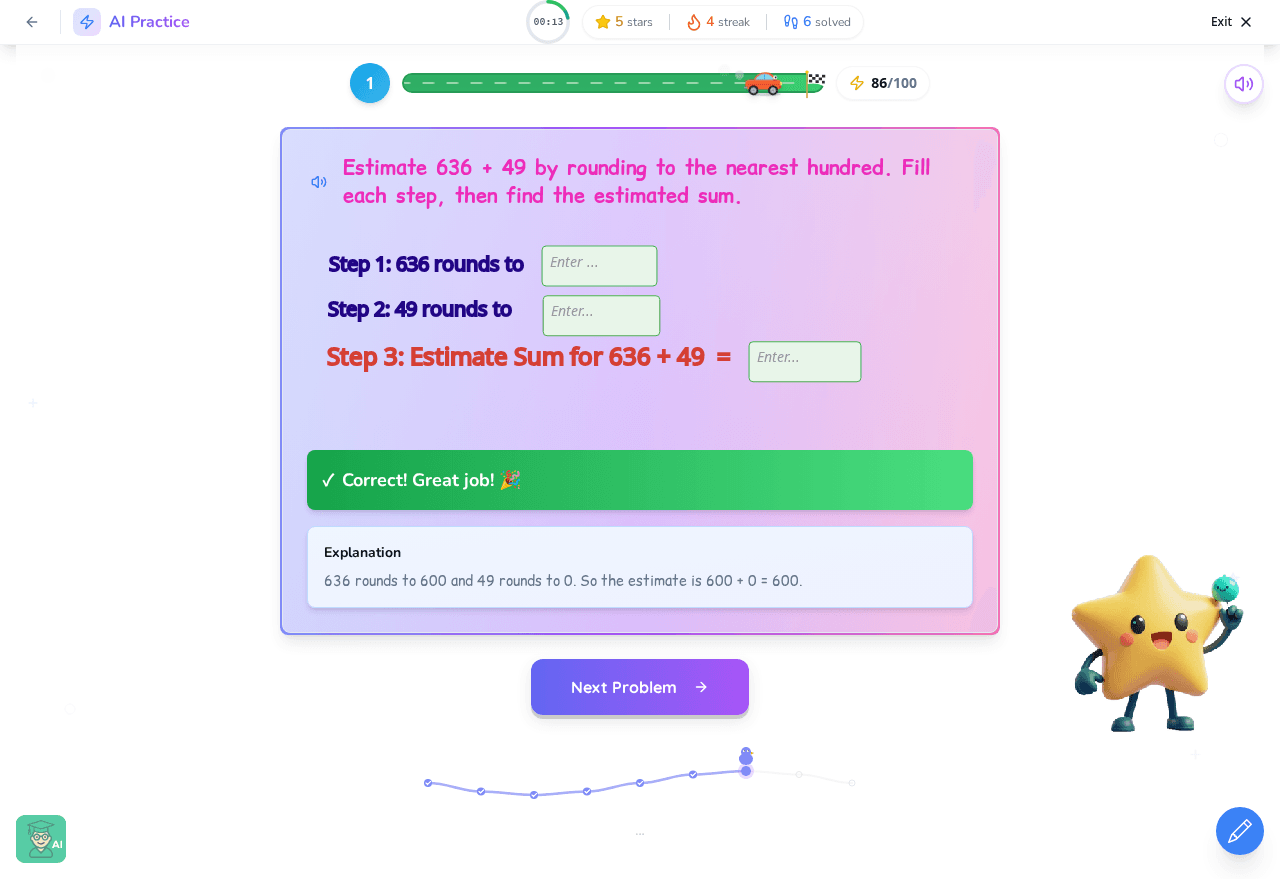
Problem: Estimate the sum of 347 + 582
Step 1: Round each number to the nearest hundred
- 347 → Look at tens digit (4) → Round DOWN → 300
- 582 → Look at tens digit (8) → Round UP → 600
Step 2: Add the rounded numbers
- 300 + 600 = 900
Step 3: Write your answer with "approximately" or "≈"
- 347 + 582 ≈ 900
The exact answer is 929, so the estimate of 900 is very close! This is what teachers mean when they say an estimate should be "reasonable."
The interactive problem below shows exactly how this step-by-step process works in practice.
Why breaking it down matters:
Many 4th graders rush through estimation, trying to do everything in their heads at once. This leads to careless errors. By teaching your child to write out each step (identify tens digit → apply rule → round → add), you're building a reliable process they can use on tests and homework.
Practice tip for parents:
When helping with homework, have your child underline the tens digit in each number before rounding. This small visual cue prevents the most common mistake: accidentally looking at the wrong digit.
See How Interactive Practice Makes It Click
Understanding the rule is one thing. Building fluency is another. That's where practice comes in, and not all practice is created equal.
Traditional worksheets can feel repetitive and frustrating, especially when your child doesn't get immediate feedback. They might complete 20 problems incorrectly before anyone catches the mistake. By then, the wrong approach is already reinforced.
Interactive lessons change the game.
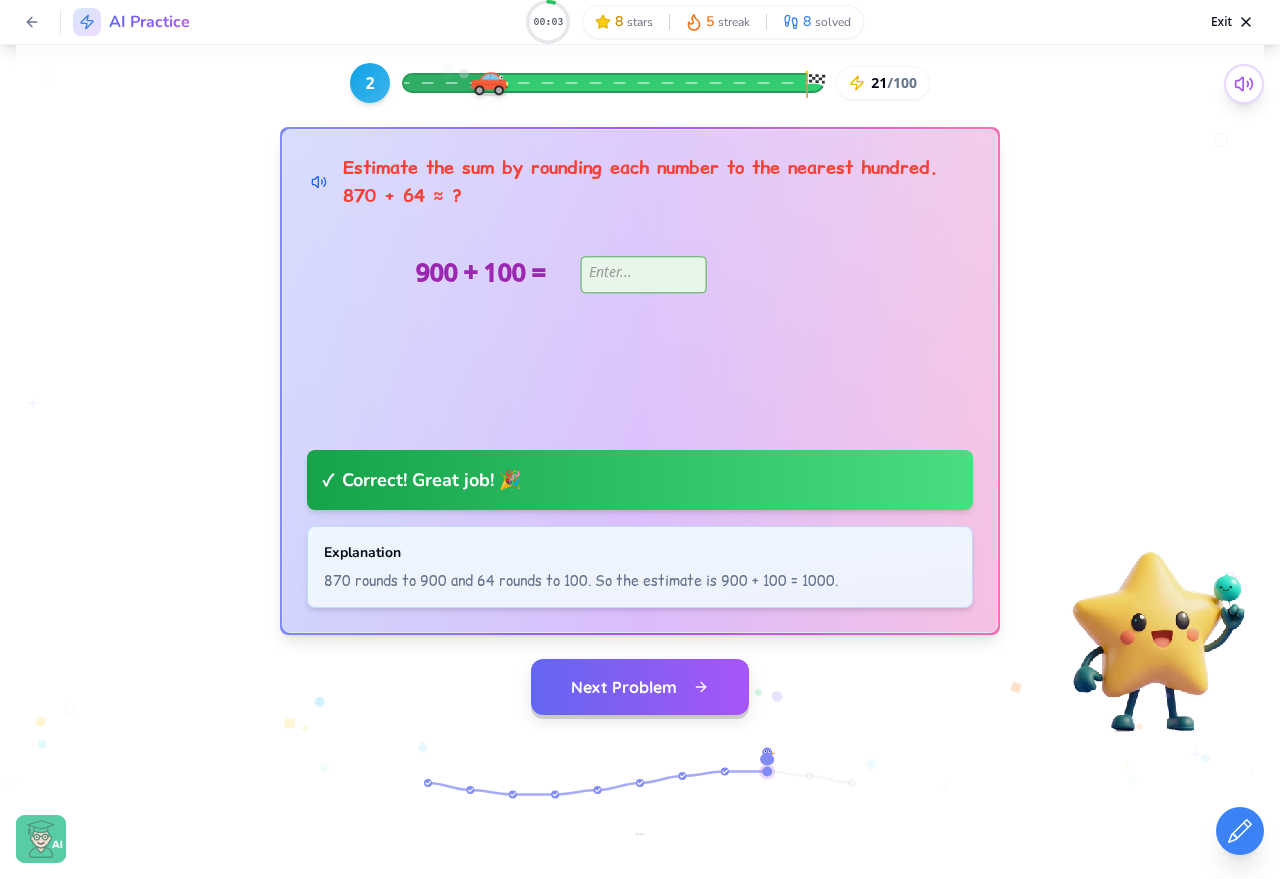
On AI Teacherly, the Estimate Sums by Rounding to the Nearest Hundred lesson guides students through the process with personalized instruction. Here's what makes it effective:
- Step-by-step scaffolding: The lesson breaks down each problem into discrete steps, so students learn the process, not just the answer
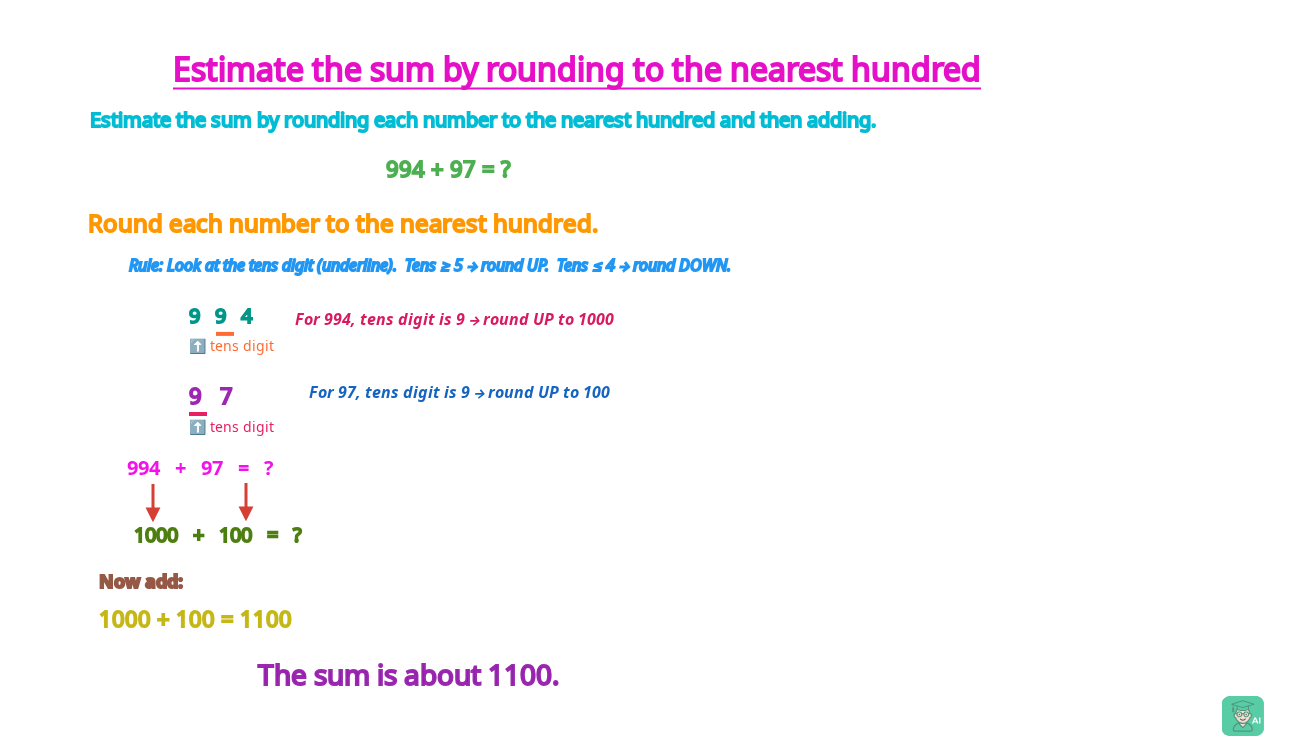
- Visual aids: Underlines and arrows highlight the rounding digit, making abstract concepts concrete
- Immediate feedback: Students know right away if they're on track, preventing bad habits from forming
- Personalized experience: The lesson uses the student's name, creating engagement and ownership of learning
Here's what the full interactive lesson looks like on AI Teacherly:
The lesson teaches: "To round to the nearest hundred, we look at the TENS digit. If the tens digit is 5 or more, round UP. If the tens digit is 4 or less, round DOWN."
This clear, memorable instruction is exactly what students need to internalize the skill. And because they're actively practicing (not passively watching), the learning sticks.
For parents: Instead of drilling your child with flashcards, let the interactive lesson do the heavy lifting. Your role shifts from "teacher" to "cheerleader," which is better for everyone.
Common Estimation Mistakes and Quick Fixes
Even with the right rule, students make predictable errors. Knowing these in advance helps you spot and correct them quickly.
Mistake #1: Looking at the wrong digit
What happens: Your child looks at the ones digit instead of the tens digit. Example: For 362, they see the "2" and round down to 300 (lucky guess), but for 364, they see "4" and also round down, missing that the tens digit is "6." Quick fix: Have them underline or circle the tens digit before doing anything else.
Mistake #2: Confusing rounding with place value
What happens: Instead of rounding 362 to 400, they write "360" (rounding to the nearest ten instead of hundred). Quick fix: Remind them that rounding to the nearest hundred means the answer MUST end in two zeros.
Mistake #3: Thinking estimates must match exact answers
What happens: Your child gets anxious because their estimate of 900 doesn't equal the exact sum of 929. Quick fix: Explain that estimates are supposed to be close, not exact. If the estimate is within 100 of the exact answer, they're doing great.
Mistake #4: Skipping estimation entirely
What happens: Your child just calculates the exact sum because "it's faster." Quick fix: Point out that on tests, estimation questions specifically ask for estimates. Also, estimation is faster for mental math. Ask them to estimate 700 + 300 in their head vs. 687 + 294.
Mistake #5: Rounding both numbers the same direction
What happens: Your child rounds both 347 and 582 up (or both down) without checking the tens digits individually. Quick fix: Each number gets its own "vote." Check them one at a time.
Addressing these mistakes early prevents frustration later. Most 4th graders only need one or two corrections before the skill becomes automatic.
Key Takeaways
- The tens digit rule is everything: 5 or more rounds UP, 4 or less rounds DOWN
- Estimation is a deliberate skill, not guessing. It's used constantly in real life for budgeting, shopping, and mental math
- Break estimation into clear steps: identify tens digit → apply rule → round each number → add rounded numbers
- Have your child underline the tens digit before rounding to prevent the most common mistake
- Interactive practice with immediate feedback builds fluency faster than worksheets
- Estimates don't need to match exact answers. Being close (within 100) means the estimation is correct
- 4th grade estimation skills form the foundation for more complex math operations in later grades
Frequently Asked Questions
What is the rule for rounding to the nearest hundred?
Look at the tens digit. If it's 5 or more, round up to the next hundred. If it's 4 or less, round down to the current hundred. For example, 362 rounds to 400 (tens digit is 6), and 824 rounds to 800 (tens digit is 2).
How do you estimate a sum by rounding to the nearest hundred?
Round each number to the nearest hundred first, then add the rounded numbers together. For 347 + 582: round to 300 + 600 = 900. The estimate (900) should be close to the exact answer (929).
Why is estimation important in 4th grade math?
Estimation builds number sense, enables quick mental math, and helps students check their work. It's tested on standardized assessments and used in real life for budgeting and shopping. It's a foundational skill for more complex math.
Is it okay if my child's estimate doesn't match the exact answer?
Yes! Estimates are supposed to be close, not exact. If your child's estimate is within about 100 of the exact answer, they're estimating correctly. That's the whole point of approximation.
What's the difference between rounding to the nearest ten and nearest hundred?
When rounding to tens, look at the ones digit and the answer ends in one zero (362 → 360). When rounding to hundreds, look at the tens digit and the answer ends in two zeros (362 → 400).
How can I help my child with estimation homework without doing it for them?
Have them underline the tens digit before rounding. Ask guiding questions like 'Is 6 more or less than 5?' Let interactive lessons provide the instruction while you offer encouragement.
What are common mistakes kids make when rounding to the nearest hundred?
The top mistakes are: looking at the ones digit instead of tens, rounding to the nearest ten by accident (writing 360 instead of 400), and thinking estimates must match exact answers perfectly.
Is estimation the same as guessing in math?
No! Guessing is random, but estimation follows specific rules. When your child estimates using the rounding rule, they're making a calculated approximation, not a guess. It's strategic math.
Ready to make estimation practice effortless? Try the interactive Estimate Sums by Rounding lesson free on AI Teacherly and watch your child's math confidence soar!