Rounding to the Nearest Ten Made Easy: A Complete 4th Grade Parent's Guide
Struggling to explain rounding to your 4th grader? This parent-friendly guide breaks down the simple 2-step method, visual number line tricks, and common mistakes to watch for.
The Simple Secret to 4th Grade Rounding Success
That moment when your child stares blankly at a rounding problem isn't a math crisis. It's actually a 5-minute teaching opportunity you can absolutely handle, even if math wasn't your favorite subject in school.
Rounding to the nearest ten is one of those foundational 4th grade skills that trips up many students, but here's the good news: the entire concept boils down to one simple rule. Once your child truly understands it, rounding becomes almost automatic.
In this guide, you'll discover the exact two-step method that makes rounding click, a visual trick using number lines that transforms confusion into clarity, and the most common mistakes to watch for. Whether you're supporting homework tonight or preparing for an upcoming math test, you'll have everything you need to turn rounding struggles into rounding success.
The key insight from experienced educators is straightforward: kids who struggle with rounding often don't lack math ability. They just haven't seen the concept presented in a way that makes sense to them yet. Let's change that together.
What Is Rounding to the Nearest Ten and Why Does It Matter?
Rounding to the nearest ten means taking any number and finding the closest multiple of ten. For example, 43 rounds to 40, while 47 rounds to 50. It sounds simple, but understanding why we round matters just as much as knowing how.
In real life, we round constantly. When someone asks how far away the store is, you might say "about 20 minutes" rather than "18 minutes and 34 seconds." When checking prices at the grocery store, you estimate totals by rounding. This everyday estimation skill starts with rounding to the nearest ten.
For 4th graders specifically, rounding serves as a gateway to more advanced math concepts. Students who master rounding develop stronger number sense and can quickly estimate whether their answers make sense. This becomes crucial when tackling multiplication, division, and eventually algebra.
The core concept revolves around place value. Every number has a tens place and a ones place. When rounding to the nearest ten, your child needs to identify these places and then make one simple decision based on the ones digit. The better your child understands place value, the easier rounding becomes.
Think of rounding as a life skill disguised as a math problem. Students who round confidently become adults who can quickly estimate budgets, distances, and quantities without reaching for a calculator every time.
How Do You Round to the Nearest Ten Step by Step?
The beautiful thing about rounding to the nearest ten is that it follows a consistent two-step process every single time. Once your child memorizes this pattern, they can apply it to any number.
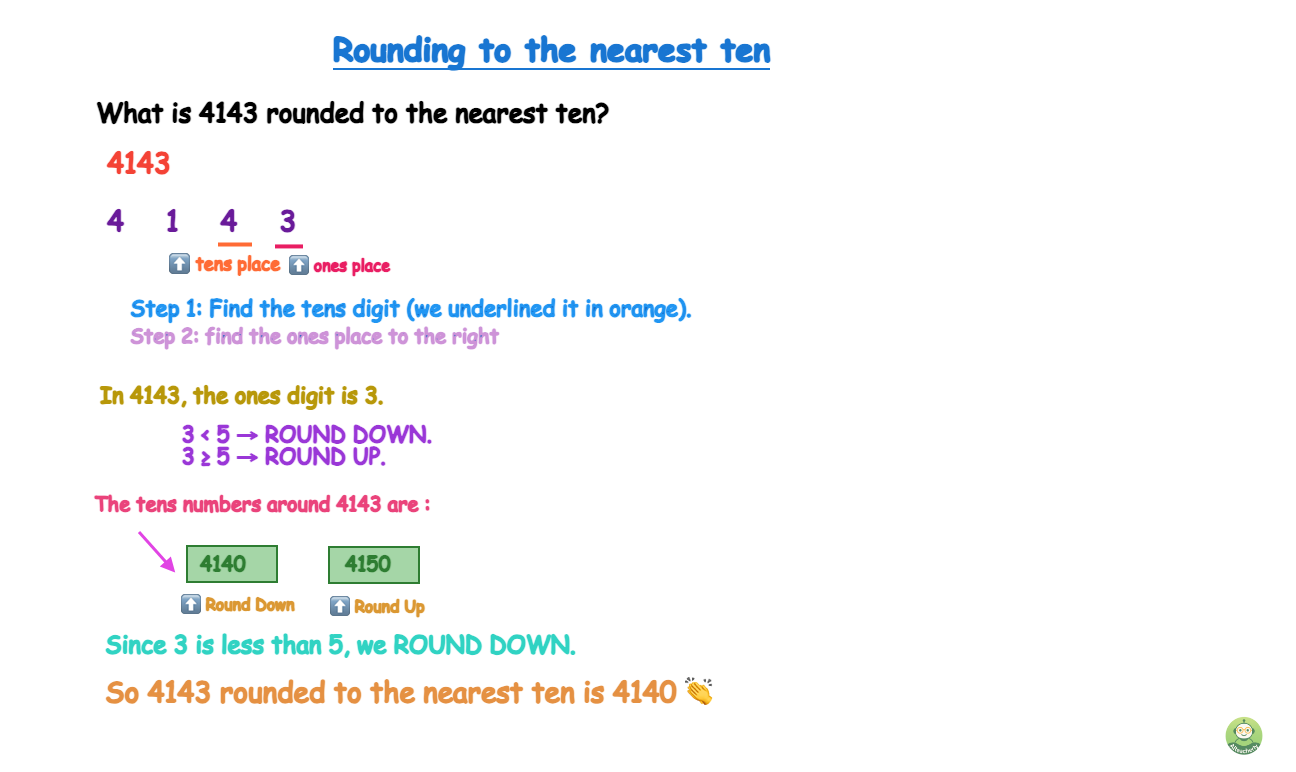
Step 1: Find the tens digit and the ones digit.
Look at the number and identify which digit is in the tens place and which is in the ones place. For a number like 73, the 7 is in the tens place and the 3 is in the ones place. For larger numbers like 1,847, still focus on the tens digit (4) and ones digit (7).
Step 2: Look at the ones digit and apply the rule.
Here's the only rule your child needs to memorize: If the ones digit is less than 5, round down. If it's 5 or greater, round up.
Let's see this in action:
- 73: The ones digit is 3. Since 3 is less than 5, round down to 70.
- 78: The ones digit is 8. Since 8 is greater than 5, round up to 80.
- 75: The ones digit is exactly 5. Since 5 meets the "5 or greater" threshold, round up to 80.
A helpful memory trick many teachers use is: "5 or more, let it soar. Less than 5, let it dive." This rhyme helps children remember which direction to round without second-guessing themselves.
The key to mastery is practice with immediate feedback. When children can check their reasoning right away, they build confidence faster than working through problems they're unsure about.
The Number Line Trick That Makes Rounding Click
If your child still seems confused after learning the rules, there's a visual approach that transforms rounding from an abstract concept into something they can literally see and touch.
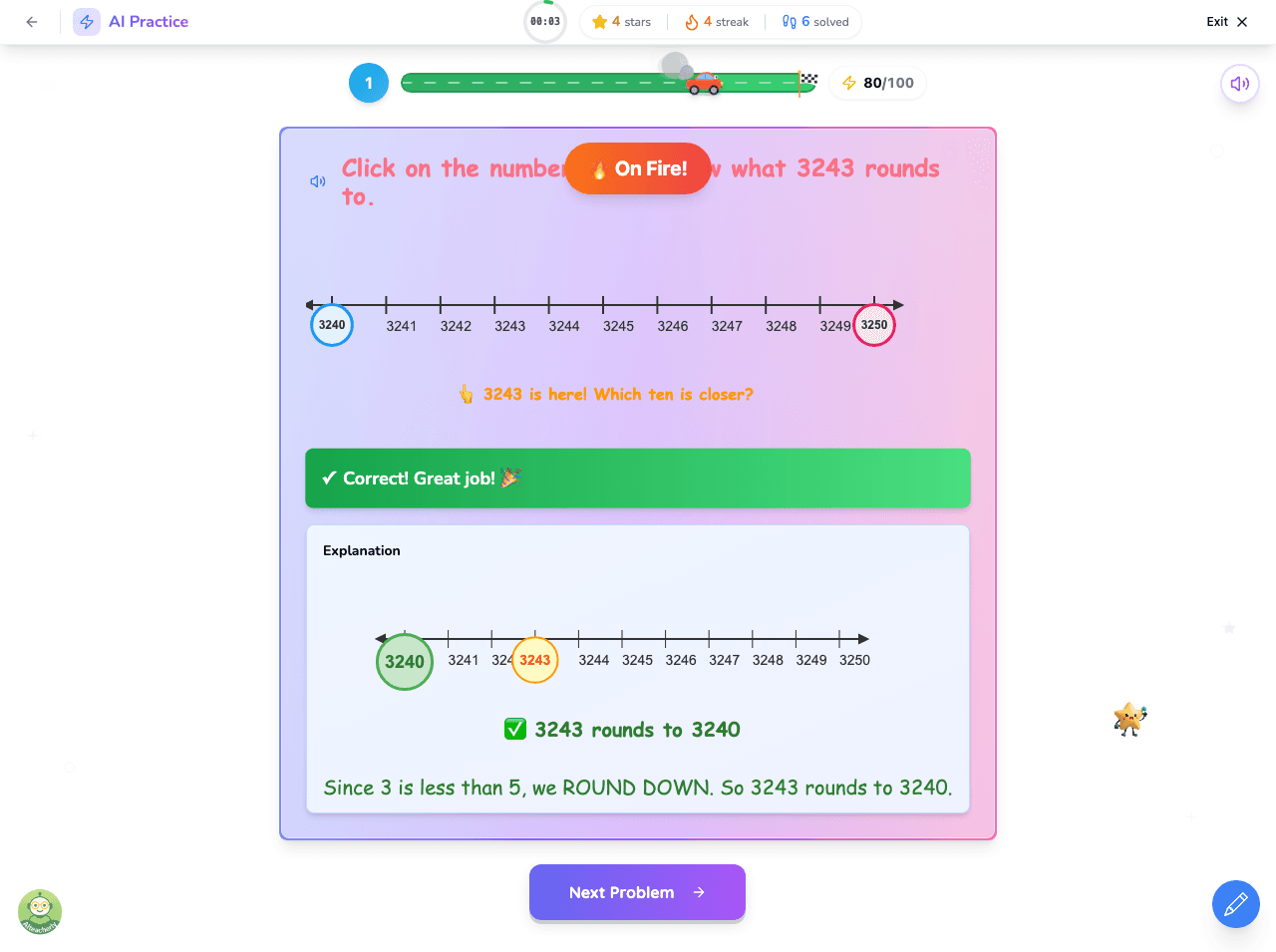
Imagine a number line with multiples of ten marked: 20, 30, 40, 50, 60, and so on. When rounding a number like 37, your child finds where 37 lives on this line. It sits between 30 and 40. The question becomes simple: is 37 closer to 30 or closer to 40?
This spatial understanding is exactly what makes interactive learning so powerful. Instead of memorizing rules that feel arbitrary, children see that rounding is really about finding the nearest neighbor.
The interactive problem below shows exactly how this number line approach works in practice.
Why the number line method works so well:
Visual learners thrive when they can see the relationship between numbers physically represented.
It explains the "why" behind the rule. Numbers ending in 1, 2, 3, or 4 are visually closer to the lower ten. Numbers ending in 6, 7, 8, or 9 are visually closer to the higher ten.
It handles the tricky 5 case intuitively. When a number ends in 5, it sits exactly in the middle, so mathematicians agreed to always round up as a consistent convention.
You can practice this at home by drawing a simple number line on paper. Pick random numbers and ask your child to mark where they would go, then identify which ten they're closest to. This hands-on approach builds lasting understanding.

See How Interactive Rounding Practice Works
Traditional worksheets have their place, but interactive practice takes learning to another level. When children engage with rounding problems that respond to their input, provide immediate feedback, and present concepts visually, understanding deepens significantly.
Here's what the full interactive lesson looks like on AI Teacherly:
The Rounding to the Nearest Ten lesson for Grade 4 on AI Teacherly breaks down this skill into manageable chunks. Students progress through 16 carefully sequenced sections that build from basic concepts to confident application.
What makes interactive practice different from worksheets:
Immediate feedback tells students whether they're on the right track. There's no waiting until tomorrow to find out if their reasoning was correct. This rapid feedback loop accelerates learning and prevents wrong patterns from becoming habits.
Visual representations make abstract numbers concrete. Students see number lines, place value charts, and real-world scenarios rather than just digits on a page.
Engaging formats keep students focused. Multiple choice, true/false, selection problems, and word problems provide variety that maintains attention and checks understanding from different angles.
Real-world contexts connect math to life. Problems about counting stickers, measuring distances, or sharing items fairly show students that rounding isn't just a school exercise; it's a useful skill.
The lesson also includes a quiz section that helps both students and parents identify any remaining gaps before moving on. This kind of structured, interactive practice builds genuine confidence rather than surface-level familiarity.
Common Rounding Mistakes and How to Fix Them
Even after learning the rules, most 4th graders make predictable errors. Knowing what to watch for helps you catch and correct these mistakes before they become habits.
Mistake 1: Rounding to the wrong place value
A child asked to round 347 to the nearest ten might accidentally round to the nearest hundred and answer 300. The fix is simple: have them underline or circle the tens digit before doing anything else. This physical marking focuses attention on the correct place.
Mistake 2: Changing all the digits
Some students think rounding 347 means changing every digit, producing answers like 350 (correct) but also 400 (incorrect). Remind them: only the tens digit and everything after it changes. The hundreds digit stays the same when rounding to tens.
Mistake 3: Forgetting what happens when rounding up from 9
Rounding 397 to the nearest ten trips many students up. Since 7 is greater than 5, we round up. But the tens digit is 9, and 9 plus 1 equals 10. This means 397 rounds to 400. Walking through this special case explicitly prevents confusion.
Mistake 4: Treating 5 inconsistently
Some children round 5 up sometimes and down other times because it feels like it's "in the middle." Reinforce that the rule is consistent: 5 always rounds up. No exceptions, no judgment calls.
Mistake 5: Rushing without checking
Many errors happen simply because students don't double-check their work. Encourage the habit of asking: "Does my answer end in zero?" Answers rounded to the nearest ten must always end in 0.
Quick Practice Ideas for Home
Building rounding skills doesn't require workbooks or screen time. These simple activities turn everyday moments into practice opportunities.
Grocery store estimation: While shopping, ask your child to round prices to the nearest ten cents. "This costs $3.47. What's that rounded to the nearest ten cents?" Then keep a running estimated total and compare it to the actual total at checkout.
License plate game: During car rides, call out numbers from license plates and take turns rounding them. The number 847 on a passing car becomes a quick rounding challenge.
Sports statistics: If your child follows sports, use player statistics for practice. "This basketball player scored 23 points. What's that rounded to the nearest ten?" Statistics feel more relevant than random numbers.
Cooking measurements: When following recipes, ask your child to round ingredient amounts. "We need 73 grams of flour. What's that rounded to the nearest ten?" This connects math to practical tasks.
Daily number journal: Have your child write down five numbers they encounter each day and round each to the nearest ten. Odometer readings, page numbers in books, and step counts from a fitness tracker all work well.
Two-minute drills: Set a timer for two minutes and see how many rounding problems your child can solve correctly. Track progress over days to show improvement, which builds confidence and motivation.
The goal is making rounding feel natural and automatic. With consistent low-pressure practice, your child will internalize the skill without associating it with stress or struggle.
Key Takeaways
- The rounding rule is simple: if the ones digit is less than 5, round down; if it's 5 or greater, round up
- Place value understanding is the foundation, so make sure your child can identify tens and ones digits before practicing rounding
- Number lines transform abstract rounding into a visual concept that makes the 'why' behind the rule clear
- Interactive practice with immediate feedback builds skills faster than traditional worksheets alone
- Watch for common mistakes like rounding to the wrong place value or treating 5 inconsistently
- Everyday moments like grocery shopping, car rides, and cooking offer natural rounding practice opportunities
- Consistency matters more than quantity: short daily practice sessions beat occasional long cramming
Frequently Asked Questions
What is the rule for rounding to the nearest ten?
Look at the ones digit: if it's less than 5, round down to the lower ten. If it's 5 or greater, round up to the higher ten. For example, 43 rounds to 40, while 47 rounds to 50.
How do you explain rounding to a 4th grader?
Use a number line to show which ten a number is closer to. For 37, ask: is it closer to 30 or 40? Since 37 is past the halfway point (35), it's closer to 40. This visual approach makes the concept concrete.
Why does 5 round up instead of down?
Since 5 is exactly in the middle between two tens, mathematicians needed a consistent rule. The convention is to always round 5 up. This ensures everyone gets the same answer and avoids confusion.
What's the difference between rounding to tens and hundreds?
When rounding to tens, look at the ones digit to decide. When rounding to hundreds, look at the tens digit. The same up/down rule applies, but you're checking a different digit in the number.
How can I practice rounding at home with my child?
Use everyday opportunities: round grocery prices, license plate numbers, sports scores, or cooking measurements. Short, frequent practice in real contexts builds skills faster than worksheets alone.
What are common rounding mistakes kids make?
The most common errors include rounding to the wrong place value (hundreds instead of tens), treating 5 inconsistently, and forgetting that answers must end in zero. Having kids underline the tens digit first prevents many mistakes.
Is rounding the same as estimating?
Rounding is one technique used in estimation. When you estimate, you often round numbers first to make calculations easier. Rounding to the nearest ten is a foundational skill that makes more complex estimation possible.
At what age should kids learn rounding?
Rounding to the nearest ten is typically introduced in 3rd grade and mastered in 4th grade. By 5th grade, students extend this skill to larger place values and decimals. Most children are developmentally ready around age 8-9.
Ready to make rounding practice engaging and effective? Try the interactive Rounding to the Nearest Ten lesson free on AI Teacherly and watch your child's confidence grow!