Rounding Numbers for 4th Graders: The Simple Puzzle Trick That Makes It Click
Discover the "hundreds digit secret" that transforms 4th grade rounding from frustrating guesswork into an engaging puzzle adventure. Simple strategies parents can use today!
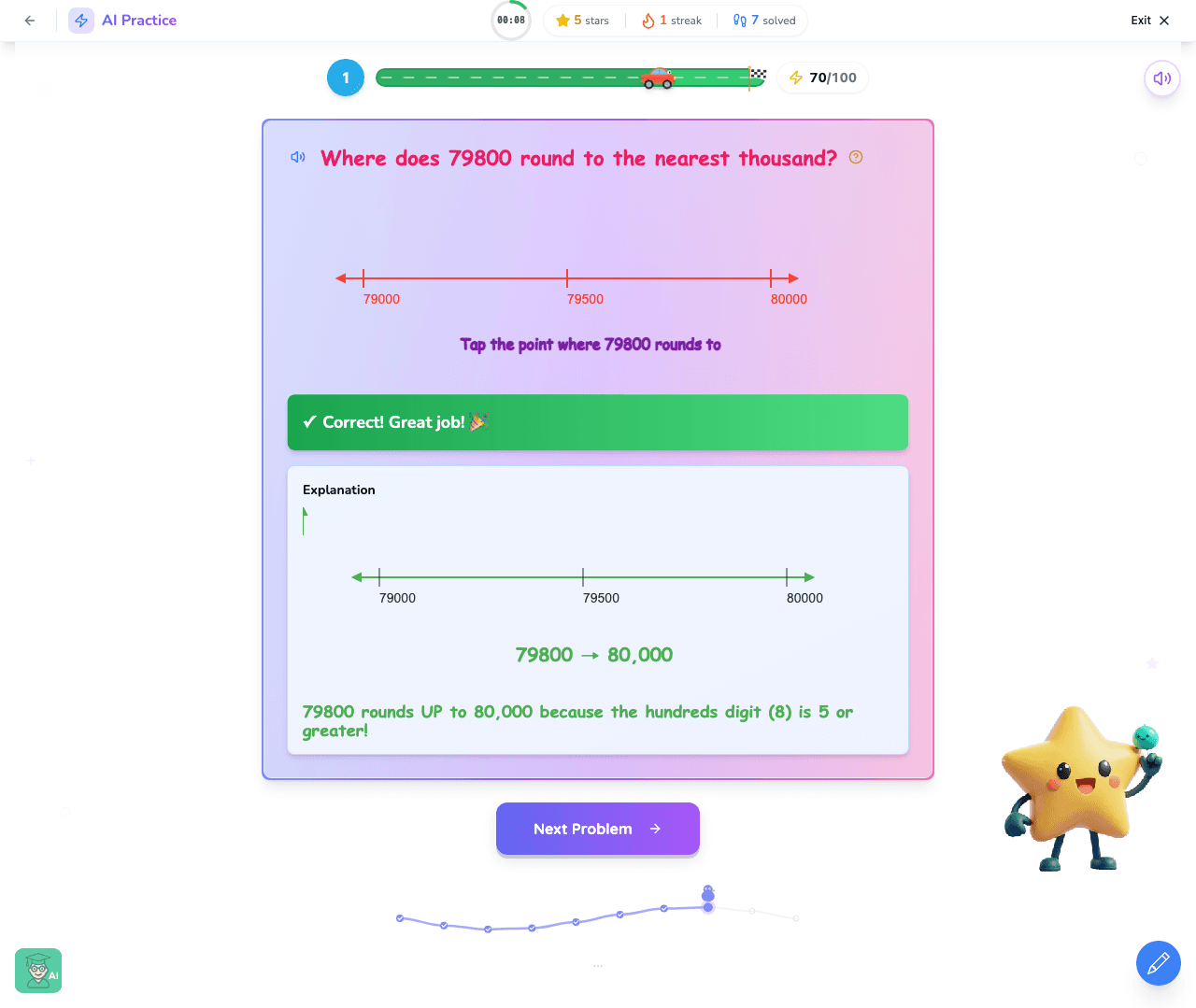
Why Rounding Feels Like Guesswork for 4th Graders
You've probably seen it happen: your 4th grader stares at a rounding problem, hesitates, and then picks an answer that seems completely random. It's frustrating for both of you. They're not struggling because they can't do math. They're struggling because rounding often gets taught as a rule to memorize rather than a concept to understand.
Here's the good news: rounding numbers for 4th graders doesn't have to feel like guesswork. Once children discover the simple logic behind rounding, it transforms from a confusing exercise into an engaging puzzle they can solve with confidence.
In this guide, you'll learn the "hundreds digit secret" that unlocks rounding to the nearest thousand, see why missing digit puzzles work better than traditional worksheets, and discover how to turn homework time into a detective-style adventure. Whether your child needs to catch up or wants to get ahead, these strategies will make rounding click.
What Is Rounding to the Nearest Thousand?
Before diving into tricks and techniques, let's make sure we're on the same page about what rounding to the nearest thousand actually means.
Rounding is about finding the closest "milestone" number. When we round to the nearest thousand, we're asking: which thousand is this number closest to? For example, is 4,382 closer to 4,000 or 5,000?
Think of it like standing between two bus stops. You'll walk to whichever stop is closer. Numbers work the same way:
- 4,382 is closer to 4,000 (it rounds down)
- 4,782 is closer to 5,000 (it rounds up)
- 4,500 is exactly in the middle, so by convention, it rounds up to 5,000
This is a critical 4th grade Common Core standard (4.NBT.A.3), and it's the foundation for estimation skills your child will use throughout their math education. Students who understand rounding conceptually (not just as a rule) perform better when they encounter decimals, fractions, and mental math strategies later on.
The challenge for most 4th graders isn't understanding the concept; it's knowing which digit to look at. That's where the "hundreds digit secret" comes in.
How Do You Know When to Round Up or Down?
This is the question that trips up most students. Here's the simple rule that makes rounding to the nearest thousand straightforward:
For rounding to the nearest thousand, you only need to look at the hundreds digit.
That's it. Forget the tens. Forget the ones. Just find the hundreds digit and apply this simple test:
- If the hundreds digit is 0, 1, 2, 3, or 4 → Round DOWN
- If the hundreds digit is 5, 6, 7, 8, or 9 → Round UP
Let's see this in action:
| Number | Hundreds Digit | Decision | Rounded Result |
|---|---|---|---|
| 7,234 | 2 | Round down | 7,000 |
| 7,834 | 8 | Round up | 8,000 |
| 7,500 | 5 | Round up | 8,000 |
| 7,499 | 4 | Round down | 7,000 |
Why does this work? The hundreds digit tells you whether the number has passed the halfway point to the next thousand. Numbers with hundreds digits 0-4 are in the lower half (closer to the current thousand). Numbers with hundreds digits 5-9 are in the upper half (closer to the next thousand).
Once your child internalizes this "quick rule," rounding becomes almost automatic. But here's what makes it truly stick: practicing with puzzles that work backwards.
The Missing Digit Puzzle: A Fun Way to Practice Rounding
Traditional rounding practice goes like this: "Round 6,472 to the nearest thousand." It's straightforward, but it doesn't build deep understanding. Missing digit puzzles flip the problem and that's what makes them powerful.
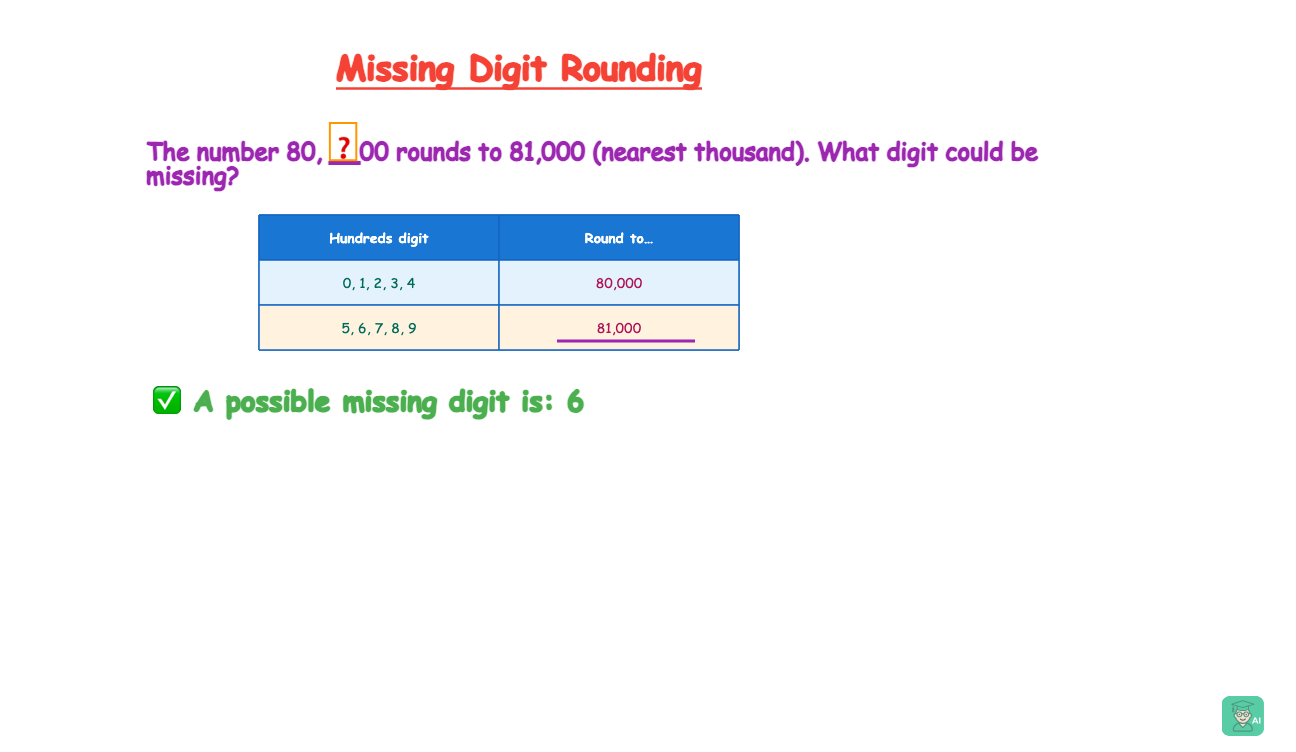
Instead of asking "What does this number round to?" these puzzles ask: "What digit would make this number round to a specific target?"
For example:
The number 3,___ 45 rounds to 4,000. What digits could go in the blank?
To solve this, your child must think: "For the number to round UP to 4,000, the hundreds digit must be 5, 6, 7, 8, or 9."
This detective-style approach accomplishes several things:
- Reinforces the rule through reasoning, not memorization
- Reveals that multiple answers can be correct (building number sense)
- Makes practice feel like a game rather than a chore
The interactive problem below shows exactly how these missing digit puzzles work in practice:
Try it at home: Write a four-digit number with one digit missing and challenge your child to find ALL the digits that would make it round up (or down) to a target thousand. Celebrate when they realize there are five possible answers, not just one!
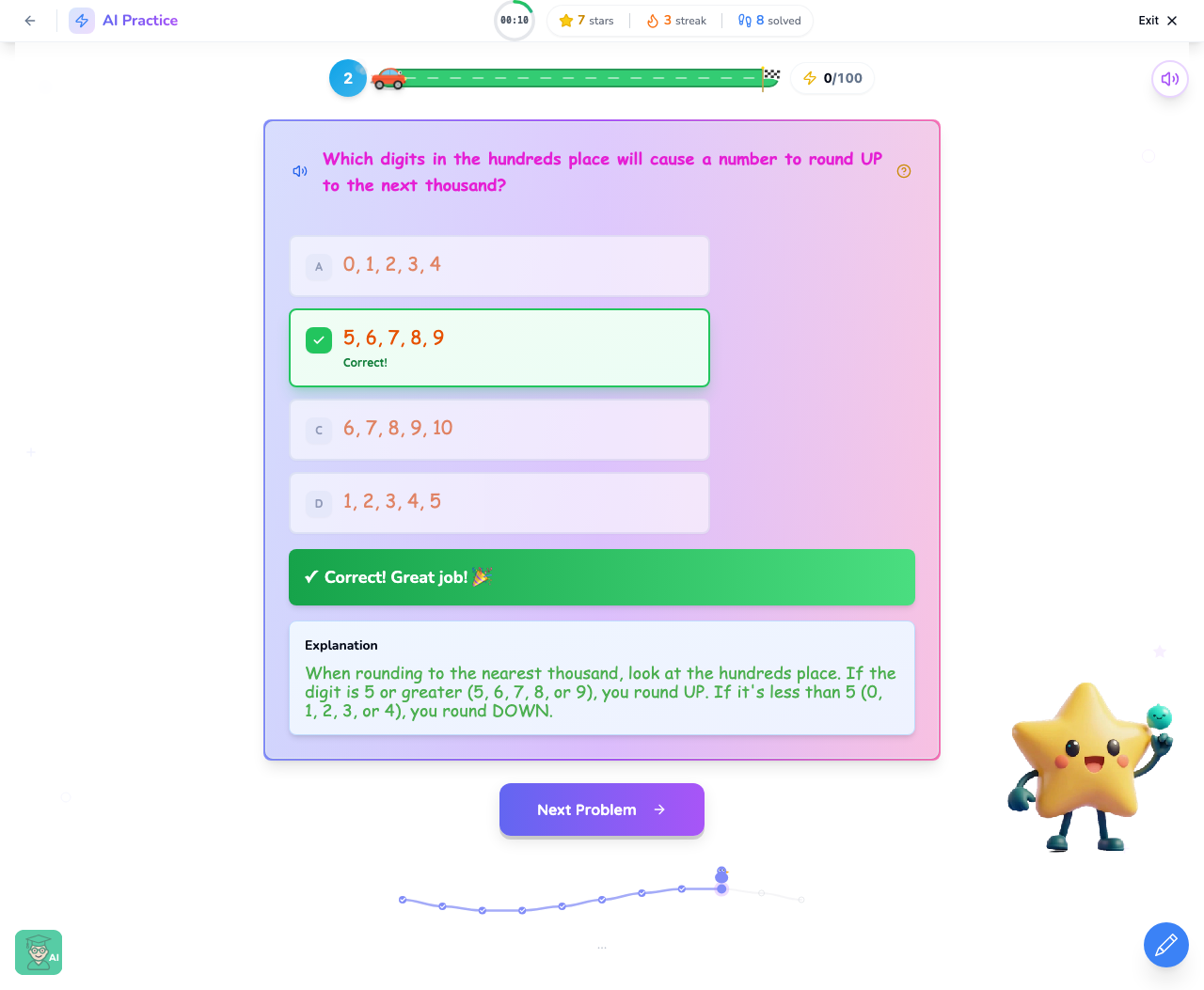
See How Interactive Rounding Puzzles Work
Reading about rounding strategies is helpful, but seeing them in action makes all the difference. AI Teacherly's Rounding Puzzles lesson for 4th graders brings these concepts to life through interactive problems that adapt to your child's skill level.
Here's what the full interactive lesson looks like on AI Teacherly:
The lesson includes several types of engaging activities:
- Multiple-choice questions that ask which digits cause rounding up or down (perfect for building the 5-9 rule into memory)
- Fill-in-the-blank puzzles where students find missing digits that satisfy rounding conditions
- Real-world problems like estimating stadium attendance, connecting abstract rounding to practical situations
- Step-by-step ordering activities that reinforce the systematic approach to rounding
What parents love about this approach:
- Immediate feedback shows your child why an answer is right or wrong
- The "puzzle" framing makes practice feel like a game
- Progress tracking lets you see exactly where your child needs more support
- No prep work required; just open the lesson and let your child explore
The visual, interactive format is especially powerful for students who struggle with traditional worksheet-style practice. When rounding becomes a puzzle to solve rather than a rule to follow, engagement (and understanding) naturally increases.
Common Rounding Mistakes 4th Graders Make
Even after learning the rules, many 4th graders make predictable errors. Knowing what to watch for helps you catch and correct these mistakes early.
Mistake #1: Looking at the wrong digit
When rounding to the nearest thousand, students sometimes look at the tens or ones digit instead of the hundreds digit. Quick fix: Have your child underline or circle the hundreds digit before deciding to round up or down.
Mistake #2: Changing all the digits after rounding
Some students think that rounding 7,849 to the nearest thousand means the answer is 8,849 (just changing the hundreds digit to 8). They forget that everything after the thousands place becomes zeros. Quick fix: Remind them that rounding "resets" all smaller place values to zero.
Mistake #3: Confusing round up with "add one"
When rounding 3,672 to the nearest thousand, a student might write 3,001 (adding 1 to the thousands digit but not understanding the concept). Quick fix: Return to the "bus stop" analogy. Which thousand is 3,672 walking toward? That's your answer: 4,000.
Mistake #4: Panicking at 5
Some students aren't sure what to do when the hundreds digit is exactly 5. Is 4,500 closer to 4,000 or 5,000? Quick fix: The convention is always to round up at 5. It's the "tiebreaker rule."
Catching these mistakes early prevents them from becoming ingrained habits. A few minutes of targeted practice with interactive puzzles can make a significant difference.
Key Takeaways
- For rounding to the nearest thousand, only look at the hundreds digit: 0-4 rounds down, 5-9 rounds up
- Missing digit puzzles build deeper understanding than traditional rounding worksheets
- The 'bus stop' analogy helps children visualize which thousand a number is closest to
- Common mistakes include looking at the wrong digit and forgetting to change remaining digits to zeros
- Interactive, puzzle-based practice keeps 4th graders engaged while reinforcing concepts
- Rounding mastery is essential for estimation, mental math, and later math success
- Short, consistent practice sessions (15-20 minutes) are more effective than occasional long sessions
Frequently Asked Questions
What is the rule for rounding to the nearest thousand?
Look at the hundreds digit only. If it's 0, 1, 2, 3, or 4, round down. If it's 5, 6, 7, 8, or 9, round up. All digits after the thousands place become zeros.
How do I explain rounding up vs rounding down to my child?
Use the 'bus stop' analogy: imagine standing between two bus stops (thousands). You'll walk to whichever is closer. If you've passed the halfway point (hundreds digit 5-9), you're closer to the next stop, so round up.
Why does my 4th grader struggle with rounding?
Most children struggle because rounding is taught as a rule to memorize rather than a concept to understand. Once they see the logic behind why the hundreds digit matters, the confusion typically disappears.
What are missing digit rounding puzzles?
These puzzles flip traditional rounding problems by asking: 'What digit would make this number round to a specific target?' This detective-style approach builds deeper understanding than simply rounding given numbers.
How can I practice rounding with my child at home?
Write four-digit numbers with one digit missing and challenge your child to find ALL digits that would make it round to a target thousand. Interactive lessons on AI Teacherly also provide engaging, self-guided practice.
Is rounding important for later math?
Yes! Rounding is foundational for estimation, mental math, working with decimals and fractions, and real-world applications like budgeting and measuring. Strong rounding skills make all these areas easier.
What should I do if my child guesses randomly on rounding problems?
Random guessing usually means they don't understand which digit to focus on. Return to basics: practice identifying the hundreds digit first, then applying the 5-or-higher rule. Puzzle-based practice helps make the connection click.
How long should my child practice rounding each day?
For 4th graders, 15-20 minutes of focused, interactive practice is ideal. Short, consistent sessions are more effective than occasional hour-long cramming. Make it feel like puzzle time, not homework.
Ready to make rounding click for your 4th grader? Try the free Rounding Puzzles lesson on AI Teacherly and watch homework frustration transform into puzzle-solving confidence!