Simple Interest for 6th Graders: The Money Math Your Child Actually Needs
Teach your 6th grader the I = Prt formula with real money examples. Master simple interest calculations and build financial literacy skills that last a lifetime.
Why Financial Literacy Starts in 6th Grade
Your 6th grader is at the perfect age to start understanding how money really works. They can handle the math, they're starting to think about what they want to buy, and they're curious about the adult world of banks, savings, and loans.
Simple interest is the gateway to financial literacy. It's not just another formula to memorize for a test; it's practical knowledge that separates smart savers from those who wonder where their money went.
Across the country, schools are recognizing that financial education can't wait until high school. Many states now require personal finance courses, and the 6th grade math curriculum introduces simple interest as a foundational concept. This is your opportunity to reinforce what they're learning and connect it to real life.
The good news? Simple interest is genuinely simple once your child understands the pieces. And the payoff goes far beyond getting good grades: your child will develop critical thinking skills about money that last a lifetime.
What Is Simple Interest and Why Does It Matter?
Simple interest is the money earned (or owed) on an original amount over time. When your child puts money in a savings account, the bank pays them interest as a reward for keeping their money there. When someone takes out a loan, they pay interest as the cost of borrowing.
Here's what makes simple interest "simple": the calculation is always based on the original amount (called the principal), not on any accumulated interest. This differs from compound interest, which calculates interest on interest.
For 6th graders, simple interest is the ideal starting point because:
- It uses straightforward multiplication that builds on skills they already have
- The formula has only three variables making it manageable to understand
- Real-world applications are everywhere: savings accounts, car loans, and store financing
- It builds the foundation for understanding more complex financial concepts later
When your child masters simple interest, they're not just passing a math unit. They're gaining insight into how banks work, why saving early matters, and how to evaluate financial decisions they'll face throughout life.
How Do You Explain the I = Prt Formula to a Child?
The simple interest formula I = Prt looks intimidating at first glance, but it breaks down into four easy pieces:
- I = Interest (the money earned or owed)
- P = Principal (the starting amount of money)
- r = Rate (the interest rate as a decimal)
- t = Time (usually in years)
Here's a simple way to explain it: "If you save $100 and the bank pays 5% interest for one year, you'll earn $5. The formula just multiplies those three things together."
Let's walk through a real example together:
Your child wants to save $200 for a new video game. They put the money in an account that pays 4% interest per year. How much interest will they earn after 2 years?
- Principal (P) = $200 (the starting amount)
- Rate (r) = 4% = 0.04 (convert percent to decimal)
- Time (t) = 2 years
I = P × r × t I = 200 × 0.04 × 2 I = $16
The total amount they'll have is the original $200 plus $16 interest = $216. That's money the bank pays them just for saving!
This "A = P + I" formula for total amount is equally important, as it shows kids how their money actually grows over time.
The Secret Step: Converting Percentages to Decimals
Here's where most 6th graders stumble: converting the interest rate from a percentage to a decimal. This single step causes more confusion than anything else in simple interest problems.
The rule is simple: Take the percent and divide by 100.
| Percentage | Decimal |
|---|---|
| 5% | 0.05 |
| 3.5% | 0.035 |
| 10% | 0.10 |
| 2.5% | 0.025 |
A helpful trick: Move the decimal point two places to the left. So 5% becomes 0.05, and 12% becomes 0.12.
Why does this matter so much? If your child uses 5 instead of 0.05 in the formula, their answer will be 100 times too large! That's the difference between earning $5 and earning $500 in their calculations.
Practice this step separately before tackling full problems. Ask your child:
- "What's 8% as a decimal?" (0.08)
- "What's 3.25% as a decimal?" (0.0325)
- "If I say the rate is 0.06, what percent is that?" (6%)
Once this conversion becomes automatic, the rest of simple interest calculations flow smoothly.
Real-World Examples That Make Simple Interest Click
Abstract formulas become memorable when connected to situations your child actually cares about. Here are examples that make simple interest relevant:
The Birthday Money Scenario Grandma gives your child $500 for their birthday. They can either spend it all now or put it in a savings account earning 3% for 2 years. How much would they have if they saved it?
I = 500 × 0.03 × 2 = $30 Total = $500 + $30 = $530
That's $30 earned by doing absolutely nothing except being patient!
The Bicycle Loan Example Your child's friend borrowed $150 from their parents to buy a bike, with an agreement to pay back the loan plus 5% simple interest after 1 year. How much do they owe?
I = 150 × 0.05 × 1 = $7.50 Total = $150 + $7.50 = $157.50
Comparing Options (Critical Thinking) Which is better: $200 at 4% for 3 years, or $300 at 2% for 2 years?
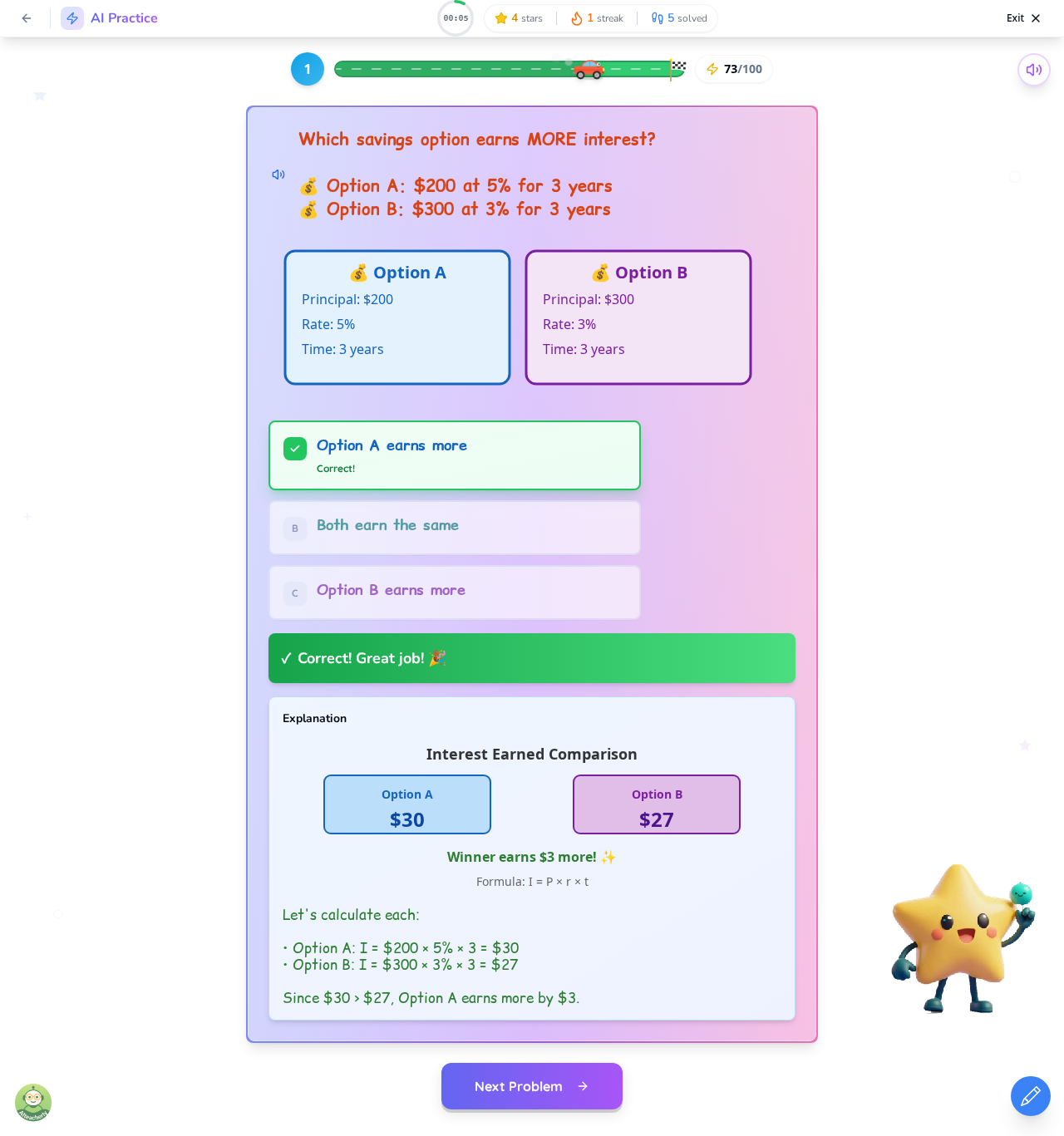
The interactive problem below shows exactly how students compare two savings options to make smarter financial decisions.
- Option A: I = 200 × 0.04 × 3 = $24
- Option B: I = 300 × 0.02 × 2 = $12
Option A earns more interest, even though Option B started with more money. This kind of comparison builds the financial reasoning skills your child will use for life.
See How Interactive Learning Makes Financial Math Fun
Let's be honest: worksheets full of interest calculations can feel tedious. That's where interactive learning changes everything.
On AI Teacherly, the Simple Interest lesson for Grade 6 transforms abstract formulas into engaging, personalized experiences. Here's what makes it effective:
Personalized Savings Goals Instead of generic word problems, students calculate interest on items they want to buy. Whether it's a video game, skateboard, or concert tickets, the math becomes immediately relevant.
Visual Learning with Tape Diagrams The lesson uses visual representations to show how principal plus interest equals the total amount. For visual learners, seeing this relationship makes the concept click instantly.
Guided Practice with Immediate Feedback Students don't just submit answers and hope for the best. They receive step-by-step guidance and can retry problems until they've mastered each skill.
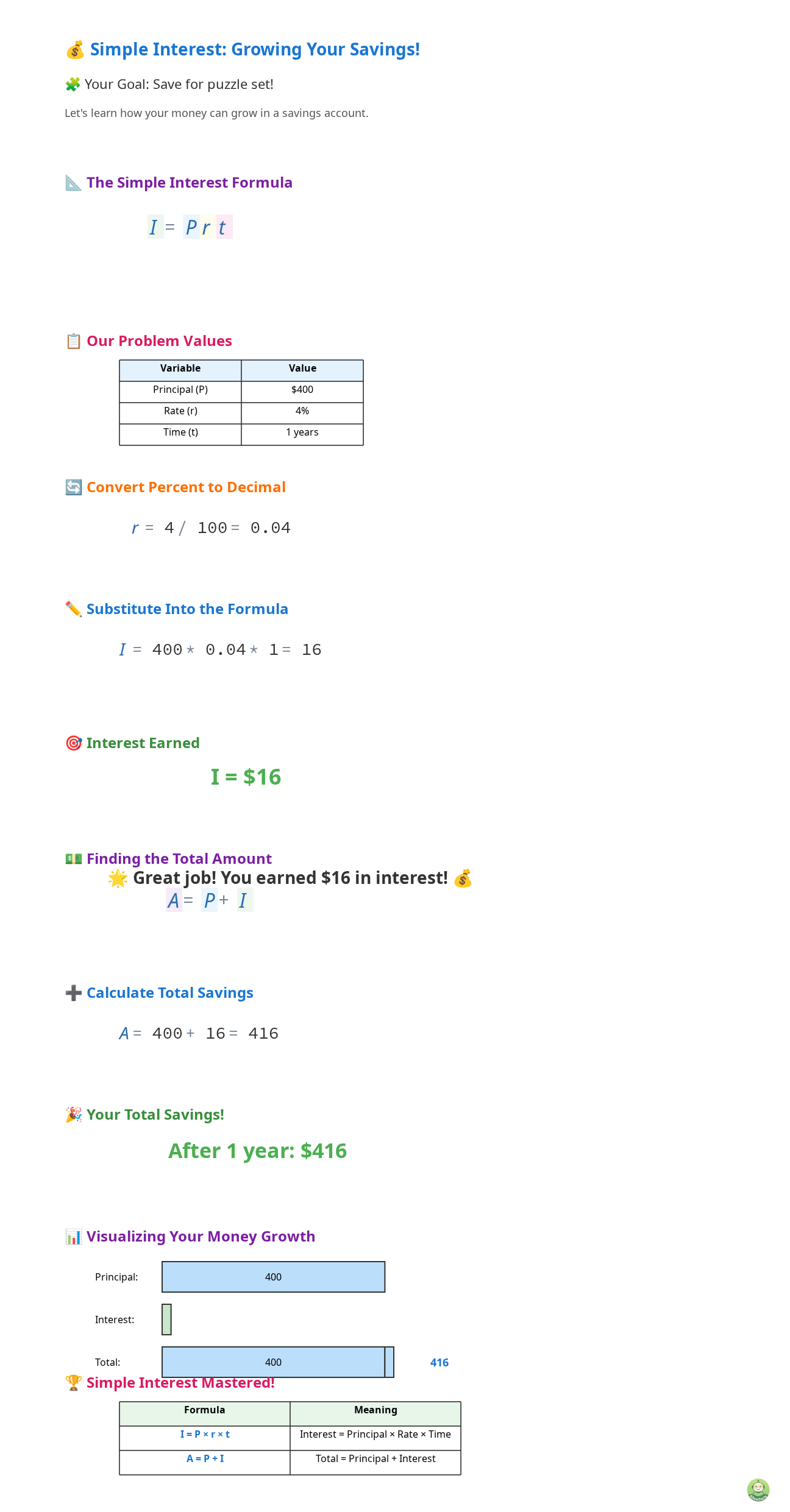
Here's what the full interactive lesson looks like on AI Teacherly:
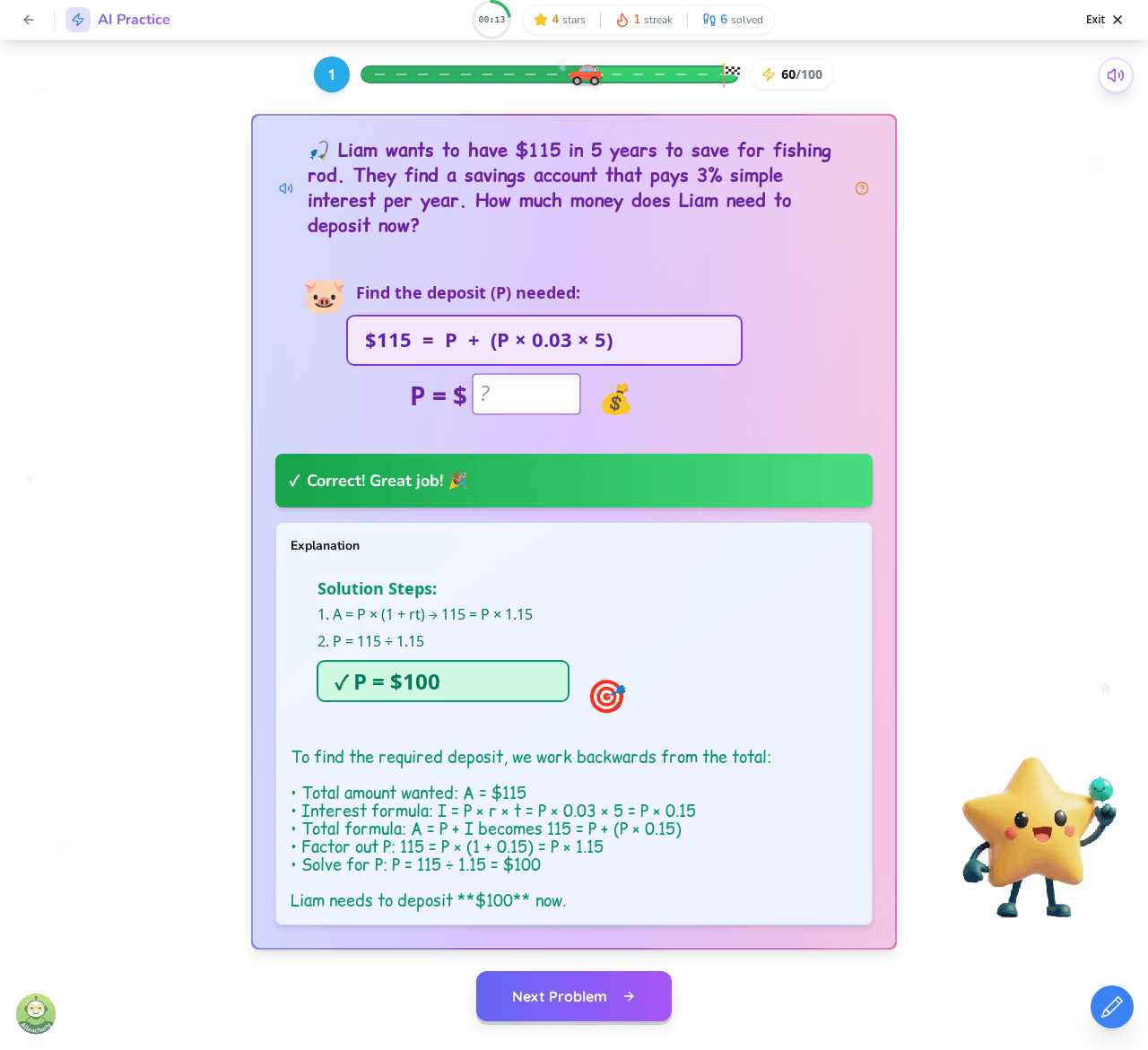
Progressive Challenge Levels The lesson starts with straightforward calculations and builds to more complex scenarios, like working backwards to find the principal when given the interest amount. This scaffolded approach ensures students build genuine understanding, not just procedural memorization.
Real Decision-Making Practice The lesson includes comparison problems where students evaluate different savings options, just like the financial decisions they'll face in real life.
Common Mistakes to Watch For (And How to Fix Them)
Even after understanding the formula, 6th graders often make predictable errors. Watch for these common pitfalls:
Mistake #1: Forgetting to Convert the Percentage This is the most frequent error. Students use 5 instead of 0.05, getting answers that are wildly off.
Fix: Make percentage-to-decimal conversion the very first step, every single time. Write it down before anything else.
Mistake #2: Confusing Interest with Total Amount When asked "How much will they have?" students sometimes give only the interest earned, forgetting to add it to the principal.
Fix: Teach both formulas together: I = Prt gives the interest, and A = P + I gives the total. Circle what the question is actually asking.
Mistake #3: Time Unit Confusion If the rate is "per year" but time is given in months, students need to convert. For 6 months, t = 0.5 (half a year), not 6.
Fix: Always check that time and rate use the same unit. Highlight "per year" in the problem as a reminder.
Mistake #4: Calculation Errors with Decimals Multiplying decimals requires careful attention to decimal placement.
Fix: Encourage using a calculator for computation once the setup is correct. The conceptual understanding matters more than mental arithmetic speed.
Mistake #5: Giving Up on Word Problems Some students freeze when facing paragraph-style problems and don't know how to extract P, r, and t.
Fix: Practice identifying the three variables first, before any calculation. Underline or highlight each one in the problem text.
Key Takeaways
- Simple interest uses the formula I = Prt, where P is principal, r is rate (as a decimal), and t is time in years
- Converting percentages to decimals is the critical first step: divide by 100 or move the decimal two places left
- Use the total amount formula A = P + I to find how much money your child will have after earning interest
- Connect lessons to real goals your child cares about, like saving for a video game or bike
- Practice comparing different savings options to build critical thinking about financial decisions
- Watch for common mistakes: forgetting to convert percentages and confusing interest with total amount
- Interactive lessons make financial math engaging by using personalized scenarios and immediate feedback
Frequently Asked Questions
What is simple interest and how is it different from compound interest?
Simple interest is calculated only on the original principal amount. Compound interest calculates interest on both the principal AND previously earned interest, making it grow faster over time. For 6th grade, simple interest provides the foundational understanding.
What does each letter in I = Prt stand for?
I = Interest earned (or owed), P = Principal (starting amount), r = Rate (as a decimal, not a percent), and t = Time (usually in years). Multiply all three together to find the interest.
How do you convert a percentage to a decimal for the interest formula?
Divide the percentage by 100, or simply move the decimal point two places to the left. For example, 5% becomes 0.05, and 3.5% becomes 0.035. This step is essential for correct calculations.
Why do 6th graders need to learn about interest?
Learning simple interest builds financial literacy skills early. Kids begin understanding how savings accounts grow money and why loans cost money. These concepts prepare them for real financial decisions as teenagers and adults.
How can I practice simple interest problems with my child at home?
Use real scenarios like saving birthday money or comparing prices. Ask questions like 'If you save $100 at 5% for 2 years, how much will you earn?' Interactive lessons on AI Teacherly also provide guided practice with immediate feedback.
What are common mistakes kids make when calculating simple interest?
The top errors are: forgetting to convert percentages to decimals (using 5 instead of 0.05), confusing interest with total amount, and mixing up time units (months vs. years). Practice the conversion step separately to build accuracy.
At what age should kids learn about interest and savings?
6th grade (ages 11-12) is ideal because students have the math skills for decimal multiplication and are beginning to think about money and saving goals. Starting early builds habits and understanding before more complex financial topics.
How do banks actually use simple interest in real life?
Some savings accounts, short-term loans, and car financing use simple interest calculations. However, most long-term savings and credit cards use compound interest. Understanding simple interest first makes compound interest easier to grasp later.
Ready to make financial math click for your 6th grader? Try the interactive Simple Interest lesson free on AI Teacherly and watch your child master the I = Prt formula with real-world examples they'll actually care about!