Simple Interest Made Simple: A Parent's Guide to Teaching the I=Prt Formula
Your 6th grader is learning about money in math class right now. Discover how to explain the simple interest formula (I=Prt) in a way that clicks and builds real financial literacy.
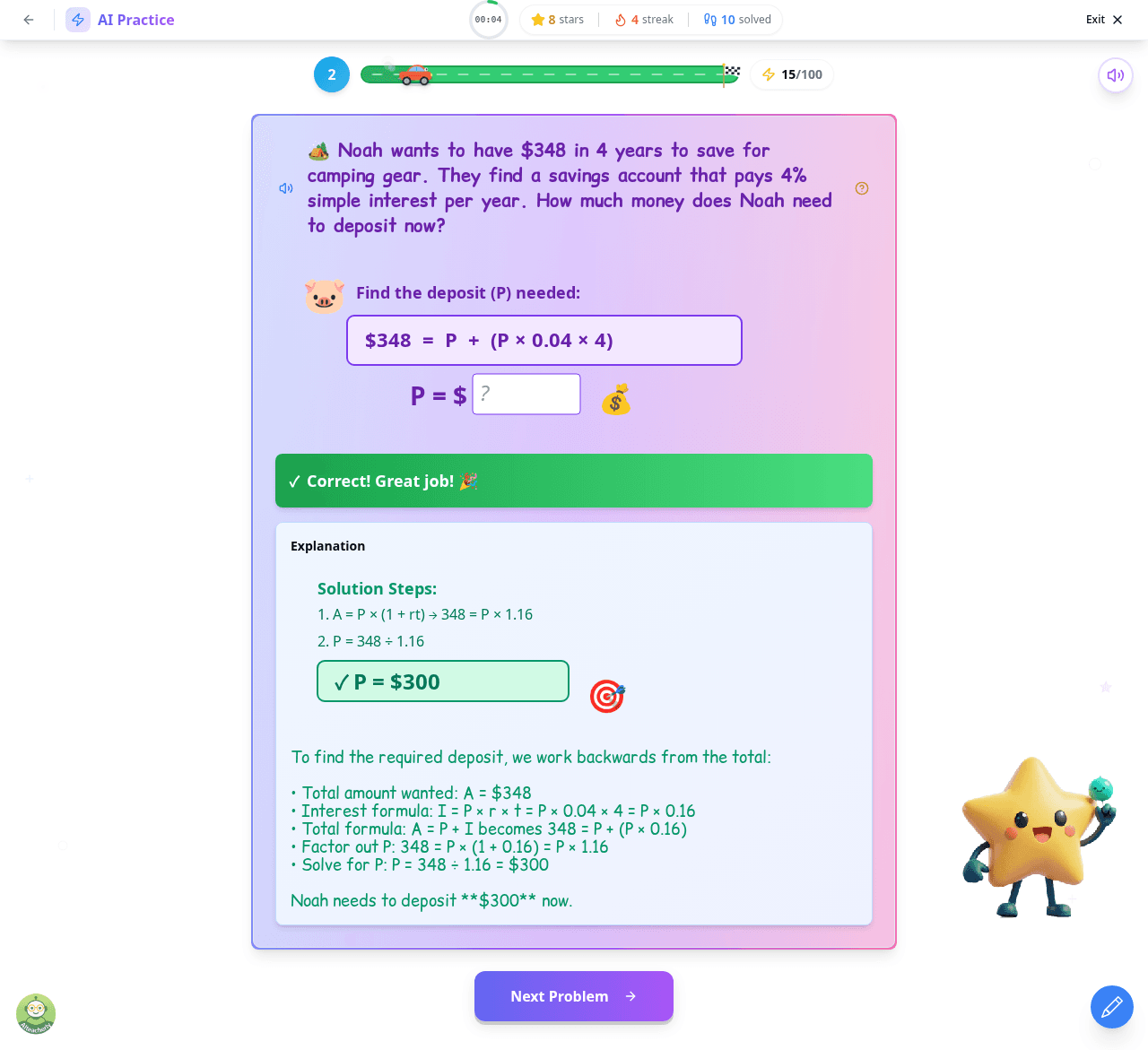
Why Simple Interest Is Your Child's First Real Money Lesson
Your child is learning about money in math class right now, but here's what matters more: do they understand how it actually works? Simple interest isn't just another formula to memorize. It's your 6th grader's introduction to how banks, savings accounts, and loans operate in the real world.
For many parents, this lesson feels like a turning point. Your child is finally learning math that connects directly to adult financial decisions. The simple interest formula (I = Prt) might look intimidating at first glance, but it's actually one of the most practical math skills your child will ever learn.
The challenge? Most kids see I = Prt as just another equation to plug numbers into. They miss the bigger picture: that understanding interest can shape their relationship with money for years to come. That's where you come in.
In this guide, you'll discover exactly how to explain simple interest in a way that makes sense. We'll break down each part of the formula, tackle the #1 stumbling block (converting percents to decimals), and show you how to make this lesson feel personally relevant using savings goals your child actually cares about.
What Is Simple Interest and Why Does It Matter?
Simple interest is the money earned or paid on a principal amount over a specific time period. When your child deposits money in a savings account, the bank pays them interest as a reward for keeping their money there. When someone takes out a loan, they pay interest to the lender for borrowing the money.
This concept is foundational because it teaches two sides of the same coin:
- Earning interest on savings: Your money grows just by sitting in the bank
- Paying interest on loans: Borrowed money costs extra over time
Why does this matter for a 6th grader? Financial literacy experts agree that middle school is the ideal time to introduce these concepts. Children at this age can grasp abstract mathematical relationships while still being young enough to form lasting habits around money.
The simple interest formula captures this relationship in just four variables:
I = P × r × t
Where:
- I = Interest (the money earned or paid)
- P = Principal (the starting amount)
- r = Rate (the interest rate as a decimal)
- t = Time (usually in years)
Once your child masters this formula, they can calculate interest on any savings account, understand loan costs, and make smarter financial decisions throughout life.
How Do You Explain the I=Prt Formula to a 6th Grader?
The key to teaching I = Prt is breaking it into bite-sized pieces that connect to real life. Here's a step-by-step approach that works:
Step 1: Start with a relatable scenario
Ask your child: "If you saved $200 for a new gaming console and the bank paid you 5% interest per year, how much extra money would you earn after 2 years?"
This immediately makes the math personal. They're not solving an abstract problem; they're calculating real money they could earn.
Step 2: Identify each variable
- Principal (P) = $200 (the money they started with)
- Rate (r) = 5% (but we need to convert this first!)
- Time (t) = 2 years
Step 3: Convert the percent to a decimal
This is where most 6th graders get stuck. Show them this simple rule: divide the percent by 100.
5% ÷ 100 = 0.05
Alternatively, just move the decimal point two places to the left.
Step 4: Plug in and multiply
I = P × r × t I = $200 × 0.05 × 2 I = $20
Step 5: Celebrate the "aha" moment
"That's $20 the bank pays you just for saving! Your money earned that just by sitting in the bank."
When kids realize their money can make more money, the formula suddenly feels like a superpower rather than homework.
The Secret Step: Converting Percents to Decimals
Here's something most parents don't realize: converting percents to decimals is the #1 stumbling block in simple interest problems. Once kids master this step, everything else clicks into place.
Why is this so tricky? Many students try to use "5" instead of "0.05" for a 5% rate. The result? Their interest calculation is 100 times too large, and the answer makes no sense.
Three ways to teach percent-to-decimal conversion:
Method 1: Divide by 100
- 5% ÷ 100 = 0.05
- 8% ÷ 100 = 0.08
- 12% ÷ 100 = 0.12
Method 2: Move the decimal two places left
- 5.0% → 0.05
- 8.0% → 0.08
- 12.0% → 0.12
Method 3: Think of it as "per hundred"
The word "percent" literally means "per hundred." So 5% means 5 per 100, or 5/100, which equals 0.05.
Practice tip: Before your child starts any simple interest problem, have them convert the rate first and write it down. This creates a habit that prevents the most common error.
You can also check their work with a quick reasonableness test: If someone earns thousands of dollars in interest on a $100 deposit, they probably forgot to convert the percent!
From Interest to Total Amount: The Complete Picture with A = P + I
Once your child can calculate interest, there's one more step to complete their understanding: finding the total amount in the account after earning interest.
This uses a second formula that builds on the first:
A = P + I
Where:
- A = Total amount (what you end up with)
- P = Principal (what you started with)
- I = Interest (what you earned)
Let's continue our earlier example:
- Principal: $200
- Interest earned: $20
- Total amount: $200 + $20 = $220
This formula answers the question kids really care about: "How much money will I actually have?"
Using a tape diagram to visualize
Many 6th graders find it helpful to see this relationship visually. Imagine a tape (or bar) divided into two parts:
[======Principal: $200======][Interest: $20]
The entire tape represents the total amount: $220.
This visual approach helps students understand that the total amount is always larger than the principal (assuming positive interest). It also reinforces that interest is "extra" money added on top of what they started with.
Why both formulas matter
In real life, people ask questions both ways:
- "How much interest will I earn?" → Use I = Prt
- "How much will I have after 3 years?" → Use I = Prt first, then A = P + I
See How Interactive Learning Makes Simple Interest Click
Sometimes the best way to understand a concept is to see it in action. Interactive lessons transform simple interest from an abstract formula into something your child can explore, manipulate, and truly understand.
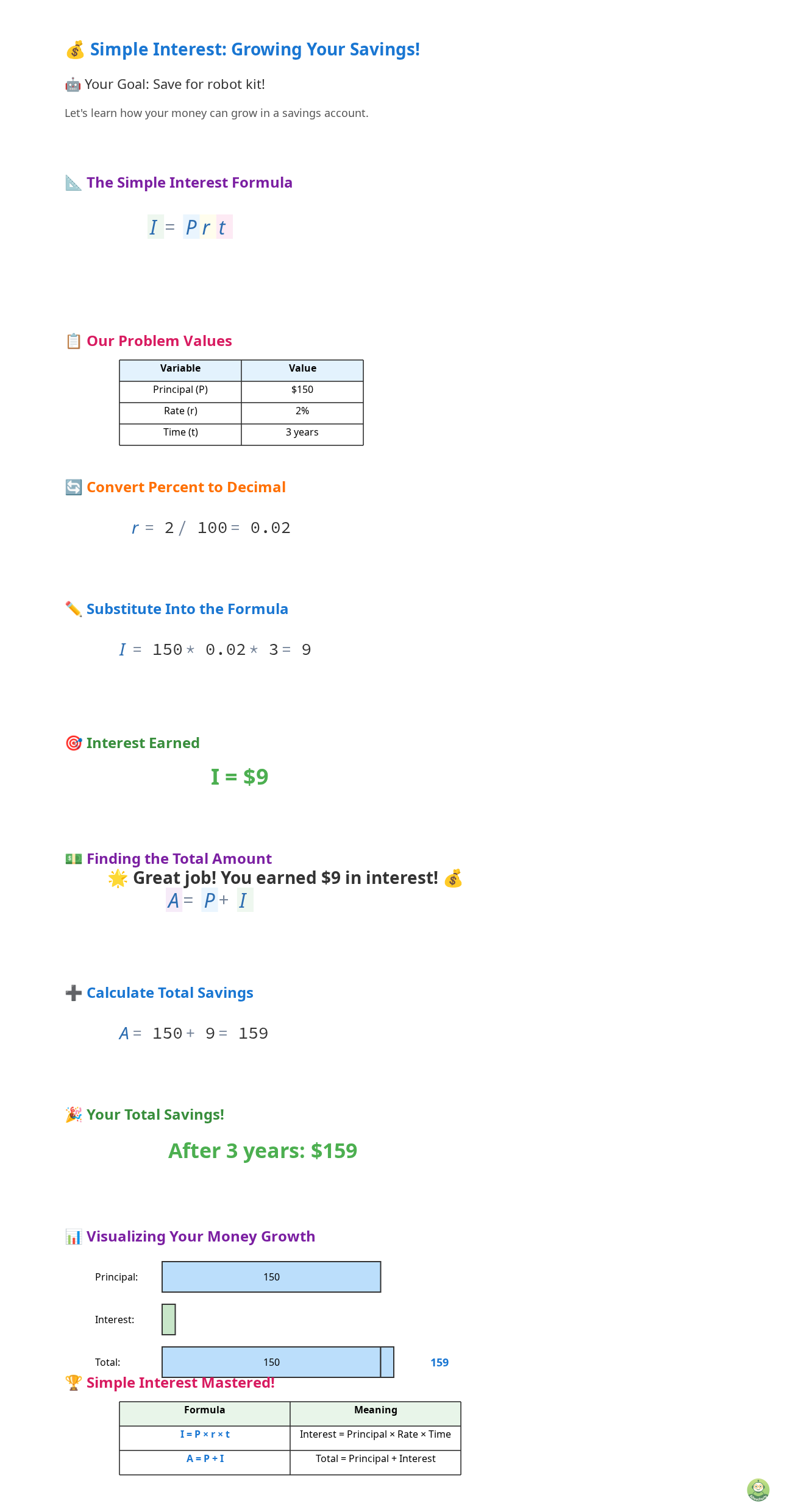
Here's what the full interactive lesson looks like on AI Teacherly:
The Simple Interest lesson on AI Teacherly guides students through each concept step by step, using visual elements, guided narration, and engaging practice problems. Instead of just reading about the formula, students actively work through scenarios, get immediate feedback, and build confidence with each correct answer.
What makes interactive learning different?
Visual scaffolding: Students see the formula broken down with color-coded variables, making it easier to track which number goes where.
Immediate feedback: When students make the common percent-to-decimal error, they get gentle correction right away rather than practicing the wrong method repeatedly.
Personalized scenarios: Problems feature savings goals that resonate with middle schoolers, like saving for video games, bikes, or phones. When math feels personal, motivation increases.
Progressive difficulty: The lesson starts with straightforward calculations and gradually introduces more complex scenarios, including working backwards to find the principal when given the interest.
This kind of structured, interactive approach is especially helpful for students who struggle with traditional worksheet-based learning. The visual elements and step-by-step guidance provide the support many 6th graders need to build genuine understanding.
Real-World Practice: Savings Goals That Motivate Your Child
The secret to making simple interest stick? Connect it to something your child actually wants. Abstract math becomes engaging when there's a personal payoff.
Try these conversation starters at home:
"If you saved your birthday money..." Ask your child to calculate how much interest they'd earn if they deposited their birthday money instead of spending it immediately. Even small amounts demonstrate the power of saving.
"Which savings account is better?" Present two options: Option A offers 3% interest for 2 years, while Option B offers 4% interest for 1 year. Which earns more? This comparison exercise builds critical thinking about financial decisions.
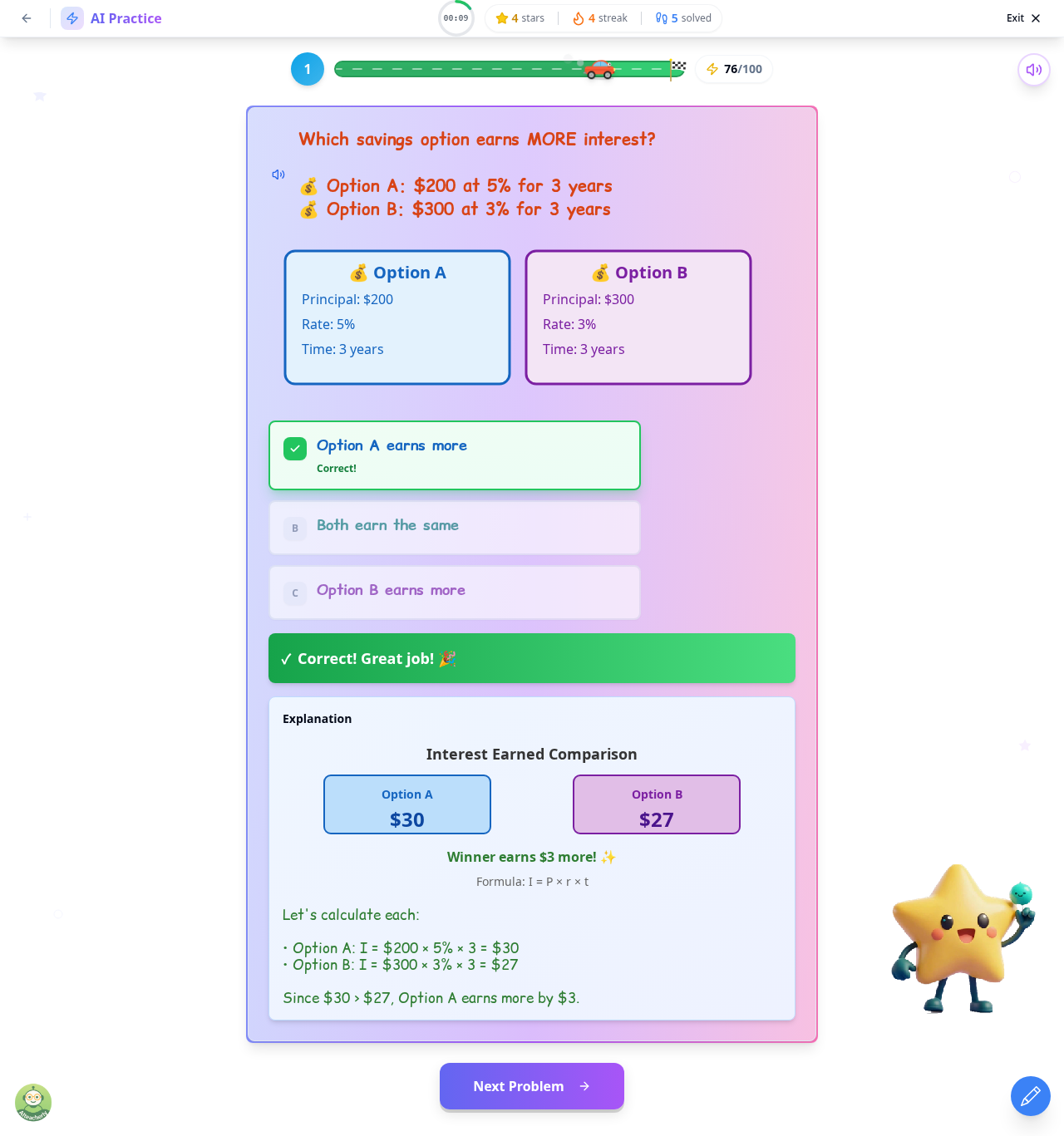
The interactive problem below shows exactly how this type of comparison works in practice:
In the AI Teacherly lesson, students face real decisions like comparing savings options. This problem uses engaging visuals and emoji formatting to present Option A versus Option B, challenging students to calculate interest for each scenario and determine which is the smarter choice.
More practice ideas for home:
- The allowance calculator: If your child receives allowance, help them calculate what they'd earn if they saved a portion in an interest-bearing account
- The big purchase planner: Is your child saving for something special? Calculate how long it would take to reach their goal with and without interest
- The loan flip side: Discuss how interest works on the other side. What if you borrowed money? Now you're paying interest instead of earning it
These real-world connections transform simple interest from a math topic into a genuine life skill.
Key Takeaways
- Simple interest (I = Prt) is your child's first introduction to how banks, savings, and loans actually work in the real world
- Converting percents to decimals is the #1 stumbling block; have your child always convert the rate first before calculating
- The total amount formula (A = P + I) answers the question kids really care about: 'How much will I actually have?'
- Real-world scenarios like saving for a gaming console or bike make abstract math feel personally relevant and motivating
- Understanding both sides of interest (earning on savings AND paying on loans) builds complete financial awareness
- Interactive lessons with immediate feedback help students catch errors early and build genuine understanding
Frequently Asked Questions
What is simple interest and why do kids learn it in 6th grade?
Simple interest is money earned on savings or paid on loans, calculated using I = Prt. It's taught in 6th grade because students are developmentally ready for financial concepts and it connects math to real-world money decisions.
How do I explain the I=Prt formula to my child?
Break it into parts: P is the starting amount (principal), r is the interest rate as a decimal, and t is time in years. Use a real example like saving for a video game to make each variable meaningful.
What's the easiest way to convert a percent to a decimal?
Divide by 100 or move the decimal point two places to the left. For example, 5% becomes 0.05. This is the most common mistake students make, so practice it separately first.
How is simple interest different from compound interest?
Simple interest is calculated only on the original principal, while compound interest earns interest on both the principal and previously earned interest. Simple interest is introduced first because it's easier to calculate.
What real-life examples can I use to teach simple interest?
Use savings goals your child cares about: gaming consoles, phones, bikes. Calculate how much extra they'd earn by saving. Also discuss loans to show how interest works both ways.
Is simple interest still used in real life?
Yes! Simple interest is used for car loans, some personal loans, and short-term savings. It's also the foundation for understanding more complex financial products your child will encounter as an adult.
How do I calculate total amount after earning interest?
Use the formula A = P + I, where A is the total amount, P is the principal (starting amount), and I is the interest earned. First calculate interest using I = Prt, then add it to the principal.
Why does my child keep getting simple interest problems wrong?
The most common error is forgetting to convert the percent to a decimal. If your child uses 5 instead of 0.05, their answer will be 100 times too large. Have them always convert the rate first.
Ready to make financial math click for your child? Try the interactive Simple Interest lesson on AI Teacherly and watch them master the I=Prt formula through engaging, real-world practice.