Skip Counting by 2s: The First Math Shortcut Every 2nd Grader Should Master
Discover why skip counting by 2s is the first math shortcut your 2nd grader needs and how to teach it at home with engaging activities that turn learning into play.
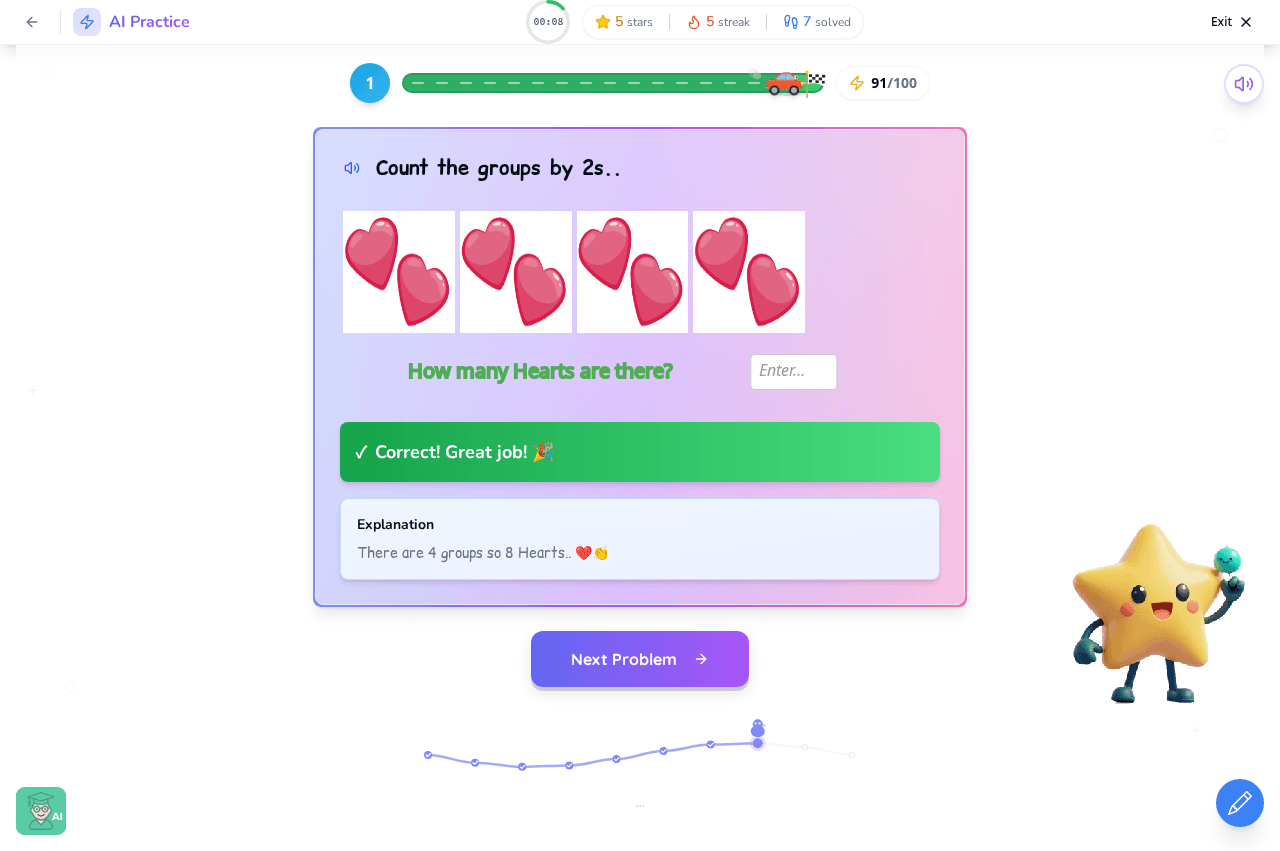
The Math Shortcut Every 2nd Grader Needs
Your 2nd grader doesn't need to count one by one anymore. There's a faster, smarter way, and it's called skip counting by 2s.
If you've ever watched your child laboriously count individual objects while their eyes glaze over, you know the struggle. But here's the exciting news: skip counting by 2s is the first "math shortcut" that makes kids feel like math wizards. Once they master it, counting becomes faster, easier, and (dare we say it?) actually fun.
Skip counting is more than just a classroom exercise. It's a foundational skill that builds the bridge to multiplication, telling time, counting money, and so much more. When your child learns to count 2, 4, 6, 8, 10, they're not just memorizing a sequence. They're developing number sense, recognizing patterns, and building mathematical confidence that will serve them for years to come.
In this guide, you'll discover exactly how to teach skip counting by 2s at home, why it matters for your child's math journey, and fun activities that turn practice into play. No teaching degree required!
What Is Skip Counting by 2s and Why Does It Matter?
Skip counting by 2s means counting forward by adding 2 each time instead of adding 1. Instead of counting 1, 2, 3, 4, 5, your child counts 2, 4, 6, 8, 10. It's like taking stairs two at a time instead of one.
Why is this skill so important for 2nd graders?
Skip counting is a core 2nd grade math standard (Common Core 2.NBT.A.2), and for good reason. It forms the foundation for multiplication, which your child will tackle in 3rd grade. When kids understand that 5 groups of 2 equals 10, they're actually doing early multiplication without even realizing it.
Beyond multiplication readiness, skip counting by 2s helps children:
- Count objects faster: Imagine counting 20 shoes one by one versus counting them by pairs. Skip counting saves time and reduces counting errors.
- Understand even numbers: Every number in the skip counting sequence (2, 4, 6, 8...) is an even number. This concept becomes crucial later in math.
- Tell time: Counting by 5s and 2s helps kids read analog clocks (those minutes go by 5s and sometimes 2s!).
- Count money: Nickels are worth 5 cents each, dimes are worth 10. Skip counting makes adding coins intuitive.
The key concept that makes skip counting "click" is visual grouping. When children see 2 objects as one unit (like a pair of socks), skip counting becomes natural. That's why hands-on, visual practice is so effective.
How Do I Teach My Child to Skip Count by 2s?
Teaching skip counting by 2s doesn't require flashcards or worksheets (though those can help). The most effective approach combines visual learning with rhythm and real-world practice. Here's a step-by-step method that works:
Step 1: Start with Physical Objects
Gather pairs of things: socks, shoes, mittens, or toy cars. Have your child group them into pairs, then count the groups. "One group of 2, two groups of 2, three groups of 2..." Then transition to "2, 4, 6."
Step 2: Make It Musical
Rhythm helps memory stick. Chant "2, 4, 6, 8, who do we appreciate?" or create a simple song. The rhythmic pattern (2, 4, 6, 8, 10, 12, 14, 16, 18, 20) becomes almost automatic when set to a beat.
Step 3: Use Visual Number Lines
Draw a number line from 0 to 20. Have your child hop a toy figure by 2s, landing on each even number. This visual representation reinforces the pattern.
Step 4: Practice Daily in Small Doses
Short, consistent practice beats long, boring sessions. Five minutes of skip counting during car rides or while walking is more effective than 30 minutes of forced practice at a desk.
Step 5: Add Interactive Digital Practice
Interactive lessons keep 2nd graders engaged longer than traditional worksheets. When practice feels like a game, kids actually want to do more of it. This is where platforms like AI Teacherly shine, turning skip counting into an interactive adventure.
5 Fun Activities to Practice Counting by 2s at Home
Skip counting practice doesn't have to feel like homework. Here are five engaging activities you can do at home with materials you already have:
1. The Sock Sorting Game Dump a basket of clean socks on the floor. Challenge your child to pair them up and count by 2s as they match. "2 socks, 4 socks, 6 socks, 8 socks!" It's chores and math practice in one.
2. Staircase Skip Counting Every time you walk upstairs together, count the steps by 2s. If you have 12 stairs, that's "2, 4, 6, 8, 10, 12!" Make it a race to see who can say the pattern fastest.
3. Snack Time Math Give your child a bowl of crackers, grapes, or cereal pieces. Have them group items into pairs and count by 2s to find the total. Then they get to eat their math problem!
4. Body Part Counting Count body parts that come in pairs: "How many eyes do 3 people have?" Your child counts: "2, 4, 6!" Expand to ears, hands, feet, and knees for more practice.
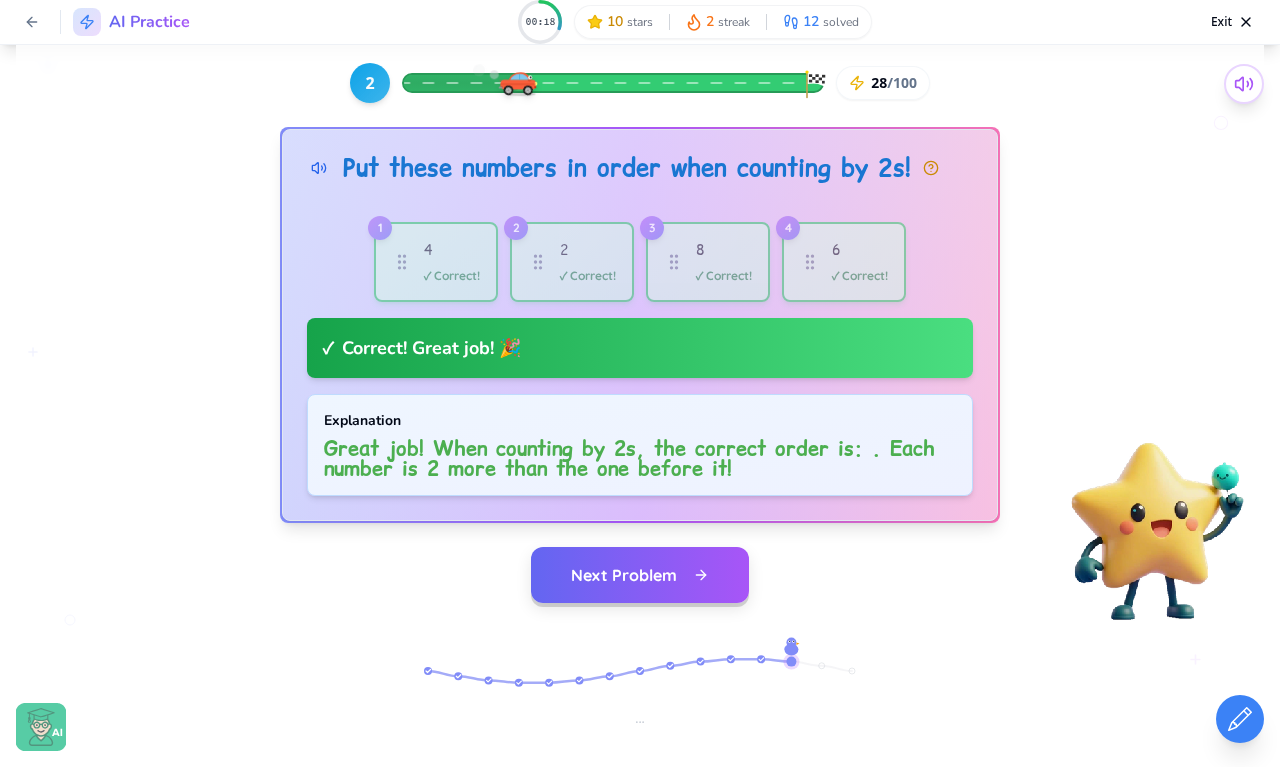
5. Interactive Digital Lessons For screen time that actually builds skills, interactive math lessons let kids practice skip counting with colorful visuals and instant feedback. The interactive problem below shows how children can arrange numbers in sequence, reinforcing the skip counting pattern through hands-on digital manipulation.
The key is variety. Mix physical activities with digital practice to keep your child engaged and reinforce the concept through multiple approaches.
See Skip Counting in Action with AI Teacherly
Sometimes the best way to understand a concept is to see it in action. AI Teacherly's Count by 2s lesson for Grade 2 brings skip counting to life through interactive, visual learning experiences.
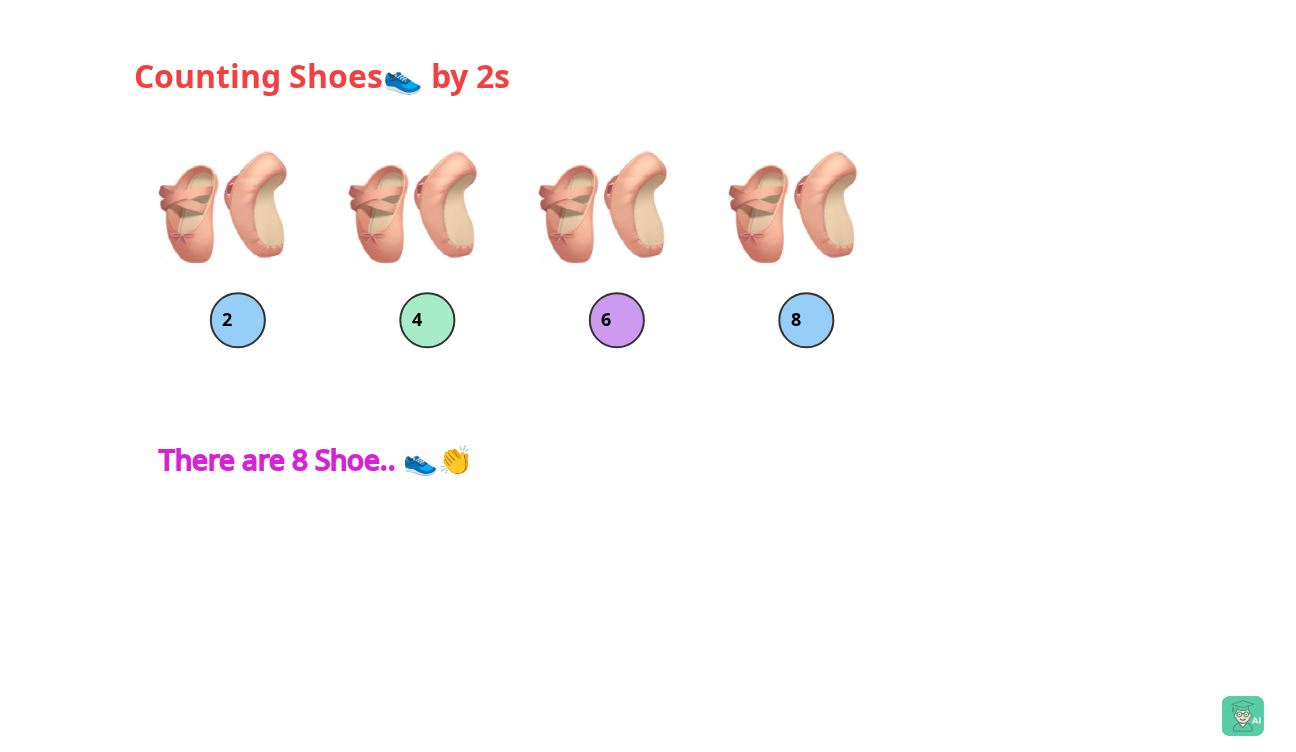
Here's what the full interactive lesson looks like on AI Teacherly:
In this lesson, children work with colorful grouped objects, counting them by 2s to find totals. The visual grouping approach transforms abstract numbers into concrete, countable items that kids can see and understand. When a child looks at 5 groups of 2 apples and counts "2, 4, 6, 8, 10," the connection between grouping and counting becomes crystal clear.
What makes interactive practice so effective?
- Instant feedback: Kids know immediately if they're on the right track, preventing the reinforcement of mistakes.
- Engaging visuals: Colorful objects and animations hold attention better than black-and-white worksheets.
- Adaptive difficulty: As your child masters easier problems, the challenges grow appropriately.
- Progress tracking: You can see exactly where your child excels and where they might need extra support.
The lesson guides students through recognizing groups of 2, counting them together, and building confidence with progressively challenging problems. As the lesson says, "When we count by 2s, it's faster and easier!"
Common Mistakes Kids Make (And How to Fix Them)
Even with great instruction, most kids hit some bumps while learning to skip count by 2s. Here are the most common mistakes and how to address them:
Mistake 1: Starting at 1 Instead of 2 Some children want to start their count at 1, saying "1, 3, 5, 7..." This usually means they're confusing skip counting with counting odd numbers or haven't fully grasped the concept of jumping by 2s.
Fix: Go back to physical objects. Show them 2 items and say, "We start at 2 because we already have 2." Use a number line and physically jump from 0 to 2 first.
Mistake 2: Losing the Pattern Mid-Sequence A child might say "2, 4, 6, 8, 9, 10..." reverting to counting by 1s partway through.
Fix: Practice shorter sequences first. Master 2 to 10 before pushing to 20. Use the chanting/singing approach to make the rhythm stick.
Mistake 3: Memorizing Without Understanding Some kids can recite "2, 4, 6, 8, 10" but can't apply it to actual counting situations.
Fix: Always connect the sequence to real objects. Ask, "If you have 4 groups of 2 stickers, how many stickers total?" Make them count the groups to find the answer.
Mistake 4: Rushing and Making Careless Errors Excitement (or impatience) leads to skipping numbers or adding incorrectly.
Fix: Slow down the practice. Have them touch each group as they count. Reward accuracy over speed.
Remember, struggles don't indicate a bigger math problem. Skip counting is a new skill that takes time and practice. Be patient, celebrate small wins, and keep practice sessions short and positive.
Key Takeaways
- Skip counting by 2s is a foundational 2nd grade skill that prepares kids for multiplication, telling time, and counting money
- Visual grouping (seeing 2 objects as one unit) is the key concept that makes skip counting click for young learners
- Short, consistent practice (5 minutes daily) is more effective than long, infrequent sessions
- Mix physical activities (sock sorting, staircase counting) with interactive digital practice for best results
- Common mistakes like starting at 1 or losing the pattern are normal and fixable with patient, hands-on correction
- Interactive lessons with instant feedback keep 2nd graders engaged and reinforce correct patterns
Frequently Asked Questions
What is skip counting by 2s and why do 2nd graders need to learn it?
Skip counting by 2s means counting forward by adding 2 each time (2, 4, 6, 8...). It's essential for 2nd graders because it builds the foundation for multiplication, helps with telling time, and makes counting large groups of objects faster and easier.
How do I teach my child to skip count by 2s at home?
Start with physical objects like socks or shoes grouped in pairs. Have your child count the pairs (2, 4, 6...). Add rhythm by chanting or singing the sequence, use number lines for visual support, and practice in short daily sessions during everyday activities.
What age should kids learn to count by 2s?
Most children learn skip counting by 2s in 2nd grade (ages 7-8), though many kindergarteners and 1st graders can begin learning with support. It's a core Common Core standard for 2nd grade math.
Why does my child struggle with skip counting?
Common reasons include not understanding visual grouping, trying to memorize without connecting to real objects, or needing more practice with shorter sequences. These struggles are normal and don't indicate a larger math problem.
How does skip counting by 2s help with multiplication later?
Skip counting is early multiplication. When kids count 5 groups of 2 as "2, 4, 6, 8, 10," they're actually solving 5 x 2 = 10. Mastering skip counting makes the transition to formal multiplication in 3rd grade much smoother.
What are fun ways to practice counting by 2s at home?
Try sock sorting (count pairs by 2s), staircase counting (count steps by 2s), snack math (group crackers into pairs), counting body parts on multiple people, and interactive digital games with colorful visuals.
How long does it take for a child to master skip counting?
With consistent daily practice of 5-10 minutes, most children can count fluently by 2s to 20 within 2-4 weeks. Mastery to 100 and applying the skill to real situations may take a few months of reinforcement.
Ready to make skip counting fun? Try the interactive Count by 2s lesson free on AI Teacherly and watch your child master this essential math shortcut!