Teach Your Kindergartener Addition at Home: A Parent's Simple 5-Step Guide
Discover how to teach your kindergartener addition using items you already have at home. This simple 5-step guide turns snack time into math time, no teaching degree required!
Your Kindergartener's First Steps Into Addition
When it comes to teaching your kindergartener addition at home, the good news is this: you don't need a teaching degree, expensive manipulatives, or hours of prep time. Everything you need is already in your kitchen, toy box, or craft drawer.
Addition is one of the first "big kid" math concepts your child will encounter, and it can feel intimidating for both of you. But here's what experienced educators know: young children learn addition best through physical, hands-on experiences before they ever see a worksheet or memorize facts.
In this guide, you'll discover the exact progression kindergarten teachers use to introduce addition, along with simple activities you can do at home in just a few minutes. Whether your child is just starting to count or already recognizes numbers, these strategies will help make addition feel like play rather than school.
The key insight that changes everything? Addition starts with combining real objects. When your child physically puts two groups of crackers together and counts the total, they're building the mental foundation that makes "2 + 3 = 5" actually make sense later.
What Does Addition Really Mean for a 5-Year-Old?
Before your kindergartener can understand the symbols "2 + 3 = 5," they need to grasp a simpler concept: addition means putting things together.
This might seem obvious to adults, but for a 5-year-old, connecting the abstract plus sign to the concrete action of combining groups is a genuine cognitive leap. When teachers introduce addition in kindergarten, they don't start with number sentences or flash cards. They start with objects, stories, and actions.
The "Putting Together" Concept
Imagine your child has 2 toy cars in one hand and 3 toy cars in the other. When they push those groups together, they're doing addition. The act of combining is addition, whether or not they know the math vocabulary yet.
This is why the phrase "put together" is so powerful for young learners. When you ask, "What do we get when we put these together?" you're speaking addition in terms a kindergartener naturally understands.
Why Physical Objects Come First
Research in early childhood mathematics consistently shows that concrete before abstract is the golden rule. Children need to manipulate real objects, see groups combine visually, and count the results with their own fingers before symbols like + and = carry any meaning.
Skipping this step is like trying to teach reading without ever showing a child the letters. The symbols only make sense when they're connected to real experiences your child has had.
How Do I Teach My Kindergartener Addition Step by Step?
Here's the exact 5-step progression that kindergarten teachers use, adapted for home practice. Follow these steps in order, and your child will build a solid understanding of addition that supports all their future math learning.
Step 1: Count Two Separate Groups
Start with two small groups of identical objects (2 crackers here, 3 crackers there). Have your child count each group separately: "One, two. One, two, three." This ensures they understand how many are in each group before combining.
Step 2: Physically Combine the Groups
Now comes the magic moment. Say, "Let's put them together!" and have your child physically push or pour the two groups into one. This action IS addition. Make it dramatic and fun!
Step 3: Count the Total Together
Once combined, count all the objects together: "One, two, three, four, five! We have five!" Use your finger to touch each object as you count, modeling one-to-one correspondence.
Step 4: Name What Happened
Now introduce the language: "We had 2 crackers. We put 3 more crackers together. Now we have 5 crackers! That's adding!" Keep it simple and celebratory.
Step 5: Show the Addition Sentence (Optional at First)
Once your child is comfortable with steps 1 through 4, you can write or say the addition sentence: "2 plus 3 equals 5." Point to the plus sign and say, "This means 'put together.'" Point to the equals sign and say, "This means 'the same as.'"
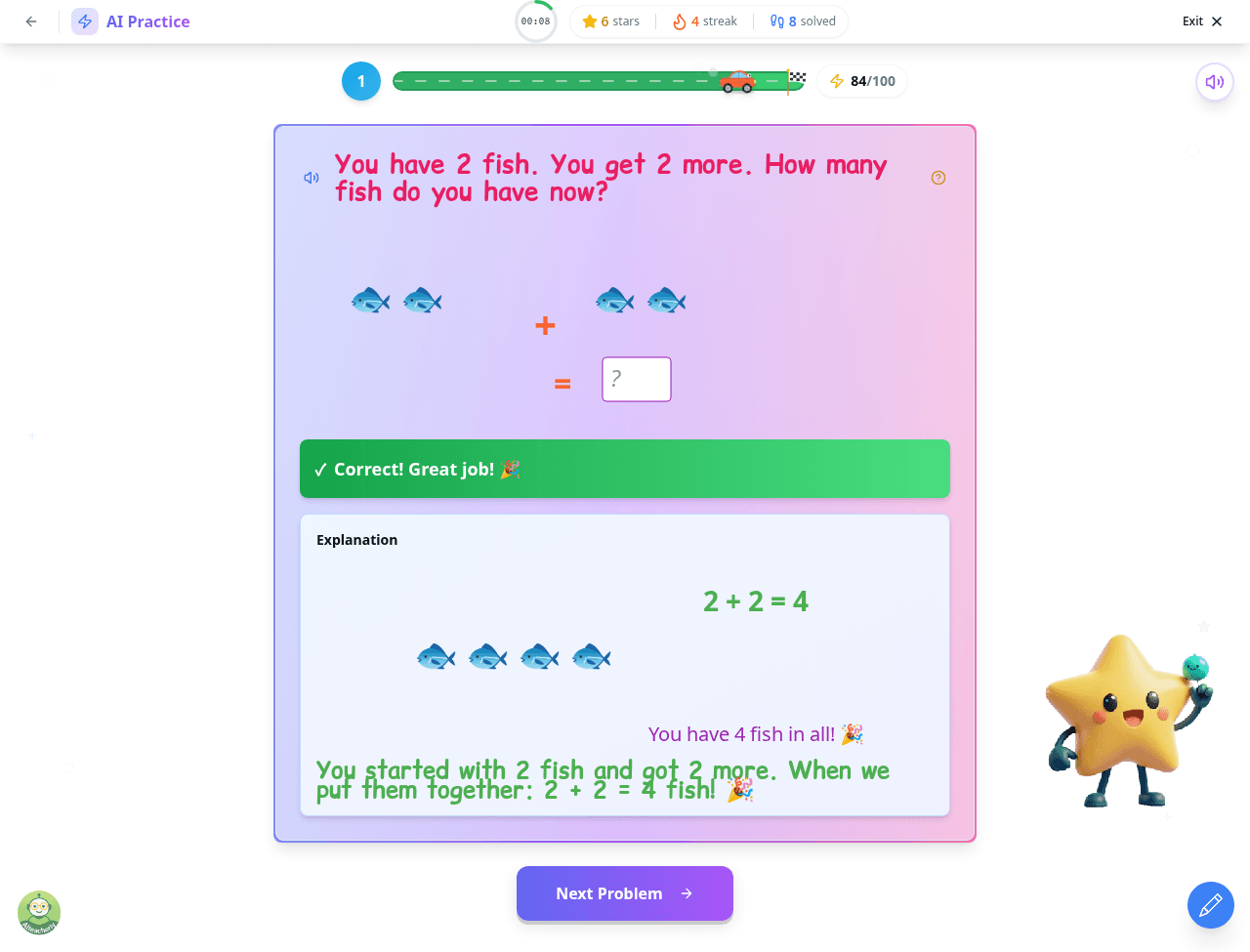
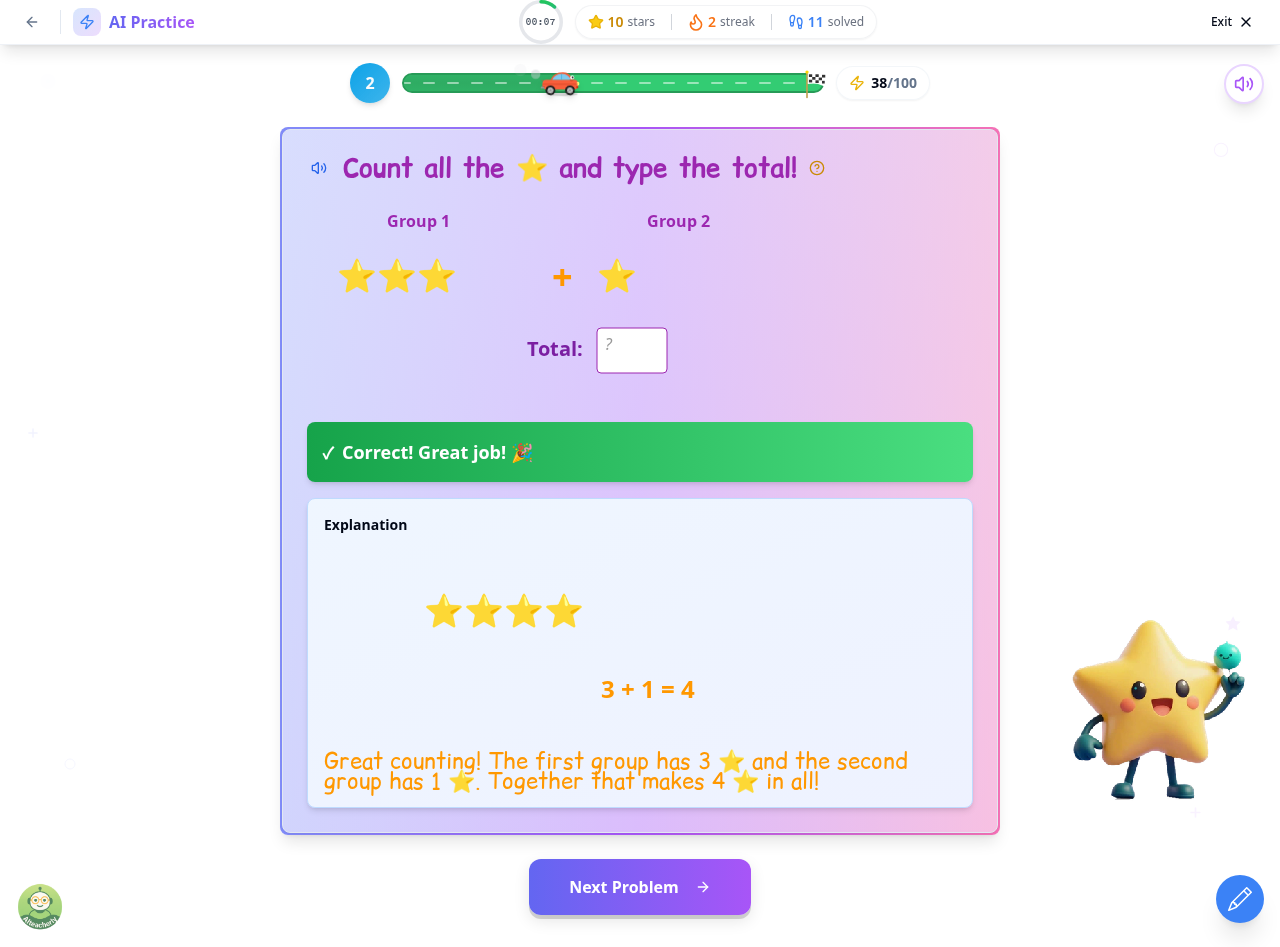
The interactive problem below shows exactly how this step-by-step approach works in practice, with colorful visuals that keep kindergarteners engaged.
5 Everyday Objects Perfect for Addition Practice at Home
You don't need to buy special math manipulatives. The best addition tools are items your child already loves and recognizes. Here are five categories of everyday objects that work beautifully for kindergarten addition practice:
1. Snacks (The Ultimate Motivator)
Goldfish crackers, grapes, cereal pieces, or raisins work perfectly. Bonus: your child gets to eat the math when you're done! "You have 2 goldfish. I'm giving you 2 more. How many do you have now?"
2. Toys They Already Play With
Lego bricks, toy cars, action figures, dolls, or stuffed animals. Use what your child naturally gravitates toward. "Your 3 dinosaurs want to play with these 2 dinosaurs. How many dinosaurs will be playing together?"
3. Art Supplies
Crayons, markers, stickers, or playdough balls. These are colorful, easy to count, and already part of your routine. "Let's put 4 red stickers here and 1 blue sticker here. How many stickers altogether?"
4. Nature Finds
Leaves, acorns, small rocks, or shells collected from outdoor play. This connects math to exploration and makes practice feel like an extension of their adventures.
5. Household Items
Spoons, buttons, coins, or socks (matching socks is secretly math!). These work great for spontaneous practice during everyday moments.
Pro tip: Keep numbers small when starting out. Sums of 5 or less are developmentally appropriate for kindergarteners and build confidence before tackling bigger numbers.
Why Starting With Small Numbers (Sums to 5) Matters
It's tempting to move quickly through addition once your child "gets it." But there's a research-backed reason why kindergarten curricula focus heavily on sums to 5 before moving to larger numbers.
Cognitive Load and Working Memory
Young children's working memory is still developing. When they're trying to hold "2" in their mind, add "3," and track the counting, there's a lot happening neurologically. Keeping sums small reduces cognitive load and lets them focus on understanding the concept rather than struggling with the counting.
Building Confidence First
Math anxiety often starts in early childhood when children feel rushed or overwhelmed. By mastering small sums thoroughly, your child develops genuine confidence. They feel like a "math person" because they experience success consistently.
The Foundation for Larger Numbers
Every larger addition problem builds on the patterns learned with small numbers. A child who truly understands that 2 + 3 = 5 will later recognize that 12 + 3 = 15 uses the same pattern. The small-number foundation pays dividends for years.
Signs Your Child Is Ready for Bigger Numbers
Move beyond sums of 5 when your child can:
- Combine groups and state the total without counting every object individually
- Recognize small quantities "at a glance" (this is called subitizing)
- Create their own addition stories using the correct language
- Show genuine enthusiasm for "harder" problems
There's no rush. Solid understanding of sums to 5 is more valuable than shaky familiarity with sums to 10.
See How Interactive Addition Lessons Work
While hands-on practice at home is irreplaceable, interactive digital lessons can reinforce and extend your child's learning in engaging ways. The best educational platforms mirror the same concrete-to-abstract progression that works at home.
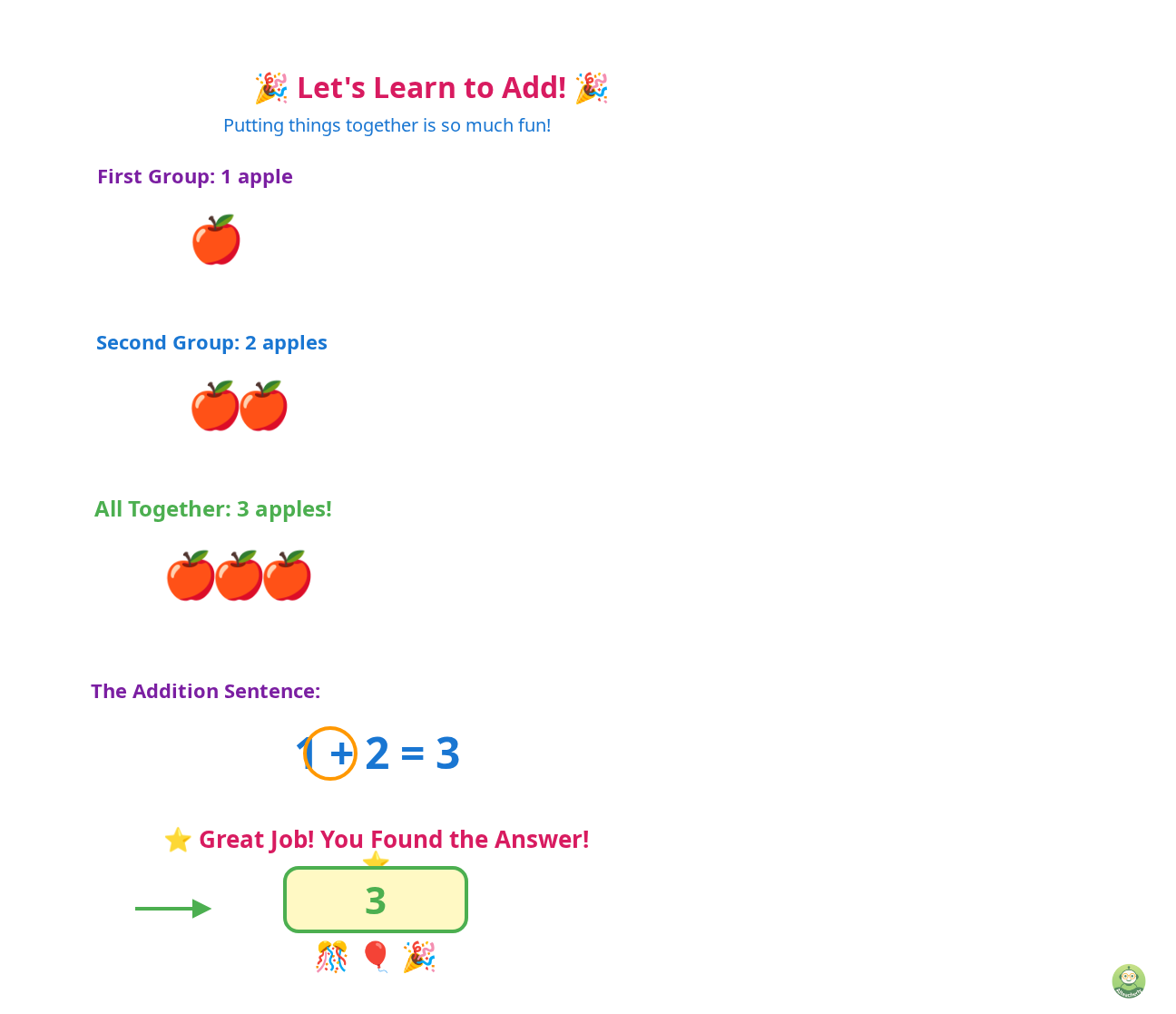
On AI Teacherly, the Introduction to Addition lesson for Kindergarten follows exactly the teaching approach we've discussed:
- Visual object grouping where children see two sets of colorful items
- Combining animations that show objects coming together
- Counting activities where children tap or drag to count the total
- Addition sentence reveals that connect the physical action to symbols
- Practice problems with immediate feedback and encouragement
Here's what the full interactive lesson looks like on AI Teacherly:
The advantage of interactive lessons is immediate feedback. When your child selects an answer, they know right away if they're on track. This prevents practicing errors and keeps motivation high.
Plus, the colorful visuals and game-like format mean your child sees math practice as screen time they want, not homework they're forced to do.
Blending Home Practice and Digital Learning
The most effective approach combines both:
- Hands-on practice for building conceptual understanding
- Interactive lessons for reinforcement and varied practice
- Real-world connections throughout the day ("We need 2 forks and 3 spoons. How many utensils is that?")
This multi-modal approach ensures your child encounters addition in many contexts, strengthening their understanding from every angle.
Key Takeaways for Teaching Kindergarten Addition
Before you close this tab and grab some crackers for your first addition session, here's a quick summary of everything we've covered:
- Addition means "putting together" and that's exactly how you should explain it to your 5-year-old
- Concrete before abstract is the golden rule; physical objects come before symbols and equations
- Follow the 5-step progression: count each group, combine, count total, name what happened, then (optionally) show the number sentence
- Everyday objects work better than fancy manipulatives because they're familiar, accessible, and make math feel like play
- Keep sums to 5 or less when starting out to build confidence and reduce cognitive overwhelm
- Interactive lessons can reinforce home practice with engaging visuals and immediate feedback
- There's no rush to move to bigger numbers; mastery of small sums creates the foundation for all future math
Remember, you're not trying to create a math prodigy. You're helping your child see that math is something they can do, something that makes sense, and (best of all) something that can be fun. Those early positive experiences matter more than any specific skill.
Key Takeaways
- Addition means 'putting together' — explain it exactly that way to your kindergartener
- Always use physical objects before introducing symbols like + and =
- Follow the 5-step progression: count groups, combine, count total, name it, then show the equation
- Everyday items (snacks, toys, crayons) work better than fancy math manipulatives
- Keep sums to 5 or less when starting to build confidence without overwhelm
- Short, playful sessions (5-10 minutes) are more effective than long practice
- Interactive digital lessons can reinforce and extend hands-on home practice
Frequently Asked Questions
What age should children start learning addition?
Most children are ready between ages 4 and 6. Start when your child can count to 10 reliably and understands that numbers represent quantities. Kindergarten (age 5-6) is typically when formal addition instruction begins.
How do I explain addition to my kindergartener?
Use the phrase "putting together." Show two groups of objects, combine them physically, and count the total together. Say "Adding means putting things together to see how many we have." Keep it concrete before introducing symbols.
What are the best objects to use for teaching addition at home?
Snacks (crackers, grapes), small toys (Legos, toy cars), art supplies (crayons, stickers), and household items (spoons, buttons) all work great. Choose objects your child already loves to make practice engaging and familiar.
How long should addition practice sessions be for a 5-year-old?
Keep sessions short: 5 to 10 minutes maximum. Young children learn best in brief, focused bursts. Multiple short sessions throughout the week are more effective than one long practice session.
Is it normal for kindergarteners to use fingers to add?
Absolutely! Finger counting is a healthy, developmentally appropriate strategy. It provides a physical reference that supports mental calculation. Children naturally move away from finger counting as their number sense develops.
Why should addition start with small numbers like sums to 5?
Small sums reduce cognitive load, allowing children to focus on understanding the concept rather than struggling with counting. Mastering sums to 5 builds confidence and creates a solid foundation for larger numbers later.
How do I know if my child is ready for addition?
Signs of readiness include: counting to 10 reliably, understanding that numbers represent quantities (not just words in a sequence), showing interest in "how many" questions, and being able to compare which group has more.
What comes after my child masters basic addition?
Once your child confidently adds sums to 5, gradually introduce sums to 10. Then explore addition word problems, missing addend problems (2 + ? = 5), and eventually the relationship between addition and subtraction.
Ready to make addition fun for your kindergartener? Try AI Teacherly's interactive Introduction to Addition lesson free and watch your child discover the joy of math!