Teach Your Kindergartener to Count to 5: The One-to-One Trick That Makes Numbers Click
Discover the one-to-one correspondence trick that transforms your kindergartener's number reciting into real counting skills. Simple touch-and-count strategies for parents.
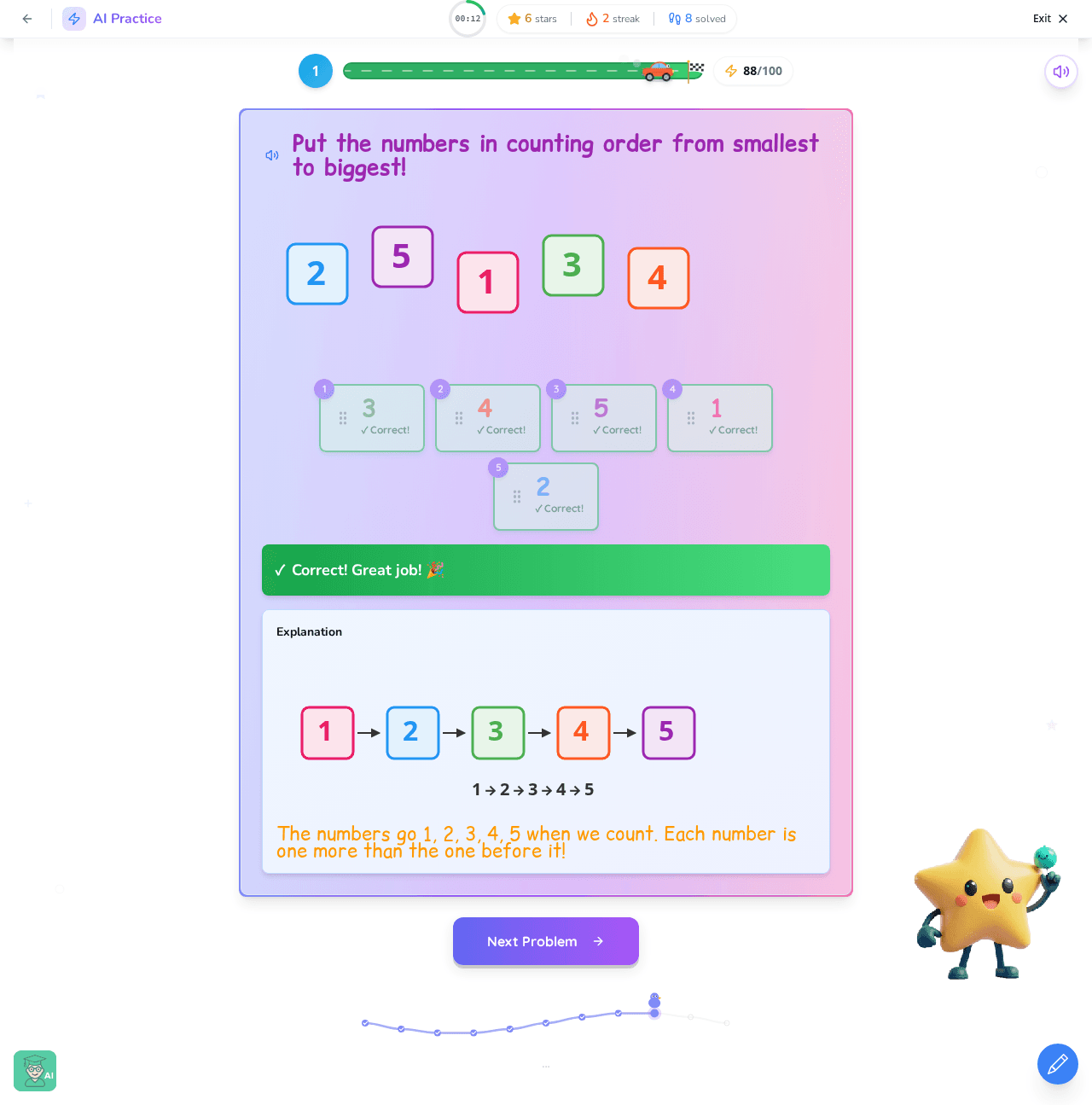
The Counting Skill That Makes Everything Click
Your kindergartener can recite "one, two, three, four, five" perfectly. They've memorized the sequence, maybe even sung it in a catchy song. But when you ask them to count the apples on the table, something goes wrong. They skip objects, count the same one twice, or land on a different number each time.
Sound familiar? You're not alone, and here's the reassuring truth: this isn't a sign of trouble. It's actually a normal developmental stage that reveals something important. Your child has learned to recite numbers, but they haven't yet mastered the hidden skill that transforms reciting into real counting.
That skill is called one-to-one correspondence, and once your kindergartener grasps it, counting to 5 (and beyond) becomes almost effortless. In this guide, you'll learn exactly what one-to-one correspondence means, why it matters so much for early math success, and simple strategies you can use at home to help your child master counting to 5 with confidence.
What Is One-to-One Correspondence and Why Does It Matter?
One-to-one correspondence is a foundational math concept that sounds complicated but is actually quite simple: it means assigning exactly one number to each object when counting. Your child touches (or points to) one object, says one number, then moves to the next object and says the next number.
Why is this so important? Because without one-to-one correspondence, counting is just reciting words. A child who hasn't developed this skill might:
- Count faster than they point, saying "1, 2, 3" while only touching two objects
- Point faster than they count, touching three objects while only saying "1, 2"
- Skip objects or count the same object multiple times
- Give different answers each time they count the same group
One-to-one correspondence is the bridge between knowing number words and actually understanding quantity. Research shows that children who master this skill early have stronger number sense and perform better in math throughout elementary school.
The good news? Most kindergarteners develop one-to-one correspondence naturally with practice, and there are simple ways to speed up this process at home.
Why Do Kindergarteners Skip Numbers or Count Objects Twice?
When your child counts four toys and confidently announces "five!" it can be confusing for parents. Is this a learning problem? Should you be worried?
In most cases, these counting errors are completely normal and have simple explanations:
Their hands and mouths aren't synchronized yet. Counting requires coordinating two separate actions: pointing and speaking. Young children are still developing this motor-language coordination, so their pointing often gets out of sync with their counting.
They don't understand the "last number rule." Here's a secret that seems obvious to adults but is actually a major discovery for children: the last number you say tells you how many objects there are in total. Until children grasp this concept, they might just keep counting or randomly pick a number.
Moving objects are harder to track. If your child is counting objects that roll around (like grapes) or that look similar (like a pile of blocks), they may lose track of which ones they've already counted.
They're excited and rushing. Kindergarteners often want to show off their counting skills quickly, which leads to skipping ahead.
Understanding why these mistakes happen is the first step. The next step is using the touch-and-count method to help your child build the coordination and understanding they need.
How to Teach the Touch-and-Count Method at Home
The touch-and-count method is exactly what it sounds like: your child physically touches each object as they say each number. This simple technique builds the motor-language coordination that's essential for accurate counting.
Here's how to teach it:
Start with just a few objects. Begin with 2 or 3 items before working up to 5. Using fewer objects reduces cognitive load and helps your child focus on the coordination.
Use large, stable objects. Start with items that don't roll or move easily, like blocks, stuffed animals, or books. This eliminates the challenge of tracking moving targets.
Model the behavior first. Show your child how you touch each object firmly while saying the number slowly: "Watch me. Touch... one. Touch... two. Touch... three."
Guide their hand. Gently hold your child's hand and help them touch each object as you count together. This physical guidance helps them internalize the rhythm.
Emphasize the last number. After counting, always highlight the total: "We counted three bears! The last number tells us how many."
The interactive activity below demonstrates exactly how this touch-and-count method works in practice, giving children guided practice with immediate feedback.
Make it a game, not a test. Count during everyday moments: "Let's count how many crackers are on your plate!" Keep it playful and pressure-free.
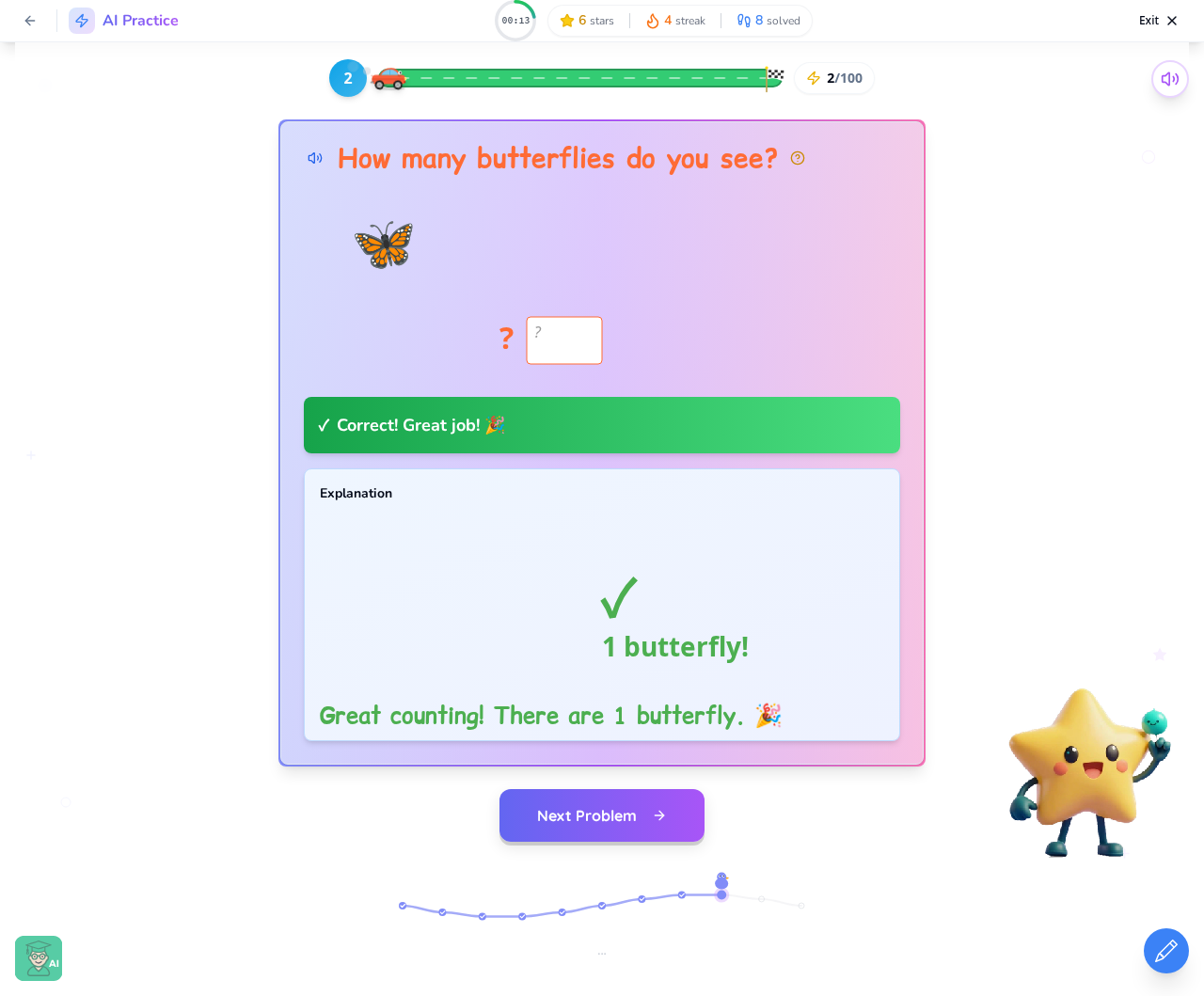
See How Interactive Counting Practice Works
While at-home practice with physical objects is wonderful, interactive digital lessons can reinforce counting skills in a uniquely effective way. Here's why:
Immediate feedback matters. When a child counts incorrectly on a worksheet, they might not know until later (if ever). Interactive lessons provide instant, gentle correction that helps children self-correct in the moment.
Visual highlighting reinforces one-to-one correspondence. Good digital counting activities highlight each object as the child counts it, making the connection between number and object crystal clear.
Guided practice builds confidence. The best lessons start with demonstration, then guided practice, then independent practice, building skills progressively.
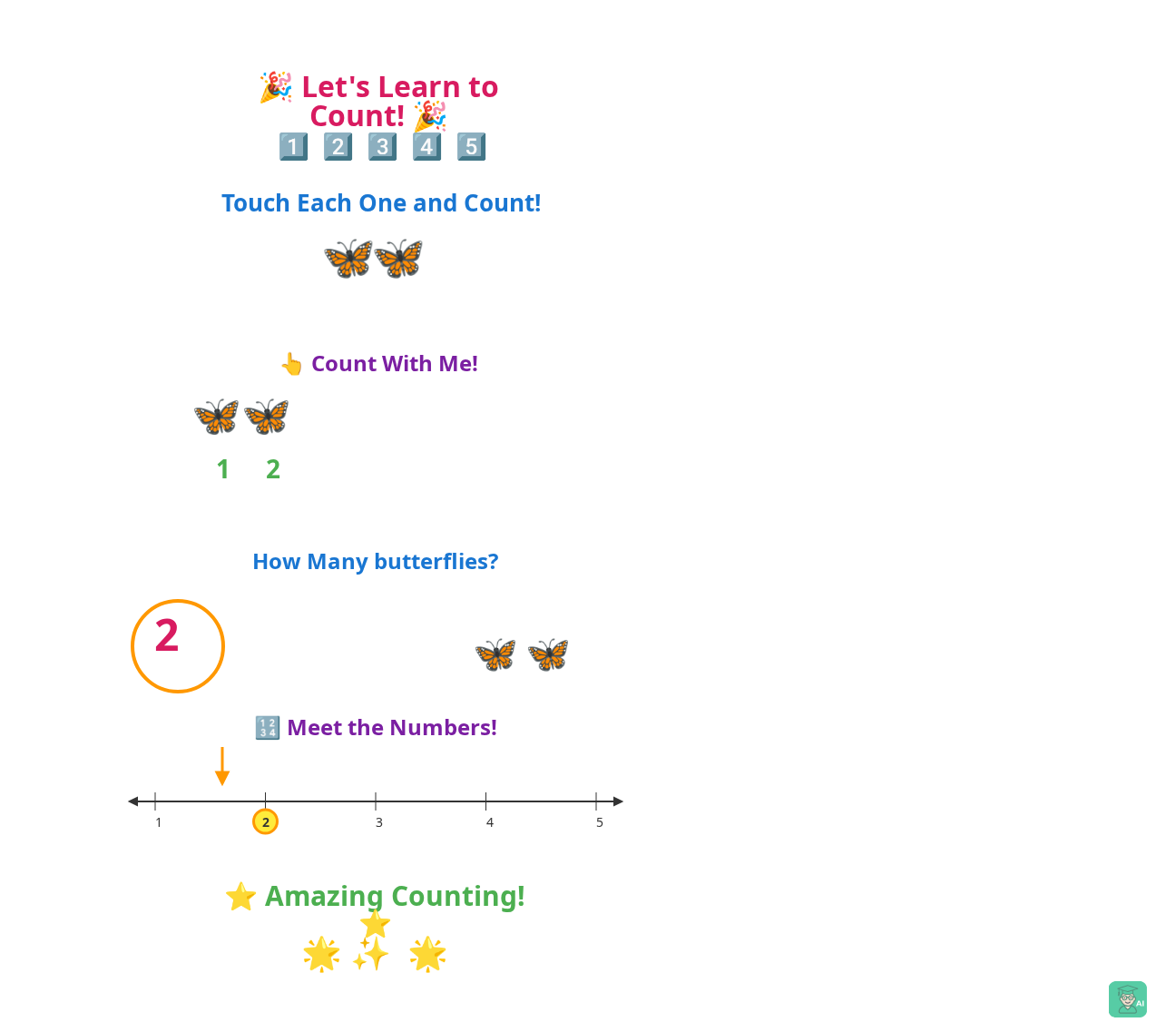
Here's what the full interactive lesson looks like on AI Teacherly:
In the Learn to Count to 5 lesson on AI Teacherly, kindergarteners practice the touch-and-count method through engaging activities that adapt to their skill level. The lesson includes:
- Interactive demonstrations where an animated guide shows the touch-and-count technique
- Guided counting practice where children tap each object while hearing the number
- The "last number rule" reinforced through celebration moments: "The last number tells us how many!"
- Progressive challenges that build from counting 2 objects up to 5
This combination of at-home practice with hands-on objects plus interactive digital reinforcement creates the strongest foundation for counting mastery.
Simple Everyday Activities to Practice Counting to 5
The best counting practice doesn't feel like practice at all. Here are everyday moments you can turn into counting opportunities:
During meals:
- Count crackers, grapes, or carrot sticks before eating
- Count place settings as you set the table
- Count ice cubes as you add them to a glass
During play:
- Count blocks as you stack them
- Count toy cars as you line them up
- Count steps on the staircase (stop at 5 for now!)
During daily routines:
- Count buttons as you button a shirt
- Count fingers during handwashing ("Let's scrub each finger: 1, 2, 3, 4, 5!")
- Count books at bedtime before choosing one to read
Make it physical:
- Do 5 jumping jacks, counting each one
- Clap hands 5 times with your child
- Take 5 giant steps across the room
Pro tip: When your child counts incorrectly, don't just say "no" or give the right answer. Instead, count together: "Let's count these again together, nice and slow." This models the correct technique without making mistakes feel like failures.
Consistency matters more than duration. Five minutes of counting practice scattered throughout your day is more effective than a 20-minute "counting lesson" that feels like work.
Common Counting Mistakes and How to Gently Correct Them
Every kindergartener makes counting mistakes. Here's how to address the most common ones without creating frustration or anxiety:
Mistake: Counting the same object twice
- What to do: Arrange objects in a line instead of a cluster. Say, "Let's put them in a row so we can count each one."
- Why it helps: Linear arrangement makes it visually clear which objects have been counted.
Mistake: Skipping objects
- What to do: Slow down and physically move each object to a "counted pile" after counting it.
- Why it helps: Creating two groups (counted vs. uncounted) provides a physical system for tracking.
Mistake: Saying numbers out of order
- What to do: Count together regularly, emphasizing the sequence. Sing counting songs that reinforce the order.
- Why it helps: Repetition strengthens sequence memory, which must be automatic for counting to work.
Mistake: Giving a random answer for "how many?"
- What to do: After counting, point to the last object and say, "We stopped at [number]. That means there are [number] altogether!"
- Why it helps: This explicitly teaches the cardinal principle (last number = total quantity).
What NOT to do:
- Don't express frustration or disappointment
- Don't drill counting when your child is tired or resistant
- Don't compare your child to siblings or classmates
Remember: mistakes are learning opportunities, not failures. Every correction is building neural pathways for counting success.
Key Takeaways
- One-to-one correspondence (touching each object while saying one number) is the hidden skill that transforms number reciting into real counting
- Counting mistakes like skipping objects or counting twice are normal and fixable with the touch-and-count method
- The 'last number rule' is a major discovery for children: the final number tells how many objects total
- Start with 2-3 stable objects before building up to 5, and guide your child's hand to establish the rhythm
- Everyday moments (mealtimes, play, routines) offer natural counting practice that doesn't feel like work
- Interactive lessons provide immediate feedback that helps children self-correct counting errors in real time
- Consistency beats intensity: five scattered minutes of counting practice daily is better than long drilling sessions
Frequently Asked Questions
What is one-to-one correspondence in counting?
One-to-one correspondence means assigning exactly one number to each object when counting. Your child touches one object, says one number, then moves to the next. It's the skill that connects number words to actual quantities.
At what age should my child be able to count to 5?
Most children can count to 5 with one-to-one correspondence by age 4-5. However, development varies widely. If your kindergartener is still working on this skill, that's completely normal with regular practice.
Why does my kindergartener skip numbers when counting?
Skipping usually happens when a child's pointing gets ahead of their speaking, or they lose track of which objects they've counted. Using stable objects in a line and slowing down helps synchronize their hand and voice.
How can I practice counting at home without worksheets?
Turn everyday moments into counting games: count crackers at snack time, buttons while dressing, steps on stairs, or toys during cleanup. Keep it playful and brief, aiming for natural moments rather than formal practice sessions.
What's the difference between reciting numbers and actually counting?
Reciting is saying number words in order (like singing the alphabet). Actual counting means assigning each number to one specific object and understanding that the last number represents the total quantity.
Should I correct my child when they count wrong?
Yes, but gently. Instead of saying 'wrong,' count together: 'Let's count these again, nice and slow.' Model the touch-and-count method. This teaches the correct technique without creating anxiety about mistakes.
How long does it take to master counting to 5?
With consistent daily practice (just 5-10 minutes spread throughout the day), most kindergarteners show significant improvement within 2-4 weeks. Mastery timeline varies by child, so focus on progress rather than speed.
Is online counting practice effective for kindergarteners?
Yes, when combined with hands-on practice. Interactive lessons provide immediate feedback and visual highlighting that reinforces one-to-one correspondence. The best approach combines physical counting at home with digital practice.
Ready to give your kindergartener interactive counting practice with instant feedback? Try the free Learn to Count to 5 lesson on AI Teacherly and watch the touch-and-count method click!