Teach Multiplication on a Number Line: A Visual Guide for 2nd Grade Parents
Turn multiplication anxiety into mastery with the number line method. Learn how visual "jumping" helps 2nd graders understand times tables before memorizing them.
Why Number Lines Make Multiplication Click for 2nd Graders
If your 2nd grader freezes up when they hear the word "multiplication," you're not alone. Many children find the concept intimidating because it feels abstract and disconnected from anything they can see or touch. But here's the good news: your child doesn't need to memorize times tables yet. What they need first is to understand what multiplication actually means.
That's where the number line method comes in. By turning multiplication into a series of visible "jumps" along a line, this approach transforms an abstract math operation into something concrete and visual. Your child can literally count the hops and see where they land. It connects multiplication to counting and addition, which are skills they already have.
In this guide, you'll learn exactly how to teach multiplication on a number line to your 2nd grader, why this visual approach works so well for young learners, and how you can practice it at home with zero special materials. Whether your child is a visual learner, a kinesthetic learner, or just needs math to feel less scary, the number line method is a game-changer.
What Is the Number Line Method for Multiplication?
The number line method teaches multiplication by showing it as repeated equal jumps. Instead of memorizing that 3 × 4 = 12, your child sees three jumps of four spaces each on a number line, landing on 12.
Here's the core concept broken down:
- Start at zero on the number line
- Make jumps of equal size (this is the number being multiplied)
- Count how many jumps you make (this is the multiplier)
- Where you land is the answer (the product)
So for 3 × 4, your child starts at 0, makes 3 jumps of 4 spaces each (landing on 4, then 8, then 12), and discovers the answer is 12.
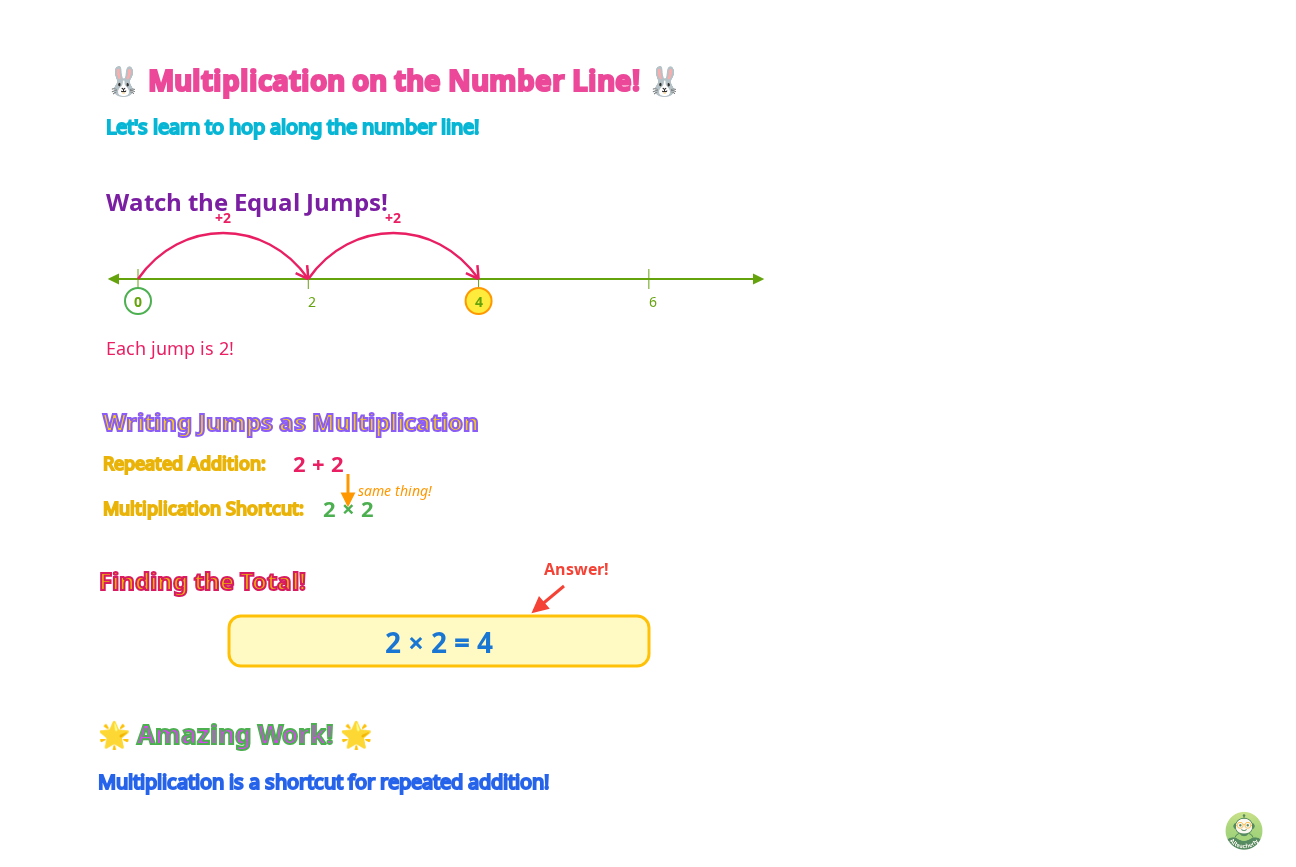
This method works because it builds on what 2nd graders already know: counting and adding. Multiplication is just a shortcut for repeated addition. Instead of writing 4 + 4 + 4 = 12, we write 3 × 4 = 12. The number line makes this connection visible.
The beauty of this approach is that it creates a mental model your child can carry with them. Even when they're not looking at a physical number line, they can visualize those equal jumps in their mind. This foundational understanding prevents confusion later when they encounter fractions, division, and more complex multiplication problems.
How Does 'Groups Of' Connect to Multiplication?
Before your child can master the number line method, they need to understand one key phrase: "groups of." This simple concept is the bridge between counting and multiplication.
When we say 3 × 4, we're really saying "3 groups of 4." On the number line, each jump represents one group. Three jumps of 4 means three groups of 4.
Here's how to explain it to your child:
Use everyday examples first:
- "If you have 3 bags with 4 apples in each bag, how many apples do you have?" (3 groups of 4)
- "If we take 4 steps, 3 times, how far have we walked?" (3 groups of 4 steps)
Then connect it to the number line:
- "Each jump is like one group. We're making 3 jumps, and each jump is worth 4."
- "So 3 jumps of 4 lands us on... let's count together!"
The "groups of" language helps children see that multiplication isn't a mysterious new operation. It's just a faster way to add the same number over and over again. When your child understands this, the number line becomes intuitive: each jump is a group, and counting jumps tells us how many groups we have.
This conceptual foundation is crucial. Research shows that children who understand why multiplication works (not just how to do it) perform better on problem-solving tasks and retain their math skills longer.
See Number Line Multiplication in Action
Let's walk through exactly what number line multiplication looks like in practice. Understanding the visual representation helps you guide your child through the process step by step.
Imagine a number line from 0 to 20. For the problem 4 × 3 (or "4 jumps of 3"), here's what happens:
- Start at 0 on the number line
- First jump: Move 3 spaces forward, landing on 3
- Second jump: Move another 3 spaces, landing on 6
- Third jump: Move 3 more spaces, landing on 9
- Fourth jump: Move 3 more spaces, landing on 12
The answer: 4 × 3 = 12
Notice how each jump is exactly the same size. That's the key insight: equal jumps, equal groups. Your child isn't just getting the right answer; they're seeing why the answer is 12.
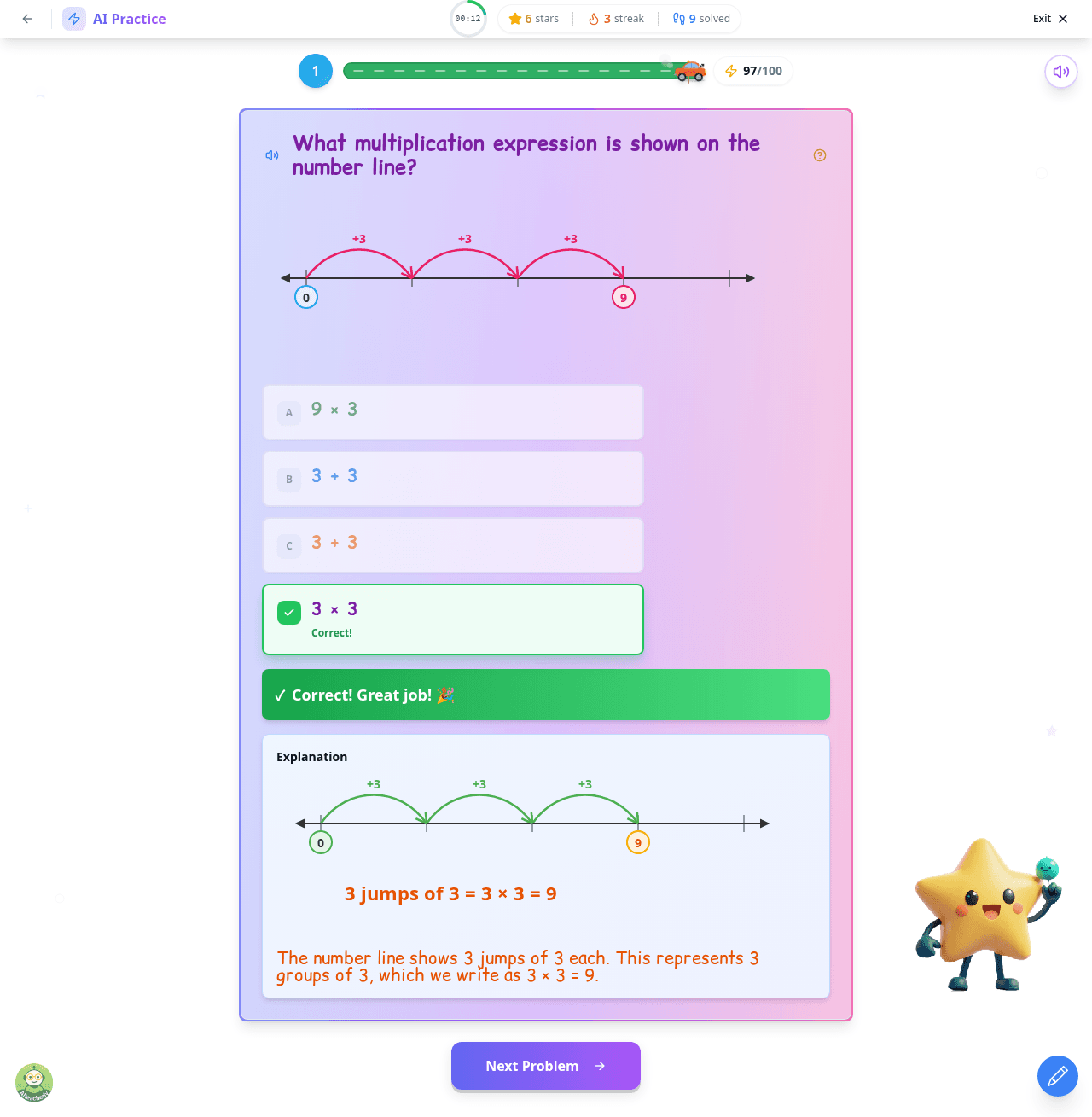
The interactive problem below shows exactly how this works in practice:
What to point out to your child:
- Count the jumps together (that's the first number)
- Notice that each jump is the same size (that's the second number)
- Where did we land? (that's our answer!)
This visual approach is especially powerful for children who struggle with abstract symbols. Instead of seeing "4 × 3 = ?" as a mysterious equation, they see a journey along the number line with a clear destination.
3 Easy Ways to Practice Number Line Jumps at Home
You don't need fancy materials to practice number line multiplication with your 2nd grader. Here are three simple, hands-on activities you can do at home:
1. The Tape Number Line Use painter's tape to create a number line on your floor (0 to 30 works well). Call out multiplication problems and have your child physically jump along the line. "Show me 3 times 5!" They make 3 jumps, each covering 5 tape marks. Where did they land? 15!
This kinesthetic approach is perfect for wiggly kids who learn best by moving their bodies.
2. Sidewalk Chalk Challenge Draw a number line on your driveway or sidewalk. Take turns giving each other multiplication challenges. Make it a game: "Can you show me 2 times 6 in the fewest jumps possible?" This adds a strategic element that keeps practice engaging.
3. Staircase Multiplication If you have stairs, number them 1 through 10 (or higher). Ask your child to climb in equal jumps. "If you go up 2 stairs at a time, and you do that 4 times, where do you end up?" They'll discover 2 × 4 = 8 by climbing!
Pro tip: Always ask your child to explain their thinking. "How many jumps did you make? How big was each jump? So what multiplication sentence did we just solve?" This verbal explanation cements understanding and builds math vocabulary.
How AI Teacherly Makes Multiplication Visual and Fun
While home practice is valuable, interactive digital lessons can reinforce the number line method with immediate feedback and engaging visuals your child will love.
The Multiplication on the Number Line lesson on AI Teacherly is specifically designed for 2nd graders learning multiplication for the first time. Here's what makes it effective:
Visual learning at its best: The lesson shows animated number line jumps that bring the concept to life. Your child sees each jump happen in real time, making the connection between "groups of" and the multiplication answer crystal clear.
Step-by-step guidance: Instead of jumping straight to problems, the lesson explains that "multiplication is just a quicker way to add the same number over and over again." It builds understanding before asking for answers.
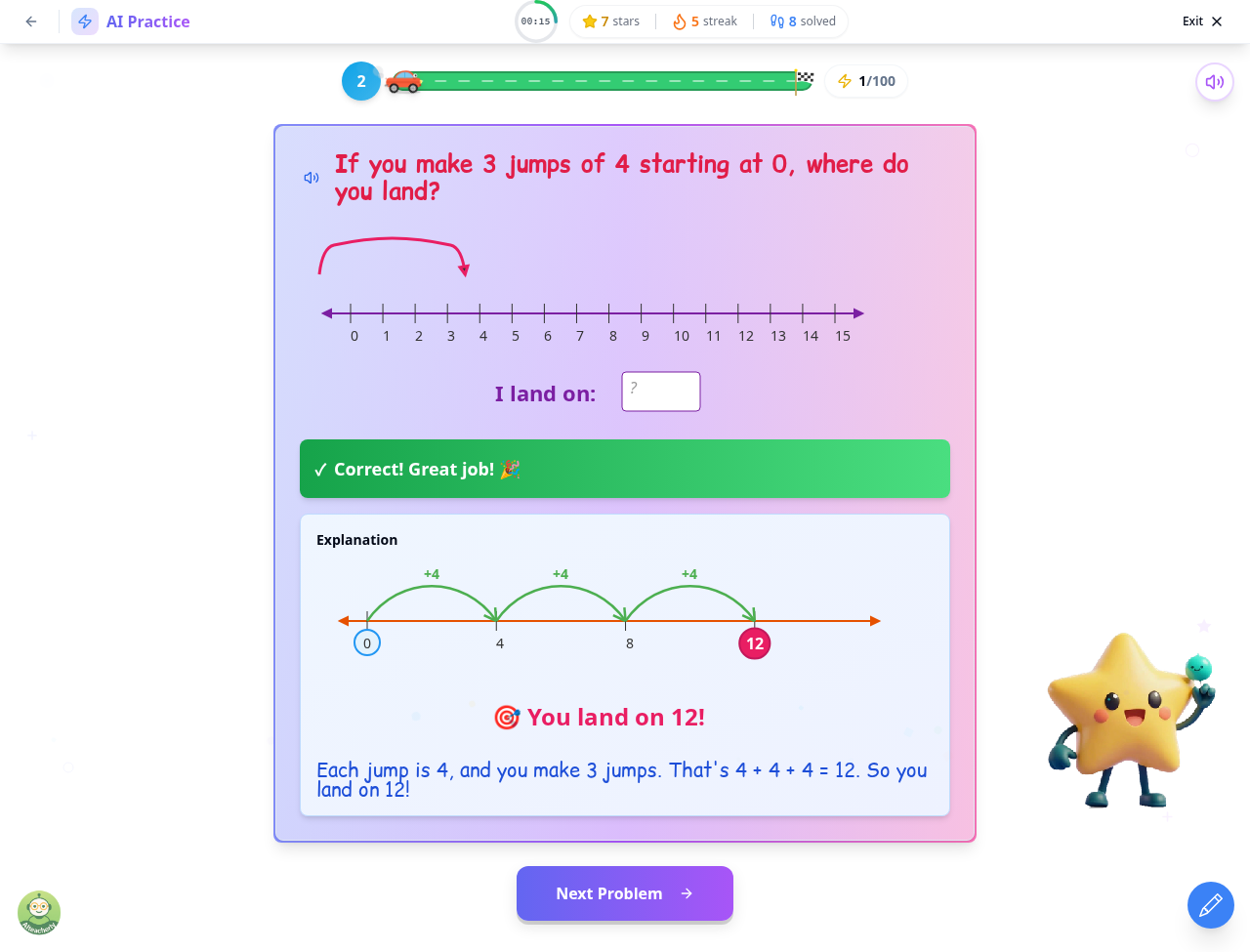
Interactive practice: Your child doesn't just watch; they participate. They identify where jumps land, match number line visuals to multiplication expressions, and build confidence through hands-on digital practice.
Here's what the full interactive lesson looks like on AI Teacherly:
Multiple problem types: The lesson includes different question formats (multiple choice, fill-in-the-blank, selection) to keep practice varied and engaging. Each problem reinforces the same core concept: multiplication is equal jumps on a number line.
The immediate feedback loop is especially valuable. When your child makes a mistake, they see why right away, which prevents wrong thinking from becoming a habit.
Key Takeaways
- The number line method teaches multiplication as equal jumps, connecting it to skills your 2nd grader already has (counting and addition)
- Understanding "groups of" is the key concept: 3 × 4 means "3 groups of 4" or "3 jumps of 4 on the number line"
- Visual and kinesthetic learners especially benefit from seeing and physically acting out multiplication
- You can practice at home with tape, sidewalk chalk, or even your staircase (no special materials needed)
- Building conceptual understanding now prevents confusion with fractions and division later
- Interactive digital practice with immediate feedback reinforces learning and builds confidence
Frequently Asked Questions
What is the number line method for teaching multiplication?
The number line method shows multiplication as equal-sized jumps starting from zero. For 3 × 4, make 3 jumps of 4 spaces each. Where you land (12) is the answer. It makes multiplication visual and connects it to counting.
How do I explain multiplication to a 2nd grader who doesn't get it?
Start with "groups of" language and real objects. 3 × 4 means "3 groups of 4 things." Use toys, snacks, or a number line to make it visual. Avoid memorization until they understand the concept.
Is using a number line better than memorizing times tables?
For 2nd graders, yes. Number lines build conceptual understanding first. Memorization should come later, after children understand what multiplication means. This foundation makes facts stick better long-term.
What does 'groups of' mean in multiplication?
"Groups of" explains what multiplication represents. 3 × 5 means "3 groups of 5 things" (like 3 bags with 5 apples each). On a number line, each jump is one group. It bridges counting to multiplication.
How can I practice number line multiplication at home without worksheets?
Create a floor number line with tape and have your child physically jump along it. Use sidewalk chalk outdoors. Count stairs in equal jumps. Make it a game with fun challenges and movement.
When should my child start learning multiplication?
Most children are introduced to multiplication concepts in 2nd grade through visual models and equal groups. Formal times table memorization typically begins in 3rd grade after conceptual understanding is established.
Why do some kids struggle with multiplication?
Often because it's taught too abstractly too soon. Children need to see and understand "groups of" before symbols make sense. Visual methods like number lines bridge the gap between concrete counting and abstract multiplication.
Ready to make multiplication click for your 2nd grader? Try the free interactive Multiplication on the Number Line lesson on AI Teacherly and watch your child discover the joy of visual math learning!