Teach Multiplication on a Number Line: A Visual Guide for 2nd Grade Parents
Discover how number line multiplication helps 2nd graders visualize math through equal jumps. Learn the step-by-step method and simple at-home activities that make multiplication click.
Why Number Lines Make Multiplication Click for Visual Learners
If your 2nd grader can count by 2s or 5s, they're already doing multiplication. They just don't know it yet. The number line method makes this connection click instantly, transforming abstract math into something your child can actually see and understand.
Many parents feel anxious when their child brings home multiplication homework. You might remember memorizing times tables through repetition, but today's classrooms use visual strategies that build deeper understanding. Number line multiplication is one of the most powerful tools in this approach.
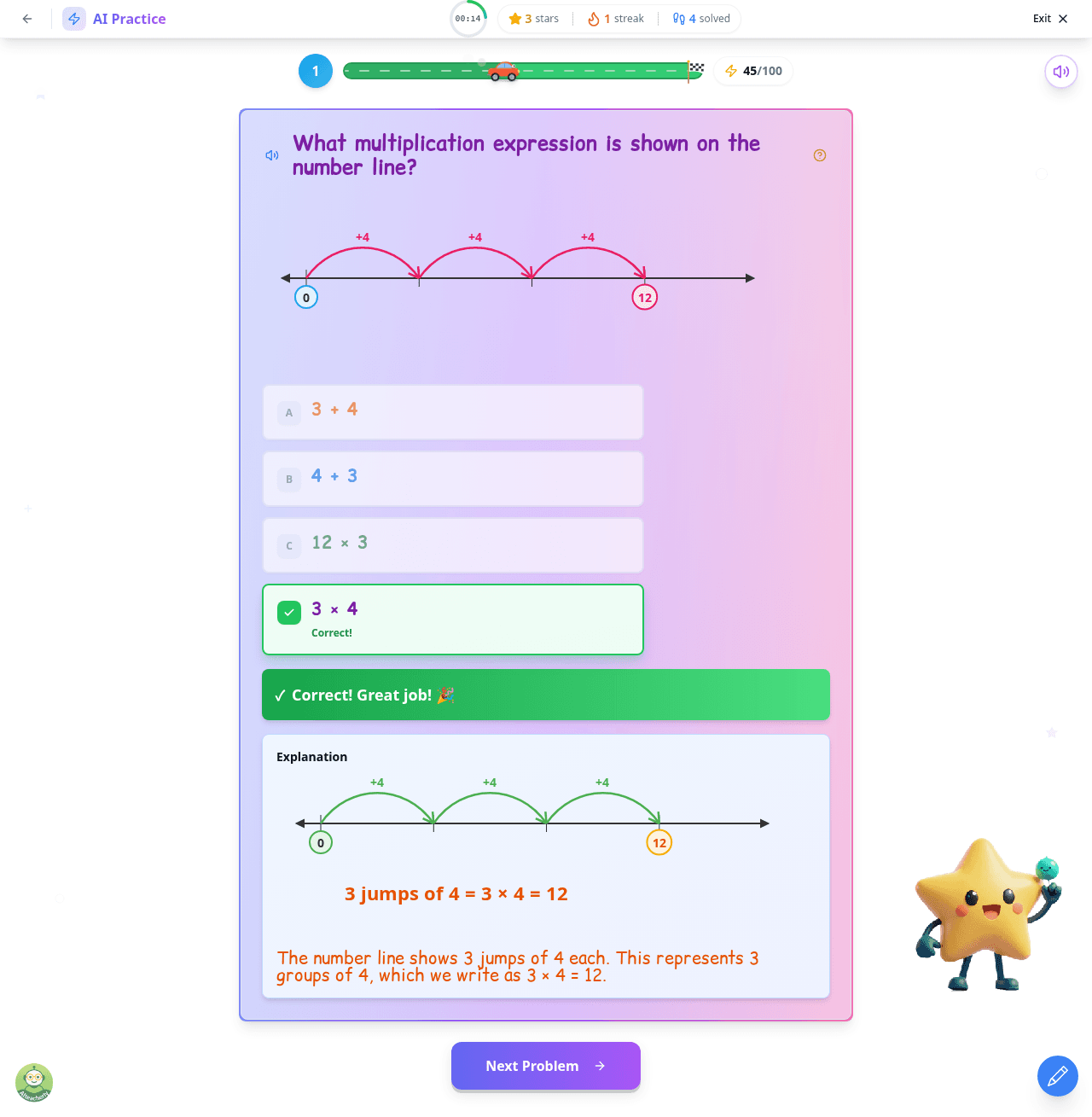
Why does this method work so well? Because it turns an abstract concept into a physical, visual experience. Instead of asking your child to believe that 3 × 4 equals 12, the number line shows them why. Each jump represents a group, and counting the jumps reveals the answer.
This visual foundation is especially important for 2nd graders who are just being introduced to multiplication. Research shows that children who understand the 'why' behind math facts retain information longer and apply it more flexibly than those who simply memorize.
What Is Number Line Multiplication?
Number line multiplication is a visual strategy where multiplication is represented as equal jumps along a number line. Each jump represents one group, and the size of each jump represents how many are in that group.
For example, to show 3 × 4 (three groups of four):
- Start at zero on the number line
- Make 3 jumps (that's your first number)
- Each jump is 4 spaces long (that's your second number)
- Where you land is your answer: 12
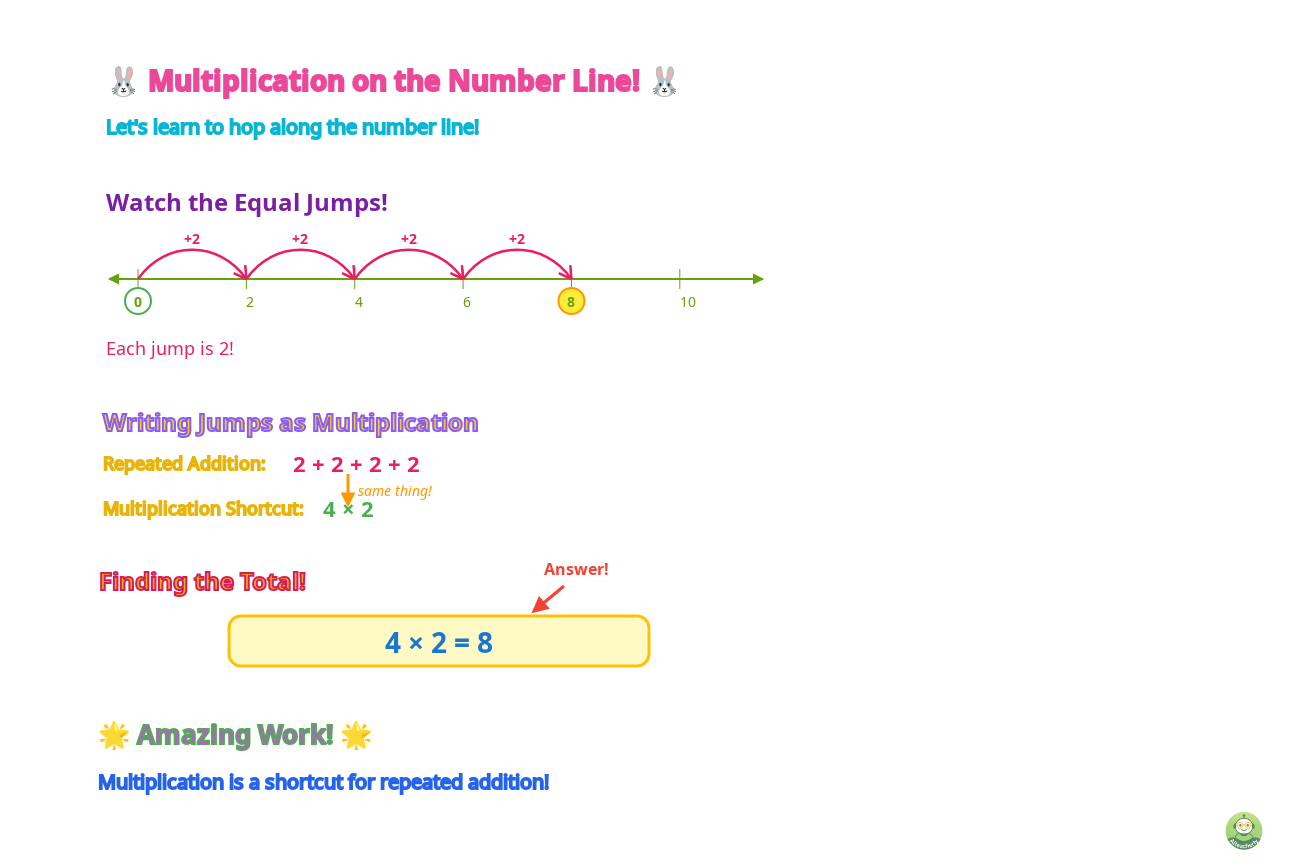
This connects directly to repeated addition. Instead of writing 4 + 4 + 4, your child learns that multiplication is simply a faster, more efficient way to express the same idea. As one lesson puts it: "Multiplication is just a quicker way to add the same number over and over again."
The key insight for 2nd graders: Each jump must be the same size. This is the concept of "equal groups" that forms the foundation of all multiplication understanding. When children see that pattern, that every jump lands the same distance apart, they grasp why multiplication works.
How Do You Teach Multiplication on a Number Line?
Teaching multiplication on a number line follows a simple, step-by-step process that builds naturally on skills your 2nd grader already has. Here's how to break it down:
Step 1: Connect to Skip Counting Start with what your child already knows. If they can count by 2s (2, 4, 6, 8...) or by 5s (5, 10, 15, 20...), they're already making equal jumps. Point out that each skip is like one jump on the number line.
Step 2: Draw the Number Line Use paper, a whiteboard, or even tape on the floor. Mark numbers from 0 to at least 20. Physical, larger number lines help younger children see the jumps more clearly.
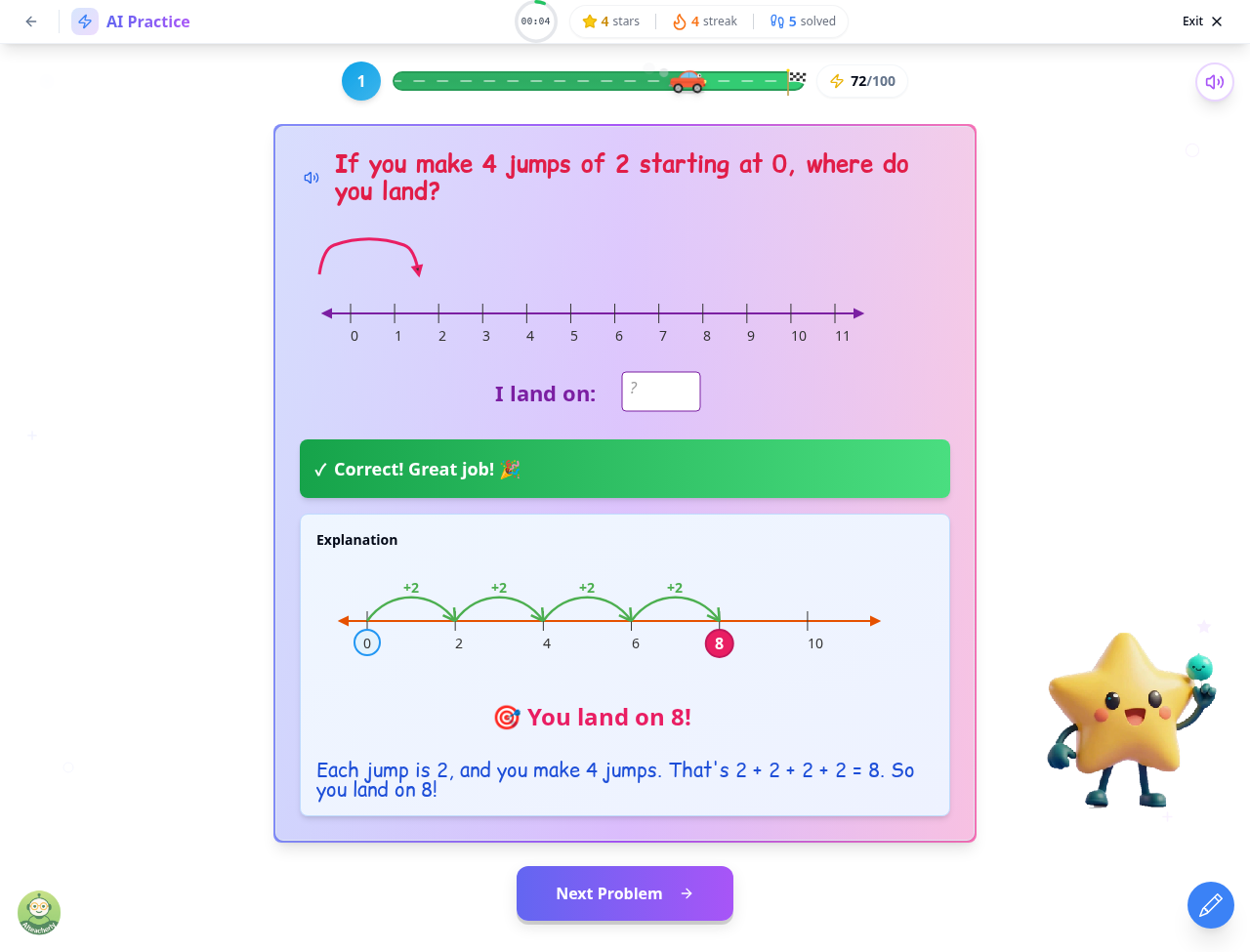
Step 3: Make Equal Jumps For 4 × 3 (four jumps of 3), start at zero and draw arcs showing four equal jumps, each landing 3 spaces ahead: 0 → 3 → 6 → 9 → 12.
Step 4: Connect Jumps to the Multiplication Expression Explain that the number of jumps is written first, and the size of each jump comes after the multiplication sign. So four jumps of 3 becomes 4 × 3.
The interactive problem below shows exactly how this works in practice, with visual jump arcs that students can count and analyze.
Step 5: Celebrate the Pattern Help your child notice that each jump lands the same distance apart. "Each jump is the same every time! That's the pattern, equal jumps." This consistency is what makes multiplication predictable and learnable.
Why 'Groups Of' Is the Key to Multiplication Understanding
Before your child can master times tables, they need to understand what multiplication actually means. That meaning is captured in two simple words: groups of.
When we write 3 × 4, we're really saying "3 groups of 4." The number line makes this visible: three jumps (groups), each covering four spaces (items in each group). Landing on 12 shows the total.
Why is this conceptual understanding so important?
Children who learn "groups of" first can:
- Solve unfamiliar problems by reasoning through them, not just recalling memorized facts
- Understand word problems that describe real-world grouping situations
- Build flexibility to tackle division (which reverses the grouping process)
- Develop number sense that supports all future math learning
Many parents worry when their 2nd grader doesn't know times tables yet. But educators intentionally teach the "groups of" concept before memorization. This sequence matters. A child who understands why 3 × 4 = 12 will remember it more reliably than one who memorized it without context.
The number line reinforces this by making groups visible. Your child doesn't have to imagine 3 groups of 4 objects. They can see three jumps covering four spaces each, landing exactly on 12. That visual proof builds confidence and genuine understanding.
See Number Line Multiplication in Action on AI Teacherly
Interactive digital lessons bring number line multiplication to life in ways that paper worksheets simply can't match. On AI Teacherly, the Multiplication on the Number Line lesson for Grade 2 uses animated visuals and instant feedback to guide students through this foundational concept.
Here's what makes the interactive approach so effective:
Visual Animations Show the Jumps Instead of static images, students see jumps appear one at a time on the number line. This movement emphasizes the "equal groups" concept and helps children predict where they'll land.
Immediate Feedback Builds Confidence When students input an answer or select a choice, they know right away whether they're correct. This rapid feedback loop reinforces understanding and prevents misconceptions from taking root.
Multiple Problem Types Keep Engagement High The lesson includes input problems, multiple choice questions, and selection activities. This variety prevents boredom and approaches the same concept from different angles.
Here's what the full interactive lesson looks like on AI Teacherly:
Scaffolded Difficulty Problems progress from simpler (small numbers, fewer jumps) to more challenging (larger numbers, connecting to multiplication expressions). This gradual increase keeps students in their learning zone.
The lesson explicitly teaches the language of multiplication: "Instead of writing all that repeated addition, we can use multiplication! We just say: number of jumps times jump size!" This direct instruction, combined with visual practice, helps the concept stick.
Simple Ways to Practice Number Line Multiplication at Home
You don't need fancy materials to practice number line multiplication with your 2nd grader. Here are practical activities you can do together:
1. Floor Tape Number Line Use painter's tape to create a number line on your floor (0-20 works well). Have your child physically jump along it. For 3 × 2, they make 3 jumps, each covering 2 numbers. The kinesthetic experience reinforces the visual concept.
2. Sidewalk Chalk Practice Draw a number line outside with chalk. Your child can hop, draw arcs, or place small toys at each landing spot. Fresh air and movement make math feel like play.
3. Connect to Real Life Look for multiplication situations: "We have 4 bags with 3 apples each. How many apples total?" Draw a quick number line to solve it together. This shows multiplication isn't just school math; it's everywhere.
4. Relate Skip Counting to Jumps When your child counts by 5s during a car ride, point out: "You just made jumps of 5! If you made 4 jumps, that's 4 × 5. Where would you land?" Build the connection naturally.
5. Use Online Interactive Lessons Platforms like AI Teacherly offer structured practice with immediate feedback. The Multiplication on the Number Line lesson provides varied problems that build skills progressively, perfect for 10-15 minute practice sessions.
Keep sessions short and positive. Ten minutes of engaged practice beats an hour of frustrated drilling. Celebrate the "aha" moments when your child sees the pattern click into place.
Key Takeaways
- Number line multiplication turns abstract math into visible, countable jumps that 2nd graders can actually see and understand
- The method connects skip counting (which kids already know) directly to multiplication expressions
- Understanding 'groups of' builds a conceptual foundation that's more durable than memorizing times tables without context
- Parents can practice at home using floor tape, sidewalk chalk, or simple drawn number lines
- Interactive digital lessons like those on AI Teacherly provide animated visuals and instant feedback that reinforce learning
- Short, positive practice sessions (10-15 minutes) are more effective than lengthy drill sessions
- This visual foundation prepares children for more advanced multiplication and division concepts
Frequently Asked Questions
What is number line multiplication and how does it work?
Number line multiplication shows multiplication as equal jumps along a number line. For 3 × 4, you make 3 jumps of 4 spaces each, starting at zero and landing on 12. It makes the concept of 'groups of' visual and concrete.
Why do 2nd graders learn multiplication on a number line?
Number lines help 2nd graders see that multiplication means equal groups. This visual understanding builds a stronger foundation than memorizing times tables without context, and it connects to skip counting skills they already have.
How do I explain 'groups of' to my child?
Use the number line to show that 3 × 4 means '3 groups of 4.' Draw 3 jumps, each covering 4 spaces. Where you land (12) is how many you have in all those groups combined.
Is number line multiplication the same as skip counting?
They're closely related. Skip counting (2, 4, 6, 8) is like making equal jumps. Number line multiplication adds structure by counting the jumps and connecting them to multiplication expressions like 4 × 2.
Why is my child learning multiplication before memorizing times tables?
Teachers intentionally build conceptual understanding first. Children who understand why 3 × 4 = 12 through visual methods remember facts longer and can solve unfamiliar problems, compared to those who only memorize.
How can I practice number line multiplication at home?
Use floor tape or sidewalk chalk to make a number line. Have your child physically jump along it or draw arcs. Even 10 minutes of hands-on practice builds strong multiplication foundations.
What age is number line multiplication appropriate for?
Number line multiplication is typically introduced in 2nd grade (ages 7-8) when students transition from addition to multiplication. It's ideal for visual learners and builds on counting skills developed in earlier grades.
Does number line multiplication work for all multiplication facts?
Yes, though it's most practical for smaller numbers. For 2nd graders learning facts up to 10 × 10, the number line provides an excellent visual scaffold before transitioning to other strategies.
Ready to make multiplication visual and fun? Try the free Multiplication on the Number Line lesson on AI Teacherly and watch your 2nd grader's understanding click into place!