Teach Multiplication on a Number Line: The Visual Method That Makes 2nd Grade Math Click
Discover how number line multiplication turns abstract times tables into visual jumps your 2nd grader can see and count. Simple at-home strategies that work.
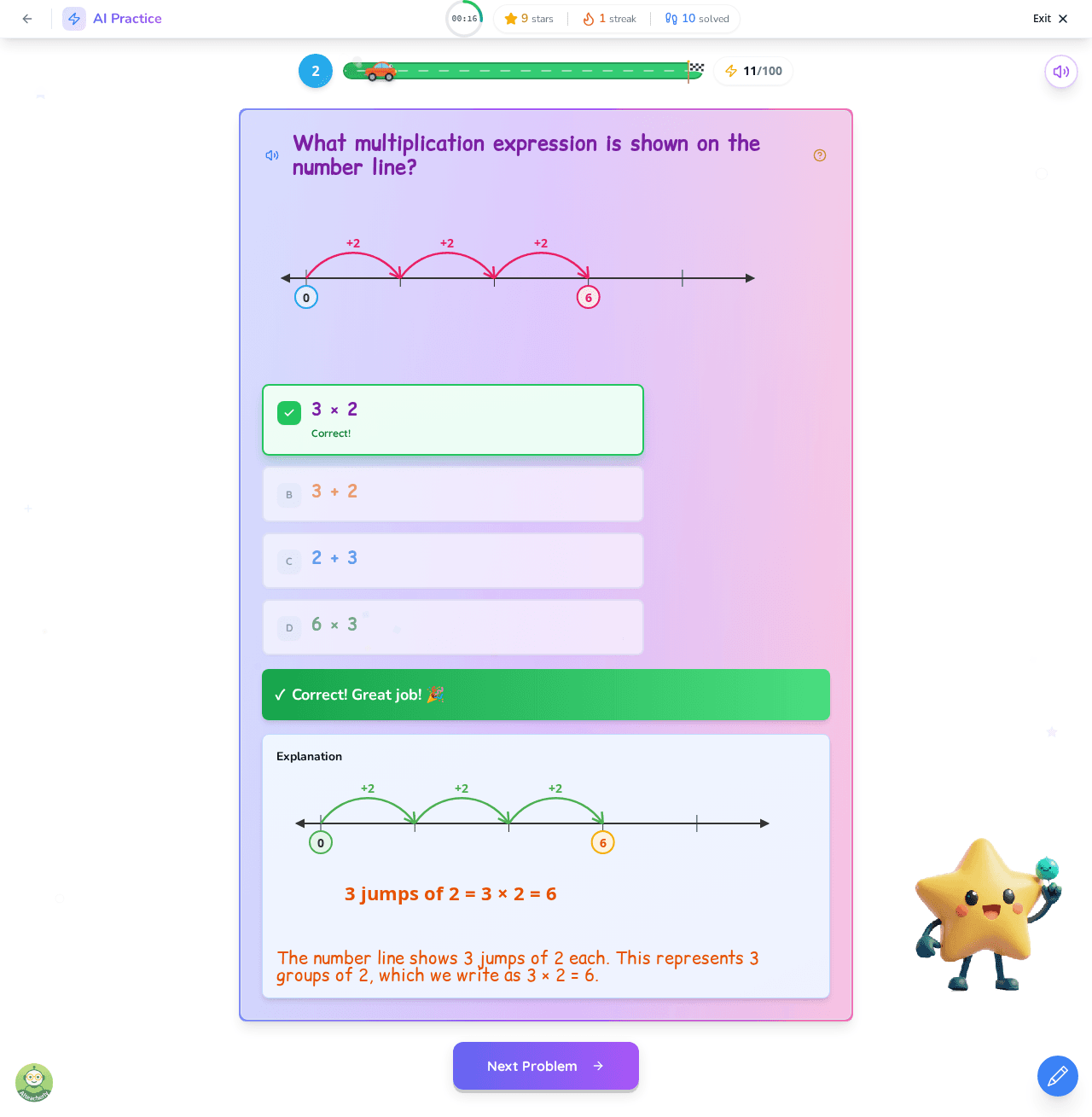
When Multiplication Feels Like a Mystery to Your 2nd Grader
Watching your 2nd grader struggle with multiplication can feel overwhelming. The moment they bring home worksheets covered in times tables, many parents feel a familiar knot of anxiety forming. You want to help, but explaining why 3×4 equals 12 in a way that actually makes sense? That's another challenge entirely.
Here's the good news: there's a visual method that transforms abstract multiplication into something kids can literally see, touch, and count. It's called number line multiplication, and it works because it builds on what your child already knows (adding the same number over and over) to introduce what they're learning (multiplication).
In this guide, you'll discover exactly how to teach multiplication using a number line, why this "jumping" approach works so well for young learners, and simple ways to practice at home without needing a math degree yourself. By the end, multiplication won't feel like a mystery anymore; it'll feel like a game of hopscotch.
What Is Number Line Multiplication and Why Does It Work?
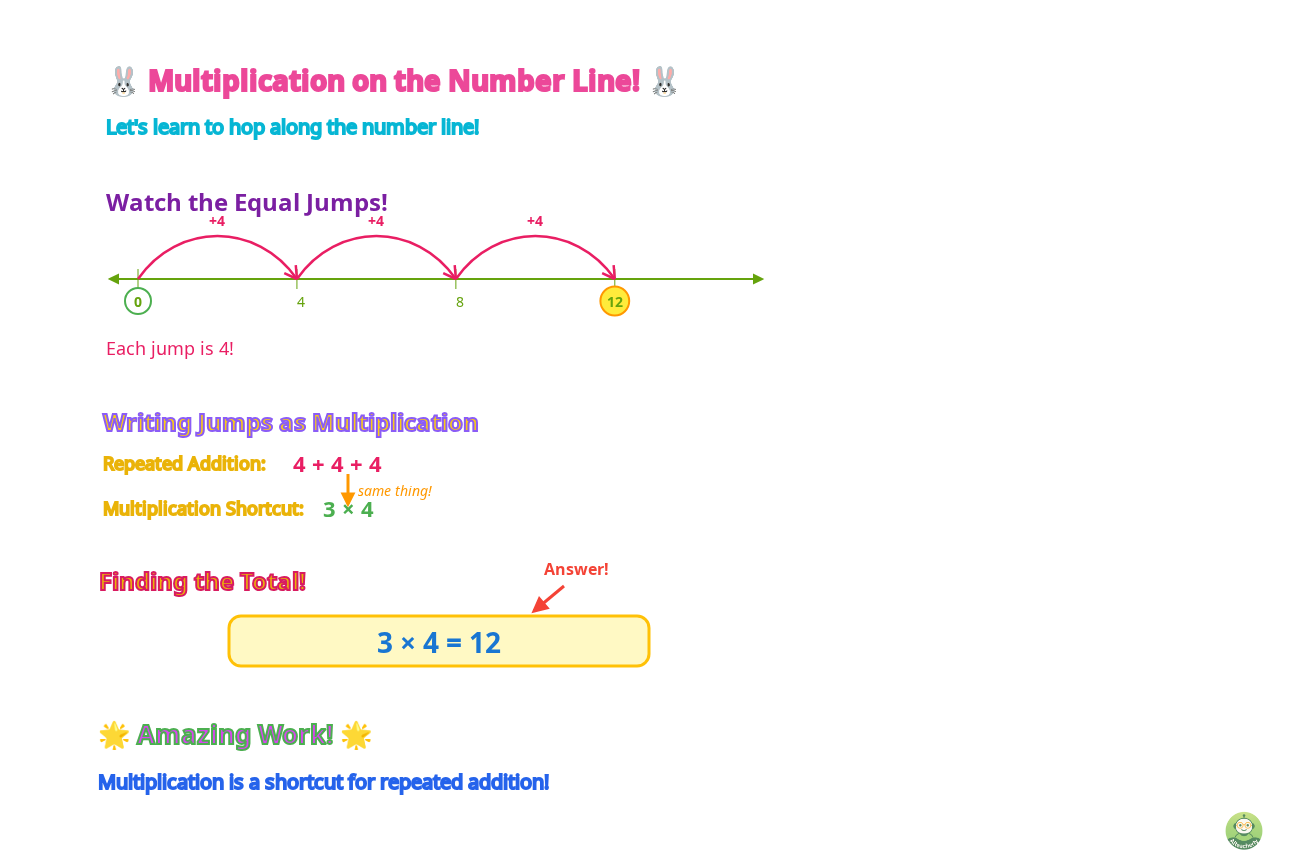
Number line multiplication is a visual strategy where kids represent multiplication as equal jumps along a number line. Instead of memorizing that 4×3=12, children physically trace or count four jumps of 3, landing on 3, then 6, then 9, and finally 12.
This method works beautifully for several important reasons:
It connects to what kids already know. Before learning multiplication, 2nd graders master addition. They understand 3+3+3+3. The number line shows them this repeated addition in action, then reveals the shortcut: "Instead of writing all that, we can just say 4 times 3!"
It makes abstract concepts concrete. Numbers on a page can feel meaningless. But jumps on a line? That's something a child can point to, count, and verify. They can literally see that four jumps of 3 lands them at 12.
It builds genuine understanding before memorization. When kids understand why 4×3=12, memorizing the fact becomes easier. They're not just storing random information; they're reinforcing something that already makes sense.
It creates memorable patterns. Each jump must be equal, and that's the key insight. Kids start recognizing that multiplication is about "groups of" the same amount, which prepares them for division later on.
How Does the 'Groups Of' Concept Connect to Jumping?
One of the trickiest parts of multiplication for young learners is understanding what "groups of" actually means. This is where the number line becomes incredibly powerful.
When you ask your child to show 4×3 on a number line, you're really asking: "Can you show me 4 groups of 3?" Each jump represents one group. The size of each jump (3 spaces forward) represents how many are in each group. And where they land tells them the total.
Let's break down the language that helps this click:
- "4 times 3" means 4 jumps of 3
- Each jump is the same size (equal groups)
- Start at zero, hop forward 3 spaces... land on 3
- Hop forward 3 more... land on 6
- Hop forward 3 more... land on 9
- Hop forward 3 more... land on 12
The "aha moment" comes when kids realize: "Wait, 3+3+3+3 and 4×3 both get me to 12! Multiplication is just a faster way to write repeated addition!"
This connection is essential. As one educator puts it: "Multiplication is just a quicker way to add the same number over and over again." Once kids see this relationship on the number line, the concept sticks.
Parents often ask if their child should memorize times tables or understand concepts first. The answer is both, but understanding should come first. A child who knows WHY 4×3=12 will remember the fact more reliably than one who simply memorized it.
3 Simple Ways to Practice Number Line Multiplication at Home
The beauty of number line multiplication is that you don't need fancy materials or a teaching background to practice it at home. Here are three approaches that work:
1. Draw and Jump (Paper Method)
Grab any piece of paper and draw a simple number line from 0 to 20. Then give your child multiplication problems to solve by jumping:
- "Show me 3 jumps of 2" (they hop from 0→2→4→6)
- "Show me 5 jumps of 4" (they hop from 0→4→8→12→16→20)
Have them draw curved arrows for each jump and circle where they land. This physical act of drawing reinforces the concept.
2. Finger Hopping (No Materials Needed)
Use your arm as a number line! Let your child "walk" their fingers along from your wrist to your shoulder, counting out equal jumps. This tactile method works great in the car, waiting rooms, or anywhere without paper.
3. Interactive Digital Practice
Interactive lessons let kids practice number line multiplication with instant feedback. The visual problem below shows exactly what this looks like in practice, where children input their answers after counting jumps on an animated number line.
Pro tip: Start with small numbers (jumps of 2 or 3) and work up gradually. Celebrate when they notice patterns, like how jumps of 2 always land on even numbers!
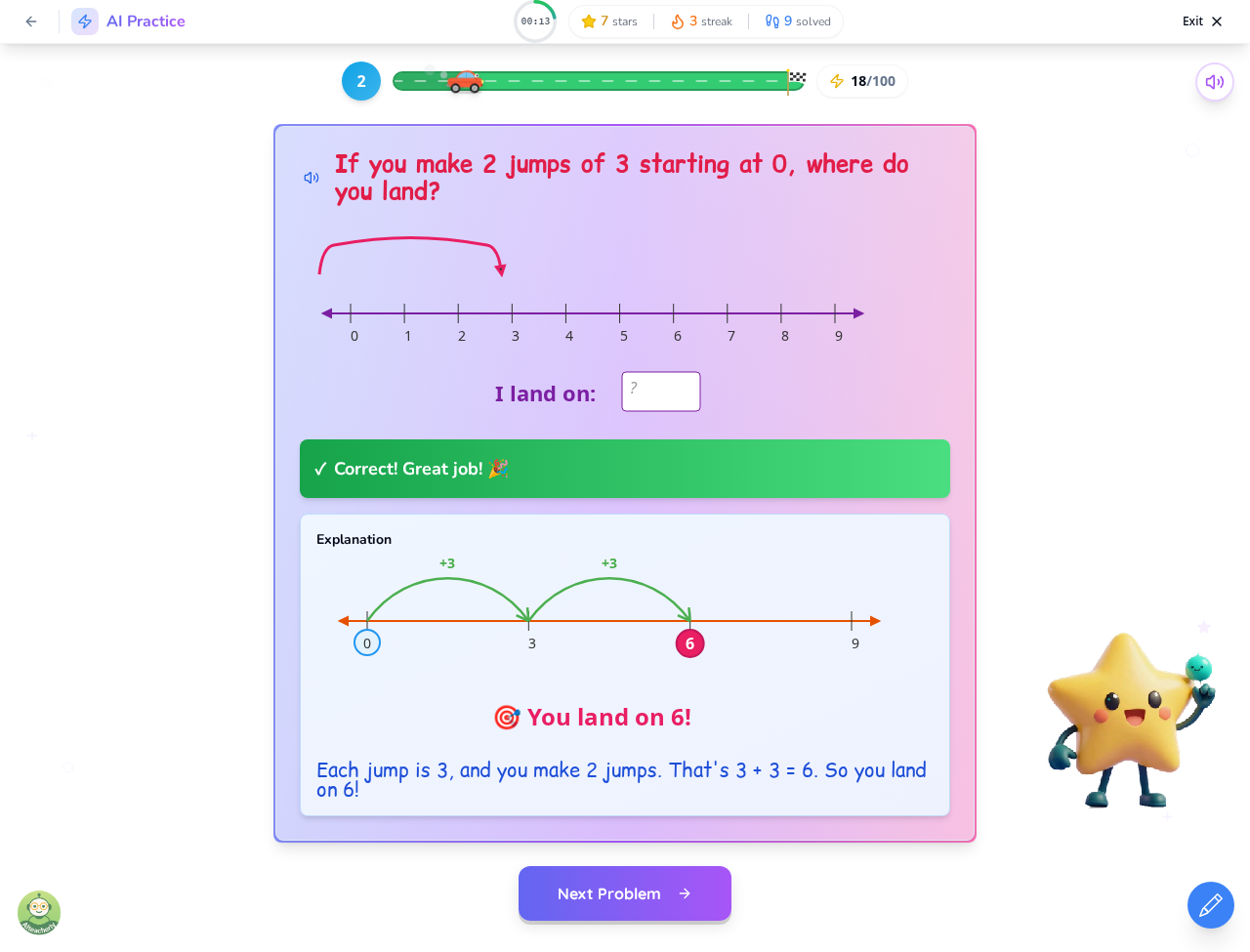
See How Interactive Number Line Lessons Work
While drawing number lines at home is valuable, interactive lessons take the learning experience to another level. On platforms like AI Teacherly, kids can practice number line multiplication with:
- Animated jumps they can watch and count in real time
- Immediate feedback that tells them if they landed in the right spot
- Progressive difficulty that builds confidence step by step
- Multiple problem types including fill-in-the-blank, multiple choice, and selection
Here's what the full interactive lesson experience looks like on AI Teacherly:
In the Multiplication on the Number Line lesson designed for Grade 2, students learn to visualize multiplication as repeated equal jumps, connecting what they already know (repeated addition) to what they're learning (multiplication expressions). The lesson uses phrases kids understand, like "Each jump is the same every time! That's the pattern: equal jumps."
What makes interactive practice different from worksheets? Kids can try, make mistakes, and try again without judgment. They see the jumps animated on screen, which reinforces the visual model in ways static images simply cannot match.
Many parents worry about screen time, but purposeful, interactive math practice is fundamentally different from passive entertainment. Your child is actively thinking, predicting, and problem-solving throughout each lesson.
Common Mistakes Kids Make (And How to Gently Correct Them)
As your child practices number line multiplication, you'll likely notice a few common stumbling blocks. Knowing these in advance helps you respond supportively:
Mistake #1: Unequal Jumps
Kids sometimes jump different distances each time, like going 0→3→5→9 instead of 0→3→6→9.
Gentle correction: "Let's count together. How big was your first jump? And your second? In multiplication, each jump needs to be the same size."
Mistake #2: Counting the Starting Point
Some children count zero as their first jump, leading to incorrect totals.
Gentle correction: "Remember, we don't count where we start. We count where we land after each jump. Let's try again, starting at zero but not counting it."
Mistake #3: Confusing the Number of Jumps with the Jump Size
For 4×3, kids might make 3 jumps of 4 instead of 4 jumps of 3. Both get to 12, but the concept differs.
Gentle correction: "In 4 times 3, the first number tells us HOW MANY jumps. The second number tells us how BIG each jump is. So we need 4 jumps, and each one is 3 spaces."
Mistake #4: Giving Up When the Answer Seems Wrong
If a child lands somewhere unexpected, they may erase everything and start over in frustration.
Gentle correction: "Let's figure out what happened together. Can you show me each jump slowly? Mistakes help us learn!"
Key Takeaways
- Number line multiplication transforms abstract times tables into visible, countable jumps that 2nd graders can trace and understand
- This method builds on repeated addition, helping kids see that 4×3 means 4 jumps of 3, landing on 3→6→9→12
- Equal jumps are the key concept: each jump must be the same size, which teaches the 'groups of' foundation of multiplication
- You can practice at home with drawn number lines, finger hopping, or interactive digital lessons without being a math expert
- Understanding WHY multiplication works should come before memorizing times tables for lasting retention
- Common mistakes like unequal jumps or counting from zero are normal and easy to correct with gentle guidance
- Interactive lessons provide animated visuals and immediate feedback that reinforce learning better than static worksheets
Frequently Asked Questions
What is number line multiplication and how does it work?
Number line multiplication shows times tables as equal jumps along a line. For 4×3, kids make 4 jumps of 3 spaces each, landing on 3, 6, 9, then 12. It turns abstract math into something visual and countable.
Why do 2nd graders learn multiplication with number lines?
Number lines connect multiplication to repeated addition, which kids already understand. Seeing jumps makes the 'groups of' concept concrete, building genuine understanding before memorization begins.
How can I explain multiplication to my 2nd grader at home?
Draw a number line and have your child make equal jumps. Say '3 times 4 means 3 jumps of 4' and let them hop from 0→4→8→12. This hands-on approach clicks faster than verbal explanations.
Is my 2nd grader ready for multiplication?
If your child can count and do basic addition, they're ready for multiplication concepts. The number line method is perfect for beginners because it builds on skills they already have.
Should my child memorize times tables or understand concepts first?
Understanding should come first. Kids who know WHY 4×3=12 remember it better than those who only memorize. Use number lines to build understanding, then practice for fluency.
What does 'groups of' mean in multiplication?
'Groups of' means equal sets. In 4×3, you have 4 groups of 3 items each. On a number line, each group is one jump, and the total items is where you land.
How long should my 2nd grader practice math each day?
For 2nd graders, 15 to 20 minutes of focused practice is ideal. Short, consistent sessions with interactive lessons are more effective than long, frustrating study blocks.
Are interactive math apps better than worksheets for learning multiplication?
Interactive apps provide animated visuals and instant feedback that static worksheets cannot match. Kids see jumps in action, try again without judgment, and stay engaged longer.
Ready to make multiplication feel like a game? Try the Multiplication on the Number Line lesson free on AI Teacherly and watch your 2nd grader's confidence soar!