Teaching Addition to Kindergarteners: 5 Hands-On Activities That Make Math Click
Discover how to teach addition to your kindergartener using everyday objects and play-based activities. No math degree required. Just hands-on fun that builds real understanding!
Why Kindergarten Addition Starts with Play, Not Worksheets
Here's something most parents don't realize: your kindergartener isn't struggling with addition because math is hard. They're struggling because they haven't had enough chances to touch it, see it, and play with it first.
Young children learn best through physical manipulation. Before the abstract symbols of "2 + 3 = 5" make any sense, kids need to experience addition with their hands. They need to hold two toy cars in one hand, three in the other, push them together, and count the total. That's when the magic happens.
This is why the best kindergarten math programs (and the most effective parents) start with concrete objects before introducing number sentences. The plus sign? It simply means "put together." When you frame it that way, addition stops being intimidating and starts being intuitive.
In this guide, you'll discover exactly how to teach addition to kindergarteners at home using everyday items you already have. No special materials required, no teaching degree needed. Just simple, play-based activities that build genuine mathematical understanding.
What Does Addition Really Mean for a Kindergartener?
For adults, addition is automatic. We see 4 + 3 and instantly know it equals 7. But kindergarteners are building this understanding from scratch, and they need a clear, concrete definition.
Addition is putting things together. That's it. That's the foundational concept your child needs to grasp before anything else makes sense.
When kindergarteners learn addition, they progress through specific stages:
- Counting the first group separately ("I have 2 apples")
- Counting the second group separately ("Here are 3 more apples")
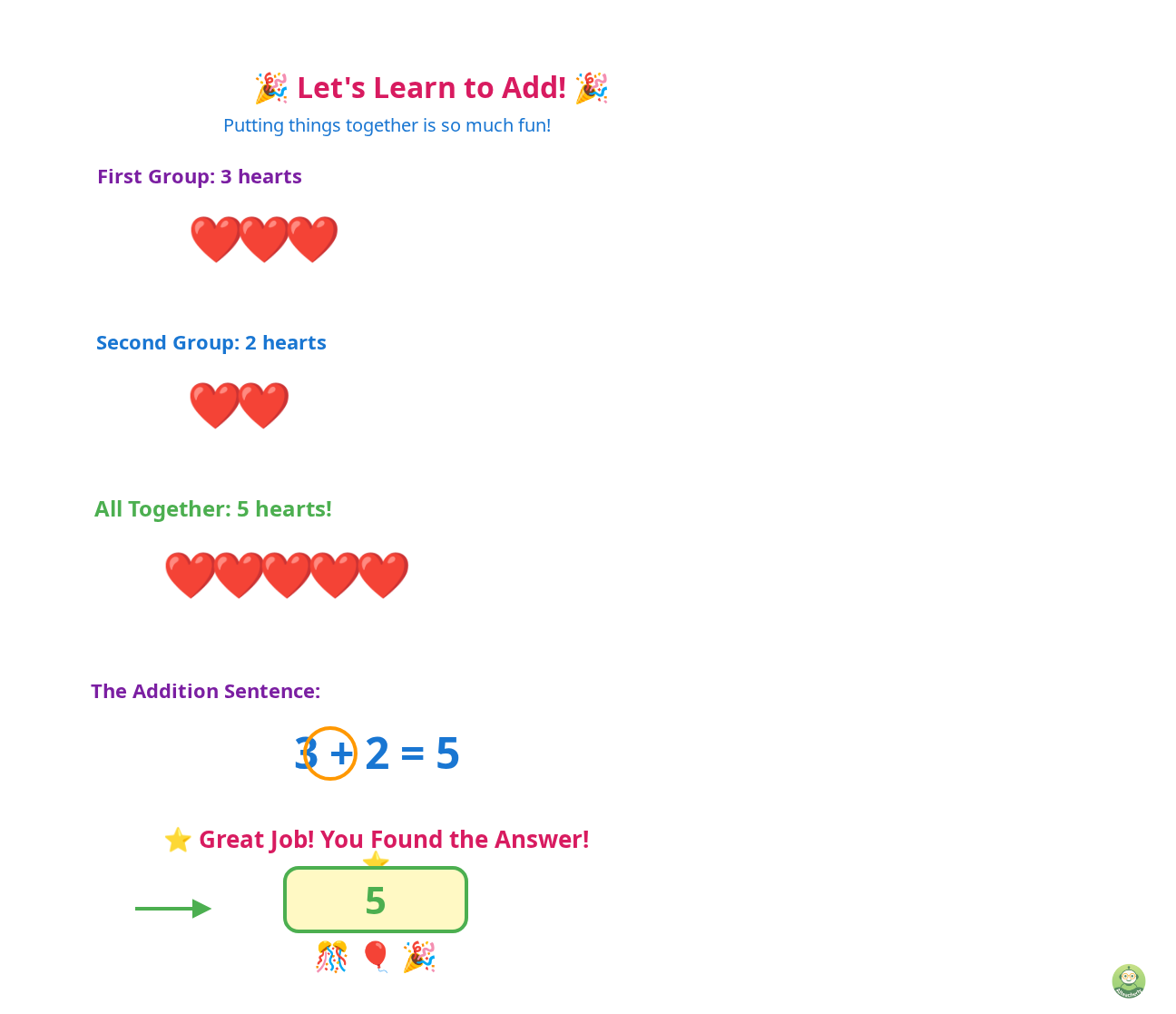
- The combining moment ("Let's put them together!")
- Counting the total ("Now I have 1, 2, 3, 4, 5 apples!")
- Connecting to symbols ("We write this as 2 + 3 = 5")
This progression matters. Children who skip the hands-on stages often struggle with mental math later because they never built true number sense. They memorized facts without understanding what those facts actually mean.
The goal isn't to rush your kindergartener through flash cards. It's to give them so many experiences of "putting together" that addition becomes as natural as breathing.
How Do I Teach My Kindergartener Addition at Home?
Teaching addition to kindergarteners at home is simpler than you think. The key is turning ordinary moments into math opportunities without making it feel like "school."
Start with quantities your child can easily count. For kindergarteners, sums to 5 are the sweet spot. Once they master these combinations confidently, you can gradually increase to sums of 10.
Use the phrase "put together" consistently. Every time you practice, reinforce that the plus sign means "put together." This creates a mental anchor that helps children decode addition problems independently.
Make it physical first, symbolic second. Always start with real objects. Let your child manipulate them, combine them, and count the result. Only after they've done this successfully several times should you introduce the written number sentence.
Celebrate the process, not just correct answers. When your child says "Let me count again," that's mathematical thinking in action. Praise the effort and the strategy, not just getting the right number.
Here are three quick activities you can try today:
- Snack math: "You have 2 crackers. I'm giving you 3 more. Put them together. How many do you have now?"
- Toy counting: Use action figures, blocks, or stuffed animals to create combining scenarios
- Finger addition: Have your child hold up fingers on both hands and count the total
5 Everyday Objects That Make Perfect Addition Manipulatives
You don't need expensive math kits to teach addition. Your home is already filled with perfect learning tools. Here are five everyday objects that work brilliantly for kindergarten addition practice:
1. Building Blocks or LEGO Bricks Blocks are ideal because children naturally want to combine them. Start with two small piles: "Here are 2 red blocks and 3 blue blocks. Let's put them together and count!" The tactile experience of physically joining the groups reinforces the concept of addition.
2. Snacks (Goldfish, Grapes, Cheerios) Food is incredibly motivating for young learners. Use small snacks to practice sums to 5. Bonus: they get to eat their math work when they're done! "You have 1 grape. I'm adding 4 more. How many grapes can you eat now?"
3. Toy Cars or Action Figures Anything your child already loves becomes a powerful math manipulative. "2 dinosaurs are playing. 3 more dinosaurs join them. How many dinosaurs are playing together?"
4. Socks or Shoes During laundry or getting dressed, count items being combined. "We have 2 socks here and 2 socks there. Let's put them together!"
5. Crayons or Markers Before art time, practice addition with coloring supplies. "Take 3 crayons from this box and 2 from that box. How many colors can you use?"
The goal is making addition feel like play, not homework. When children associate math with fun experiences, they develop positive attitudes that carry through their entire education.
From Counting to Number Sentences: Building the Bridge
Once your kindergartener can confidently combine objects and count totals, it's time to introduce the written form of addition. This is where many parents worry they'll "do it wrong," but the bridge is simpler than you think.
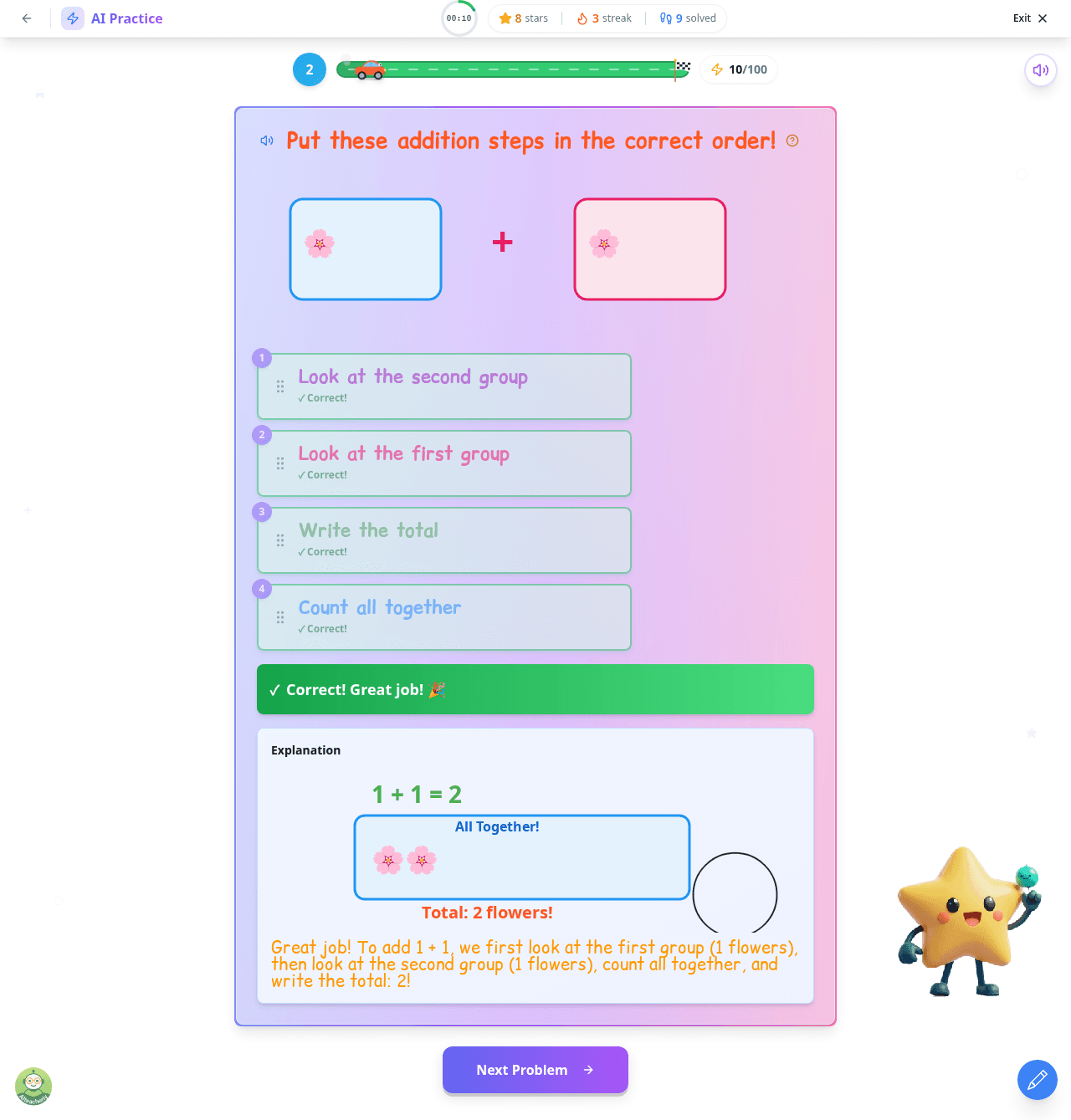
Step 1: Narrate while they manipulate. As your child combines 2 blocks with 3 blocks, say: "You have 2. You're adding 3 more. 2 plus 3 equals 5."
Step 2: Write it down together. After the physical activity, show them the number sentence: 2 + 3 = 5. Point to each part: "This says 2 (point to the objects), plus means put together (gesture combining), 3 (point to those objects), equals 5 total."
Step 3: Connect symbols to meaning. Explain that the plus sign is just a short way of writing "put together" and the equals sign means "the same as." So 2 + 3 = 5 means "2 put together with 3 is the same as 5."
The interactive problem below shows exactly how this concrete-to-abstract connection works in practice:
Step 4: Practice recognition before writing. Let your child match pictures to number sentences before asking them to write equations themselves. This builds confidence and reinforces the connection between visual quantities and symbolic notation.
Remember: fluency with number sentences develops over time. Don't rush this stage. The goal is understanding, not speed.
See How Interactive Addition Lessons Work
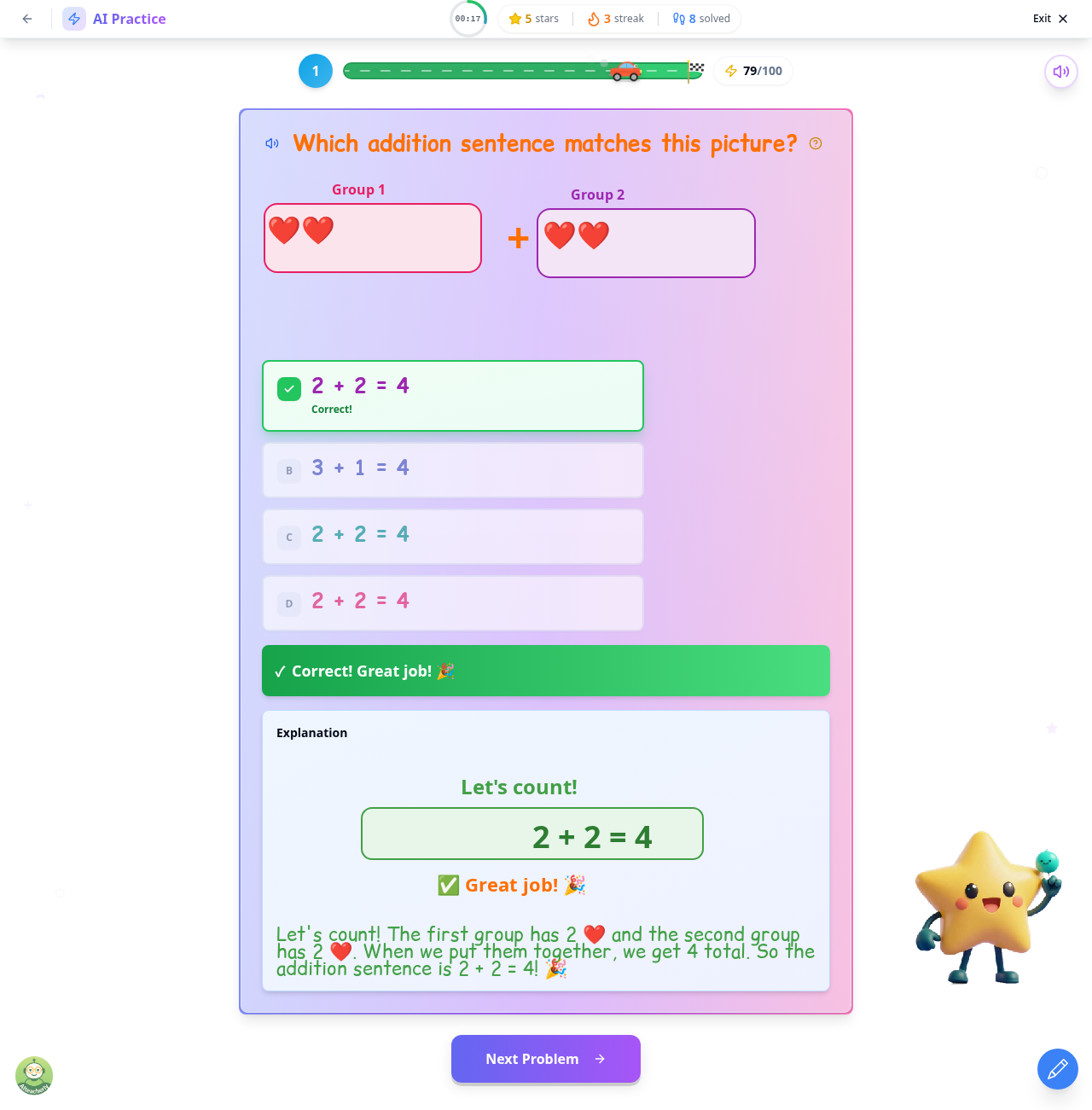
While hands-on activities at home are essential, interactive digital lessons provide structured practice that reinforces what children learn through play. The best educational platforms mirror how kindergarteners naturally learn addition: visually, with lots of pictures, and with immediate feedback.
Here's what the full interactive lesson looks like on AI Teacherly:
In the Introduction to Addition lesson designed for Kindergarten, students:
- Count groups of colorful objects displayed on screen, building that crucial first step of recognizing quantities
- Watch groups combine visually so they can see the "putting together" concept in action
- Count the combined total with animated support that makes the process clear
- Connect pictures to number sentences through matching activities that bridge concrete to abstract
- Receive instant feedback that celebrates correct answers and gently guides incorrect ones
The lesson uses engaging visuals like emojis and familiar objects that appeal to kindergarteners. Each problem builds on the previous one, gradually increasing complexity while ensuring children don't feel overwhelmed.
What makes interactive lessons particularly powerful is the multi-sensory engagement. Children see the objects, click or tap to interact with them, and receive audio reinforcement like "Adding is putting things together!" and "You learned to add!" This combination of visual, tactile, and auditory learning cements understanding in ways that worksheets simply cannot match.
For parents, these lessons offer peace of mind. You know your child is practicing with developmentally appropriate content designed by education experts, and you can see their progress over time.
Common Mistakes Parents Make When Teaching Addition
Even well-intentioned parents can accidentally make addition harder for their kindergarteners. Here are the most common mistakes and how to avoid them:
Mistake #1: Starting with symbols instead of objects. Jumping straight to "What's 2 + 3?" without physical manipulation leaves children guessing instead of understanding. Always start with real objects they can touch and count.
Mistake #2: Using numbers that are too large. Kindergarteners should master sums to 5 before moving to larger numbers. If your child struggles with 4 + 5, drop back to smaller combinations like 2 + 2 or 1 + 3 to rebuild confidence.
Mistake #3: Expecting instant recall. Your kindergartener is not supposed to have addition facts memorized. They're supposed to be able to figure them out by counting. Fact fluency comes later, in first and second grade, after understanding is solid.
Mistake #4: Correcting too quickly. When children make errors, resist the urge to immediately say "No, that's wrong." Instead, ask: "Let's count again together" or "Show me with the blocks." This teaches problem-solving rather than fear of mistakes.
Mistake #5: Making it feel like a test. If every interaction becomes "quiz time," children develop math anxiety. Keep practice playful and low-pressure. Comment on the math in everyday situations without demanding answers.
Mistake #6: Skipping the "put together" language. Consistently using the phrase "put together" for the plus sign creates a mental anchor. Without this language bridge, the plus symbol remains abstract and confusing.
Key Takeaways
- Addition means "putting things together" and kindergarteners need to understand this concrete concept before abstract symbols make sense
- Start with sums to 5 using physical objects your child can touch, combine, and count
- Use everyday items like blocks, snacks, and toys as math manipulatives; no special materials needed
- The plus sign simply means "put together" and the equals sign means "the same as"
- Let children manipulate objects first, then introduce written number sentences after they understand the concept
- Interactive digital lessons reinforce learning through visual, tactile, and auditory engagement
- Avoid rushing to memorization; understanding comes before fact fluency
Frequently Asked Questions
What age should a child learn addition?
Most children are developmentally ready for basic addition around age 5. Kindergarten curriculum typically introduces addition with sums to 5 and 10, focusing on concrete objects before abstract symbols.
How do I explain addition to a kindergartener?
Tell them addition means "putting things together." Use real objects like toys or snacks. Let them combine two groups and count the total. Connect this physical action to the plus sign and number sentences.
Why is hands-on learning important for teaching addition?
Young children think concretely, not abstractly. They need to physically manipulate objects to understand what combining quantities means before written symbols like 2 + 3 = 5 make sense.
What are good objects to use for teaching addition at home?
Use anything your child enjoys: building blocks, toy cars, snacks like Goldfish or grapes, crayons, or stuffed animals. The best manipulative is whatever captures your child's interest.
How high should kindergarteners be able to add?
By the end of kindergarten, most children should confidently add within 5 and be working on sums to 10. Focus on understanding over speed; memorized fact fluency develops in grades 1 and 2.
Is it normal for my kindergartener to struggle with addition?
Yes! Addition is a new concept and takes time to master. If your child needs to count on fingers or use objects, that's perfectly normal and developmentally appropriate for kindergarteners.
What does the plus sign mean for kids?
Teach children that the plus sign (+) means "put together." This simple phrase gives them a concrete way to understand the symbol and decode addition problems independently.
How do I know if my child is ready for addition?
Your child is ready if they can count objects reliably to at least 5 and understand that numbers represent quantities. They should be able to answer "How many?" after counting a small group.
Ready to make addition fun for your kindergartener? Try the interactive Introduction to Addition lesson free on AI Teacherly and watch your child discover the joy of math!