Teaching Counting to 5: The First Math Skill Every Kindergartener Needs to Master
Discover proven techniques for teaching counting to 5 that turn everyday moments into math practice. Learn the secret skill behind counting success and fun activities to try today.
Why Counting to 5 Is Your Kindergartener's First Big Math Win
Teaching counting to 5 kindergarten children might seem like a small step, but it's actually one of the most important math milestones your child will ever reach. This foundational skill sets the stage for everything that comes next: addition, subtraction, multiplication, and even algebra years down the road.
Many parents wonder if their kindergartener is "on track" with counting. Here's the reassuring truth: most children begin to understand counting between ages 4 and 5, and you're already equipped to be their best teacher. No math degree required.
The key isn't just getting your child to recite "1, 2, 3, 4, 5" like a song. The real magic happens when they understand that each number represents a quantity, that touching one object means saying one number, and that the last number they say tells them "how many." This deeper understanding is what separates rote memorization from true mathematical thinking.
In this guide, you'll discover practical activities, the science behind early counting, and how to turn everyday moments into learning opportunities. Whether your kindergartener is just starting or needs a bit more practice, you'll find actionable tips you can use today.
What Is One-to-One Correspondence and Why Does It Matter?
One-to-one correspondence is the fancy term for a simple but powerful concept: matching one number to one object when counting. It's the secret skill that transforms your child from someone who can recite numbers to someone who truly understands counting.
Here's what it looks like in practice: when your child counts five crackers, they need to point to (or touch) each cracker exactly once while saying exactly one number. No skipping, no double-counting. The last number they say ("5!") tells them how many crackers there are.
This skill is called the "cardinality principle," and it's a major cognitive leap for young children. Before this clicks, kids might touch the same object twice or say numbers faster than they point. After it clicks, they've unlocked the foundation for all future math.
Why does this matter so much? Research shows that children who master one-to-one correspondence in kindergarten perform significantly better in math throughout elementary school. It's not just about counting; it's about understanding that numbers represent real quantities in the world.
The good news? You can practice this anywhere: at the grocery store, during snack time, or while playing with toys. Every moment becomes a counting opportunity once you know what to look for.
How Do I Teach My Kindergartener to Count to 5?
Teaching counting to 5 year olds doesn't require flashcards or formal lessons. The most effective approach combines physical touch, verbal counting, and real objects. Here's a step-by-step method that works:
Step 1: Start with the Touch-and-Count Method
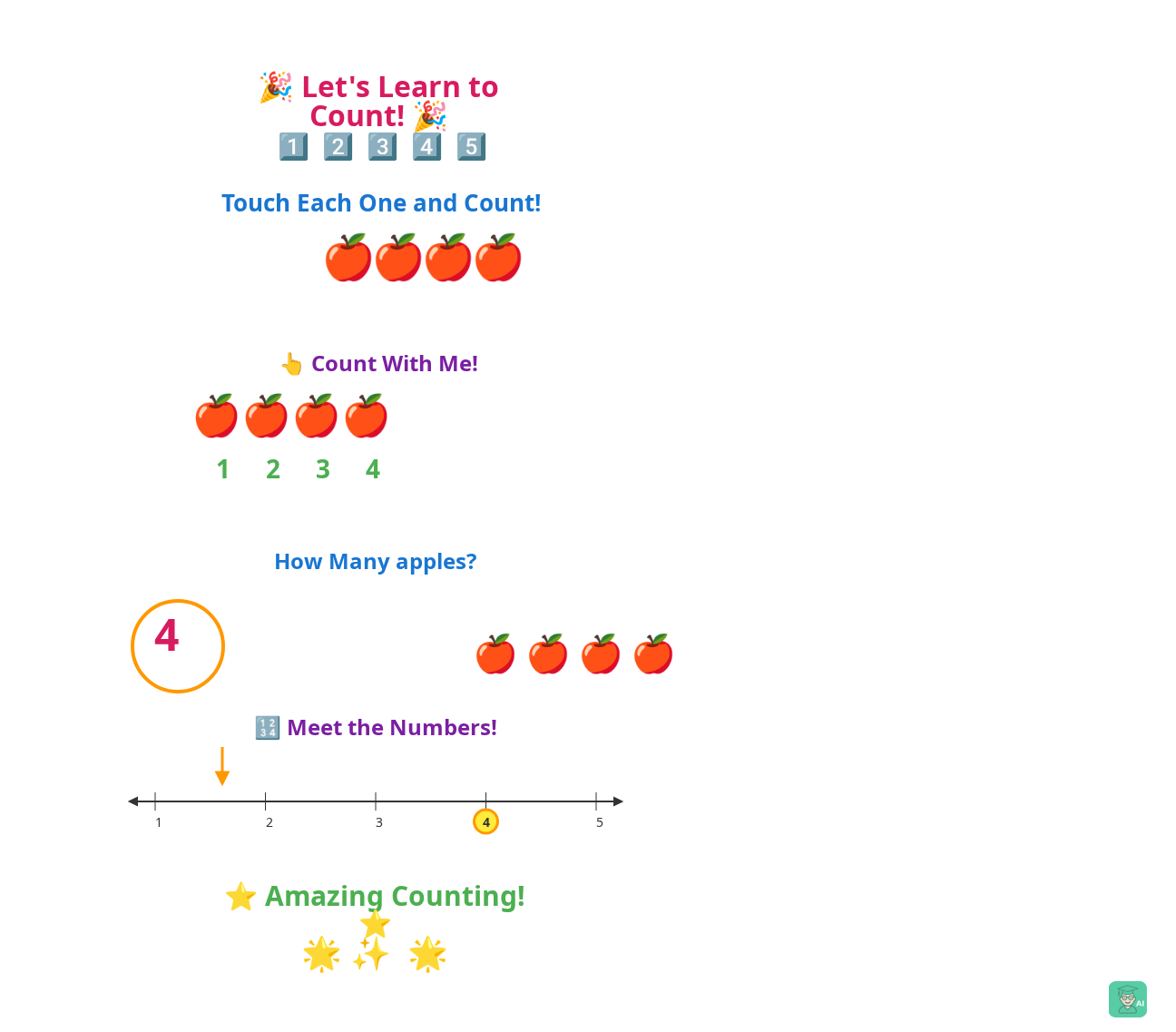
Show your child how to touch each object while saying one number. Demonstrate slowly: "Watch me count these apples. One (touch), two (touch), three (touch)." The physical connection between hand and object helps cement the concept.
Step 2: Use the Magic Question
After counting together, ask: "How many do we have?" If your child recounts from the beginning, gently remind them: "The last number we said tells us how many!" This reinforces the cardinality principle.
Step 3: Practice with Different Objects
Variety matters. Count toys, snacks, fingers, steps, buttons, anything. This helps your child understand that "three" means the same thing whether it's three teddy bears or three grapes.
Step 4: Let Them Lead
Once they're comfortable, let your child do the counting while you observe. Resist the urge to correct immediately; let them self-correct when possible. Ask questions like, "Are you sure? Can you count again to check?"
Step 5: Celebrate Small Wins
Every successful count deserves recognition. A simple "You counted all five! Great job touching each one!" reinforces both the skill and their confidence.
5 Fun Counting Activities You Can Do at Home Today
Counting practice for kids works best when it doesn't feel like practice. These activities turn everyday moments into engaging math experiences without any prep work required.
1. Snack Time Counting
Before eating, count out loud together: "Let's see how many strawberries you have. Touch each one!" Bonus: ask your child to give you a specific number ("Can you give me 3 crackers?").
2. Stair Step Math
Count each step as you go up or down. This adds movement to counting and naturally limits the numbers (most home staircases have 10-15 steps). For counting to 5, stop halfway and count back down.
3. Toy Sorting Challenge
During playtime, ask: "Can you find exactly 4 red blocks?" or "How many cars do you have?" Sorting and counting together builds both skills.
4. Bath Time Bubble Count
Bubbles, rubber ducks, cups of water; bath time is full of countable items. The relaxed environment makes learning feel like play.
5. Interactive Digital Practice
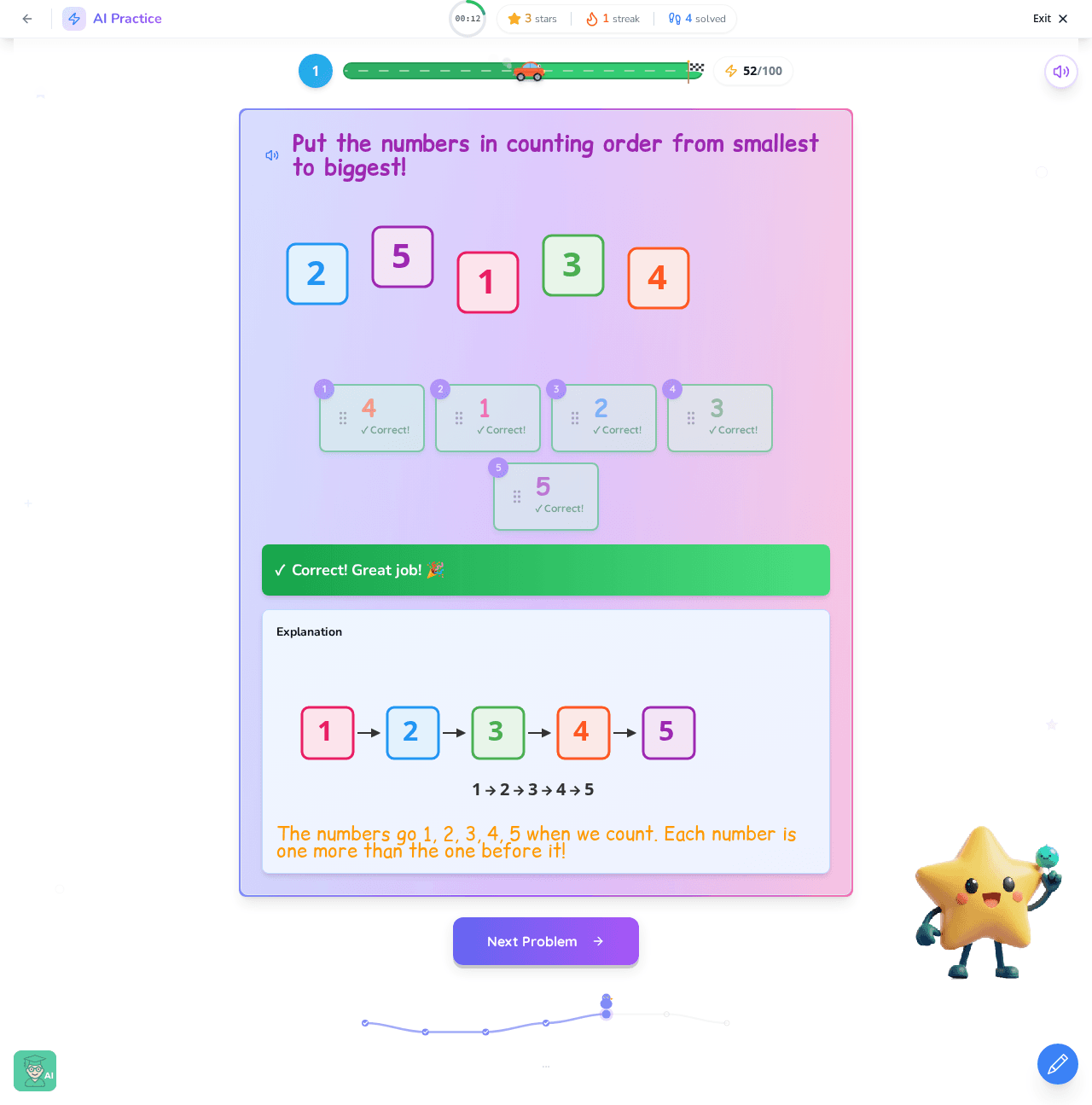
The activity below shows how AI Teacherly's Learn to Count to 5 lesson turns counting into an interactive game. Children touch colorful objects on screen, reinforcing the same touch-and-count method you're using at home.
Tip: Mix up your activities to keep things fresh. The goal is consistent practice in varied settings, not repetitive drills.
Common Counting Mistakes and How to Gently Correct Them
Even the brightest kindergarteners make counting errors. Understanding why these mistakes happen helps you respond in ways that build skills rather than frustration.
Mistake #1: Skipping Numbers
Your child counts "1, 2, 4, 5" and misses "3." This usually means they're reciting numbers faster than they can track objects.
What to do: Slow down. Model counting at a deliberate pace, touching firmly on each object. Say: "Let's count together, nice and slow."
Mistake #2: Double-Counting Objects
They touch the same item twice or count an object without touching it. This indicates one-to-one correspondence is still developing.
What to do: Move counted objects to a separate pile. "Let's put each one over here after we count it." This physical separation helps.
Mistake #3: Not Knowing "How Many"
After counting to 5, you ask "How many?" and they start over from 1. The cardinality principle hasn't clicked yet.
What to do: Emphasize the last number with excitement: "Five! The last number tells us how many. You have FIVE blocks!" Repetition here is key.
Mistake #4: Memorizing Without Understanding
They can count to 5 perfectly but can't hand you 3 items when asked.
What to do: Practice "Give me X" activities. This tests true understanding beyond recitation.
Remember: these mistakes are normal and necessary parts of learning. Your patient guidance makes all the difference.
See Interactive Counting Practice in Action
Sometimes children benefit from practice beyond everyday activities. Interactive digital lessons can reinforce counting skills in engaging ways that feel like play rather than work.
Here's what the full interactive lesson looks like on AI Teacherly:
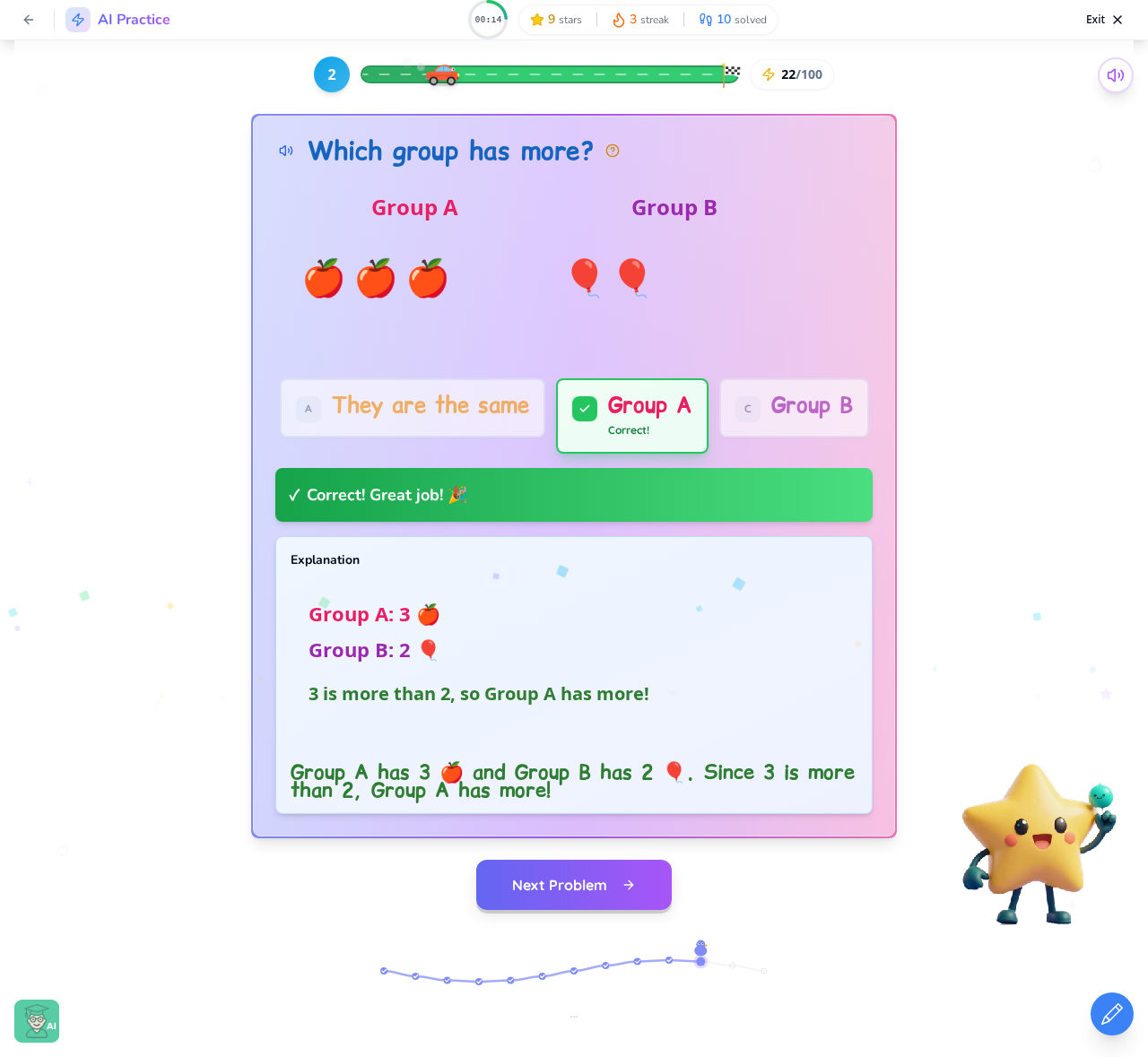
The Learn to Count to 5 lesson on AI Teacherly uses colorful visuals and touch-based interactions that mirror the one-to-one correspondence method you're practicing at home. Children drag, tap, and count on screen, receiving immediate feedback that celebrates correct answers and gently guides them through mistakes.
What makes interactive practice effective:
- Visual engagement: Bright colors and friendly characters capture attention
- Kinesthetic learning: Touching and dragging objects reinforces the physical counting connection
- Instant feedback: Children know immediately if they're on track
- Repetition without boredom: Different problem types keep practice fresh
- Progress tracking: Parents can see which skills are solid and which need more work
The lesson includes sections that introduce each number, practice counting groups of objects, and build toward comparing quantities. It's designed to supplement your at-home activities, not replace them.
Screen time becomes learning time when it's purposeful, interactive, and connected to real-world skills you're already building together.
Key Takeaways
- One-to-one correspondence (touching each object while saying one number) is the foundation of counting success
- The last number said tells 'how many', which is a critical concept called the cardinality principle
- Teaching counting to 5 kindergarteners works best through everyday activities: snacks, stairs, toys, and play
- Common counting mistakes like skipping numbers are normal and fixable with patient, slow practice
- Variety matters: count different objects in different settings to build true understanding
- Interactive digital practice reinforces the same skills and keeps learning engaging
- Celebrate every counting win to build confidence alongside competence
Frequently Asked Questions
At what age should a child be able to count to 5?
Most children can count to 5 between ages 4 and 5. However, understanding what the numbers mean (one-to-one correspondence) typically develops during kindergarten with practice and guidance.
What is one-to-one correspondence in counting?
One-to-one correspondence means matching exactly one number to each object when counting. It's the foundational skill that helps children understand counting isn't just reciting numbers but representing quantities.
Why does my child skip numbers when counting?
Number skipping usually happens when children count faster than they can track objects. Slow down, use the touch-and-count method, and practice with physical objects they can move to a separate pile after counting.
How can I practice counting with my kindergartener at home?
Turn everyday moments into counting practice: count snacks before eating, steps on the stairs, toys during playtime, or items at the grocery store. The key is consistent, playful practice in varied settings.
How do I know if my child understands counting or is just memorizing?
Ask your child to give you a specific number of objects. If they can hand you exactly 3 crackers when asked, they understand. If they just grab a handful, they may be memorizing without grasping quantity.
What comes after my child masters counting to 5?
After counting to 5, children typically progress to counting to 10, then 20, while also learning to recognize written numerals, compare quantities, and eventually add and subtract small numbers.
Is screen time okay for teaching counting?
Interactive, educational screen time can reinforce counting skills effectively when it involves touching, dragging, and problem-solving rather than passive watching. Pair it with hands-on activities for best results.
What are signs my child is ready to learn counting?
Readiness signs include interest in numbers, ability to follow simple instructions, pointing at objects, and beginning to understand concepts like 'more' and 'less.' Most children show these signs between ages 3 and 4.
Ready to give your kindergartener a head start in math? Try the interactive Learn to Count to 5 lesson free on AI Teacherly and watch counting click!