Teaching Greater Than Less Than to 1st Graders: The Alligator Trick That Really Works
Struggling to teach your 1st grader those confusing comparison symbols? Discover the alligator trick and fun home activities that make greater than and less than finally click.
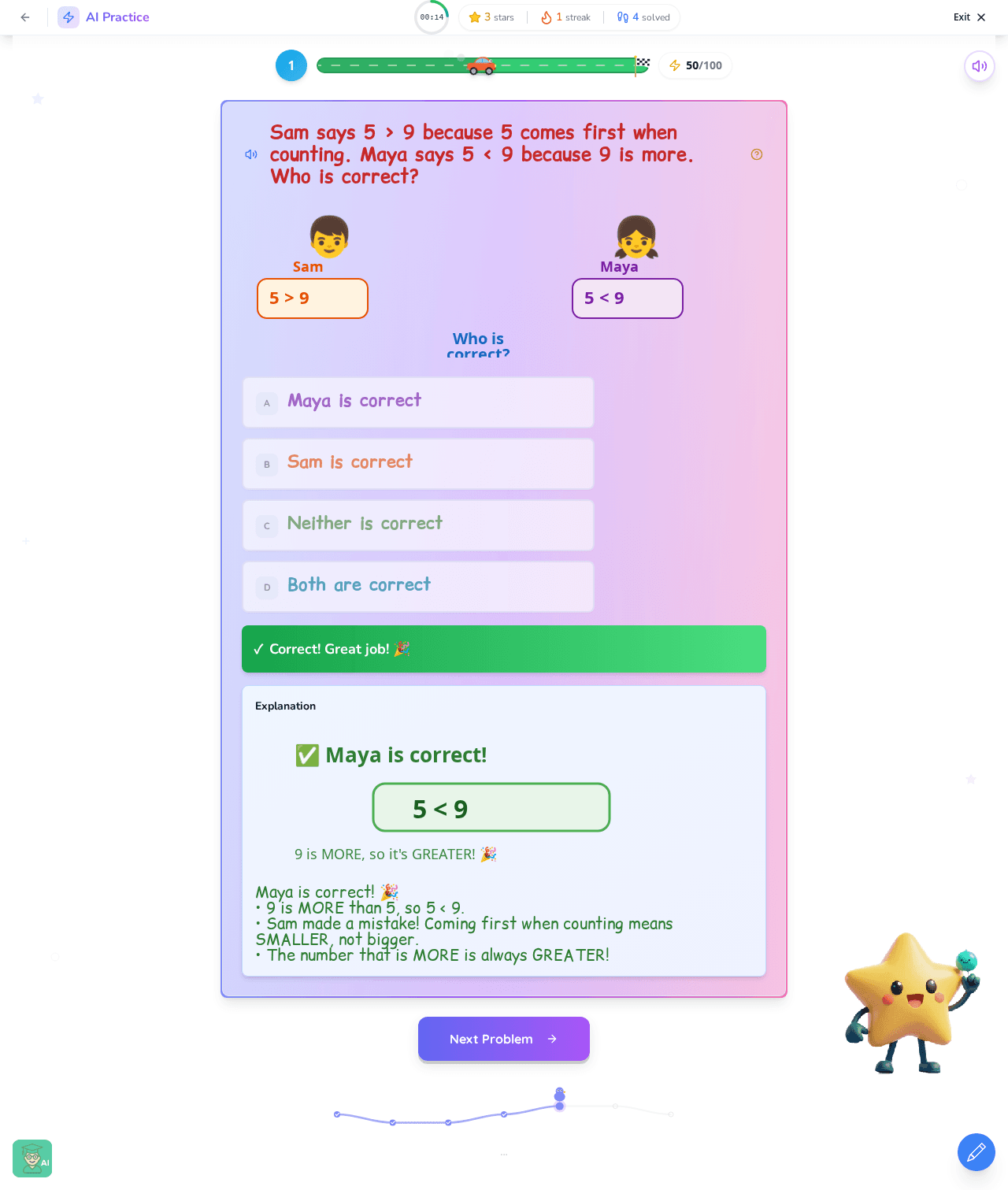
Why Comparing Numbers Is a Building Block for Math Success
If you've watched your 1st grader stare blankly at those crocodile-mouth symbols, you know the frustration. Greater than, less than, and equal to might seem simple to adults, but for 6 and 7-year-olds, these abstract symbols can feel like a foreign language.
Here's the good news: teaching greater than less than for 1st graders doesn't require a math degree. With the right approach and a few memorable tricks, your child can master comparison symbols in no time.
Number comparison is one of the most important foundational skills in early elementary math. When children understand that 7 is greater than 4, or that 3 is less than 9, they're building number sense, the intuitive understanding of how numbers relate to each other. This skill directly supports:
- Addition and subtraction (knowing which number is bigger helps with mental math)
- Problem-solving (comparing quantities in word problems)
- Later concepts like fractions, decimals, and algebra
The challenge? Those pesky symbols. The less than sign (<)** and **greater than sign (>) look almost identical, just facing different directions. No wonder kids get confused! But there's a classic trick that has helped generations of children remember which symbol is which.
What Do Greater Than, Less Than, and Equal To Actually Mean?
Before diving into symbols, let's make sure the underlying concepts are crystal clear. Children need to understand the words before they can connect them to symbols.
Greater than means more. When we say 8 is greater than 5, we're saying 8 is a bigger quantity. If you had 8 cookies and your friend had 5, you'd have more cookies.
Less than means fewer. When 2 is less than 6, we're saying 2 is the smaller quantity. Two apples is fewer than six apples.
Equal to means the same amount. When 4 equals 4, both quantities are identical. Four toy cars is the same as four toy cars.
The symbols are simply a shorthand way to write these comparisons:
| Symbol | Meaning | Example |
|---|---|---|
| > | Greater than | 9 > 3 (9 is greater than 3) |
| < | Less than | 2 < 7 (2 is less than 7) |
| = | Equal to | 5 = 5 (5 equals 5) |
A helpful tip: always read comparison statements from left to right, just like reading a sentence. The first number is being compared to the second number.
How Does the Alligator Trick Work for Comparison Symbols?
Here's the memory trick that has helped millions of children remember their comparison symbols: The alligator mouth always opens toward the bigger number because it wants to eat the most!
Imagine the greater than (>) and less than (<) symbols as an alligator's open mouth. Alligators are hungry creatures, and they always want to eat the biggest meal possible. So the open side of the symbol (the alligator's mouth) always faces the larger number.
Let's see this in action:
Example 1: Compare 8 and 3
- Which number is bigger? 8!
- The alligator wants to eat 8, so its mouth opens toward 8
- We write: 8 > 3 (the mouth opens left, toward the 8)
Example 2: Compare 2 and 9
- Which number is bigger? 9!
- The alligator wants to eat 9, so its mouth opens toward 9
- We write: 2 < 9 (the mouth opens right, toward the 9)
Why this trick works so well:
- It's visual: Children can literally picture a hungry alligator
- It's memorable: The story element sticks in young minds
- It's consistent: The rule never changes, no matter which numbers you're comparing
Some teachers use variations like "the greedy crocodile" or "the hungry shark." The animal doesn't matter; what matters is that your child visualizes the open mouth always pointing toward the bigger number.
5 Easy Activities to Practice Comparing Numbers at Home
Learning sticks when it's hands-on and connected to real life. Here are five simple activities you can do at home to reinforce comparing numbers up to 10:
1. Snack Time Comparison Give your child two small groups of snacks (goldfish crackers, grapes, or cheerios work great). Ask: "Which group has more? Which has less?" Have them arrange the groups and point the "alligator mouth" toward the bigger pile before eating!
2. Toy Count Challenge Grab two handfuls of small toys (LEGO bricks, action figures, crayons). Count each group together, then have your child write the comparison using symbols. Make it a game: can they create an "equal" comparison by moving pieces?
3. Stair Step Numbers On a piece of paper, write two numbers. Have your child build each number using blocks or coins stacked vertically. The taller stack is greater! This visual really drives home why one number is "bigger."
4. Number Card Wars Use a deck of cards (remove face cards) or make number cards 1-10. Each player flips a card. Whoever can correctly say the comparison statement ("6 is greater than 2!") first wins both cards.
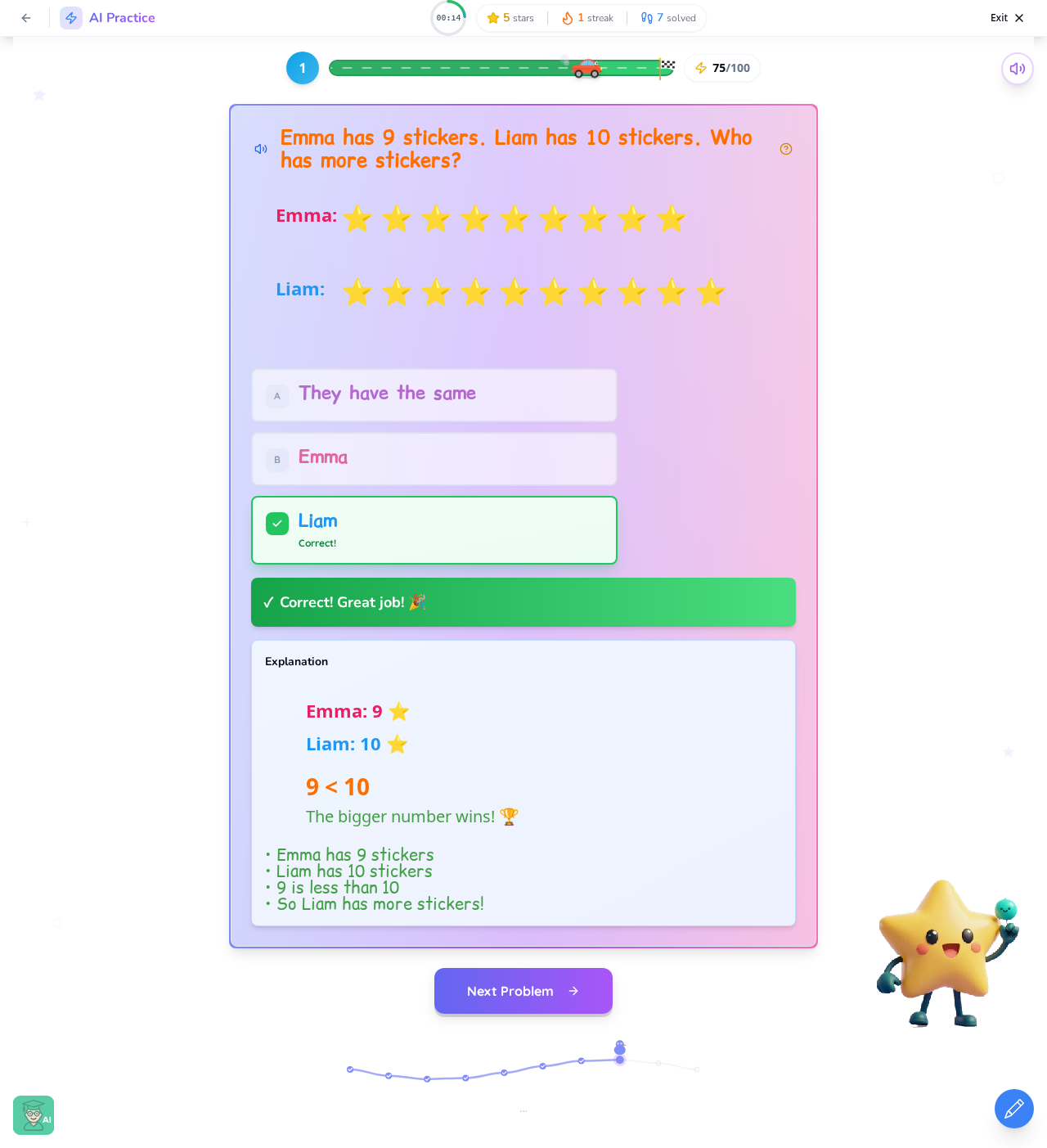
5. Interactive Online Practice Digital learning tools provide immediate feedback and keep kids engaged. The interactive problem below shows exactly how practice activities use relatable scenarios to make comparison meaningful:
This example features Emma and Liam comparing their sticker collections, turning abstract math into a story children can connect with. When kids see characters their age solving comparison problems, it feels relevant and achievable.
Common Mistakes Kids Make with Comparison Symbols (And How to Fix Them)
Even with the alligator trick, children often stumble in predictable ways. Knowing these common mistakes helps you catch and correct them early.
Mistake #1: Confusing < and > because they look similar
The fix: Always bring it back to the alligator. Ask: "Which number does the hungry alligator want to eat? Point the mouth that way!" Repetition with this visual cue builds automatic recognition over time.
Mistake #2: Reading the statement backward
Children sometimes read "3 < 7" as "3 is greater than 7" because they focus on the position rather than the symbol.
The fix: Practice reading left to right, just like reading words. Point to each element as you read: "Three... is less than... seven." Emphasize that the symbol in the middle tells us the relationship.
Mistake #3: Thinking "less than" means "bad" or "wrong"
Some children avoid choosing the less than symbol because they associate "less" with negative outcomes.
The fix: Normalize both comparisons. Say things like, "2 is less than 5, and that's just a math fact! It's not good or bad; it's just telling us about the numbers."
Mistake #4: Struggling when numbers are close together
Comparing 7 and 8 is harder than comparing 2 and 9 because the difference is smaller.
The fix: Use a number line! Having children locate both numbers on a number line shows that the number further to the right is always greater. This visual support is especially helpful for close comparisons.
Mistake #5: Forgetting the equal sign is an option
When both numbers are the same, children sometimes force a greater than or less than symbol.
The fix: Always ask three questions: Is the first number bigger? Smaller? Or the same? Remind them that equal to (=) is just as valid an answer.
See How Interactive Learning Makes Comparison Fun
Traditional worksheets have their place, but let's be honest: they're not exactly exciting for a 6-year-old. That's where interactive digital lessons shine.
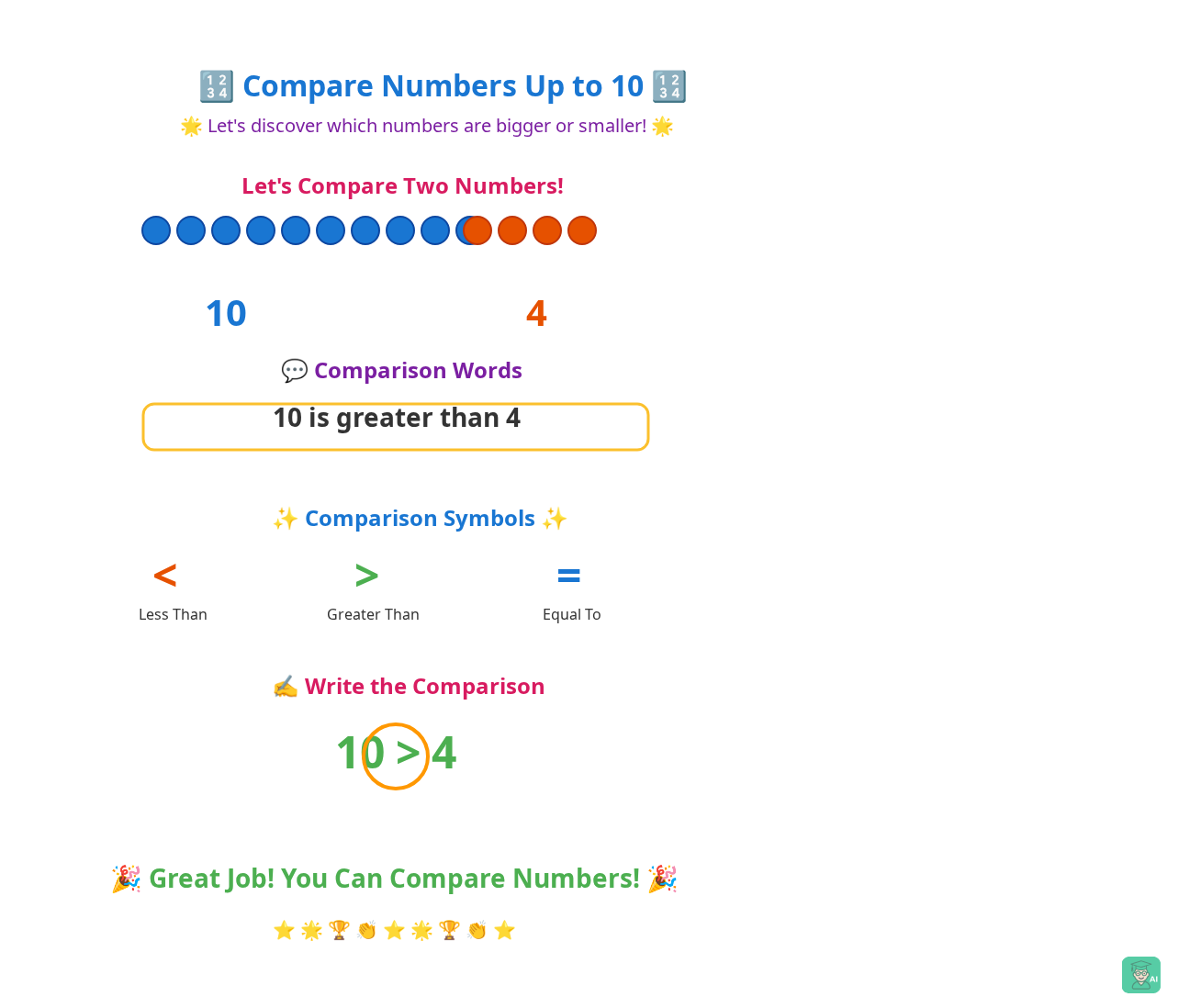
On AI Teacherly, the Compare Numbers Up to 10 lesson for 1st graders uses colorful visuals, engaging characters, and immediate feedback to keep children motivated. Here's what the full interactive lesson experience looks like:
Notice how the lesson uses bright colors and visual dot groups to represent quantities before introducing abstract symbols. This progression from concrete (pictures) to abstract (symbols) mirrors how children naturally learn mathematical concepts.
The lesson also incorporates the memorable alligator analogy directly in its teaching: "The alligator mouth always opens toward the bigger number. It wants to eat the most!" Students hear this explanation, see it demonstrated visually, and then practice applying it through interactive problems.
Key features that make digital practice effective:
- Immediate feedback: Children know right away if they're on track
- Multiple question types: Multiple choice, true/false, and fill-in-the-blank keep practice varied
- Progress tracking: Parents can see exactly which skills need more work
- Self-paced learning: No pressure, no rushing; children learn at their own speed
The combination of direct instruction, visual models, and varied practice problems creates a complete learning experience that builds genuine understanding, not just memorization.
Key Takeaways
- The alligator trick works: teach your child that the symbol's 'mouth' always opens toward the bigger number because the alligator wants to eat more
- Build understanding with words first (greater than, less than, equal to) before introducing symbols (<, >, =)
- Use everyday activities like snack comparisons and toy counting to practice number comparison naturally
- Watch for common mistakes like reading statements backward or confusing similar-looking symbols
- Interactive digital practice with immediate feedback accelerates learning and keeps kids engaged
- Number comparison builds essential number sense that supports all future math learning
Frequently Asked Questions
What is the easiest way to teach greater than and less than to a 1st grader?
The alligator trick is the most effective method. Teach your child that the comparison symbol is like an alligator's mouth that always opens toward the bigger number because it wants to eat more. This visual memory trick helps children consistently remember which way the symbol should point.
How does the alligator trick work for comparison symbols?
Imagine the > and < symbols as an alligator's open mouth. Since alligators are hungry and want the biggest meal, the open side always faces the larger number. For example, in 8 > 3, the mouth opens toward 8 because 8 is bigger.
Why does my child keep confusing the < and > symbols?
The symbols look nearly identical, just facing opposite directions, which makes them easy to mix up. Consistent practice with the alligator trick helps. Always ask your child: 'Which number is bigger? Point the alligator mouth toward it.' Repetition builds automatic recognition.
At what age should kids understand greater than and less than?
Most children learn comparison symbols in 1st grade, around ages 6-7. By the end of first grade, students should confidently compare numbers up to 100 and use the symbols correctly. However, some children grasp these concepts earlier with informal exposure.
What are fun ways to practice comparing numbers at home?
Try snack comparisons (which pile has more crackers?), toy counting challenges, number card games like 'War,' or building block towers to see which number is taller. Interactive online lessons also provide engaging practice with immediate feedback.
Should I teach comparison words or symbols first?
Start with words. Children should understand 'greater than,' 'less than,' and 'equal to' as concepts before connecting them to abstract symbols. Once the vocabulary is solid, introduce symbols as a shorthand way to write the same ideas.
How do I know if my child is struggling with number comparison?
Warning signs include consistently mixing up symbols, avoiding comparison problems, or guessing randomly instead of thinking through which number is bigger. If your child struggles with comparing single-digit numbers after consistent practice, consider extra support or interactive tools.
Is online tutoring effective for teaching math to 1st graders?
Yes, interactive online learning is highly effective for young children when it includes visual models, immediate feedback, and engaging activities. Platforms like AI Teacherly use colorful manipulatives and game-like elements that keep 1st graders motivated while building real understanding.
Ready to make number comparison click for your 1st grader? Try the interactive Compare Numbers Up to 10 lesson free on AI Teacherly and watch your child master those tricky symbols with confidence!