Teaching Multiples to 4th Graders: How Venn Diagrams Make Math Click
Discover how skip counting connects to multiples and why Venn diagrams create those "aha moments" for 4th graders learning common multiples and LCM. Practical tips for parents.
The Skip Counting Secret Your Child Already Knows
Here's something that might surprise you: your 4th grader has been working with multiples for years. They just didn't know the fancy math word for it.
Remember when your child learned to count by 2s? 2, 4, 6, 8, 10... That's finding multiples of 2. Counting by 5s to tell time? Those are multiples of 5. The concept isn't new; only the vocabulary is.
The challenge in 4th grade is connecting what kids already know (skip counting) to formal mathematical language and more complex applications. When children realize that multiples are simply "what you get when you skip count," the intimidation factor drops dramatically.
In this guide, you'll discover:
- A simple way to explain what multiples are using familiar concepts
- The division trick that checks any number instantly
- How Venn diagrams create visual "aha moments" for abstract math
- Real-world examples that make common multiples meaningful
Whether you're supporting homework, preparing for assessments, or just want to understand what your child is learning, this guide breaks down 4th grade multiples into parent-friendly language.
What Are Multiples and Why Do 4th Graders Learn Them?
Multiples are the numbers you get when you multiply a number by 1, 2, 3, 4, and so on. It's really that straightforward.
The multiples of 3 are: 3, 6, 9, 12, 15, 18... The multiples of 4 are: 4, 8, 12, 16, 20, 24...
Notice something? The list goes on forever. Every number has infinite multiples because you can always multiply by a bigger number.
Why This Matters in 4th Grade
Multiples form the foundation for several critical math skills coming up:
- Fraction operations: Finding common denominators requires understanding common multiples
- Division fluency: Recognizing multiples helps students divide more efficiently
- Number patterns: Multiples reveal predictable patterns that strengthen number sense
- Real-world problem solving: From sharing items equally to planning purchases, multiples appear everywhere
If your child struggled with multiplication facts earlier, multiples offer a fresh entry point. Rather than memorizing isolated facts, kids see multiplication as a pattern, as a relationship, as something predictable.
The Multiplication Connection
Here's the key insight: Multiples come from multiplication! Each multiple is just the number times the next number in sequence.
- 3 × 1 = 3 (first multiple of 3)
- 3 × 2 = 6 (second multiple of 3)
- 3 × 3 = 9 (third multiple of 3)
When kids see this connection, they stop viewing multiples as a separate topic and start recognizing them as multiplication in action.
How to Check If a Number Is a Multiple (The Division Trick)
Your child will encounter questions like: "Is 24 a multiple of 6?" or "Which numbers are multiples of 8?"
There's a reliable trick that works every time: divide and check for a remainder.
The Division Trick Step-by-Step
- Take the number you're checking (24)
- Divide it by the number you're testing (6)
- If there's no remainder, it's a multiple!
24 ÷ 6 = 4 with no remainder → Yes, 24 is a multiple of 6! 25 ÷ 6 = 4 with remainder 1 → No, 25 is NOT a multiple of 6.
Why This Method Works
When division comes out evenly, it means the smaller number "fits" into the larger number a whole number of times. That's exactly what a multiple is: a number that contains another number perfectly.
This trick also reinforces the relationship between multiplication and division. If 6 × 4 = 24, then 24 ÷ 6 = 4. They're two sides of the same coin.
Practice Questions to Try at Home
Ask your child these questions during dinner or car rides:
- Is 36 a multiple of 9? (Yes, 36 ÷ 9 = 4)
- Is 50 a multiple of 7? (No, 50 ÷ 7 = 7 remainder 1)
- Is 42 a multiple of 6? (Yes, 42 ÷ 6 = 7)
The more they practice this quick mental check, the more automatic it becomes. Soon they'll recognize multiples without consciously going through the division step.
What Is a Venn Diagram and How Does It Sort Multiples?
If you haven't seen a Venn diagram since your own school days, here's a quick refresher. A Venn diagram uses overlapping circles to show relationships between groups.
For multiples, the magic happens in the overlap.
Imagine two circles: one contains multiples of 3, the other contains multiples of 4. Most numbers belong in just one circle. But some numbers, like 12, 24, and 36, are multiples of BOTH 3 and 4. These special numbers go in the middle where the circles overlap.
How Kids Learn to Sort Multiples
In the AI Teacherly lesson Identify and Sort Multiples, students practice placing numbers into the correct sections of a Venn diagram. The process looks like this:
Check the first number: Is 9 a multiple of 3? Yes (9 ÷ 3 = 3). Is 9 a multiple of 4? No (9 ÷ 4 = 2 remainder 1). So 9 goes in the "3 only" section.
Check for overlaps: Is 12 a multiple of 3? Yes. Is 12 a multiple of 4? Yes. So 12 goes in the MIDDLE (overlap section).
Find the outsiders: Some numbers aren't multiples of either number. These go outside both circles.
Why Visual Sorting Matters
The Venn diagram transforms abstract number relationships into something kids can literally see. The overlap section isn't just a math concept; it's a physical space on the page where common multiples live.
This visual representation creates those "aha moments" when kids realize: "Oh! The numbers in the middle work for BOTH circles!" That understanding sticks far better than memorizing a definition.
Finding Common Multiples: Where the Magic Happens
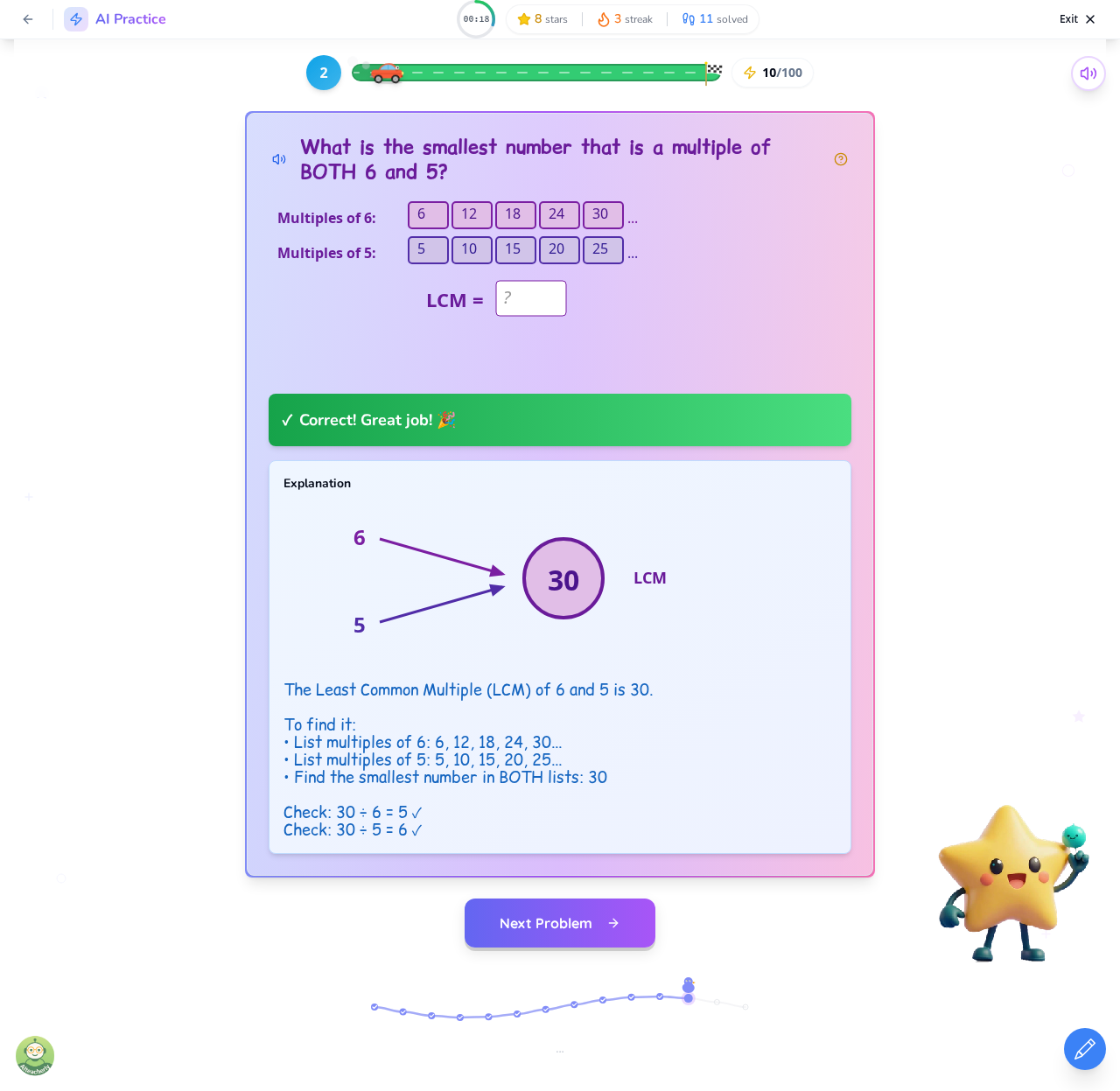
Common multiples are numbers that appear in the multiplication tables of two or more numbers. They're the special members of both clubs, the numbers that belong in that Venn diagram overlap.
Let's find the common multiples of 3 and 4:
Multiples of 3: 3, 6, 9, 12, 15, 18, 21, 24, 27, 30, 33, 36... Multiples of 4: 4, 8, 12, 16, 20, 24, 28, 32, 36, 40...
The numbers in bold (12, 24, 36) appear in BOTH lists. These are common multiples of 3 and 4.
The Least Common Multiple (LCM)
Among all common multiples, the smallest one has a special name: the Least Common Multiple or LCM.
For 3 and 4, the LCM is 12. It's the first number where both multiplication tables meet.
Why does the LCM matter? In 5th grade, your child will use LCMs constantly when adding and subtracting fractions with different denominators. Understanding this concept now makes fraction operations much smoother later.
The interactive problem below demonstrates exactly how students discover common multiples in the Venn diagram overlap.
How the Venn Diagram Reveals the LCM
When students complete a Venn diagram for multiples, the LCM becomes visually obvious. It's the smallest number sitting in that middle overlap section. There's no formula to memorize; kids simply find where the circles first intersect.
See How Interactive Venn Diagrams Make Multiples Click
Understanding multiples on paper is one thing. But when kids can drag numbers into circles, test their thinking, and get instant feedback, the learning goes deeper.
Here's what the full interactive lesson looks like on AI Teacherly:
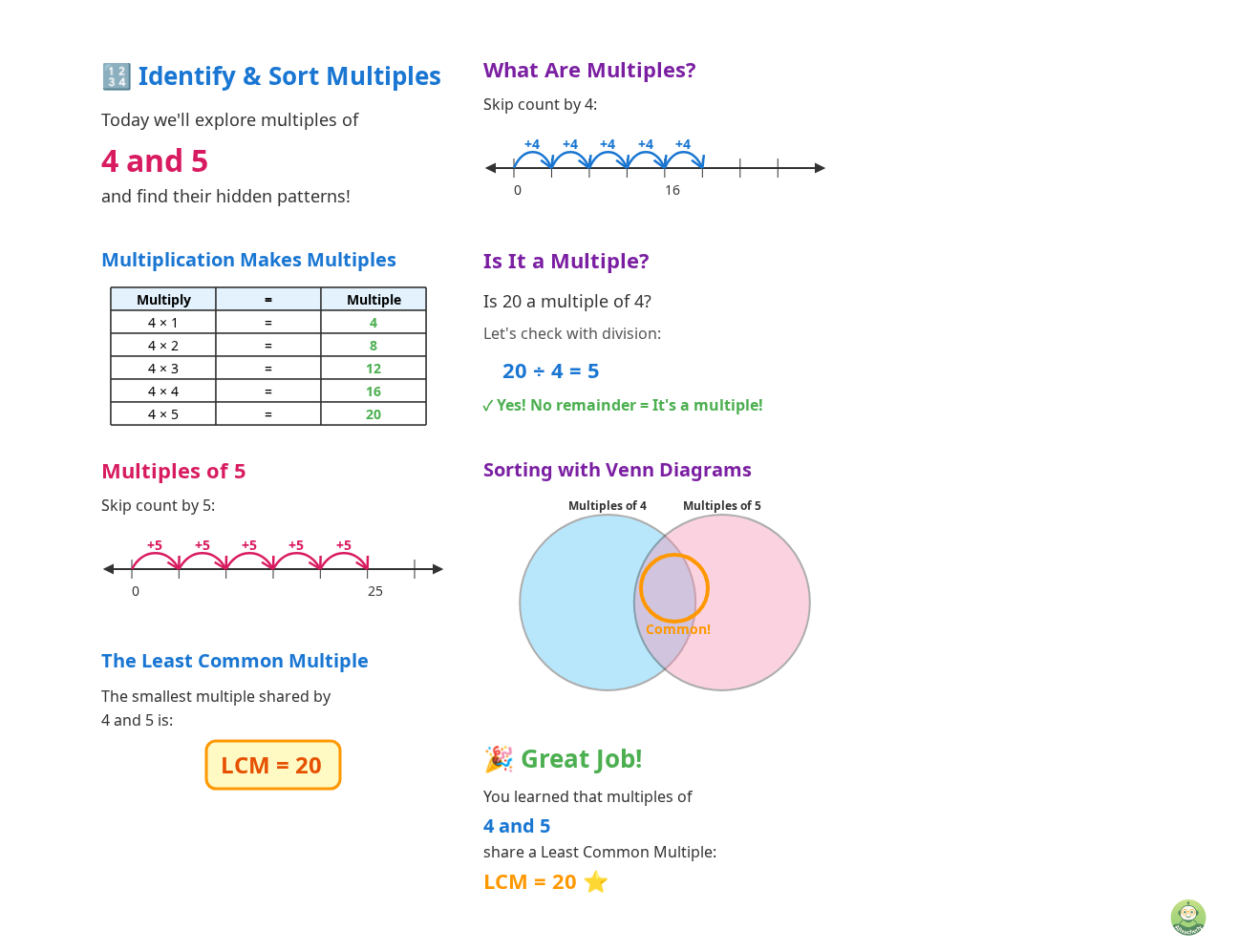
The Identify and Sort Multiples lesson on AI Teacherly guides students through this process step by step:
Section 1: Multiples on the Number Line Students see how skip counting creates a visual pattern. Each hop is the same distance, making multiples predictable and pattern-based rather than random.
Section 2: The Multiplication Connection Kids discover that multiples aren't a new concept; they're multiplication results. This connects new learning to existing knowledge.
Section 3: The Division Check Students practice the "no remainder" test with instant feedback. Wrong answers lead to explanations, not just corrections.
Section 4: Venn Diagram Sorting The heart of the lesson! Kids sort numbers into overlapping circles, discovering common multiples through active exploration.
Section 5: Real-World Applications Word problems show why multiples matter beyond the classroom.
Why Interactive Learning Works
Research shows that active problem-solving creates stronger memory traces than passive reading. When your child drags a number into the wrong circle and sees why it doesn't fit, they're learning from the mistake immediately. This trial-and-feedback loop accelerates understanding in ways worksheets simply can't match.
Real-World Multiples: From Hot Dogs to Race Tracks
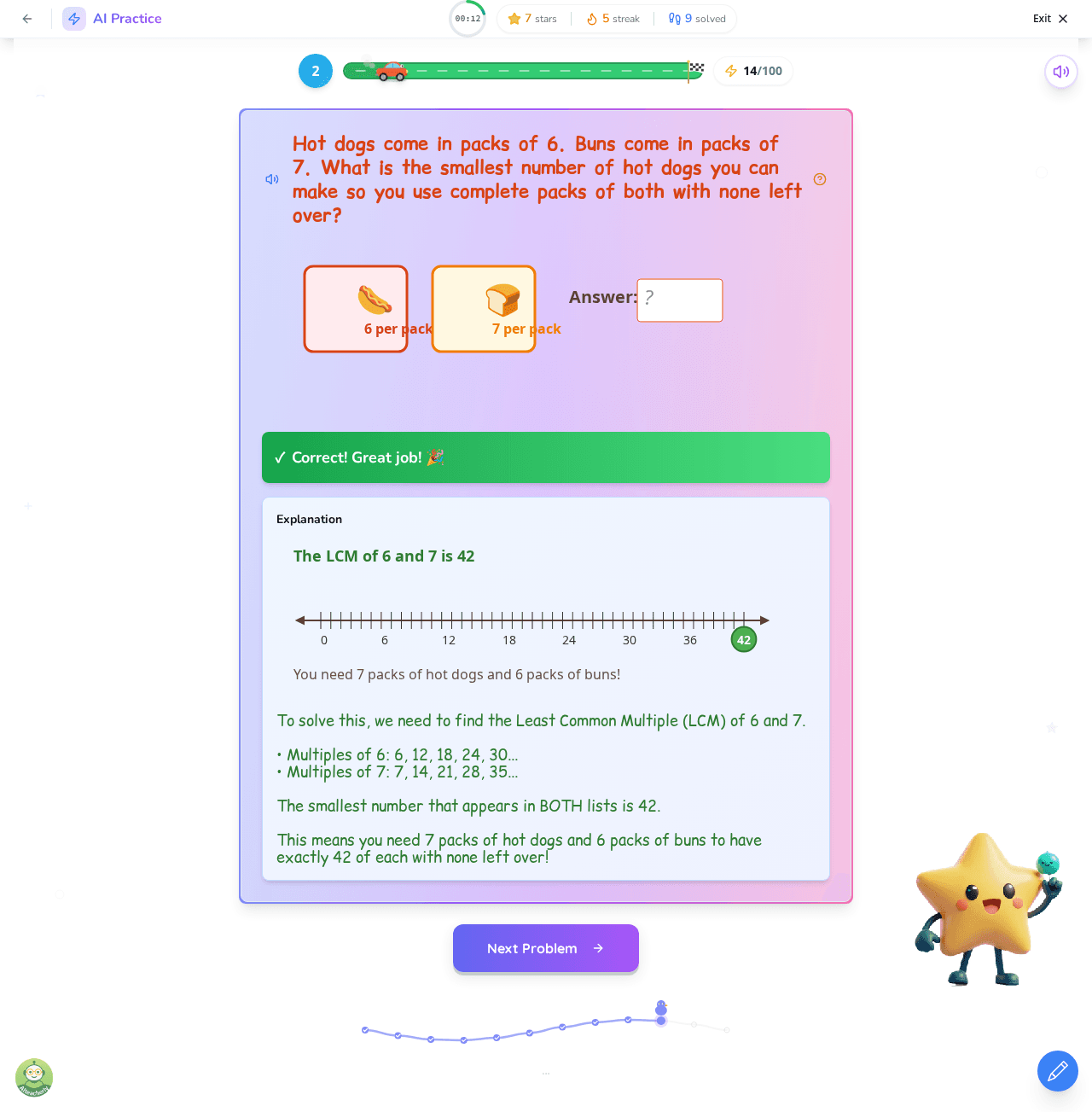
Math clicks when it connects to real life. Here are two classic LCM problems that show why multiples matter:
The Hot Dog Problem
Hot dogs come in packs of 8. Buns come in packs of 6. What's the smallest number of each you can buy so you have equal amounts with none left over?
This is an LCM problem in disguise! Students need to find a number that's a multiple of both 8 and 6.
Multiples of 8: 8, 16, 24, 32, 40, 48... Multiples of 6: 6, 12, 18, 24, 30, 36, 42, 48...
The LCM is 24. So you'd buy 3 packs of hot dogs (3 × 8 = 24) and 4 packs of buns (4 × 6 = 24). Perfect match!
The Running Track Problem
Sarah runs a lap every 3 minutes. James runs a lap every 4 minutes. They start at the same spot. When will they be at the start line together again?
Sarah's positions at the start: 3 min, 6 min, 9 min, 12 min, 15 min... James's positions at the start: 4 min, 8 min, 12 min, 16 min...
They meet again at 12 minutes (the LCM of 3 and 4).
Practice at Home
Look for multiples in everyday situations:
- Egg cartons (multiples of 6 or 12)
- Arranging chairs in equal rows
- Sharing snacks equally among friends
- Counting money (quarters are multiples of 25 cents)
When kids see that math isn't just a school subject but a tool for solving real problems, their motivation and engagement improve dramatically.
Key Takeaways
- Multiples are skip counting with math vocabulary: connect what kids already know to new terms
- Use the division trick: no remainder means yes, it's a multiple
- Venn diagrams make common multiples visible by showing the overlap between number groups
- The Least Common Multiple (LCM) is the smallest number in the overlap section
- Real-world problems like hot dogs and buns make abstract math meaningful and memorable
- Interactive practice with immediate feedback accelerates understanding far beyond worksheets
- Mastering multiples now builds the foundation for fraction operations in 5th grade
Frequently Asked Questions
What are multiples and how do I explain them to my child?
Multiples are the numbers you get when skip counting or multiplying a number by 1, 2, 3, and so on. Tell your child: 'Multiples are just skip counting! The multiples of 5 are 5, 10, 15, 20...' It connects new vocabulary to something they already know.
How do you check if a number is a multiple of another number?
Use the division trick: divide the number by the potential factor. If there's no remainder, it's a multiple! For example, 24 ÷ 6 = 4 with no remainder, so 24 is a multiple of 6.
What is a Venn diagram and how does it help with multiples?
A Venn diagram uses overlapping circles to sort numbers. One circle holds multiples of one number, another holds multiples of a second number, and the overlap shows common multiples of both. It makes abstract relationships visual.
What's the difference between factors and multiples?
Factors are numbers that divide evenly INTO a number (factors of 12 are 1, 2, 3, 4, 6, 12). Multiples are numbers you get FROM multiplying (multiples of 12 are 12, 24, 36...). Factors go into; multiples come from.
What is the Least Common Multiple (LCM)?
The LCM is the smallest number that's a multiple of two or more numbers. For 3 and 4, the LCM is 12 because it's the first number that appears in both multiplication tables. It's essential for adding fractions later.
Why do 4th graders need to learn about multiples?
Multiples are foundational for 5th grade fractions, especially finding common denominators. They also strengthen multiplication fluency, number pattern recognition, and real-world problem-solving skills like equal sharing.
Is it normal for kids to confuse factors and multiples?
Absolutely normal! Even adults mix them up. Help your child remember: factors are smaller numbers that fit INTO a number, while multiples are bigger numbers that come FROM multiplying. Practice both together to reinforce the difference.
How can I practice multiples with my child at home?
Use everyday moments: count by 3s while walking, find multiples on license plates, solve the hot dog and buns problem at the grocery store, or ask 'Is 36 a multiple of 9?' during car rides. Make it a quick game, not homework.
Ready to make multiples click for your 4th grader? Try the interactive Identify and Sort Multiples lesson free on AI Teacherly. Watch your child discover common multiples through hands-on Venn diagram activities that make abstract math visual and fun!