Teaching Multiplication to 3rd Graders: Equal Groups and Arrays Made Simple
When your 3rd grader brings home multiplication for the first time, don't panic. Learn the simple visual strategies teachers use so you can confidently explain equal groups and arrays at home.
Why Multiplication Feels Like a Big Leap for 3rd Graders
When your child comes home with multiplication homework for the first time, you might feel a flash of panic. "How do I explain this without confusing them?" You're not alone. Teaching multiplication to 3rd graders is one of the most common challenges parents face because it's the first truly "new" math operation kids encounter since kindergarten.
Unlike addition and subtraction, which kids build gradually through counting, multiplication requires a conceptual leap. Your child needs to understand that multiplication isn't just about memorizing times tables. It's about recognizing patterns in groups and seeing numbers in a completely new way.
The good news? Modern math instruction has evolved to make this transition smoother. Today's classrooms use visual strategies like equal groups and arrays that help children see what multiplication actually means before they ever memorize a single fact. And once you understand these strategies, you can use them at home to support your child's learning with confidence.
This guide will walk you through exactly how teachers introduce multiplication, so you can reinforce these concepts using the same language and methods your child encounters at school.
What Are Equal Groups in Multiplication?
At its core, multiplication is simply counting things that are organized into equal groups. The key word here is equal. Every group must have exactly the same number of items. This "fairness" concept is something kids can grasp intuitively.
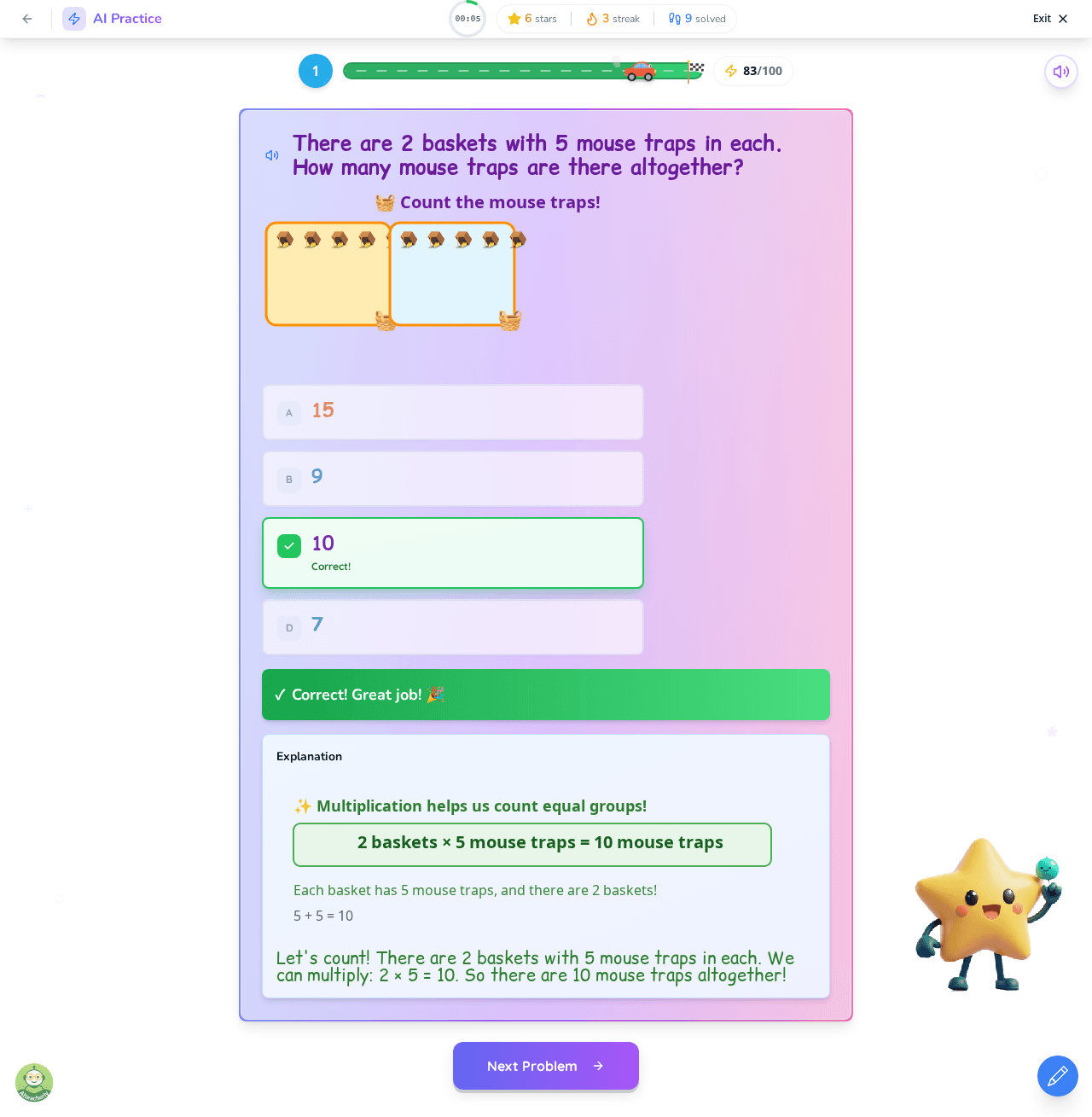
Think about it this way: if you have 4 bags of apples and each bag contains 3 apples, that's an equal groups situation. Every bag has the same amount. Instead of counting all 12 apples one by one (or adding 3+3+3+3), multiplication gives us a shortcut: 4 × 3 = 12.
How to read a multiplication expression:
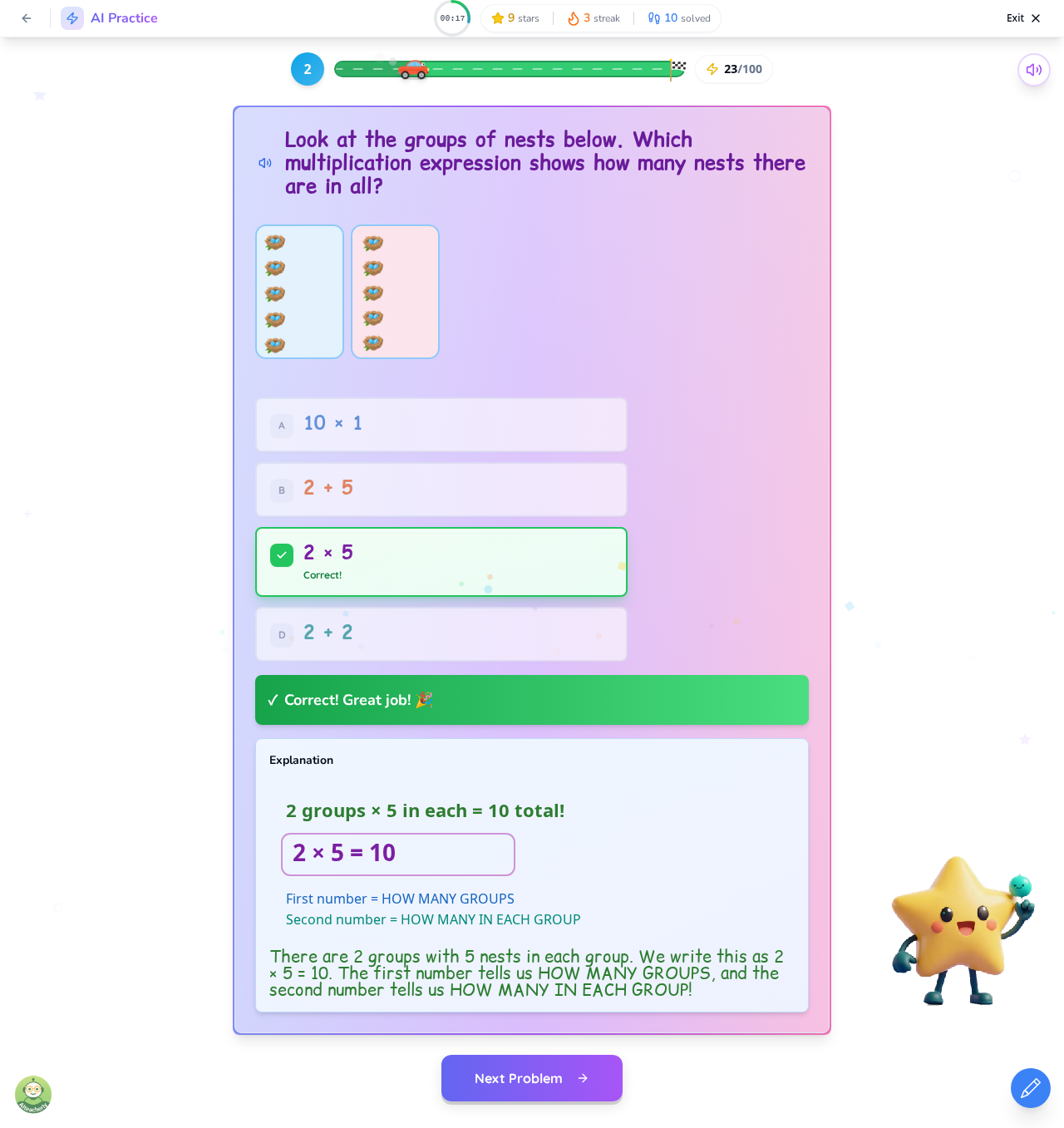
- The first number tells us how many groups we have
- The second number tells us how many items are in each group
- The answer is called the product
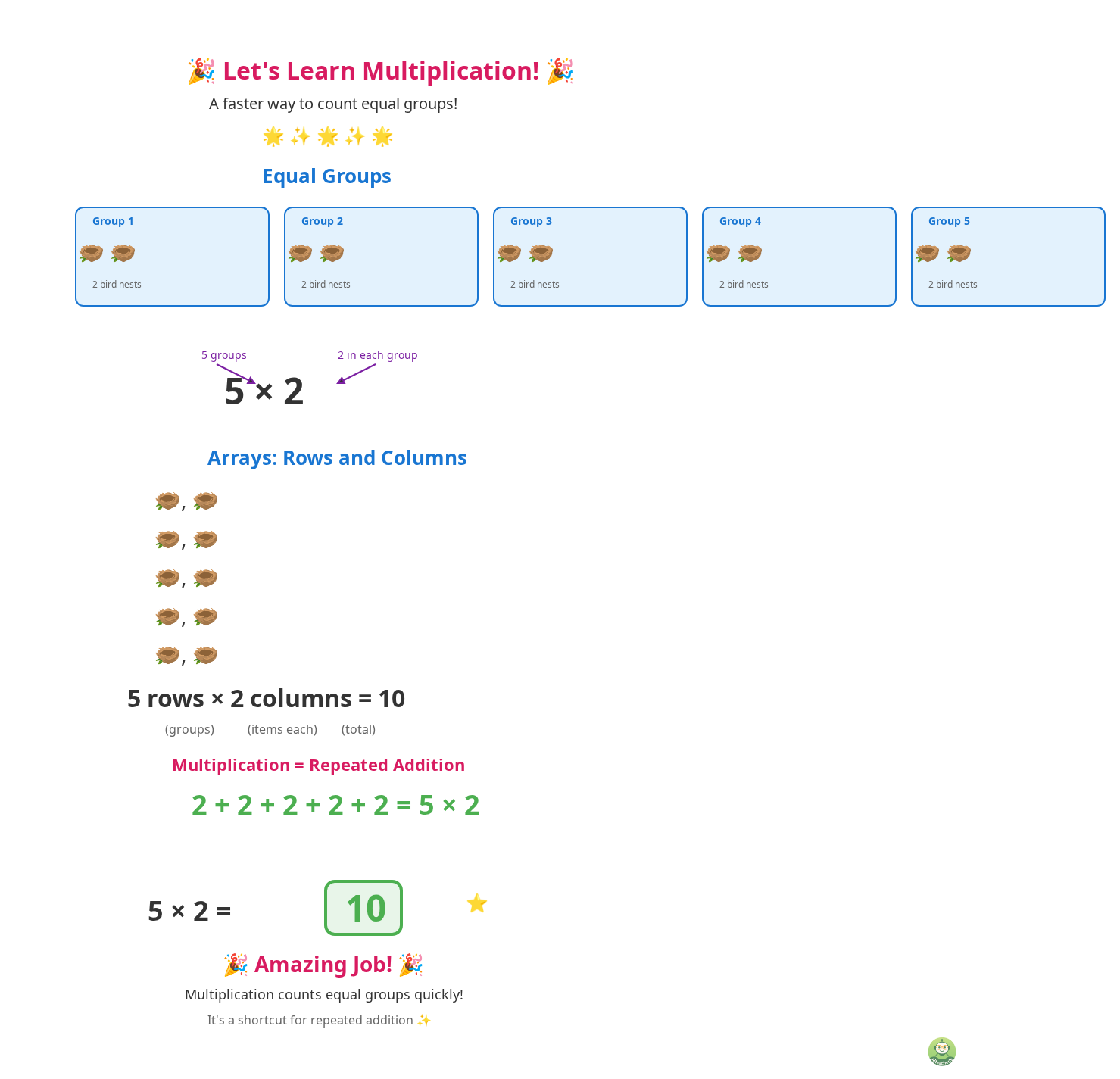
So when your child sees 5 × 2, they should think: "5 groups with 2 in each group."
You can practice this concept anywhere. At the grocery store, count egg cartons (how many rows? how many eggs per row?). At home, arrange snacks into equal groups on plates. The more your child sees equal groups in everyday life, the more natural multiplication becomes.
The interactive problem below shows exactly how equal groups work in practice, giving kids a visual way to count and understand multiplication.
How Do Arrays Help Kids Visualize Multiplication?
Once kids understand equal groups, teachers introduce arrays. An array is simply equal groups arranged neatly into rows and columns, like a grid or a chocolate bar divided into squares.
Arrays are powerful because they help children see multiplication facts in an organized way. Instead of loose groups scattered around, everything lines up. This makes counting easier and helps kids discover important patterns.
The beauty of arrays:
- Rows go across (left to right)
- Columns go up and down
- You can count rows × items per row OR columns × items per column
Here's where it gets exciting: arrays help kids discover the commutative property naturally. A 3×4 array (3 rows of 4) has the same total as a 4×3 array (4 rows of 3). When kids see this visually, they realize that 3 × 4 and 4 × 3 both equal 12. That's one less fact to memorize!
Try this at home: Use square crackers, coins, or building blocks to create arrays. Ask your child: "How many rows? How many in each row? What's the total?" Then rearrange the same objects into a different array and watch them discover it's the same product.
Arrays also prepare kids for more advanced concepts like area (length × width) that they'll encounter in later grades. By building a strong visual foundation now, you're setting your child up for future math success.
The Secret Connection: Multiplication Is Repeated Addition
Here's a secret that makes multiplication click for many kids: multiplication is just repeated addition made faster.
When your child already knows that 3 + 3 + 3 + 3 = 12, you can show them that 4 × 3 is simply a quicker way to write the same thing. This connection is incredibly powerful because it builds on what kids already know (addition) to introduce something new (multiplication).
Show them the transformation:
- 2 + 2 + 2 = 6 becomes 3 × 2 = 6 (three groups of 2)
- 5 + 5 + 5 + 5 = 20 becomes 4 × 5 = 20 (four groups of 5)
- 10 + 10 + 10 = 30 becomes 3 × 10 = 30 (three groups of 10)
As one lesson explains it: "Multiplication is a super fast way to count things when they're in equal groups." When kids understand this, multiplication stops feeling like a scary new operation and starts feeling like a helpful shortcut they already had the pieces to understand.
Why this matters for confidence: Kids who see multiplication as "fast addition" don't freeze when they forget a fact. They know they can fall back on adding if needed. This safety net reduces math anxiety and encourages them to keep practicing until the facts become automatic.
The key is letting your child make this discovery themselves. Show them a repeated addition problem, then the multiplication version, and ask: "Do you notice anything?" That "aha moment" when they see the connection is worth more than any flashcard drill.
Special Rules: Why Anything Times 0 or 1 Works the Way It Does
Two multiplication rules often confuse kids (and sometimes parents!): the zero property and the identity property. But when you explain them through equal groups, they make perfect sense.
The Zero Property: Any number × 0 = 0
Ask your child: "If you have 5 bags, but each bag has 0 apples, how many apples do you have?" Obviously, none! Zero groups of anything is nothing. And any number of groups with nothing in them is still nothing.
- 7 × 0 = 0 (seven groups with zero in each)
- 0 × 4 = 0 (zero groups of 4... no groups at all!)
The Identity Property: Any number × 1 = that number
Now ask: "If you have just 1 group with 6 toys, how many toys do you have?" Six! One group of any amount is just that amount.
- 8 × 1 = 8 (one group of 8)
- 1 × 5 = 5 (five groups, but only 1 in each group)
Why these properties matter: These aren't just rules to memorize. Understanding WHY they work gives kids mathematical reasoning skills. When your child can explain that "5 × 0 is zero because there's nothing in the groups," they're thinking like a mathematician, not just reciting facts.
These properties also cut down the number of facts kids need to memorize. If they know anything times 0 or 1 is automatic, that eliminates a huge chunk of the times table right away!
Easy Ways to Practice Multiplication at Home
The best multiplication practice doesn't feel like homework. Here are proven ways to reinforce these concepts without worksheets or flashcard battles:
1. Snack Math Arrange crackers, grapes, or candies into equal groups. "Can you make 3 groups of 4? How many total?" Then eat them as a reward!
2. Egg Carton Exploration A standard egg carton is a built-in array. Ask: "2 rows of 6 eggs... how many total?" Cut off sections to create different arrays.
3. Window Pane Arrays Count the panes in windows around your home or neighborhood. "That window has 2 rows of 3 panes. What's 2 × 3?"
4. LEGO Math LEGO bricks are perfect arrays! A 2×4 brick shows 2 × 4 = 8 studs. Build different combinations and count.
5. Storybook Multiplication Make up word problems during car rides: "If 4 friends each have 2 cookies, how many cookies altogether?"
6. Dice Games Roll two dice. Multiply the numbers. First to reach 100 wins! This makes practice feel like a game.
7. Interactive Digital Practice Online platforms with visual problems let kids practice equal groups and arrays with immediate feedback. This is especially helpful for kids who need to see concepts repeatedly before they click.
The key principle: Keep sessions short (10-15 minutes), make it playful, and always connect back to equal groups and arrays. Consistent, low-pressure practice beats occasional drilling every time.
See How Interactive Learning Makes Multiplication Click
While hands-on activities at home are valuable, interactive digital lessons offer something unique: visual animations that show mathematical concepts in motion.
In AI Teacherly's Introduction to Multiplication: Equal Groups and Arrays lesson for Grade 3, students don't just look at static pictures. They watch equal groups transform into arrays. They see repeated addition equations morph into multiplication expressions. These animated transitions create "aha moments" that stick.
The lesson builds understanding step by step:
- First, students explore what makes groups "equal"
- Then, they learn to read multiplication expressions (groups × items per group)
- Next, they discover how arrays organize equal groups
- Finally, they connect multiplication to the repeated addition they already know
Each concept includes interactive practice problems where kids manipulate visual models and receive immediate feedback. When a child gets stuck, they can see the visual representation again rather than just being told the answer.
Here's what the full interactive lesson looks like on AI Teacherly:
The combination of storytelling, visual models, and interactive practice addresses different learning styles. Visual learners see the concepts. Kinesthetic learners interact with problems. And everyone benefits from the patient, repeatable explanations that busy parents can't always provide after a long day.
For parents, this means guilt-free screen time that actually builds math skills.
Key Takeaways for Parents
Teaching multiplication to 3rd graders doesn't require a math degree. Here's what to remember:
Equal groups are the foundation. Every group must have the same number of items. Practice spotting equal groups everywhere.
Arrays organize equal groups. Rows and columns make multiplication visible and help kids discover patterns like the commutative property.
Multiplication is repeated addition. Building on what kids already know reduces anxiety and provides a fallback when they forget facts.
Zero and one rules make sense. Zero groups = nothing. One group = just that amount. Help kids reason through these rather than memorize blindly.
Practice should feel playful. Snacks, LEGOs, dice games, and interactive lessons beat worksheet drilling for building lasting understanding.
Conceptual understanding comes before memorization. Kids who understand why multiplication works eventually memorize facts faster than those who try to memorize without understanding.
You're capable of helping. The strategies in this guide are the same ones teachers use. Use the same language, and you'll reinforce school learning perfectly.
Key Takeaways
- Equal groups are the foundation of multiplication, and every group must have the same number of items
- Arrays (rows and columns) help kids visualize multiplication and discover the commutative property
- Multiplication is simply repeated addition made faster, which builds on what kids already know
- The zero property (anything × 0 = 0) and identity property (anything × 1 = that number) make sense when explained through equal groups
- Practice multiplication at home using snacks, egg cartons, LEGOs, and everyday objects
- Interactive visual lessons help kids see mathematical concepts in motion for deeper understanding
- Conceptual understanding should come before fact memorization for lasting math confidence
Frequently Asked Questions
What are equal groups in multiplication and why do they matter?
Equal groups are collections where every group has exactly the same number of items. They matter because multiplication is essentially counting equal groups quickly. Understanding this concept helps kids see multiplication as logical, not just memorization.
How do I explain arrays to my child in a simple way?
Tell them an array is just equal groups organized into neat rows and columns, like a chocolate bar or window panes. Rows go across, columns go up and down. Count rows times items per row to find the total.
Why do teachers connect multiplication to repeated addition?
Because it builds on what kids already know. Showing that 4 × 3 is the same as 3+3+3+3 reduces anxiety and gives kids a fallback strategy when they forget multiplication facts.
Is it normal for 3rd graders to struggle with multiplication at first?
Absolutely. Multiplication is the first truly new operation since kindergarten. Most kids need multiple exposures with visual models before it clicks. Patience and consistent practice are key.
What everyday objects can I use to practice multiplication at home?
Egg cartons, snacks arranged in groups, LEGO bricks, window panes, dice, and coins all work great. Any objects you can arrange into equal groups or arrays help make multiplication concrete.
What's the difference between equal groups and arrays?
Equal groups can be scattered anywhere, while arrays arrange those same groups into organized rows and columns. Arrays make patterns easier to see but represent the same math concept.
How do I explain why anything times zero equals zero?
Use equal groups: If you have 5 bags with 0 items in each, you have nothing. Zero groups of anything is also nothing. The visual explanation makes the rule obvious.
When should my child have multiplication facts memorized?
Most curricula expect basic fact fluency by the end of 3rd or early 4th grade. But understanding should come first. Kids who understand the concepts eventually memorize faster than those who drill without comprehension.
Ready to make multiplication click for your 3rd grader? Try the interactive Equal Groups and Arrays lesson free on AI Teacherly and watch those "aha moments" happen!