Teaching Multiplication with Equal Groups and Arrays: A Parent's Complete Guide for 3rd Grade Success
Your 3rd grader is learning multiplication, and it looks different from how you learned it. Discover how equal groups and arrays make multiplication intuitive before memorizing times tables.
Why Multiplication Feels Like a Big Deal in 3rd Grade
Third grade marks one of the most significant math milestones in your child's elementary school journey: the introduction of multiplication. If you've noticed your child bringing home worksheets filled with pictures, groups of objects, and arrays instead of traditional times tables, you're not alone in wondering what's happening.
Here's the reassuring truth: teaching multiplication with equal groups is actually a more effective approach than jumping straight into memorization. Modern math education focuses on building conceptual understanding first, which means your child will truly understand why 3 × 4 = 12 before being asked to memorize it.
The good news? You don't need to remember your times tables perfectly to support your 3rd grader's multiplication journey. The visual methods schools use today, including equal groups and arrays, are intuitive strategies that you can easily reinforce at home. This guide will walk you through exactly what these concepts mean, why they matter, and how you can confidently support your child's learning.
What Are Equal Groups in Multiplication?
Equal groups are the foundation of multiplicative thinking. Simply put, equal groups means organizing items so that every group has the same number of objects. This concept is the cornerstone of teaching multiplication with equal groups.
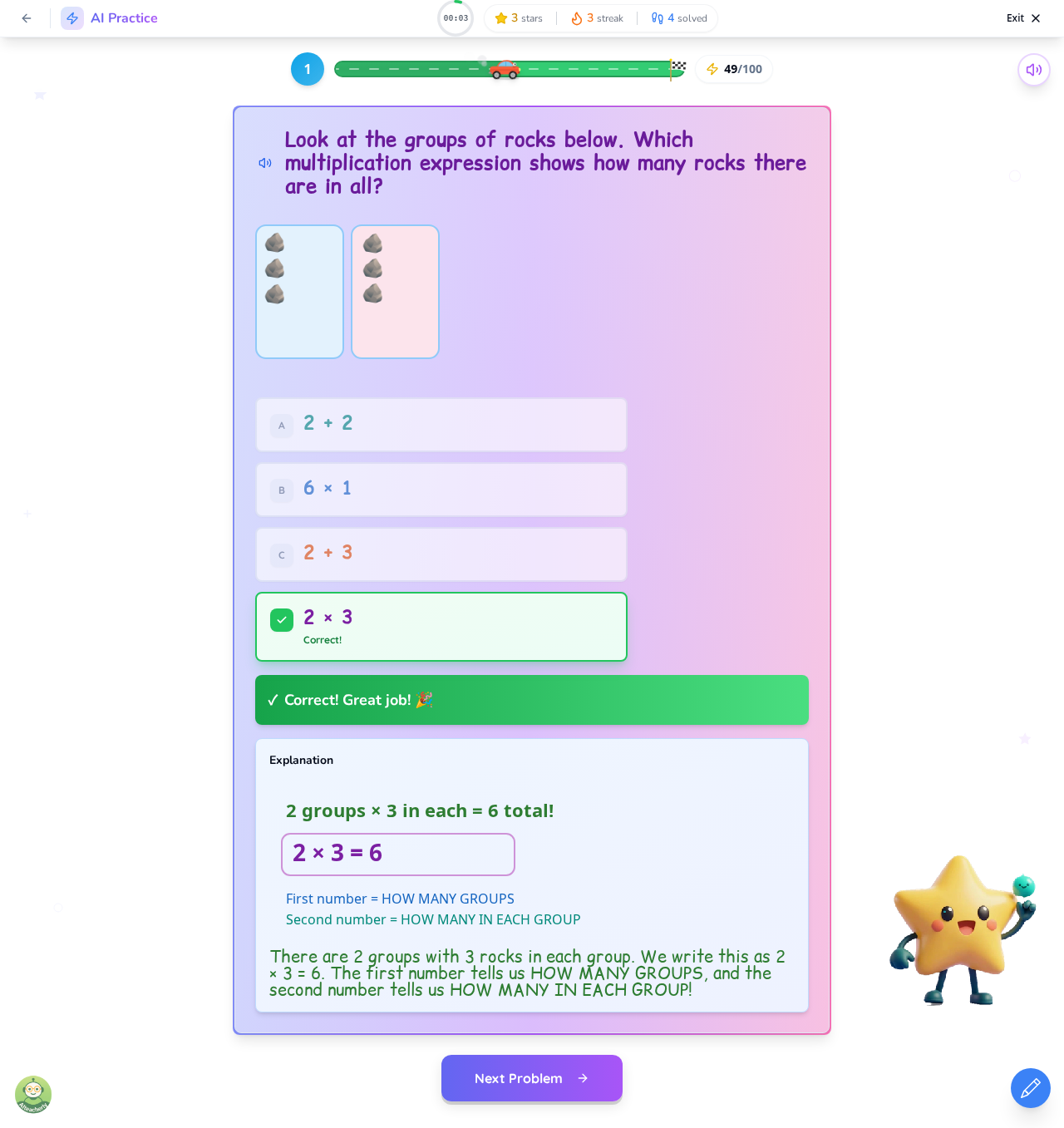
Imagine your child has 12 stickers and wants to share them equally among 3 friends. Each friend would get 4 stickers. That's 3 groups of 4, which we write as 3 × 4 = 12. The first number tells us how many groups, and the second number tells us how many in each group.
Why do teachers start with equal groups?
Because multiplication is essentially a faster way to count items arranged in equal groups. When children understand this connection, they're not just memorizing facts; they're building number sense that will serve them throughout their math education.
Real-world examples make this concept click:
- 4 baskets with 5 apples each = 4 × 5 = 20 apples
- 3 shelves with 6 books each = 3 × 6 = 18 books
- 5 hands with 5 fingers each = 5 × 5 = 25 fingers
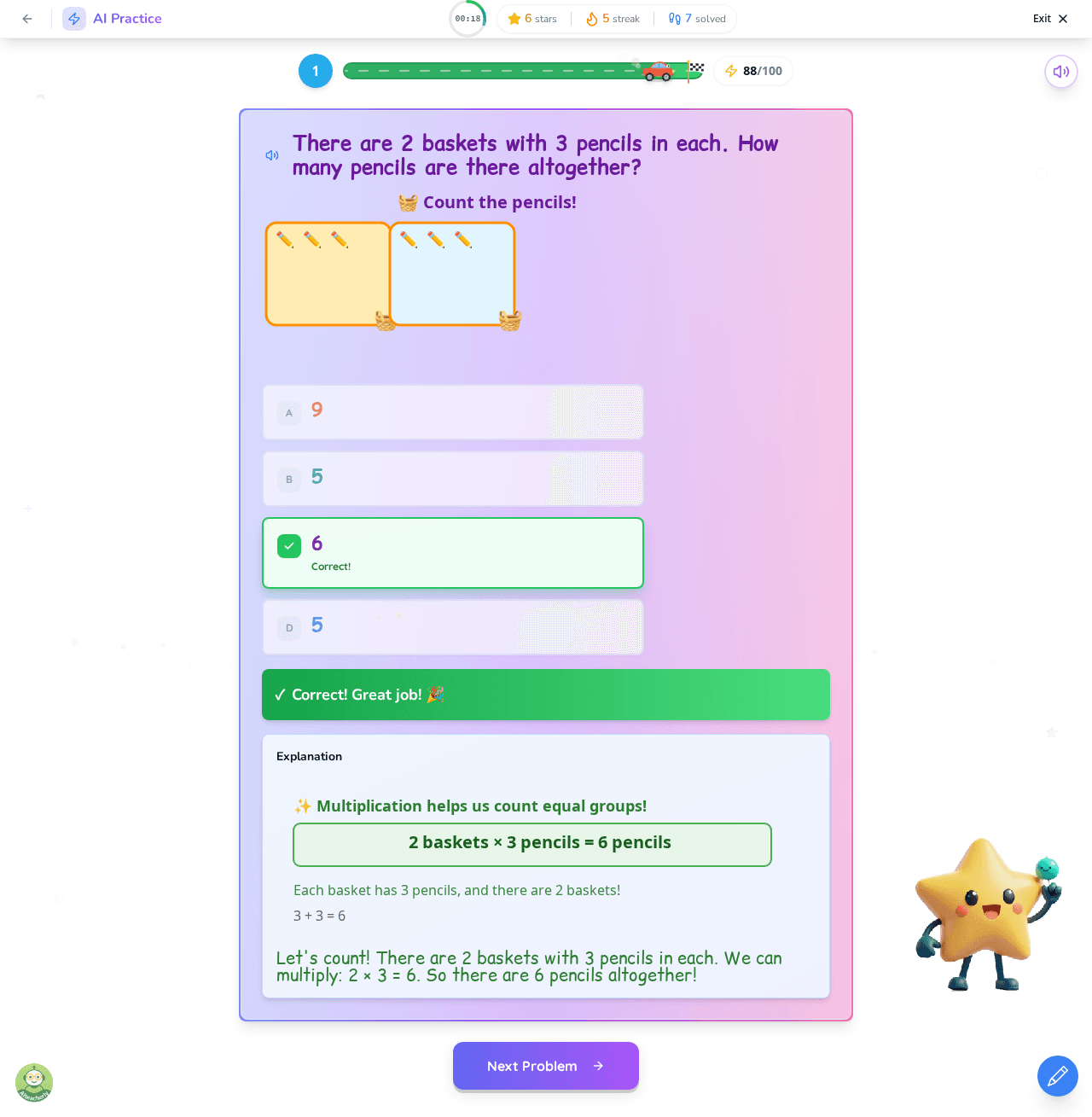
The interactive problem below shows exactly how equal groups work in practice.
When your child can look at grouped objects and immediately see a multiplication equation, they've developed true multiplicative thinking rather than rote memorization.
How Do Arrays Help Children Visualize Multiplication?
Arrays take the equal groups concept and organize it into a powerful visual structure. An array is simply a set of objects arranged in rows and columns, like seats in a movie theater or eggs in a carton.
Here's the beautiful thing about arrays: they show children that the same multiplication fact can be represented in multiple ways. A 3 × 4 array (3 rows with 4 objects in each) contains the exact same number of items as a 4 × 3 array (4 rows with 3 in each). This visual proof of the commutative property (that 3 × 4 = 4 × 3) is far more powerful than simply being told it's true.
How arrays connect to equal groups:
Rows become your groups, and columns show how many items are in each group. Same multiplication concept, just organized differently!
Why arrays matter for future math:
Arrays aren't just a teaching tool for multiplication. They lay the groundwork for:
- Understanding area (length × width)
- Working with grids and coordinates
- Grasping data tables and matrices in higher math
When your child draws an array to solve 4 × 6, they're not taking the "easy way out." They're building spatial reasoning skills that will benefit them for years to come. Encourage array drawing as a legitimate problem-solving strategy, not a crutch to avoid memorization.
The Secret Connection: Repeated Addition and Multiplication
Here's the "secret" that makes multiplication click for many children: multiplication is just a shortcut for adding the same number over and over. This connection between repeated addition and multiplication bridges what kids already know (addition) with what they're learning (multiplication).
Consider 4 × 3. This means "4 groups of 3," which is the same as: 3 + 3 + 3 + 3 = 12
When children see that multiplication gives them the same answer as repeated addition, but faster, they understand why multiplication exists. It's not an arbitrary rule to memorize; it's a mathematical shortcut that makes calculations more efficient.
How to reinforce this connection at home:
- Start with addition: "We have 5 bags with 4 cookies each. Let's count: 4 + 4 + 4 + 4 + 4 = 20"
- Introduce the shortcut: "That's a lot of adding! There's a faster way: 5 × 4 = 20"
- Let them discover: Give your child problems and let them figure out when multiplication saves time
This approach prevents the frustration that comes from memorizing without understanding. When your child truly grasps that 7 × 8 means "eight added together seven times," they have a backup strategy if they forget the memorized fact. They can figure it out because they understand what multiplication means.
Understanding the Rules for Multiplying by 0 and 1
Two multiplication rules often confuse children when taught without context: multiplying by zero and multiplying by one. But when explained through equal groups, these rules become unforgettable.
The Zero Rule: Why 5 × 0 = 0
Imagine 5 baskets with 0 apples in each basket. How many apples total? Zero! No matter how many groups you have, if each group has nothing in it, you end up with nothing.
5 × 0 = 0 (Five groups of zero is zero)
This also works the other way: 0 × 5 = 0 (Zero groups of five is still zero, because you have no groups at all!)
The Identity Rule: Why 5 × 1 = 5
Now imagine 5 baskets with exactly 1 apple in each basket. Count them up: 1 + 1 + 1 + 1 + 1 = 5 apples.
5 × 1 = 5 (Five groups of one is five)
And 1 × 5 = 5 (One group of five is just five)
Why this matters:
When children understand these rules through the equal groups model, they never forget them. They're not memorizing arbitrary facts; they're applying logical reasoning. If your child ever gets stuck on a "times zero" or "times one" problem, encourage them to draw it out with groups. The answer will become obvious.
Practice Multiplication with Interactive Lessons
Understanding concepts is crucial, but practice solidifies learning. The key is finding the right kind of practice: engaging, visual, and appropriately challenging.
Interactive lessons that use equal groups and arrays help children practice multiplication in a way that reinforces understanding rather than just drilling memorization. When kids can drag and drop items into groups, watch arrays form, and see the connection between pictures and equations, learning sticks.
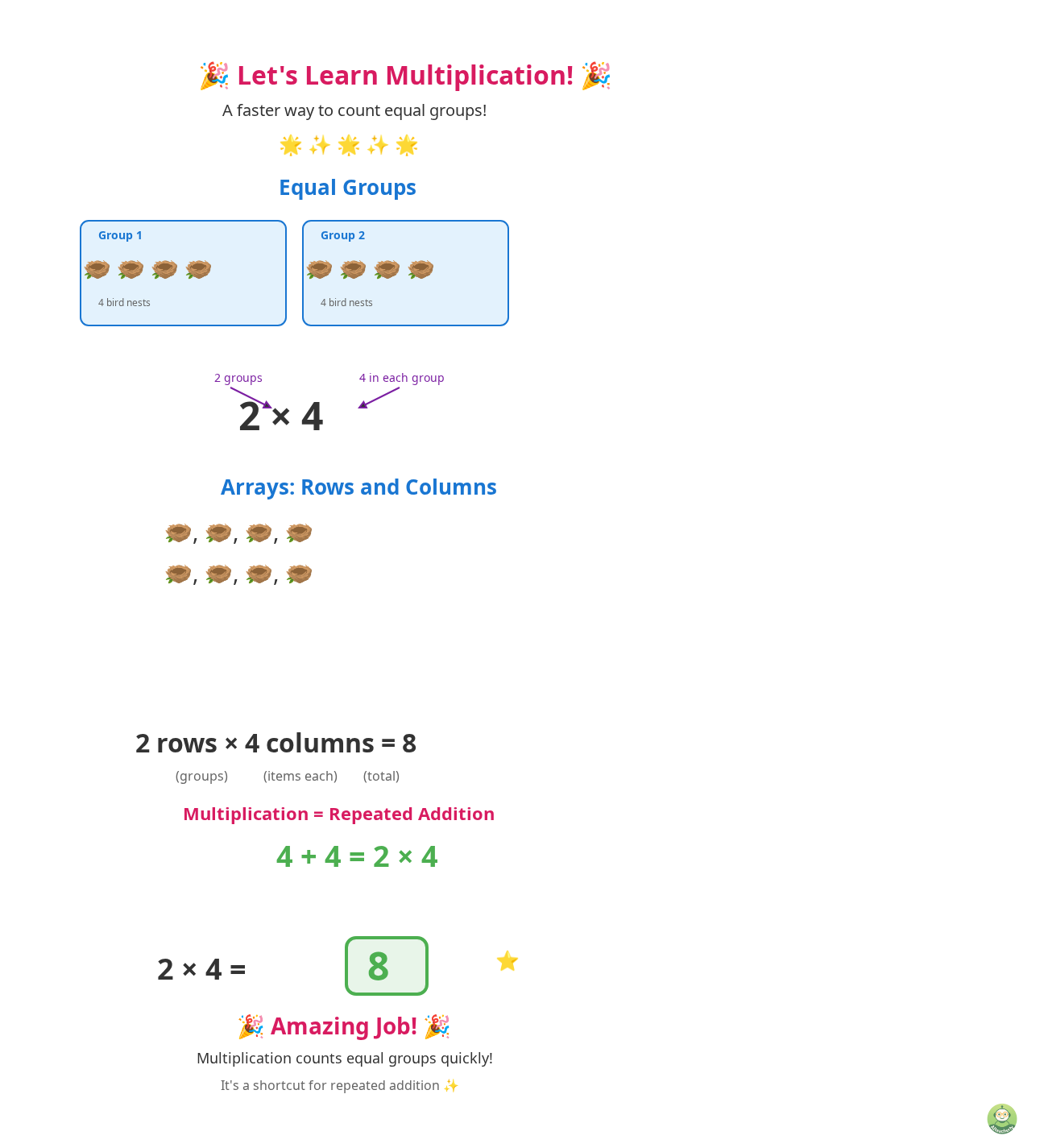
Here's what the full interactive lesson looks like on AI Teacherly:
What makes interactive practice effective:
- Visual feedback: Children see the groups and arrays they're working with
- Immediate correction: Mistakes become learning moments, not sources of frustration
- Progressive difficulty: Problems build on each other, scaffolding understanding
- Multiple representations: The same fact shown as groups, arrays, repeated addition, and equations
In AI Teacherly's Introduction to Multiplication: Equal Groups and Arrays lesson, 3rd graders explore multiplication through guided discovery. The lesson includes narrated explanations that break down concepts step by step, followed by interactive practice problems where students apply what they've learned.
Tips for supporting practice at home:
- Keep sessions short: 15-20 minutes of focused practice beats an hour of frustrated drilling
- Celebrate understanding over speed: Ask "How did you figure that out?" rather than timing them
- Connect to real life: Count items in groups at the grocery store, during cooking, or while playing games
Key Takeaways
- Equal groups are the foundation of multiplication: every group must have the same number of items, and understanding this concept builds true number sense
- Arrays organize equal groups into rows and columns, helping children visualize multiplication and preparing them for area, grids, and advanced math
- Multiplication is a shortcut for repeated addition: showing this connection helps children understand WHY multiplication works, not just memorize facts
- The zero and one rules make sense through equal groups: 5 × 0 = 0 because zero items in each group means zero total; 5 × 1 = 5 because one item per group means just five
- Visual practice before flashcards prevents the 'I hate math' frustration that comes from memorizing without understanding
- Interactive lessons with drag-and-drop groups and arrays reinforce concepts while keeping children engaged
Frequently Asked Questions
What are equal groups in multiplication and why do teachers use them?
Equal groups are sets of items where every group has the same number. Teachers use them because they help children understand that multiplication means counting groups of equal size, building conceptual understanding before memorization.
How do arrays help children understand multiplication?
Arrays arrange objects in rows and columns, showing children that 3×4 and 4×3 have the same total. This visual proof of the commutative property is more powerful than memorizing rules, and arrays prepare kids for area concepts later.
Is repeated addition the same as multiplication?
Yes! Multiplication is a shortcut for repeated addition. 4×3 means 3+3+3+3=12. Understanding this connection gives children a backup strategy when they forget a memorized fact.
Why isn't my child just memorizing times tables like I did?
Modern math education builds conceptual understanding first because research shows children retain facts better when they understand why they work. Memorization comes after understanding, leading to stronger long-term retention.
What grade do kids start learning multiplication?
Most curricula formally introduce multiplication in 3rd grade, though children may encounter equal groups and skip counting earlier. By end of 3rd grade, students typically work on memorizing facts through 10×10.
How can I practice multiplication at home without worksheets?
Use real-world situations: count items in groups at stores, divide snacks equally, arrange toys in arrays, or play multiplication card games. Interactive apps with visual problems also make practice engaging.
How long does it take for a child to learn basic multiplication facts?
With consistent practice, most children develop fluency with basic facts over the course of 3rd grade. Focus on understanding first; speed and automaticity develop naturally with continued exposure and practice.
What if my child is struggling with multiplication in 3rd grade?
Return to concrete visuals: draw equal groups, build arrays with objects, and connect to repeated addition. Interactive lessons with visual manipulatives can help struggling learners see what multiplication means before memorizing.
Ready to make multiplication click for your 3rd grader? Try the Introduction to Multiplication: Equal Groups and Arrays lesson free on AI Teacherly and watch visual learning transform math time!