Teaching Patterns to Kindergarteners: Fun Color and Shape Activities for Early Math Success
Pattern recognition isn't just play; it's the foundation of algebraic thinking. Discover fun, practical ways to teach patterns to your kindergartener at home with engaging color and shape activities.

The Hidden Math Skill Your Kindergartener Is Building Right Now
That colorful activity your kindergartener is doing with shapes and colors? It's not just play. It's building the exact brain pathways they'll use for algebra, coding, and problem-solving years from now.
When your child spots that red, blue, red, blue sequence and shouts "Red comes next!" they're doing something remarkable. They're recognizing patterns, and this seemingly simple skill is actually the foundation of mathematical thinking.
Many parents underestimate how important pattern recognition is for early math development. Research shows that children who master basic patterns in kindergarten perform significantly better in mathematics throughout elementary school. The good news? Teaching patterns to kindergarteners is easier than you might think, and you don't need to be a math whiz yourself.
In this guide, you'll discover exactly what pattern recognition means for your child's future, practical activities you can do at home, and how interactive learning tools make pattern practice genuinely fun. Whether your kindergartener is just starting out or ready for more complex challenges, you'll find everything you need to support their pattern learning journey.
What Is Pattern Recognition and Why Does It Matter for Math?
Pattern recognition is the ability to identify and predict repeating sequences. For kindergarteners, this starts with simple patterns like alternating colors (red, blue, red, blue) or shapes (circle, square, circle, square).
But here's what many parents don't realize: pattern recognition isn't just a kindergarten checkbox. It's the foundation of algebraic thinking. When mathematicians talk about early algebraic reasoning, they're talking about the skills your five-year-old develops while playing with colored blocks.
Why patterns matter so much:
- Number sense development: Counting itself is a pattern (1, 2, 3, 4...). Children who understand patterns grasp number sequences more easily.
- Problem-solving skills: Recognizing patterns helps children predict outcomes and make logical connections.
- Future math success: Skip counting, multiplication tables, and algebraic equations all rely on pattern recognition.
- Critical thinking: Patterns teach children to look for structure and organization in information.
The concept that makes pattern learning click is understanding the core unit. This is the part of the pattern that repeats. When your child can identify "red, blue" as the core unit that keeps repeating, they've grasped the fundamental principle. This skill transfers directly to understanding place value, multiplication, and even coding sequences later in their education.
How Do I Teach My Kindergartener About Patterns?
Teaching patterns to kindergarteners works best when you break it down into three stages: observe, predict, and create. This progression builds confidence while deepening understanding.
Stage 1: Observe Patterns
Start by pointing out patterns everywhere. "Look! Your shirt has stripes: blue, white, blue, white. That's a pattern!" The key is helping your child see that patterns exist all around them, not just in worksheets.
Stage 2: Predict What Comes Next
Once your child can spot patterns, ask them to predict. "Red, yellow, red, yellow... what do you think comes next?" This "what comes next" question is the classic pattern exercise because it requires children to understand the core unit well enough to extend it.
The interactive problem below shows exactly how this prediction skill works in practice.
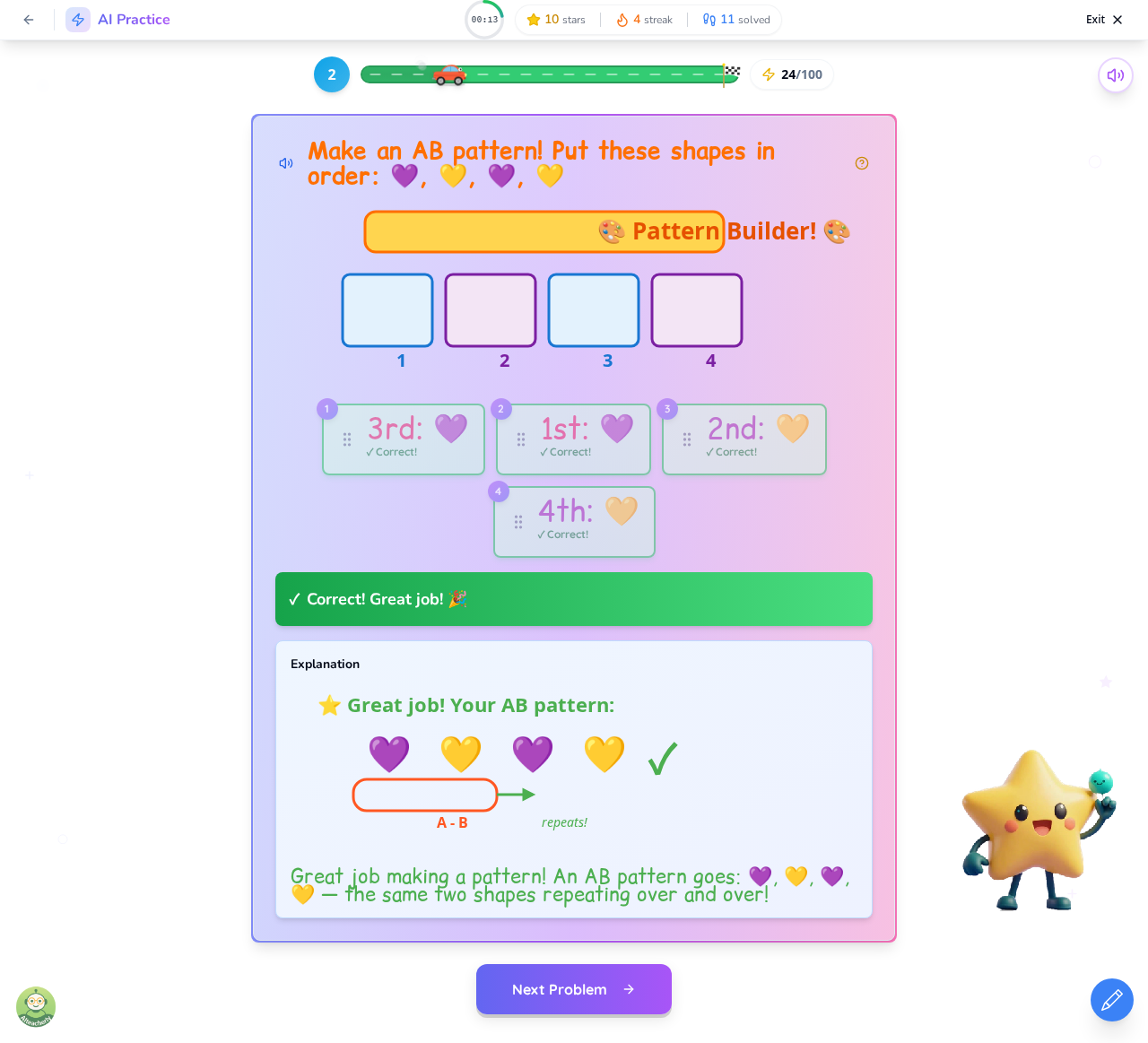
Stage 3: Create Their Own Patterns
The highest level of pattern understanding is creation. Give your child materials and let them make their own patterns. This demonstrates true mastery because they must understand the concept well enough to apply it independently.
Tips for success:
- Say patterns out loud: "Circle, square, circle, square" reinforces learning through multiple senses
- Use physical objects first: Blocks, cereal, toys work better than abstract worksheets for beginners
- Celebrate the "core unit" discovery: When your child identifies what repeats, make it a big deal
- Keep sessions short: 10 to 15 minutes of focused pattern play is more effective than long sessions
Color Patterns vs. Shape Patterns: Practice Both for Stronger Skills
You might wonder whether to start with color patterns or shape patterns. The answer? Both matter, and they strengthen different cognitive pathways.
Color patterns are typically easier for kindergarteners to start with because:
- Colors are visually distinct and easy to name
- Most children already know basic color names
- Color differences are immediately obvious even at a glance
A simple color pattern like "red, blue, red, blue" lets children focus purely on the concept of repetition without additional complexity.
Shape patterns add another layer of learning:
- Children must recognize shape attributes (circles have no corners, squares have four sides)
- Shape patterns reinforce geometry vocabulary
- They require slightly more visual analysis
The magic happens when children realize that patterns work the same way regardless of what's repeating. Whether it's colors, shapes, sounds, or movements, the core concept of identifying what repeats remains constant.
Progression tips:
- Start with simple two-element color patterns (AB patterns): red, blue, red, blue
- Move to shape patterns with the same structure: circle, square, circle, square
- Introduce three-element patterns (ABC patterns): red, blue, yellow, red, blue, yellow
- Try patterns with repeating elements (AAB patterns): red, red, blue, red, red, blue
This progression matches how the Color and Shape Patterns lesson on AI Teacherly scaffolds learning, moving children from simple recognition to more complex pattern types.
See How Interactive Pattern Learning Works
Traditional worksheets have their place, but interactive learning transforms pattern practice from passive to engaging. When children can drag, drop, and immediately see whether their answer is correct, learning becomes a game rather than a chore.
Here's what makes interactive pattern learning so effective:
Immediate feedback: Children know right away if they've identified the pattern correctly. This instant response keeps them engaged and prevents practicing mistakes.
Visual appeal: Colorful, animated shapes capture kindergarten attention far better than black-and-white worksheets.
Hands-on manipulation: Even on a screen, dragging shapes to complete patterns engages the same motor learning pathways as physical manipulatives.
Progressive difficulty: Good interactive lessons automatically adjust, offering easier problems after mistakes and harder challenges after successes.
Here's what the full interactive lesson looks like on AI Teacherly:
The Color and Shape Patterns lesson guides kindergarteners through a complete learning journey. It starts with an engaging introduction explaining that "Patterns are things that repeat over and over!" Then children progress through increasingly challenging activities.
First, they observe patterns and identify what repeats. Then they predict "what comes next" in sequences of colorful shapes. Finally, they create their own patterns by arranging shapes. Throughout the lesson, encouraging feedback celebrates their progress: "You're a pattern pro! Patterns repeat and you can tell what comes next."
For parents, the benefit is clear: your child gets focused, effective pattern practice while you get 15 to 20 minutes of educational screen time you can feel good about.

5 Easy Pattern Activities to Try at Home Today
You don't need special materials to practice patterns with your kindergartener. Here are five activities using things you already have:
1. Breakfast Pattern Practice
Use cereal pieces, fruit slices, or even toast cut into shapes. "Let's make a pattern with your Cheerios and blueberries!" Children can eat their creation afterward, making learning deliciously rewarding.
2. Nature Walk Patterns
Collect leaves, sticks, and stones on a walk. Back home (or right there in the park), arrange them into patterns. This activity connects math to the natural world and gets everyone outside.
3. Movement Patterns
Create patterns with actions: jump, clap, jump, clap. Or try stomp, stomp, spin, stomp, stomp, spin. Movement patterns reinforce learning through the body and burn off kindergarten energy.
4. LEGO or Block Patterns
Build towers with alternating colors or arrange blocks in pattern sequences. Challenge your child: "Can you continue my pattern?" Then swap roles and let them create one for you.
5. Sticker or Stamp Patterns
Provide stickers, stamps, or even finger paints. Ask your child to create a pattern on paper. Display their pattern artwork proudly to reinforce that patterns are something to celebrate.
Pro tip for all activities: Always verbalize the pattern together. Saying "red, blue, red, blue" out loud while pointing to each element strengthens the connection between visual recognition and verbal understanding.
For structured practice that complements these activities, interactive lessons like Color and Shape Patterns on AI Teacherly provide systematic skill-building with colorful, engaging problems that kindergarteners love.
Key Takeaways
- Pattern recognition is the foundation of algebraic thinking, making it one of the most important kindergarten math skills
- The key concept is identifying the 'core unit' or the part of the pattern that repeats
- Practice both color patterns and shape patterns to strengthen different cognitive pathways
- Use the observe, predict, create progression to build pattern skills systematically
- Interactive learning with immediate feedback makes pattern practice more engaging and effective
- Everyday activities like breakfast, nature walks, and block play offer perfect pattern learning opportunities
- Short, consistent practice sessions of 10 to 15 minutes work better than long, infrequent ones
Frequently Asked Questions
What is pattern recognition and why is it important for kindergarteners?
Pattern recognition is the ability to identify repeating sequences. It's crucial for kindergarteners because it builds the foundation for algebraic thinking, number sense, and problem-solving skills that support all future math learning.
How do I teach my child to identify the repeating part of a pattern?
Point to each element while saying it aloud, then ask 'Which part keeps happening again?' Start with simple two-element patterns like red, blue, red, blue. Celebrate when they spot that 'red, blue' is the part that repeats.
What's the difference between AB, ABC, and AAB patterns?
AB patterns alternate two elements (red, blue, red, blue). ABC patterns cycle through three elements (red, blue, yellow, repeat). AAB patterns have one element twice before the second (red, red, blue, red, red, blue).
At what age should children be able to recognize and continue patterns?
Most children can recognize simple AB patterns by age 4 and continue them by age 5. By the end of kindergarten, children typically handle ABC and AAB patterns. Every child develops at their own pace.
What are some everyday activities to practice patterns at home?
Use breakfast cereals to make edible patterns, collect nature items on walks, create movement patterns (jump, clap, jump, clap), build with colored blocks, or make patterns with stickers and stamps.
What if my child struggles with pattern recognition?
Start with very simple two-color patterns and use physical objects they can touch. Say patterns aloud together repeatedly. Keep practice sessions short and pressure-free. Most children improve quickly with consistent, playful practice.
How does learning patterns help with future math skills?
Patterns are the foundation of mathematics. Skip counting, multiplication tables, place value, and algebraic equations all rely on pattern recognition. Children who master patterns early show stronger math performance throughout school.
Is my child behind if they can't recognize patterns yet?
Not necessarily. Children develop pattern skills at different rates. Focus on playful exposure rather than pressure. If concerns persist by mid-kindergarten, speak with their teacher about additional support strategies.
Ready to make pattern learning fun and effective? Try the interactive Color and Shape Patterns lesson free on AI Teacherly. Your kindergartener will love the colorful activities while building essential math skills!