Turn Shopping Into Math Practice: Teaching Sales Tax, Tips, and Discounts to 6th Graders
Every shopping trip is a hidden math lesson. Learn how to teach your 6th grader sales tax, tips, and discounts using real-world practice that makes percent calculations click.
Why Every Shopping Trip Is a Hidden Math Lesson
Here's something most parents don't realize: every trip to the store, every restaurant meal, and every online purchase is packed with exactly the math skills your 6th grader needs to master.
Sales tax, tips, and discounts might seem like separate topics, but they all use the same core skill: multiplying by a percent. When your child understands this connection, those abstract percentage problems from their textbook suddenly have real meaning.
The beauty of consumer math is that it meets kids where they already are. They see price tags, restaurant bills, and "30% off" signs constantly. Instead of drilling worksheets, you can turn these everyday moments into natural learning opportunities. And here's the best part: you don't need to be a math expert yourself to make this work.
In this guide, you'll discover exactly how sales tax, tips, and discounts work mathematically, plus practical ways to practice these skills with your child during your regular daily activities. By the end, those percent word problems won't seem so intimidating anymore.
What Is Consumer Math and Why Does Your 6th Grader Need It?
Consumer math is the practical application of mathematical concepts to everyday financial situations. For 6th graders, this primarily means working with percentages in contexts like shopping, dining out, and managing money.
Why does this matter so much? Three key reasons:
1. It makes abstract concepts concrete. When percentages live only on worksheets, they feel meaningless. But when your child calculates the tip on a $24 restaurant bill, suddenly "15%" becomes real and memorable.
2. It builds essential life skills. Financial literacy starts with understanding how money works in everyday transactions. Kids who master consumer math are better prepared to manage allowances, evaluate deals, and eventually handle their own finances responsibly.
3. It's what 6th grade math standards require. Calculating percentages, understanding percent increase and decrease, and solving multi-step problems are all core 6th grade learning objectives. Consumer math provides the perfect context for practicing these skills.
The three pillars of consumer math for 6th graders are:
- Sales tax: A percentage added to the price (you pay more)
- Tips: A percentage added to show appreciation for service (you pay more)
- Discounts: A percentage subtracted from the price (you pay less)
All three use the same formula: Price × Rate = Amount. Once your child sees this pattern, consumer math becomes much more manageable.
How to Calculate Sales Tax Step by Step
Sales tax is often the first consumer math concept kids encounter, yet it trips up many students because they forget to add the tax back to the original price. Here's the straightforward process:
Step 1: Convert the percent to a decimal. Move the decimal point two places to the left. For example, 8% becomes 0.08, and 6.5% becomes 0.065.
Step 2: Multiply the price by the decimal. If an item costs $45 and the sales tax is 8%: $45 × 0.08 = $3.60 (this is the tax amount)
Step 3: Add the tax to the original price. $45 + $3.60 = $48.60 (this is the total cost)
Common mistakes to watch for:
- Forgetting to add the tax to the original price
- Moving the decimal the wrong direction when converting
- Confusing sales tax with discounts (tax adds, discounts subtract)
Practice tip for parents: When you're shopping with your child, have them estimate the sales tax before checkout. Start with easy numbers: "This costs about $20 and tax is around 10%, so we'll pay about $22." This builds mental math skills and number sense.
The key phrase to remember: "Price times rate equals tax." Once kids internalize this formula, they can apply it to any sales tax percentage.
The Easy Trick for Calculating Tips (Even in Your Head)
Calculating tips is where consumer math gets fun because there's a mental math shortcut that works every time. The secret? 10% of any amount is just that amount divided by 10.
Let's say your restaurant bill is $48.
- 10% tip: $48 ÷ 10 = $4.80
- 20% tip: Double the 10% ($4.80 × 2 = $9.60)
- 15% tip: Take 10% + half of 10% ($4.80 + $2.40 = $7.20)
This trick works because finding 10% is the easiest percentage calculation. You simply move the decimal point one place to the left. From there, you can build any common tip percentage.
Why tips matter for 6th grade math: Tips reinforce the same skill as sales tax (percent of a number), but with a twist: kids must decide what percentage to use. This adds a decision-making element that mirrors real adult situations.
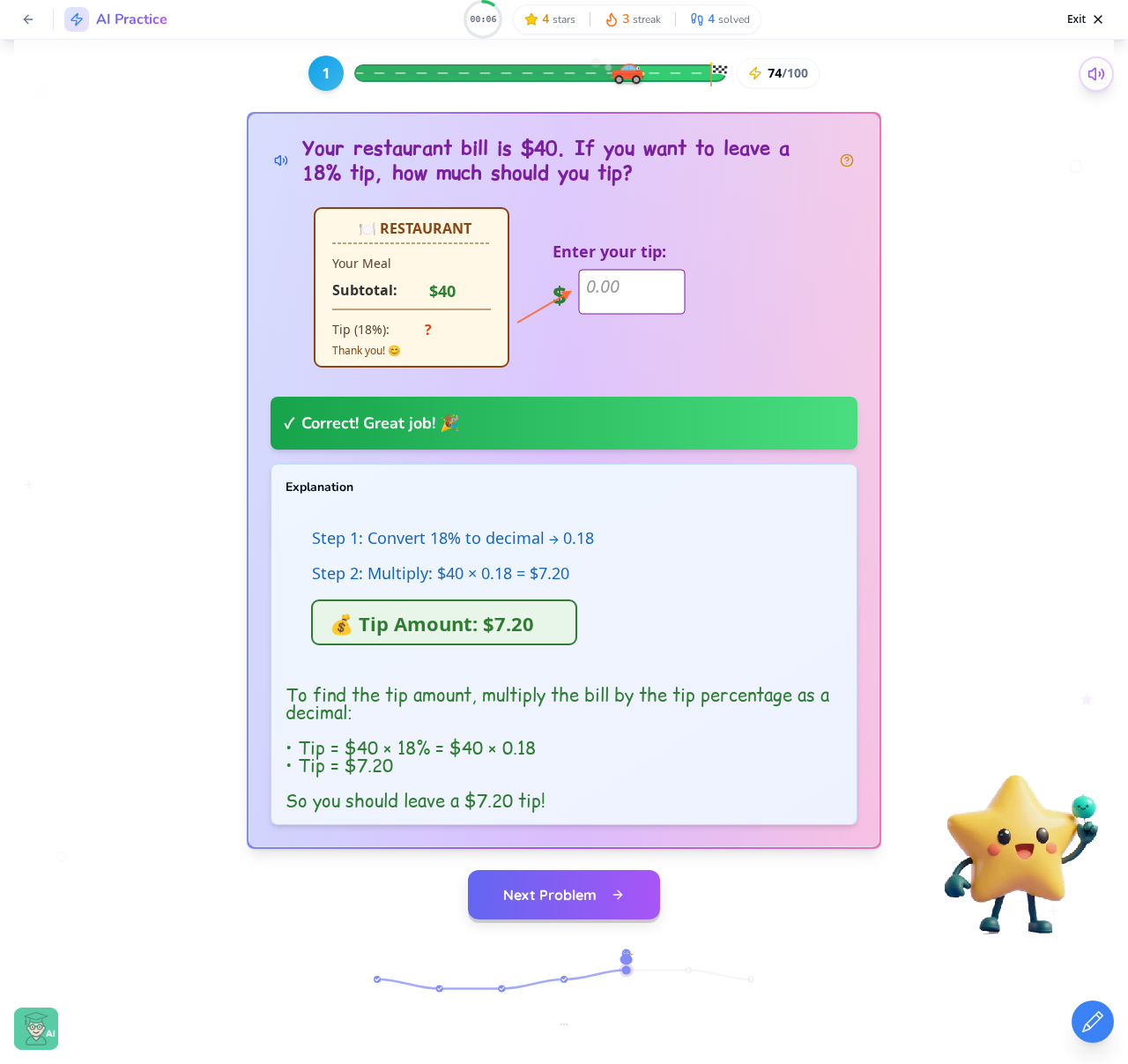
The interactive problem below shows exactly how tip calculations work in practice:
Notice how the problem presents a real restaurant scenario with a specific bill amount. Students must identify the tip percentage, convert it to a decimal, and calculate the correct tip. This type of hands-on practice builds confidence faster than abstract worksheet problems.
Practice tip for parents: At restaurants, let your child calculate the tip on the receipt. Start with round numbers and work up to more complex bills. Make it a game: "Can you figure out the 20% tip before I do?"
Finding Sale Prices: How Discounts Work
Discounts are the mirror image of taxes and tips. Instead of adding a percentage, you're subtracting it. This is where many kids get confused, but a clear two-step process makes it simple:
Method 1: Calculate the discount, then subtract
- Find the discount amount: Original Price × Discount Rate
- Subtract from the original: Original Price − Discount Amount = Sale Price
Example: A $60 jacket is 25% off.
- Discount: $60 × 0.25 = $15
- Sale price: $60 − $15 = $45
Method 2: The "what you pay" shortcut If something is 25% off, you pay 75% (100% − 25% = 75%).
- $60 × 0.75 = $45
This shortcut is faster once kids understand the logic, but start with Method 1 so they truly grasp what's happening.
Common discount scenarios 6th graders should recognize:
- "30% off" means multiply by 0.30 to find savings
- "Buy one, get one 50% off" requires finding half the price of the second item
- "Extra 10% off sale prices" means applying a second discount after the first
Real-world practice ideas:
- Browse online sales together and calculate actual savings
- Compare "$10 off" versus "20% off" on different priced items
- Check store receipts to verify the discount was applied correctly
When something's on sale, your child should be able to answer two questions: "How much do I save?" and "How much do I actually pay?" Both calculations use the same skill but give different answers.
Putting It All Together: Multi-Step Consumer Math Problems
Here's where 6th grade consumer math gets challenging: real-world situations often combine multiple calculations. A typical scenario might involve a discount AND sales tax, or a restaurant bill with both tax AND tip.
The critical question is: What order do you apply discounts and taxes?
The real-world rule: Discounts come first, then tax is calculated on the reduced price.
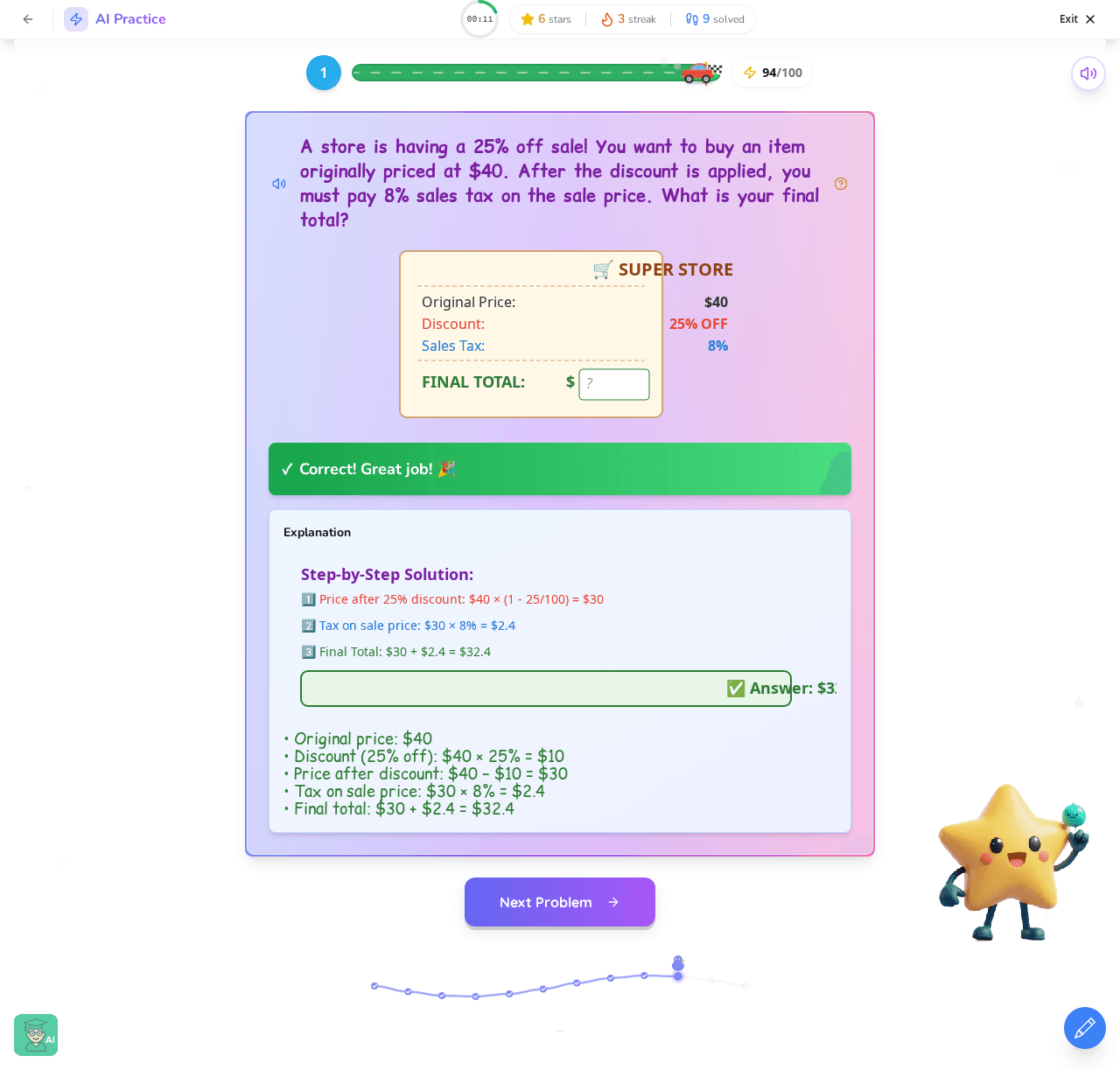
Example problem: A $80 shirt is 20% off, and sales tax is 8%. What's the total?
- Calculate the discount: $80 × 0.20 = $16
- Find the sale price: $80 − $16 = $64
- Calculate tax on the sale price: $64 × 0.08 = $5.12
- Find the total: $64 + $5.12 = $69.12
Why the order matters: If you calculated tax first, you'd pay tax on money you're not actually spending. Stores calculate tax on the discounted price, not the original.
Restaurant multi-step problem: Bill is $50, tax is 6%, tip is 18%.
- Tax: $50 × 0.06 = $3.00
- Subtotal with tax: $50 + $3 = $53
- Tip (usually calculated on pre-tax amount): $50 × 0.18 = $9.00
- Total: $53 + $9 = $62
These multi-step problems prepare kids for real financial decisions. When your 6th grader can work through a discount-plus-tax problem confidently, they're building skills they'll use for the rest of their lives.
How Interactive Learning Makes Consumer Math Click
Traditional worksheets have their place, but consumer math truly shines when kids can visualize the concepts and get immediate feedback on their thinking.
Interactive lessons transform abstract percent calculations into engaging, hands-on experiences. Instead of just reading about how to calculate a tip, students work through realistic scenarios with visual supports that make each step clear.
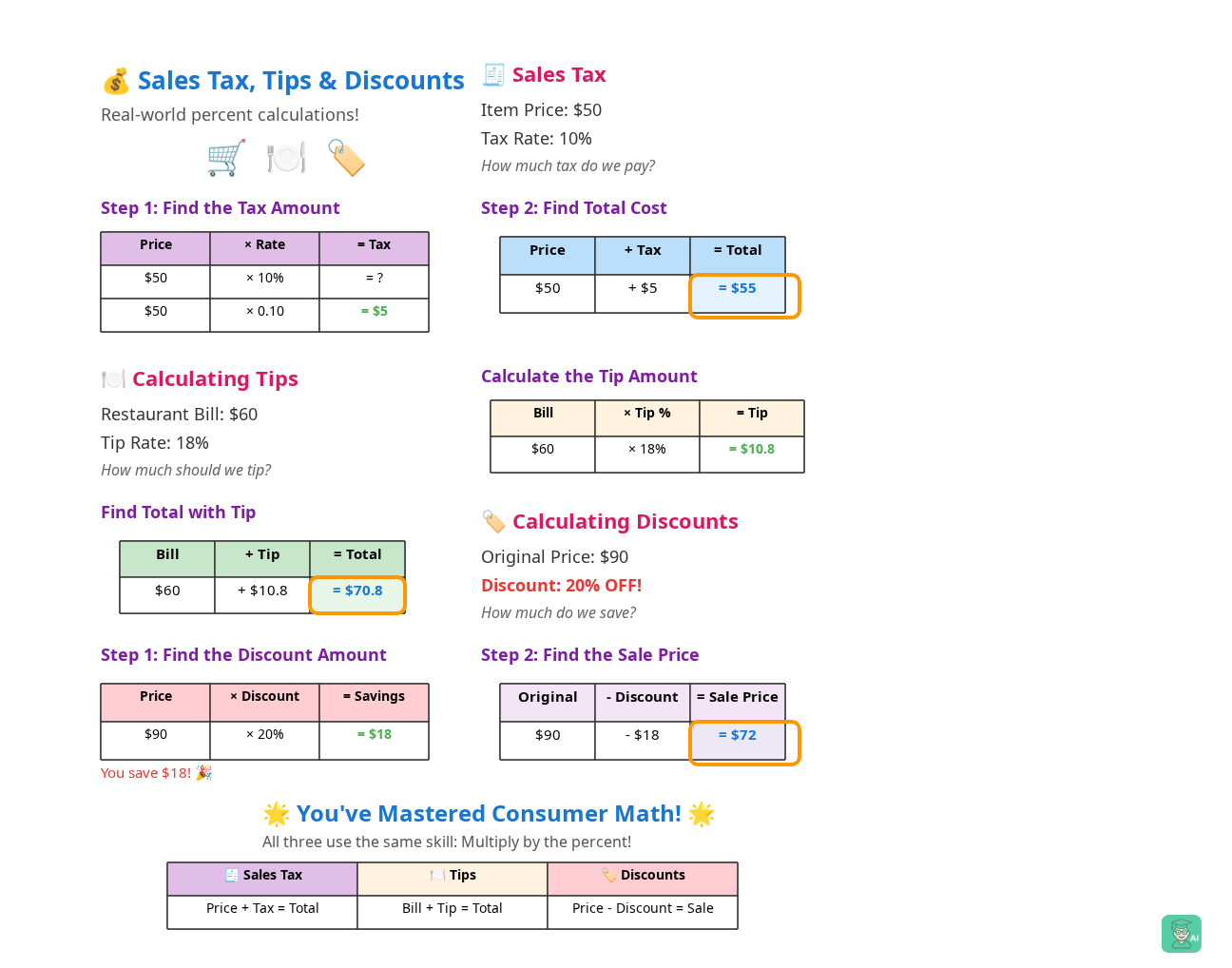
Here's what the full interactive lesson looks like on AI Teacherly:
The Sales Tax, Tips, and Discounts lesson on AI Teacherly guides 6th graders through progressively challenging problems. Students start with single-step calculations (just tax, or just a discount), then advance to multi-step scenarios that combine concepts.
What makes interactive learning effective for consumer math:
- Visual representations help kids see what "15% of $40" actually looks like
- Immediate feedback catches misconceptions before they become habits
- Real-world scenarios (restaurant bills, shopping receipts) make practice feel relevant
- Progressive difficulty builds confidence before introducing complexity
- Self-paced practice lets kids spend more time where they need it
The parent advantage: When your child practices with interactive lessons, you can focus on the real-world reinforcement (like calculating tips at dinner) rather than drilling mechanics. The platform handles the structured practice; you provide the authentic application.
This combination of interactive learning and real-world practice is what makes consumer math skills stick for the long term.
Key Takeaways
- Sales tax, tips, and discounts all use the same core skill: multiplying by a percent (Price × Rate = Amount)
- The 10% shortcut makes mental math easy: just divide by 10, then adjust for other percentages
- Discounts subtract from the price, while tax and tips add to it — help your child recognize this pattern
- For multi-step problems, always apply discounts first, then calculate tax on the reduced price
- Turn everyday shopping and dining into natural practice opportunities — no formal teaching required
- Interactive lessons combined with real-world practice help consumer math concepts stick long-term
Frequently Asked Questions
What is consumer math and why do 6th graders need it?
Consumer math applies percentages to real financial situations like sales tax, tips, and discounts. It's essential for 6th graders because it makes abstract percent calculations concrete and builds practical money skills they'll use throughout life.
How do you calculate sales tax step by step?
Convert the tax percentage to a decimal (move decimal two places left), multiply by the price to find the tax amount, then add the tax to the original price. For example: $50 item with 8% tax = $50 × 0.08 = $4 tax, so total is $54.
What's the easiest trick for calculating tips in your head?
Find 10% by dividing by 10 (just move the decimal one place left). For 20%, double that amount. For 15%, add half of the 10% to itself. Example: $40 bill → 10% is $4, so 20% is $8.
How do you find the sale price after a discount?
Multiply the original price by the discount percentage to find the savings, then subtract from the original. For 30% off a $60 item: $60 × 0.30 = $18 off, so sale price is $60 - $18 = $42.
What order do you apply discounts and taxes?
Always apply discounts first, then calculate tax on the reduced price. This is how stores actually process transactions — you only pay tax on the amount you're actually spending.
Is it normal for kids to struggle with percent word problems?
Yes, very common. Word problems require translating language into math operations. Using real-world contexts like shopping and dining helps because kids can visualize what's happening with the money.
How can I practice consumer math with my child at home?
Let them calculate tips at restaurants, estimate sales tax before checkout, compare discounts when shopping online, and verify receipt calculations. These natural moments build skills without feeling like homework.
What's the difference between calculating tips, taxes, and discounts?
Tips and taxes ADD to the price (you pay more), while discounts SUBTRACT from it (you pay less). All three use the same formula: multiply the base amount by the percentage rate.
Ready to make consumer math click for your 6th grader? Try the interactive Sales Tax, Tips, and Discounts lesson free on AI Teacherly and watch percent calculations become second nature!